 Connected CMMS

 Connected Buildings
 Connected Refrigeration


 Download ebook

 Read case study


 Watch now


 Retail
 Healthcare
 FM Services
 Commercial Portfolios
 Corporate Facilities
 Education
 Data-driven Portfolio Ops
 Facility Management Software
 360° Asset Lifecycle
 Continuous Sustainability

 Blogs
 Help docs
 Knowledge Hub
 ROI Calculator
 Ebooks & Guides
 Webinars
 Case studies


 About us
 Newsroom
 Careers
 Contact us
 Partners
 Events


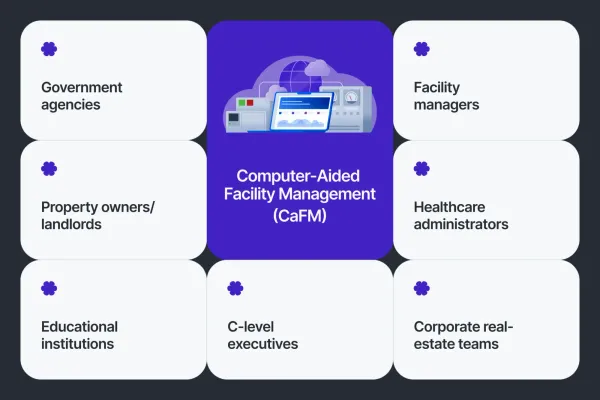
Computer-aided facility management (CAFM) is software that helps facility teams plan, manage, and optimize an organization's buildings, spaces, assets, and maintenance from one centralized system.
It replaces spreadsheets, paper logs, and disconnected point tools with a single source of truth for facility operations, so the people running a building stop chasing information and start acting on it.
If you manage facilities for a living, what follows answers the questions you actually have: what CAFM covers, how it differs from a CMMS, an IWMS, and EAM, whether you even need it, what it costs, and how to roll it out without the project stalling.
Modern CAFM software now does far more than draw floor plans, and the gap between a legacy system and a connected one is where most of the value hides.
Key takeaways
- CAFM is a software system for managing buildings, spaces, assets, people, and maintenance in one place.
- Its core jobs are space and occupancy management, asset tracking, work order and maintenance management, preventive and predictive maintenance, CAD/BIM integration, and energy tracking.
- CAFM is broader than a CMMS (which focuses on maintenance) and narrower than an IWMS (which adds corporate real estate and lease accounting).
- It is used across commercial real estate, healthcare, education, retail, data centers, and government, by in-house teams and outsourced FM providers.
- The buying decision comes down to scope and fit, not brand: match the tool to how many sites you run and whether you need space and real-estate data alongside maintenance.
What does CAFM stand for?
CAFM stands for computer-aided facility management.
The term describes the use of software to run the day-to-day operations of a physical building or an entire property portfolio: tracking assets, scheduling maintenance, managing space, and keeping a reliable record of what happened, when, and who did it.
It is one of several software categories that grew up around facility management as a discipline.
The naming is regional, and it trips people up. In the UK, the Middle East, and much of Asia-Pacific, "CAFM" is the common term. In North America, teams more often say "CMMS" for the maintenance-led version of the same idea.
The concepts overlap heavily, which is exactly why the acronyms get used interchangeably and why so many buyers start with a definition search before anything else.
What is CAFM software, and how does it work?
For decades, running a building meant a filing cabinet of equipment manuals, a maintenance calendar in someone's head, work requests buried in email, and a spreadsheet that only one person understood. When that person left, the knowledge left with them.
CAFM software replaces that patchwork with one connected record of the physical environment. Every asset, space, work order, contract, and inspection lives in the same place, linked together, so a work order knows which asset it belongs to, which space that asset sits in, and which vendor is accountable for it.
Underneath, a modern CAFM system works like a digital model of your portfolio. You can view operations across every location at once, then drill into a single chiller in a single building and see its service history, warranty, open tickets, and sensor readings.
The better platforms connect to the systems you already run, from the building management system (BMS) and HVAC controls to your ERP and finance tools, so data flows in automatically instead of being keyed in twice.
Teams work from a web dashboard in the office and from a mobile app in the field, including offline, so a technician in a basement plant room without signal can still complete a job.
What a CAFM system actually does: the core features
Most CAFM platforms share the same operational backbone. Here is what each capability covers and why it matters on the ground.
Space and occupancy management
CAFM tracks how physical space is laid out and used: floor plans, room and desk assignments, bookings, and utilization. For organizations juggling hybrid work or growth, this answers the expensive questions directly. Which floors are half empty? Can we consolidate before the lease renews?
Where do we put the next 40 hires? This is the heritage of the category and still one of its defining jobs. For a deeper look, see our explainer on space management.
Asset tracking and the asset register
At the heart of any CAFM system is the asset register: a living digital record of every piece of equipment you own, from HVAC units and elevators to generators and fire panels.
Each asset carries its location, make and model, warranty, service history, documents, and a QR or barcode tag. When something breaks, the technician scans it and sees everything at once instead of guessing.
A complete register is also what makes real repair-versus-replace decisions possible, because you finally know what each asset has cost you over its life.
Work order and maintenance management
This is the operational engine. CAFM turns requests into tracked work orders, assigns them by skill and location, and keeps a full audit trail from request to sign-off.
It covers both hard FM (the physical fabric and equipment) and soft FM (cleaning, security, catering), and both planned and reactive work.
Instead of a technician discovering a problem, writing it on a form, and hoping someone keys it in, the whole loop stays in one system where nothing falls through the cracks.
Preventive and predictive maintenance
Rather than wait for equipment to fail, CAFM schedules preventive maintenance software routines based on time, usage, or meter readings, so routine servicing happens before a breakdown.
The US Department of Energy's Federal Energy Management Program estimates a preventive program can cut maintenance costs by 12% to 18% over running assets to failure, as noted in its O&M Best Practices guide.
Connected platforms go a step further with predictive maintenance, using live sensor data to flag a failing bearing or a drifting temperature before it becomes a 2 a.m. emergency.
CAD and BIM integration
CAFM connects operations to the drawings. CAD (computer-aided design) floor plans let teams visualize space, plan moves, and see exactly where an asset or a fault sits on a plan rather than in a list.
BIM (building information modeling) integration carries that further, linking the as-built model of a building to its live operational data so the digital record and the physical asset stay in sync.
This is a genuinely underserved area: many tools mention CAD in passing, but few connect CAD, BIM, and live IoT data together, which is where spatial context becomes operational intelligence.
Energy and operational monitoring
By integrating with the BMS and metering, CAFM gives visibility into how a building consumes energy and how its systems are performing, and feeds that into fault detection. Framed correctly, this is an operating-cost lever: catching a HVAC fault early protects both the energy bill and the equipment.
Helpdesk, vendors, inspections, and compliance
Rounding out the platform: a helpdesk and self-service portal so occupants and clients log and track requests without phoning anyone; vendor and subcontractor management to keep contractor licenses, insurance, and SLAs in check; mobile inspections and audits with checklists; and automated compliance and HSE reporting so audits stop being a fire drill.
These capabilities only pay off when they run on one connected system rather than six that do not talk to each other. You can see how the full platform fits together to understand what that looks like in practice.
CAFM vs CMMS vs IWMS vs EAM: what's the difference?
This is the single most common point of confusion, and for good reason. The categories overlap, vendors blur the lines, and the "alphabet soup" of FM software genuinely is confusing. Here is the clean version.
| System | Full name | Primary focus | Best suited for | Where it overlaps |
|---|---|---|---|---|
| CAFM | Computer-Aided Facility Management | Buildings, space, assets, and maintenance for facility operations | FM teams and providers running one or many buildings | Shares maintenance with CMMS, space and real estate with IWMS |
| CMMS | Computerized Maintenance Management System | Maintenance, work orders, and asset upkeep | Maintenance-led teams, plants, and equipment-heavy sites | The maintenance core sits inside CAFM too |
| IWMS | Integrated Workplace Management System | Enterprise real estate, leases, capital, and workplace | Large enterprises managing a corporate real estate portfolio | Adds lease and capital planning on top of CAFM's operational scope |
| EAM | Enterprise Asset Management | Full asset lifecycle, reliability, and capital assets | Asset-intensive industries (utilities, manufacturing, transport) | Deep asset management overlaps with CAFM's register |
The short way to hold it in your head: a CMMS is maintenance-first; CAFM wraps maintenance together with space and building operations; an IWMS sits above CAFM and adds the corporate real estate and finance layer; and EAM goes deepest on the asset lifecycle itself.
In practice, the lines keep blurring, and many modern platforms deliver several of these at once. If you want the detailed side-by-side, we break it down in our guide to the difference between CAFM and CMMS.
Not sure which system fits your portfolio? A 30-minute walkthrough maps CAFM, CMMS, IWMS, and EAM to your actual sites and systems, so you buy the scope you need and nothing you don't.
Book a demo →Do you actually need CAFM, or is a CMMS (or a spreadsheet) enough?
A fair question, and the honest answer depends on how you operate.
A spreadsheet is enough when you run a single small site, maintenance is light, and one person can hold it in their head. The moment that person is on vacation and nobody can find the service history, you have outgrown it.
A maintenance-led CMMS is enough when your pain is almost entirely equipment and work orders, and you do not need to manage space, floor plans, leases, or occupancy. Many single-industrial-site teams live happily here.
You need CAFM when any of these are true: you run multiple buildings or a growing portfolio, space and occupancy matter as much as maintenance, you are accountable to clients or executives for SLAs and reporting, or your data is scattered across tools that do not talk to each other.
If you are an outsourced provider bidding for contracts, CAFM is increasingly the price of entry, because clients expect transparency and real-time reporting.
A simple test: write down the three things that go wrong most often in your week. If they are all "the boiler failed again," a CMMS covers it. If they are a mix of failed assets, space you cannot account for, and reports you cannot produce fast enough, that is a CAFM problem.
Who uses CAFM, and in which industries?
CAFM is used by anyone accountable for keeping buildings running, and the vocabulary around the role is real: titles like CAFM Specialist, CAFM Administrator, and CAFM Coordinator exist because operating one of these systems is a job in itself.
By role, the typical users are facility and operations managers who live in the day-to-day, executives and property owners who want portfolio visibility and better repair-or-replace decisions, and the technicians and vendors who do the work in the field.
By delivery model, it splits into in-house teams managing their employer's buildings and FM service providers managing buildings for clients.
By industry, the operational reality shifts, but the strongest CAFM use cases repeat: centralizing work orders across every site, enforcing preventive maintenance on critical assets, giving occupants and clients a self-service channel, and turning scattered data into reports leadership and clients actually trust.
Here is how that plays out sector by sector.
Commercial real estate and offices
Multi-tenant buildings live on tenant experience and space efficiency. CAFM runs tenant requests through a branded helpdesk, tracks SLAs against each lease, and shows which floors are genuinely occupied before a renewal or fit-out decision.
Across a commercial portfolio, that is one dashboard for every building instead of a spreadsheet per site.
At ICD Brookfield Place in Dubai, Property Operations Manager Haithem Ibraheem credits automated data collection with "continuous improvements in asset and staff performance" and results "consistently exceeding SLA and KPI expectations."
At Kingsmede, Head of Asset Management Natashia Steed points to a platform that helped "unify fragmented systems" with "an intuitive interface that required no technical expertise to adopt."
Healthcare
In a hospital, a failed chiller, a tripped generator, or a missed inspection is a patient-safety and accreditation risk, not an inconvenience.
CAFM enforces planned maintenance on critical assets like HVAC, medical gas, and backup power, keeps a time-stamped record for accreditation audits, and routes urgent work orders by priority so the most critical failures jump the queue.
This is why healthcare facility management carries the strictest uptime and documentation requirements of any sector, and why paper logs are a genuine liability there rather than just an inefficiency.
Education
A campus is a sprawling estate of mixed-age buildings, classrooms, labs, dorms, and grounds, run on a tight budget.
CAFM centralizes work orders across the whole campus estate, schedules preventive maintenance around the academic calendar, and arms facilities leadership with the asset data to justify capital requests.
Breck School's Director of Facilities, Mike Thorson, describes the Connected CMMS platform as "a future-proof choice" offering "a level of customization and flexibility that allows us to tailor the system to our specific needs."
At Purdue University Fort Wayne, Director of Operations Ashley Tash reports "centralized control across campus, helping our FM teams to focus on more strategic initiatives."
Retail and multi-site operations
Retail facilities management is a many-small-sites problem: dozens or hundreds of stores, each with refrigeration, HVAC, and lighting that has to stay within set-points or stock spoils and energy bills climb.
CAFM standardizes maintenance across every retail site, ties refrigeration and equipment alarms directly to work orders, and automates the compliance reporting that multi-site chains struggle to keep current.
King Kullen's VP of Engineering, Stanley Mitchell, reports "full visibility across store assets," where "real-time alerts help us stay on top of events to mitigate any potential compliance risks" and "all compliance processes are fully automated now."
At Lunds & Byerlys, Director of Maintenance Kevin Kungel notes the platform "removed one of the biggest roadblocks for our store facility operations" by "integrating our work order system with refrigeration management processes."
Data centers and mission-critical sites
Here, uptime is the product. A facilities fault can take client workloads offline, so CAFM enforces rigorous preventive maintenance, tracks the condition of every critical asset, and keeps an auditable trail against demanding data center operations SLAs.
Mission-critical operators such as MDS Critical Facilities Services run precisely this way, standardizing how assets are inspected, serviced, and reported across the estate.
FM service providers and outsourced teams
FM service providers are the largest CAFM buyer group, because they manage buildings for clients and have to prove it. They need contractual SLA reporting, vendor accountability, and a branded client portal, all while protecting thin margins across multi-site contracts.
At Q3 Services, Managing Director Mark Hazelwood describes consolidating "fragmented, outdated systems into a single platform that delivers real-time visibility, mobile-first control, and sustainability insights," with roughly 90% of transactions now self-service and every transaction documented and visible to the client.
RA International's Head of IFM, Ryan Hattingh, selected a CAFM solution specifically for its ability to integrate "with SFG20" and to "manage complex facilities in scattered far-reaching remote locations."
What CAFM actually delivers: the business case
Software is only worth it if the operation runs better. Here is what facility teams report after moving to a connected platform, with the outcomes attributed to the customers who achieved them (as of 2026).
Across its deployments, Facilio cites results including 97% SLA adherence, a 40% reduction in asset downtime, 40% better operational visibility across estates, and a 30% drop in reactive call volumes.
These are customer outcomes rather than guarantees, and the pattern behind them is consistent: when data stops being siloed, teams stop firefighting.
The stories make it concrete. At Quality FM, Operations Manager Sumith Sukumaran notes that "Facilio's integrated solution suite helps our stakeholders make data-led operational decisions to deliver continuous value to our customers."
At Musanadah FM, Operations Director Vijayshankar Kavasseri points to "the user-friendly interface and seamless mobility" that help technicians "deliver world-class IFM services across multi-site portfolios."
And at CFS/MDS Critical Facilities Services, Facilities Ops Manager Mohamad Jaber describes a platform "intuitive, scalable" enough "to run mission-critical data centres at the highest operational standards." CIT Ltd chose the platform, says Executive Chairman Nuh Gulaid, because "it was tailor-made to our requirements."
"Facilio's Connected CMMS gives us one digital infrastructure where every action, cost, and approval is visible and validated. It is the kind of operational transparency the FM industry has been waiting for."
The market is moving the same direction.
The CAFM market is projected to grow from roughly $1.3 billion in 2024 to nearly $4 billion by 2033, a compound annual growth rate of about 12.9%, according to Datahorizzon Research (as of 2026).
Facility management itself is now a formalized global discipline, represented by professional bodies such as IFMA and codified in the international standard ISO 41001, which is part of why buyers increasingly expect their operations to be systematized rather than improvised.
Common misconceptions about CAFM
Much of the hesitation around CAFM comes from outdated reputation rather than current reality.
- "It is too expensive." The old enterprise suites were, and some still are. Modern cloud platforms are subscription-based and scale with you, and the cost of not having one (downtime, duplicated tools, failed audits) usually dwarfs the license.
- "It is only for large enterprises." This was true when the only options were heavyweight on-premise systems. Today there are platforms sized for a handful of sites as comfortably as for hundreds.
- "Implementation takes forever." Legacy rollouts did run a year or more. Cloud-native platforms deploy in weeks, not months, because there is no server to stand up and no code to write for configuration.
- "The software is clunky and nobody will use it." The fastest way to kill a CAFM project is a tool technicians avoid. Mobile-first, low-training systems exist precisely because adoption, not features, decides success.
How to choose a CAFM system
When you evaluate platforms, weigh the things that actually predict success rather than the longest feature list.
- Ease of use and a real mobile app. If field technicians will not use it, the data dies. A strong mobile, offline-capable app is non-negotiable.
- Integration. It must connect to your BMS, IoT sensors, ERP, and finance systems. Siloed tools recreate the exact problem you are trying to solve.
- Right-sizing. Do not buy a heavyweight real-estate suite if you need operational FM. Buying scope you never use is a common and expensive mistake.
- Deployment speed and support. Ask how long rollout takes and what onboarding looks like, because vendor support quality is one of the biggest differentiators buyers report.
- Reporting and configurability. You should be able to build the reports your clients and executives want without filing an IT ticket.
If you are comparing named products, our roundups of the best CAFM software and the best CMMS software walk through the leading options with honest pros and cons.
How to implement CAFM without the project stalling
Even good software fails when the rollout is rushed. The projects that stick follow a pattern:
- Audit what you have. Inventory your assets, spaces, vendors, and current processes before you migrate anything. Bad data in means bad decisions out.
- Define objectives and KPIs. Decide what success looks like (SLA adherence, downtime, response times) so you can measure it later.
- Start with a pilot. Roll out to one site or one team, prove the workflow, then scale. A phased rollout beats a big-bang launch almost every time.
- Drive adoption. The number-one failure mode is teams quietly falling back to paper and spreadsheets. Train for the field, keep forms short, and make the mobile experience genuinely easy.
- Migrate carefully. Clean your asset and space data as you bring it across, because the system is only as trustworthy as the records inside it.
How much does CAFM software cost?
Pricing varies widely by scope, number of sites, and modules, but the broad shape is consistent (as of 2026):
- Entry-level CAFM for a small portfolio typically starts around $1,000 per month.
- Mid-market deployments across multiple sites commonly land in the $5,000 to $15,000 per month range.
- Enterprise platforms for large, multi-site portfolios with deep integrations run $30,000 per month and up.
Most modern vendors price per user, per asset, or per module rather than charging a large upfront license, which is a big part of why the total cost of ownership has come down. For how maintenance-platform pricing is typically structured, see our breakdown of CMMS pricing.
Want pricing for your exact portfolio? Share your site count and the systems you run, and we will put together a tailored estimate and a walkthrough built around your operation.
Talk to our team →Why legacy CAFM falls short, and what connected systems change
Here is the part most definition pages skip. The reason facility teams are still frustrated is not that they lack software. It is that the software they have was built for a different era.
Legacy CAFM and legacy CMMS platforms were designed as systems of record: a place to store assets and log work orders, and little else. Any integration needed IT. Reporting was rigid. Automation was thin.
The result is the exact pain practitioners describe: data trapped in silos, teams stitching together separate tools, and managers who can see what happened last month but cannot change what happens next week.
A connected approach treats the platform differently.
Instead of just recording work, it links three things that legacy tools keep apart: the people (executives, technicians, occupants, vendors) who need to act, the processes that move work forward without manual chasing, and the systems (BMS, HVAC, energy, ERP, finance) that hold the data, integrated with no code so you connect and unify rather than rip and replace.
That is the shift that turns facility management from a cost center into an operation leadership can actually steer.
It is also why platforms like Facilio's Connected CMMS frame the category around operations that keep moving, not records that sit still.
The quieter cost of staying legacy is the one that compounds: every month of siloed data is a month of decisions made on incomplete information, and that gap does not close on its own.
The bottom line
CAFM is how modern facility teams run buildings: one connected system for space, assets, maintenance, and the people and vendors who keep everything working.
The category has moved well beyond its floor-plan origins, and the real decision is no longer "CAFM or not" but "a legacy system that records work, or a connected one that moves it forward."
If you want to see what connected facility operations look like for your portfolio, book a demo and we will walk through it with your use case in mind.
Frequently asked questions
What does CAFM stand for?
CAFM stands for computer-aided facility management: software that helps teams manage a building or portfolio's spaces, assets, and maintenance from one system. (Note: it can also mean Certified Automotive Fleet Manager, an unrelated fleet credential.)
What is the difference between CAFM and CMMS?
A CMMS focuses on maintenance and work orders. CAFM is broader, wrapping that maintenance core together with space, occupancy, and building operations. CMMS is maintenance-first; CAFM manages the whole facility.
Do I need CAFM, or is a CMMS enough?
If your pain is almost entirely equipment and work orders on one site, a CMMS may be enough. If you run multiple buildings, manage space and occupancy, or answer to clients for SLAs and reporting, you need CAFM.
Can you give an example of a CAFM system?
A CAFM system lets a facility team log a work request, auto-assign it to a technician by skill and location, link it to the exact asset and floor, track it to sign-off, and report on SLA performance, all in one platform.
What does a CAFM administrator do?
A CAFM administrator (or specialist) configures and runs the system: maintaining the asset register, building workflows and reports, managing users and vendors, and supporting the maintenance team so the data stays accurate and useful.
Is Planon a CAFM system?
Planon is often described as an IWMS, with CAFM capabilities inside it. Several vendors span CAFM, CMMS, and IWMS, which is why buyers should compare by scope and fit rather than by the category label a vendor uses.
Does CAFM include CAD and BIM?
Many CAFM platforms integrate CAD floor plans for space planning, and the more advanced ones link BIM models to live operational data. Depth varies widely, so confirm how well a tool connects CAD, BIM, and sensor data.
How much does CAFM software cost?
Pricing scales with sites and modules. Entry-level deployments start around $1,000 per month, mid-market runs roughly $5,000 to $15,000 per month, and enterprise platforms with deep integrations start near $30,000 per month (as of 2026).
Which industries use CAFM?
Commercial real estate, healthcare, education, retail, data centers, and government all use CAFM, alongside outsourced FM service providers managing buildings for clients. The needs differ by sector, but the core platform holds.