Connected CMMS

 Connected Buildings
 Connected Refrigeration


 Download ebook

 Read case study


 Watch now


 Retail
 Healthcare
 FM Services
 Commercial Portfolios
 Corporate Facilities
 Education
 Data-driven Portfolio Ops
 Facility Management Software
 360° Asset Lifecycle
 Continuous Sustainability

 Blogs
Blogs
 Help docs
 Knowledge Hub
 ROI Calculator
 Ebooks & Guides
 Webinars
 Videos
 Case studies


 About us
 Newsroom
 Careers
 Contact us
 Partners
 Events




The top CAFM software in 2026 are 1. Facilio, 2. Planon, 3. IBM Maximo, 4. Archibus (Eptura), 5. Accruent, 6. MRI Software, 7. Spacewell, 8. Corrigo, 9. Infraspeak, 10. eMaint, 11. FMX, and 12. UpKeep.
Your choice depends on whether you prioritise connected real-time operations, deep space and lease planning, or heavy enterprise asset management, with Facilio leading for teams that want to unify existing building systems rather than replace them.
Top 12 CAFM software in 2026
Here is the shortlist, ordered from the top CAFM system down. If you want the fast version, this is the top 10 CAFM systems plus two strong current-age options, before the detailed reviews below.
- Facilio: Connected CAFM that unifies maintenance, helpdesk, vendor management, inspections and energy on one no-code platform, with IoT, a digital twin and agentic AI layered on top of your existing systems.
- Planon: Broad IWMS covering space, lease, sustainability and maintenance for large international real estate portfolios, strong on ESG and compliance reporting.
- IBM Maximo: Enterprise asset management suite for asset-heavy, high-value portfolios, with predictive maintenance, lifecycle tracking and deep analytics.
- Archibus (Eptura): Space planning and CAD/BIM heavyweight for occupancy, move management and floor-plan-led facility records.
- Accruent: FAMIS 360 for asset-tied work orders plus EMS for room and desk booking, favoured by healthcare, education and government estates.
- MRI Software: Property-led IWMS (formerly FSI Concept Evolution) pairing lease and financial management with maintenance for real estate operators.
- Spacewell: Nemetschek-owned smart-building platform combining workplace analytics, IoT and maintenance for hybrid offices.
- Corrigo: JLL Technologies work-order and vendor-management engine built for outsourced, contractor-heavy facility portfolios.
- Infraspeak: Multi-site intelligent maintenance platform connecting internal teams and external contractors through the Infraspeak Network.
- eMaint: Fluke Reliability's configurable cloud CMMS for multi-site preventive maintenance and compliance-ready records.
- FMX: Simplified facility scheduling and work-order software popular with schools, public sector and mid-sized estates.
- UpKeep: Mobile-first CMMS for single-site or smaller teams that need fast, technician-friendly work-order tracking.
CAFM (Computer-Aided Facility Management) software helps organisations manage buildings, assets, space, maintenance and vendors from one system, so facility teams can plan work, track service levels and make decisions from live data rather than spreadsheets. The best CAFM systems act as the operational backbone for teams running facility management software across multiple sites, whether they are cloud-based applications for a single estate or AI-powered platforms spanning hundreds of locations.
This list of the best CAFM software hides the real decision. Most of these platforms and applications overlap on the basics and diverge sharply on how they handle multi-site scale, integration, mobile work and the total cost of ownership.
The rest of this guide breaks down what each CAFM system is genuinely good at, where it falls short, and which category of buyer it suits.
What is CAFM software?
CAFM software is a computer-aided system that centralises the management of buildings, assets, workspaces, maintenance and service requests. It evolved from CAD-based floor-plan tools into a full operational platform that connects people, spaces, assets and processes in one place, so facility managers can move from reactive firefighting to planned, data-driven operations.
The category sits alongside three confusable siblings, and buyers routinely mix them up:
- CAFM vs CMMS: A CMMS (Computerised Maintenance Management System) focuses on maintenance, work orders and asset upkeep. CAFM adds space, occupancy and workplace management on top. The difference between CAFM and CMMS matters most when space planning is a core need.
- CAFM vs IWMS: An IWMS (Integrated Workplace Management System) is the enterprise umbrella that layers real estate, lease and capital planning over CAFM capabilities.
- CAFM vs EAM: An EAM (Enterprise Asset Management) system is built for industrial, asset-intensive operations. The CMMS vs EAM distinction usually comes down to whether you manage buildings or heavy plant.
For a fuller primer, see what is CAFM. The practical takeaway: modern CAFM platforms are cloud-based, mobile-enabled and increasingly integrate IoT sensors, building management systems and AI to support predictive maintenance and real-time visibility, which is exactly where the older tools on this list struggle.
This shift matters commercially. According to Mordor Intelligence, the facility management software market is projected to grow from USD 2.66 billion in 2025 to USD 4.97 billion by 2030, a 13.3% compound annual growth rate, while MarketsandMarkets tracks the CAFM segment growing at a high single-digit rate through the decade. Buyers are moving budget toward connected platforms, not standalone record-keepers.
Comparing the top 12 CAFM platforms for 2026
| Platform | Category | Best for | Standout strength | Honest limitation | Pricing model |
|---|---|---|---|---|---|
| Facilio | Connected CAFM | Multi-site owner-operators and FM service providers | No-code platform that unifies existing systems, IoT and agentic AI | Younger brand than legacy incumbents; deep customisation rewards a discovery call | Quote-based |
| Planon | Legacy IWMS | Large global real estate portfolios | Broad IWMS breadth and ESG reporting | Long implementation; high total cost of ownership | Quote-based, enterprise |
| IBM Maximo | Legacy EAM | Asset-intensive enterprises | Predictive maintenance and asset lifecycle depth | Steep learning curve; EAM overkill for pure FM | Quote-based, enterprise |
| Archibus (Eptura) | Legacy IWMS | Space and CAD/BIM-led teams | Deep floor-plan and move management | High configuration complexity; admin-heavy | Quote-based |
| Accruent | Legacy IWMS | Healthcare, education, government estates | FAMIS 360 plus EMS room and desk booking | Dated interface; slower onboarding | Quote-based |
| MRI Software | Legacy IWMS | Property-led real estate operators | Lease and financial management with maintenance | Customisation tied to the MRI ecosystem | Quote-based |
| Spacewell | Legacy IWMS | Hybrid workplace and smart offices | Workplace analytics with IoT | Workplace-centric; lighter on heavy maintenance | Quote-based |
| Corrigo | Legacy CAFM | Outsourced, contractor-heavy portfolios | Work-order and vendor management within JLL | Predefined config; best inside the JLL ecosystem | Quote-based |
| Infraspeak | Current-age CMMS | Multi-site contractor coordination | Infraspeak Network connecting all stakeholders | Younger enterprise footprint | Subscription |
| eMaint | Current-age CMMS | Multi-site preventive maintenance | Configurable workflows and mobile updates | Maintenance-first; lighter on space and lease | Per user, subscription |
| FMX | Current-age CMMS | Schools and public sector | Simple scheduling and work orders | Limited advanced analytics for large portfolios | Quote-based |
| UpKeep | Current-age CMMS | Single-site or smaller teams | Fast, mobile-first onboarding | Not built for enterprise multi-site scale | Per user, subscription |
Grouping matters more than the row order. The market splits into three camps: legacy IWMS and EAM incumbents built for depth but slow to deploy, current-age SMB CMMS tools built for speed but light on enterprise scale, and connected platforms that aim to give you both. That framing shapes every review below.
The 12 best CAFM software, reviewed
1. Facilio
Best for: Enterprise owner-operators and FM service providers managing multi-site portfolios who want to unify fragmented systems without ripping out what already works.
Facilio is a cloud-native, IoT-based CAFM software platform, positioned as Connected CAFM and Connected CMMS.
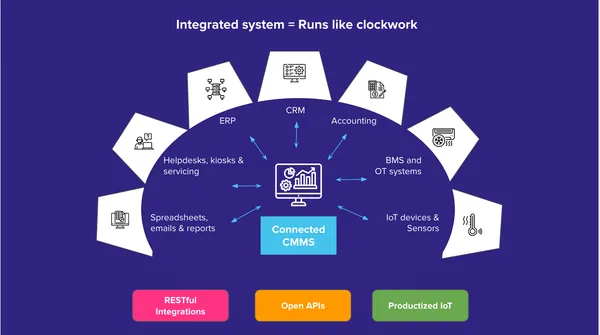
Rather than acting as another isolated system of record, it overlays and unifies your existing building systems, then connects three things most legacy tools keep separate: people (executives, technicians, occupants, clients and vendors), processes (no-code, drag-and-drop workflow automation), and systems (BMS, HVAC, energy, security, ERP and finance). The guiding principle is connect and unify, not rip and replace.
The practical result is a single operational layer where every request, work order, approval and cost is visible in real time, backed by a digital twin that lets you monitor a whole estate or drill down to one asset.
Key features:
- Maintenance and work order management: Hard, soft, planned and reactive maintenance with priority-based routing, integrated inventory and auto-conversion of request emails into work orders, positioned as part of Facilio's CMMS software.
- Helpdesk and self-service portal: A centralised helpdesk with a branded occupant portal, automated escalations and broadcasts for tenant and client communication.
- Vendor and subcontractor management: Standardised induction, KPI tracking, mobile check-in and compliance monitoring that can auto-deactivate non-compliant vendors.
- Inspections and audits: Mobile inspection management software with checklists, audits and incident reporting for field teams.
- No-code reporting and dashboards: Configurable, real-time SLA and KPI reporting plus a portfolio-wide operations dashboard, with no dependence on IT for new reports.
- Field service and mobile: Smart dispatch by skill, availability and location, delivered through an offline-first mobile CMMS app so a lost connection never stops work.
- Energy and fault detection: Native fault detection and diagnostics and BMS integration for teams that need to connect operations to building performance.
- Agentic AI: AI agents announced in 2026, including FM Copilot for natural-language portfolio questions and OpsVision, layered on top of existing systems to reduce repetitive intake, triage and reporting work.
Pros:
- No-code configuration means facility teams adapt workflows themselves, without waiting on developers or paid professional services for every change.
- Connect-and-unify integration lets you keep legacy BMS, ERP and finance systems and stitch them into one view, avoiding a disruptive rip-and-replace project.
- Stakeholder portals for vendors and occupants close the accountability gap that pure maintenance tools leave open.
- Fast multi-site deployment suits FM service providers who need to stand up a new client estate quickly and prove transparency.
Cons:
- As a newer platform than incumbents like IBM Maximo or Planon, Facilio carries less multi-decade brand recognition in the most conservative procurement processes.
- The depth of no-code configuration means the biggest gains come from a proper discovery and scoping conversation rather than a self-serve trial.
Pricing: Quote-based, scoped to portfolio size and modules. Facilio does not publish per-seat pricing publicly; request a tailored quote for an accurate figure (as of 2026).
Customer proof: Neil Henderson, Managing Director of Integrated Estate Management, describes the outcome directly: "Facilio's Connected CMMS gives us one digital infrastructure where every action, cost, and approval is visible and validated. It is the kind of operational transparency the FM industry has been waiting for."
At RA International, Head of IFM Ryan Hattingh selected Facilio's CAFM solution as "a robust, centralized platform capable of seamlessly integrating with SFG20" to manage facilities across scattered, far-reaching remote locations. Across FM service provider deployments, Facilio reports customer results including 97% SLA adherence, a 40% reduction in asset downtime and a 30% reduction in reactive call volumes (customer-reported, as of 2026).
Verdict: If your pain is fragmentation, manual coordination and vendor accountability across many sites, Facilio is built for exactly that problem. It is the strongest fit for teams that want connected, real-time operations without a multi-year replacement programme.
2. Planon
Best for: Large, global real estate portfolios that need a full IWMS spanning space, lease, sustainability and maintenance.
Planon is one of the most established IWMS platforms, favoured by international enterprises, campuses and healthcare systems that need broad functional coverage and strong regulatory reporting in one suite.
Key features:
- Integrated space, real estate, lease and maintenance management in one IWMS, so a single platform covers the full property lifecycle rather than a stack of point tools.
- ESG and sustainability reporting with multi-region and multi-currency support, built for operators that report emissions and compliance across several countries.
- CAD and BIM integration for space planning, letting teams tie occupancy and move data directly to live floor plans.
- Pre-built accelerator workflows for common facility processes, which shortens configuration for standard maintenance and service scenarios.
Pros:
- Exceptional functional breadth for organisations that genuinely need the full IWMS scope across property, space and maintenance in one system.
- Strong compliance and ESG reporting that suits regulated, multi-country operators with heavy audit obligations.
Cons:
- Implementation is often long and typically requires certified consultants, a recurring theme in user feedback on Gartner Peer Insights.
- High total cost of ownership and slower, monolithic upgrade cycles make it heavy for mid-market teams that need to move quickly.
Pricing: Quote-based, enterprise, with deployment cost that usually includes system-integration partners on top of the licence.
3. IBM Maximo
Best for: Asset-intensive enterprises where high-value equipment lifecycle management outweighs space and workplace needs.
IBM Maximo Application Suite is an enterprise asset management platform with deep predictive maintenance, lifecycle tracking and analytics. It is powerful, and it is more EAM than CAFM, which shapes both its strengths and its overhead.
Key features:
- Advanced predictive maintenance and condition monitoring that flags likely failures on critical equipment before they cause downtime.
- Deep asset lifecycle and capital planning, tracking each asset from commissioning through repair, replacement and disposal.
- Enterprise-grade analytics and AI for large, data-rich portfolios that need forecasting and reliability modelling.
- On-premise or cloud deployment options, giving heavily regulated or air-gapped operations a route that fits their IT policy.
Pros:
- Best-in-category depth for complex, asset-heavy portfolios where critical equipment reliability is the priority.
- Mature predictive and IoT-driven maintenance capabilities backed by years of industrial deployment.
Cons:
- Steep learning curve and lengthy implementation, commonly cited across G2 reviews, which lengthens time to value.
- EAM depth is overkill, and the interface can feel dated, for teams whose core job is building and space operations rather than industrial plant.
Pricing: Quote-based, enterprise. Note that IBM began transitioning TRIRIGA SaaS customers toward Maximo Real Estate and Facilities in 2026, so confirm the current product path before buying (verify with IBM, as of 2026).
4. Archibus (Eptura)
Best for: Teams whose core need is space optimisation, occupancy and CAD/BIM-led facility records.
Now part of Eptura following the Archibus and iOFFICE merger, Archibus connects spatial data directly to facility records, making it a natural fit where floor plans drive decisions.
Key features:
- Native AutoCAD and Revit connectivity that keeps facility records synchronised with the actual building drawings.
- Deep space utilisation tracking and move management for orchestrating departmental moves and occupancy changes at scale.
- Asset and service request management tied to spatial data, so a work order carries the exact location context.
Pros:
- Market-leading depth for space planning and move orchestration across large, drawing-driven estates.
- Strong for optimising occupancy rates across sprawling campuses and corporate headquarters.
Cons:
- High configuration complexity and a steep admin learning curve that demand a dedicated system owner.
- Substantial onboarding and training investment before the platform delivers value.
Pricing: Quote-based, scoped by modules and users, with configuration effort a meaningful part of the first-year cost.
5. Accruent
Best for: Healthcare, education and government estates that need asset-tied work orders alongside room and desk booking.
Accruent takes a dual approach: FAMIS 360 handles maintenance and asset work orders, while EMS manages space scheduling and bookings. That pairing suits public-sector and campus environments.
Key features:
- Asset-linked work orders and inspections across sites, keeping maintenance history attached to each tracked asset.
- Room, desk and event scheduling through EMS, which covers the booking side that pure maintenance tools miss.
- Capital planning and compliance reporting for long-horizon estates with regulatory obligations.
Pros:
- Strong fit for regulated, schedule-heavy environments such as hospitals, campuses and government buildings.
- Solid capital planning that helps long-horizon estates budget renewals years ahead.
Cons:
- The interface feels less modern than newer cloud-native platforms, which slows adoption.
- Onboarding can be slow for non-technical staff without dedicated admin support.
Pricing: Quote-based, with FAMIS 360 and EMS often licensed as separate modules.
6. MRI Software
Best for: Property-led real estate operators who want lease and financial management joined to maintenance.
Formerly FSI Concept Evolution, MRI Evolution brings a property and lease-centric IWMS to facility operations, which appeals to real estate operators who think finance-first.
Key features:
- Lease and financial management integrated with FM, so property finance and maintenance sit in one property-led system.
- Configurable maintenance and compliance workflows tuned for real estate operators rather than industrial plant.
- Portfolio and property reporting that rolls site-level activity up to a real estate view.
Pros:
- Genuine strength in lease and financial operations, an area most CAFM tools treat as an afterthought.
- Established presence in real estate management with a long track record among property operators.
Cons:
- Customisation is tied to the MRI ecosystem, and feature rollout can be slow compared with cloud-native rivals.
- User experience lags more modern platforms, adding friction for frontline teams.
Pricing: Quote-based, typically scoped to portfolio size and the property modules in use.
7. Spacewell
Best for: Hybrid workplace teams that want occupancy analytics and IoT alongside maintenance.
Part of the Nemetschek Group, Spacewell blends workplace experience, IoT sensors and maintenance, making it a fit for smart-office and hybrid-work environments.
Key features:
- Workplace and occupancy analytics that show how space is actually used across hybrid offices.
- IoT-driven sensor data for space, comfort and environmental conditions in real time.
- Configurable maintenance workflows that tie building performance to service tasks.
Pros:
- Strong workplace-experience and space-utilisation tooling for organisations optimising hybrid-work footprints.
- Native IoT that makes smart-building and comfort use cases straightforward to deploy.
Cons:
- Workplace-centric focus means lighter depth on heavy, multi-trade maintenance operations.
- Best value depends on a sensor-instrumented estate, which adds hardware cost and effort.
Pricing: Quote-based, with value closely tied to the level of IoT instrumentation deployed.
8. Corrigo
Best for: Outsourced, contractor-heavy facility portfolios, particularly within the JLL ecosystem.
Corrigo, a JLL Technologies product, focuses on work-order and vendor management for facilities that rely heavily on third-party service providers.
Key features:
- Strong work-order routing and vendor management built for facilities that lean heavily on third-party service providers.
- Contractor performance and spend tracking that compares vendors and controls external maintenance cost.
- A service marketplace within the JLL network that streamlines sourcing and dispatch of contractors.
Pros:
- Excellent vendor and contractor management for outsourced, multi-site operations.
- Proven at scale across large managed portfolios inside the JLL ecosystem.
Cons:
- Built primarily for JLL-managed facilities, with predefined configuration that limits flexibility.
- Integration with systems outside the JLL ecosystem can be costly and effortful.
Pricing: Quote-based, generally aligned to JLL-managed service arrangements.
9. Infraspeak
Best for: Multi-site teams coordinating internal staff and external contractors.
Infraspeak is an intelligent maintenance and asset management platform whose Infraspeak Network connects every stakeholder in one place, reducing administrative overhead.
Key features:
- Work order, preventive maintenance and asset tracking in one intelligent maintenance platform.
- Compliance and procurement modules that keep certifications and purchasing inside the same system.
- AI-assisted automation across the Infraspeak Network, connecting internal teams and external contractors in one place.
Pros:
- Connects internal and external stakeholders neatly, cutting the administrative overhead of coordinating contractors.
- Modern, approachable interface that reduces training time for frontline teams.
Cons:
- Younger enterprise footprint than legacy incumbents, so very large global rollouts are less proven.
- Deepest value depends on contractors actively adopting the Infraspeak Network.
Pricing: Subscription, with quote-based tiers for larger multi-site deployments.
10. eMaint
Best for: Multi-site maintenance teams that want a configurable, compliance-ready cloud CMMS.
eMaint, part of Fluke Reliability, is a flexible cloud CMMS strong on preventive maintenance and multi-site compliance records.
Key features:
- Configurable preventive maintenance workflows that adapt to varied multi-site maintenance processes.
- Mobile technician updates and inspections so field teams log work from any site.
- Compliance and audit-ready reporting that stands up to regulatory review across locations.
Pros:
- Highly configurable for varied maintenance processes without heavy developer involvement.
- Strong mobile and compliance capabilities backed by Fluke Reliability's maintenance heritage.
Cons:
- Maintenance-first by design, so lighter on space, lease and workplace management.
- Lacks the vendor and occupant portals that enterprise FM teams often need for accountability.
Pricing: Per user, subscription, scaling with the number of technicians and sites.
11. FMX
Best for: Schools, public sector and mid-sized estates that value simplicity.
FMX offers straightforward facility scheduling, work orders and utility tracking, and is popular in education and the public sector for its ease of use.
Key features:
- Simple work-order and request management that non-technical staff can use with little training.
- Facility and event scheduling built for the calendar-driven needs of schools and public buildings.
- Utility and equipment tracking that keeps basic asset and consumption records in one place.
Pros:
- Fast to adopt with a clean, approachable interface that suits smaller facility teams.
- Good fit for education and public-sector scheduling where simplicity beats depth.
Cons:
- Limited advanced analytics for large, complex portfolios that need portfolio-wide insight.
- Less suited to enterprise multi-site operations with heavy integration needs.
Pricing: Quote-based, typically scaled to building count and users.
12. UpKeep
Best for: Single-site or smaller teams that need mobile-first work-order tracking.
UpKeep is a mobile-first CMMS built for frontline technicians and quick onboarding, ideal for smaller operations or a single facility.
Key features:
- Mobile work-order creation with photo attachments, built for technicians who work primarily from a phone.
- Preventive maintenance and asset tracking that covers the essentials for a single site or small estate.
- Real-time notifications that keep frontline teams moving without desk-based coordination.
Pros:
- Fast onboarding and excellent mobile usability that get small teams live quickly.
- Low barrier to entry, making it an easy first step away from spreadsheets.
Cons:
- Not built for enterprise multi-site scale or drag-and-drop workflow configuration.
- Limited reporting and no occupant or tenant portal for stakeholder communication.
Pricing: Per user, subscription, with a published entry-level tier for smaller teams.
See Facilio's Connected CaFM in action
Unify maintenance, space, vendors and compliance across your whole portfolio, without ripping out existing systems.
How to choose the best CAFM software: Factors to consider
The right platform depends on the shape of your estate and your operating model. When evaluating these platforms, prioritise the criteria that map to your reality rather than a generic feature count:
- Define your primary job: If maintenance and asset upkeep dominate, weigh CMMS-led tools; if space, occupancy and lease planning matter, weigh IWMS breadth. Compare your shortlist against a proper best CMMS software list if maintenance is the core need.
- Test integration honestly: Ask whether the platform can connect to your existing BMS, ERP and finance systems without a rip-and-replace project. Connect-and-unify beats forced migration.
- Prioritise no-code configuration: Rigid, developer-dependent workflows create a permanent dependency on the vendor. Drag-and-drop configuration lets your team adapt as operations change.
- Insist on offline-first mobile: Field technicians lose connectivity in basements and plant rooms; work should never stop because the internet did.
- Check multi-site permissions and reporting: Role-based access, portfolio hierarchy and real-time SLA dashboards separate enterprise-ready platforms from SMB tools.
- Compare total cost of ownership, not licence price: Long implementations, certified-consultant fees and paid change requests often dwarf the subscription. For asset-intensive estates, also weigh a best EAM software shortlist.
Common mistakes to avoid when choosing CAFM software
Most regret in a CAFM purchase traces back to a handful of avoidable errors. Watch for these before you sign:
- Buying features instead of fit: A long feature checklist rarely predicts success. A tool that does everything but suits none of your workflows loses to one that maps cleanly to how your team actually operates. Match the platform to your primary job first.
- Ignoring total cost of ownership: The licence is the visible number. Certified-consultant fees, long implementations and paid change requests are the invisible ones, and on legacy IWMS they often dwarf the subscription. Ask for an all-in figure across three years.
- Underestimating integration: A platform that cannot talk to your BMS, ERP and finance systems forces a rip-and-replace project or, worse, another data silo. Test real integrations during evaluation, not after.
- Over-buying on scale: Enterprise EAM depth is wasted money if your core job is building and space operations. Many teams pay for a heavy suite and use a fraction of it. Size the tool to the estate.
- Under-buying on scale: The mirror error. An SMB tool that onboards fast will cap out on multi-site permissions, portfolio reporting and stakeholder portals just as you grow. Check the ceiling before you hit it.
- Skipping mobile and offline testing: Technicians work in basements and plant rooms with no signal. If the mobile app is an afterthought or fails offline, adoption collapses on day one.
- Forgetting vendor and occupant accountability: Pure maintenance tools track your team but leave contractors and tenants outside the system, which is exactly where SLAs slip. Confirm the platform closes that loop.
- Choosing a passive system of record: A tool that only logs what already happened keeps you reactive. Prioritise platforms that automate intake, routing and early fault detection so the system moves work forward, not just files it.
Best CAFM software by use case
Different estates reward different strengths, so match the tool to the job:
- FM service providers and IFM: Facilio and Infraspeak, for fast per-client deployment, vendor accountability and transparency you can show the client. Facilio's facility management services fit is built around winning RFPs on technology.
- Enterprise owner-operators in commercial real estate: Facilio and Planon, for portfolio-wide visibility across large commercial portfolios.
- Healthcare estates: Accruent and Facilio, for compliance-heavy, uptime-critical environments running healthcare facility management software.
- Education campuses: FMX and Facilio, for scheduling-heavy campuses using education facility management software.
- Retail and multi-site refrigeration: Facilio and ServiceChannel-style tools, for distributed store estates that lean on retail facility management software.
- Data centres and mission-critical sites: Facilio and IBM Maximo, for reliability-first operations across data center facility management.
The hidden cost of a passive system of record
Here is the trap most facility teams fall into. A CAFM tool that only records what already happened keeps you permanently reactive, and reactive operations are expensive.
Analysis from Re-Leased and other property-operations research shows reactive maintenance can cost three to five times more per repair than the same task done as planned preventive work, and that mature preventive programmes cut operating expenses by 12% to 18%.
The compounding effect is worse. Every unit of maintenance deferred can quadruple into capital-renewal cost later, which is why a platform that surfaces problems early, through predictive maintenance software and tighter energy management software, pays for itself well before the contract renews. Strong asset lifecycle management compounds the saving over the life of the estate.
A passive system of record cannot do this. It waits for a human to log a fault, route it and chase it. A connected platform automates that intake and coordination, which is the single biggest difference between the legacy tools and the connected ones on this list.
Why FM leaders are choosing connected CAFM
The platforms that struggle in enterprise evaluations share a pattern: they were built as isolated systems that manage maintenance, or space, or assets, and nothing else. They require IT support for integration, ship rigid workflows and lock reporting inside their own ecosystem. Those are the lasting scars of the legacy model, missed SLAs, scattered financials and fragmented communication.
Connected CAFM inverts that model. At Al Fajer FM, Deputy CEO Sangeetha Balakrishna reports that "Facilio's connected buildings approach has helped us upgrade the quality of service for our customers, using the same resources and assets that were at our disposal earlier."
At Q3 Services, Managing Director Mark Hazelwood describes a platform that "consolidates fragmented, outdated systems into a single platform that delivers real-time visibility, mobile-first control," with roughly 90% of transactions now self-service and fully documented for the client.
That is the shift: facility management moving from a cost centre to a strategic lever, and from a system of record to a system that keeps operations moving. Facilio operates across more than 10,000 buildings on four continents (as of 2026), and the reason enterprise teams pick it is rarely a single feature. It is the ability to unify what they already have and run it in real time.
Why business leaders choose Facilio's CAFM software
Facility teams evaluate CAFM on work orders and dashboards. Business leaders evaluate it on a different question: does this turn facility management from a cost centre into a source of value. That is where Facilio's Connected CAFM earns its place in the boardroom conversation, for four reasons.
It makes operations visible to the people who fund them: Executives cannot manage what they cannot see. Facilio gives leadership a portfolio-wide view where every action, cost and approval is validated in real time, so a CFO or operations director can answer a board question without waiting for a monthly report.
Haithem Ibraheem, Property Operations Manager at ICD Brookfield Place, describes automating data collection and using intelligent algorithms to "achieve continuous improvements in asset and staff performance, consistently exceeding SLA and KPI expectations."
It protects margin without adding headcount: For FM service providers, technology is how you win RFPs and defend margin. Al Fajer FM reports upgrading service quality for its customers "using the same resources and assets that were at our disposal earlier," while Q3 Services moved roughly 90% of transactions to self-service.
That is more output from the same cost base, which is the number a business leader actually tracks.
It avoids a disruptive replacement programme: A rip-and-replace project is a capital risk and an operational one. Facilio's connect-and-unify approach layers onto existing BMS, ERP and finance systems, so leaders modernise operations without betting the year on a migration.
Rob Devereux, CEO of ICD Brookfield, chose Facilio to "unify all of our disparate building systems" after concluding its thought leadership and product portfolio stood out.
It positions FM as a strategic lever, not a line item: With roughly 80% of a building's lifecycle cost sitting after construction, better operations is one of the largest untapped savings pools a real estate business owns.
Facilio operates across more than 10,000 buildings on four continents (as of 2026) precisely because leaders increasingly treat FM as a growth and efficiency lever rather than an overhead to minimise.
The bottom line
Choosing CAFM software in 2026 comes down to one question: do you want a system that records your operations, or one that runs them. The legacy incumbents on this list offer depth but demand long implementations and IT dependency. The SMB tools offer speed but cap out on scale. Connected CAFM aims to give you enterprise depth with the speed and flexibility of a modern, no-code platform, unifying the systems you already own instead of replacing them.
If your estate spans multiple sites, leans on external vendors and runs on fragmented tools today, the connected approach is built for your reality. See how Facilio unifies it in one platform, book a 30-minute demo and we will map it to your portfolio.
Frequently Asked Questions on CAFM software
What is the best CAFM software in 2026?
What is the difference between CAFM and CMMS?
How much does CAFM software cost?
Can CAFM software integrate with existing building systems?
Is CAFM software cloud-based?
Which CAFM software is best for FM service providers?
How does AI improve CAFM software?
About the Author

More from Facilio