






 Service intake

















If you want to build a business case for AI agents in facilities management, start with the time your team spends today, not with the vendor's promise. Measure the hours, take away what the agent handles, put a fair cost on the hours freed and subtract what the agent costs to run. Then count the losses it prevents, separately.
Most AI business cases fail because they skip a step: no starting point, savings that are really freed capacity, or a platform cost left out. In this guide, we have tried to explain the method we use with customers, show it worked through at Charter Hall and Berkeley Services, and give you a free calculator to run it on your own numbers.
Key takeaways
- Measure each function before any agent goes live. That is your starting point.
- Follow one chain: time spent, time reduced, capacity freed, value of that capacity.
- Keep freed capacity apart from cash savings. They are not the same number.
- Count losses an agent prevents on their own line, and only the ones you can defend.
- Include the full cost: platform, setup, your team's time and running costs.
What does a business case for AI agents in facilities management need?
Five numbers, worked out in order: the time a task takes today, how much of it the agent takes off your team, what that freed time is worth, what the agent costs, and what losses it prevents. Anything else is a forecast dressed up as a result.
The order matters. Each number depends on the one before it, and finance will test every link. A business case that starts with a vendor percentage and multiplies it by headcount will not survive the first question.
How do you set a starting point for each function?
Pick the functions where your team spends the most repeat effort, and measure each one for at least a month before anything changes. For most FM teams, that means five areas.
| Function | What to count each month | Where to find it |
|---|---|---|
| Service request intake | Calls, WhatsApp messages and emails, and the minutes to log each one | Phone system, shared inboxes, CMMS |
| Work order dispatch | Jobs assigned, and the time to find and confirm a technician or vendor | CMMS, coordinator notes |
| Vendor coordination | Quotes, visits and reports chased, and follow-ups per job | Email, CMMS |
| Invoice validation | Invoices checked, minutes per invoice and errors found | Finance or accounts payable system |
| Compliance documents | Certificates and policies tracked, renewals chased and lapses | Spreadsheets, vendor portal |
Step 1: Count the volume
How many requests, jobs, vendor follow-ups, invoices and compliance documents your team handles each month. Your CMMS, phone system and shared inboxes already hold most of it.
Step 2: Time the work
How many minutes of a person's time each item takes, start to finish, including the chasing. Time a sample of 20 to 30 items rather than asking people to estimate. Estimates usually come in low.
Step 3: Note the errors and the misses
Duplicate tickets, missed SLAs, invoices paid wrongly, expired vendor certificates. These feed the losses you count later, and they are also the starting point you will measure the agent against every week.
How do you turn time saved into money?
Follow one chain and do not skip a link: time spent, time reduced, capacity freed, then the value of that capacity at your real labour cost.

Time spent and time reduced
Multiply volume by minutes per item to get the hours your team spends today. Then take off the items the agent handles in full, and add back the minutes a person still spends checking them. The difference is the time reduced.
Capacity freed
Divide the hours freed by the working hours in a month. That tells you how many full-time people's worth of time the agent frees, known as FTE.
The value of that capacity
Multiply the hours freed by a fully loaded hourly cost: salary, benefits and overheads. Use your own number. A business case built on someone else's labour rates will be challenged straight away.
Capacity is not the same as cash
This is where most business cases go wrong. If the freed person moves to other work, you have created capacity: more done with the same team. You only save cash if you avoid a hire, cut overtime, end an agency contract or reduce headcount. Show both numbers, and let finance decide which one to count.
Run the numbers on your own operation.
Download our AI agent ROI calculator: five functions, your own labour cost, and capacity kept apart from cash.
What costs belong in the business case?
All of them, including the ones on your side. A business case that shows only the subscription will look better than reality, and finance will find the gap.
- The platform: The subscription or usage charges. For example, our Helpdesk AI pricing is per call or chat session.
- Setup: Connecting your systems, loading your rules and the trial run before go-live.
- Your team's time: The hours your people spend agreeing rules, scoring the trial run and reviewing exceptions.
- Running it: Monitoring, fixing what slips and adding new rules as your operation changes.
Ask every vendor which of these are included. With us, our FM Ops Engineers do the setup and keep running the agent, so the last line is part of the service rather than a hidden cost.
How do you count losses an agent prevents?
On their own line, and only the ones you can defend. An agent that checks every invoice or every vendor certificate will catch problems a busy team misses. That value is real, but it is not certain, so keep it apart from the labour numbers.
- Use your own history: How often did this go wrong last year, and what did it cost?
- Count the conservative floor: If a range is wide, use the low end.
- Leave out what would have been fixed anyway: An overcharge your team would have caught and corrected is not a loss avoided.
For invoices, that means penalties and lost tax credits, not every billing error. For compliance, it means jobs that would have gone ahead with a lapsed certificate, which is why we track vendor compliance before dispatch, not after.
What did the numbers look like at Charter Hall and Berkeley Services?
Two worked examples, one for invoices and one for the helpdesk. Both follow the same chain.
Charter Hall: Invoice validation
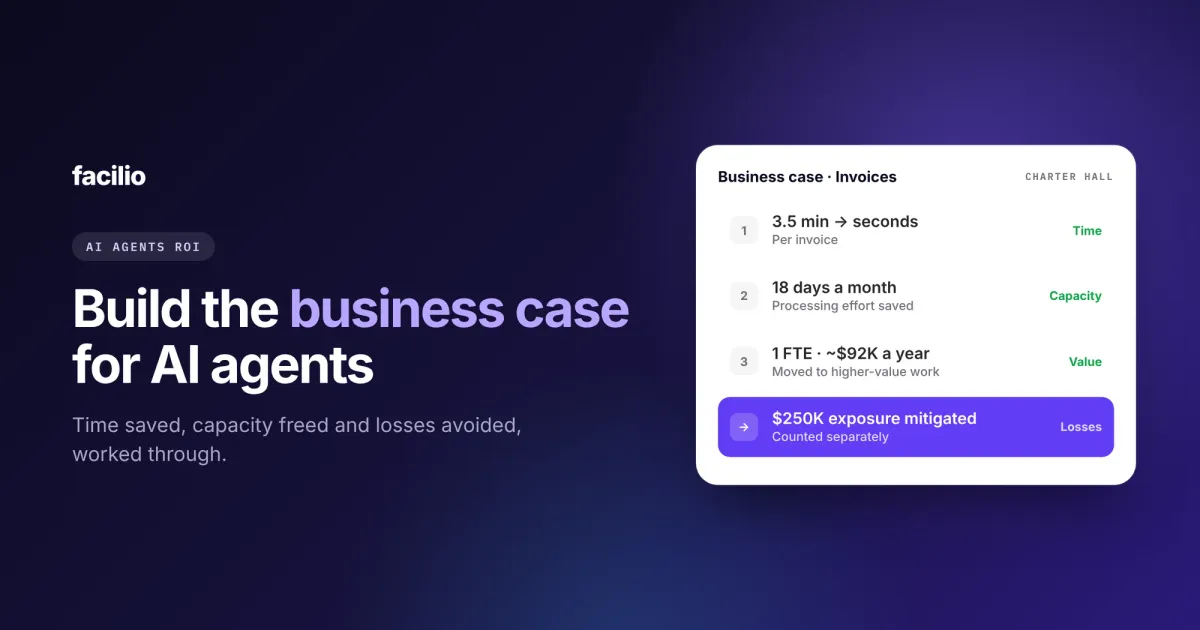
Charter Hall, an Australian property funds manager with 100+ office assets, had a person check every supplier invoice before payment. Each one took about 3.5 minutes of reading. Our invoice processing agent now checks every invoice against the purchase order and Charter Hall's rules, and only judgment calls reach a facilities manager.
- Time spent and reduced: 6,200+ invoices checked in four months, 4,960+ of them with no manual review. Each check now takes seconds.
- Capacity freed: 18 days of processing effort saved every month, so one FTE moved to higher-value work.
- Value of that capacity: About $92,000 a year. This is capacity, not cash, because the person was reassigned, not removed.
- Losses avoided, counted separately: $250,000 of GST compliance and penalty exposure mitigated.
Read the full invoice validation case study.

Berkeley Services: The tenant helpdesk
Berkeley's helpdesk team answered every call and WhatsApp message by hand. Our intake agent, Al-Najāḥ, now finishes 98% of conversations end to end: 761 of 777 in its last 30 days. Here is how Berkeley's AI intake agent went live.
- Capacity freed: Three of the four people who answered calls moved to other work.
- Value of that capacity: Berkeley has not published a cost figure, so here is the method with an assumption. If a helpdesk role costs $40,000 a year fully loaded, three roles of capacity are worth about $120,000 a year. Change the assumption in the calculator to your own cost.
- More capacity from the next step: A second agent now enters Berkeley's work orders into a client's portal, which is on track to free around 150 hours a month at full volume.
The same chain works for every function. Here is where the time usually goes, before and with an agent.
| Function | Before | With an AI agent |
|---|---|---|
| Service request intake | Typed in by hand, with duplicates and thin cover at night | Logged in the CMMS from calls and WhatsApp, at any hour |
| Work order dispatch | Coordinators phone around to find who is free | Assigned, confirmed and chased against the SLA |
| Vendor coordination | Quotes, visits and reports chased by email | Requested, booked and collected by an AI vendor coordination agent |
| Invoice validation | Every invoice read by a person | Checked against the PO and your rules, with judgment calls sent to a person |
| Compliance documents | Certificates tracked in spreadsheets | Checked every day, with lapsed vendors flagged before dispatch |
How does Facilio build the business case with you?
We build the business case with you before an agent goes live, and we keep it honest after. We start from your own numbers, take one of our AI agents for facility operations live on top of the CMMS you already use, and report the result every week against the starting point. Our FM Ops Engineers do the measuring, the setup and the running.
Here is what the first 90 days usually look like:
Your first 90 days
Who does whatWhy the numbers hold up
What FM teams see on Facilio
From Charter Hall's invoice validation case study and Berkeley Services' helpdesk.
Before you take the case to finance, check the agent's controls with our AI governance assessment. Still building the case for the CMMS itself? Start with our CMMS ROI calculator.
The bottom line: Is the business case for AI agents worth building?
Yes, if one of your functions has high volume, repeat steps and a team that is stretched. Build it on a measured starting point, show capacity and cash separately, and include every cost. A case built that way will hold up in front of finance, and it becomes the scorecard you use once the agent is live.
A simple first step: pick the function your team complains about most, count last month's volume and time 20 items. Then put those numbers into the calculator.
Build the business case
Build your AI business case with us.
Our FM Ops Engineers measure your starting point, take one agent live and report the result against it every week.
Frequently asked questions about the ROI of AI agents in facilities management
How do you calculate the ROI of AI agents in facilities management?
What is a realistic return from AI agents in facilities management?
Is freed capacity the same as cost savings?
What costs should an AI business case include?
How long does it take to see a return?
About the Author

More from Facilio