Connected CMMS

 Connected Buildings
 Connected Refrigeration


 Download ebook

 Read case study


 Watch now


 Retail
 Healthcare
 FM Services
 Commercial Portfolios
 Corporate Facilities
 Education
 Data-driven Portfolio Ops
 Facility Management Software
 360° Asset Lifecycle
 Continuous Sustainability

 Blogs
 Help docs
 Knowledge Hub
 ROI Calculator
 Ebooks & Guides
 Webinars
 Videos
 Case studies


 About us
 Newsroom
 Careers
 Contact us
 Partners
 Events



If you want to coordinate vendors with AI, you connect an AI vendor coordination agent to your work orders, vendor list and contracts. The agent then takes over the follow-up work. It requests and compares quotes, books and confirms visits, chases no-shows, collects service reports and closes the job. Your team approves anything above budget, scope changes and disputes.
Most FM teams we talk to still do this by hand. Someone chases a quote, then chases it again. Someone confirms Thursday's visit and calls when nobody shows. Then they wait on a service report so the work order can finally close. It is the slowest part of subcontractor management, and it grows with every site and every contractor you add.
In this guide, we have tried to show where time leaks in the vendor loop, what an AI agent sends and records at each stage, how vendor scorecards build themselves and where a person still needs to step in.
Key takeaways
- The vendor loop has five stages where time leaks: quotes, scheduling, attendance, service reports and close-out.
- An AI agent sends the request, waits for the reply, chases silence and records the result on the work order.
- Every interaction becomes data, so vendor scorecards build from the record, not from memory.
- People stay in charge of spend above budget, scope changes, disputes and vendor selection.
- Vendors keep using email, WhatsApp and phone. Nobody is forced onto a new portal.
Where does time leak when you coordinate vendors manually?
Every job that goes to a contractor follows the same five stages. Each one waits on someone outside your organisation.
- Quotes: requests go out by email, replies come back in different formats, and someone retypes the numbers into a spreadsheet to compare them.
- Scheduling: agreeing a visit window takes several messages, more if site access needs arranging.
- Attendance: nobody knows the vendor is not coming until the tenant calls to ask.
- Service reports: job sheets, photos and certificates arrive late, half done or not at all. The work order stays open.
- Close-out: without the report, nobody can check the invoice against the work.
Across hundreds of vendors, that adds up to thousands of follow-ups a month.
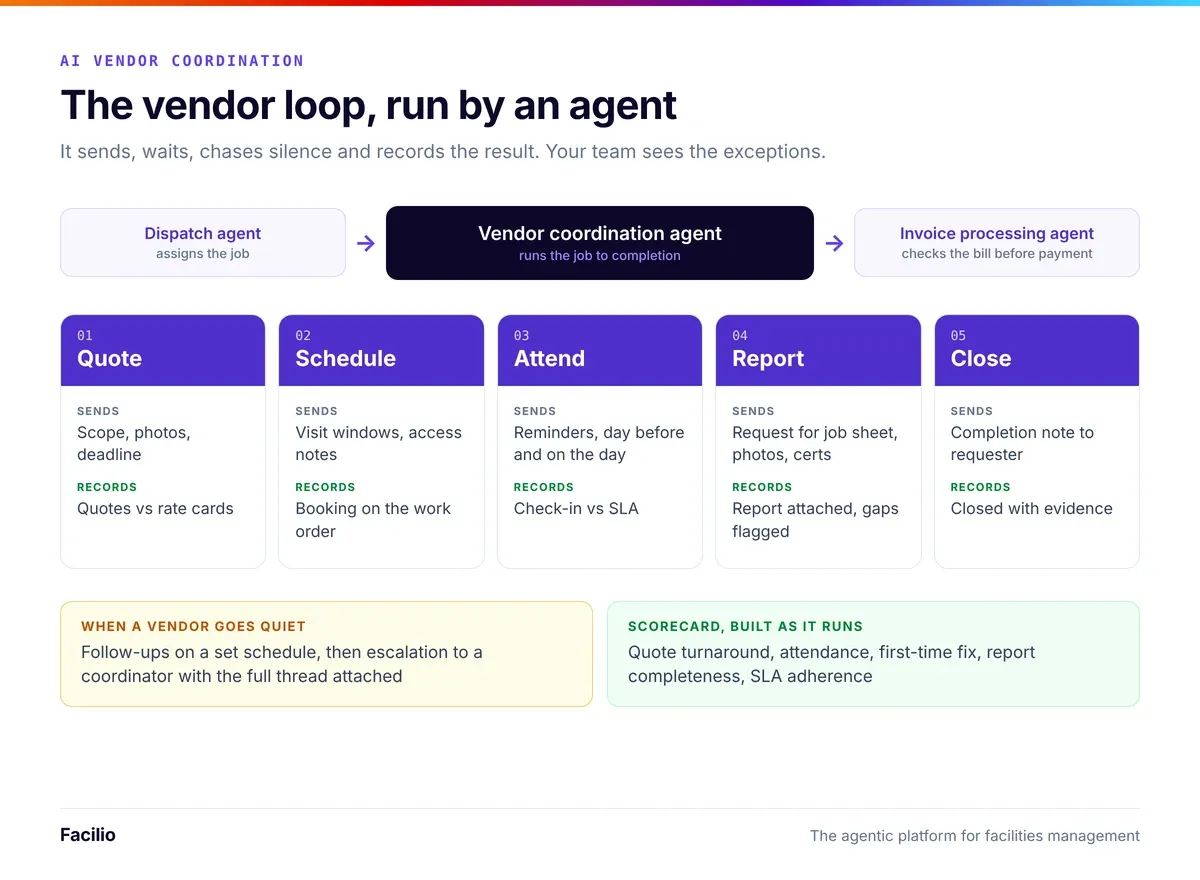
What does an AI vendor coordination agent send, wait for and record?
The agent works through the same five stages on every job. It uses the channels your vendors already use: email, WhatsApp, phone and the vendor portal.
| Stage | The agent sends | It waits for | It records |
|---|---|---|---|
| Quote | Scope, site details, photos and deadline to eligible vendors | Priced quotes | Quotes side by side, checked against rate cards |
| Schedule | Proposed visit windows and access instructions | Confirmed date and time | Booking on the work order |
| Attend | Reminder the day before and on the day | Check-in on site | Arrival time against the SLA |
| Report | Request for job sheet, photos and certificates | Completed service report | Report attached, gaps flagged |
| Close | Completion confirmation to the requester | Sign-off where required | Closed work order, ready for invoice checks |
When a vendor goes quiet, the agent follows up on a set schedule. If the follow-ups run out, it hands the thread to a coordinator with everything attached. Nobody starts from scratch.
How does the agent handle quotes, attendance and service reports?
These three stages cause most of the chasing. So they get the most rules.
Quotes: requested from eligible vendors and checked against your rates
The agent only asks vendors who hold the right trade, cover the site and meet your contractor compliance requirements. It pulls the replies into one comparison and checks them against your contracted rates. This is the same check that stops margin leakage in FM invoices. Anything above the not-to-exceed amount goes to an approver, and approved quotes can move straight into procurement automation for the PO.
Attendance: confirmed the day before and tracked on the day
The agent confirms the visit the day before. On the day, it watches for check-in. A missed check-in triggers a chase right away. If needed, the job goes back to the AI work order dispatch agent to find another vendor before the SLA is breached. Meanwhile, the requester gets updates at every stage instead of having to call.
Service reports: requested on completion and checked for gaps
As soon as the job is marked complete, the agent asks for the job sheet, photos and certificates. It checks that each required item is there. A missing gas safety certificate gets chased now, not found at audit. That keeps your compliance evidence audit-ready.
How do vendor scorecards build themselves from the record?
Every quote, booking, check-in and report runs through the agent. So vendor performance gets measured on every job, and nobody has to fill in a form.
The scorecard tracks five numbers for every vendor at every site:
- Quote turnaround: hours from request to priced quote.
- Attendance against booking: visits that started inside the agreed window.
- First-time fix: jobs closed without a return visit.
- Report completeness: service reports with every required item attached.
- SLA adherence: response and fix times against the contract.
That changes the vendor review. You stop debating impressions and open the scorecard in your vendor management software instead. The dispatch agent reads the same history when it picks who gets the next job.
Stop chasing vendors. Start reviewing exceptions.
See our vendor coordination agent run quotes, visits and reports on your own contractors.
When does a person still need to step in?
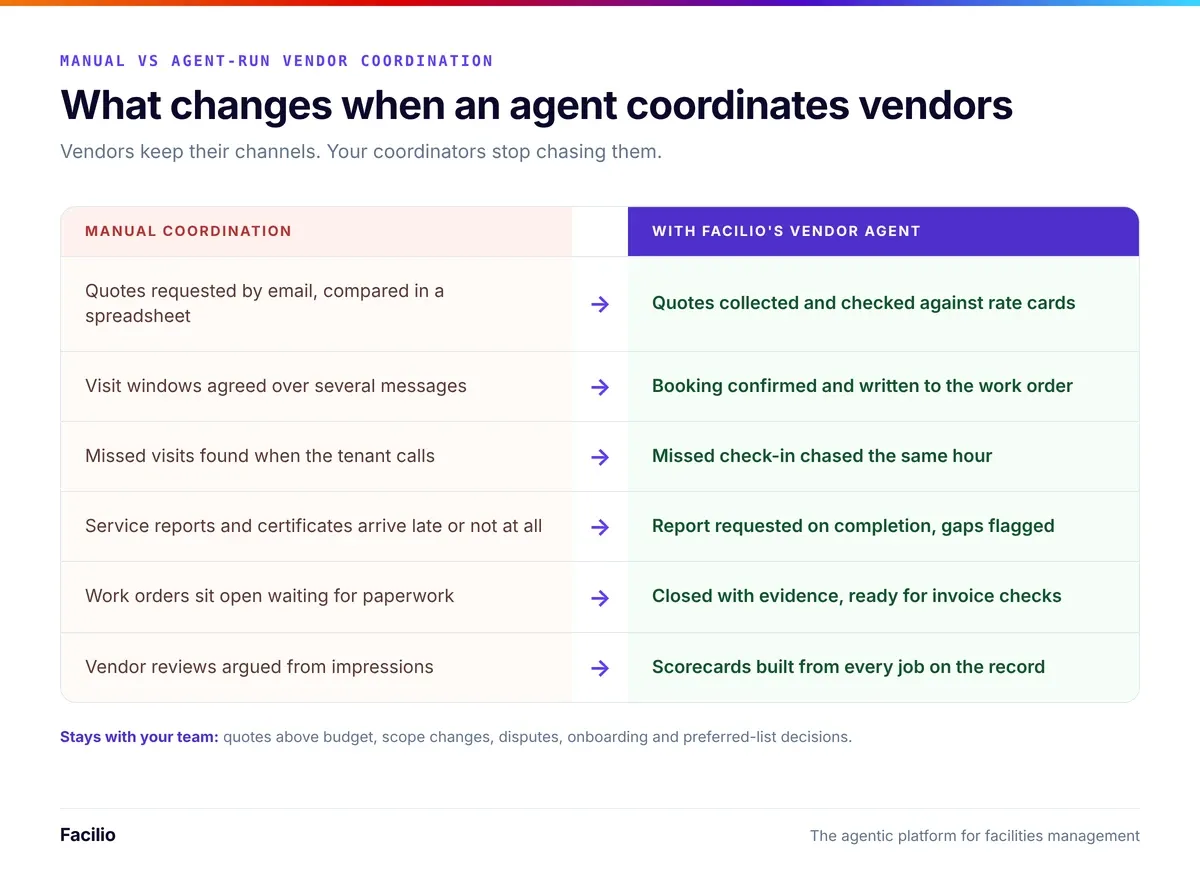
The agent takes away the chasing. It does not take away the judgement. Each of these decisions reaches a person, with the context already pulled together.
- Approving quotes above budget or outside contract scope.
- Agreeing scope changes once a vendor is on site.
- Handling disputes over quality, charges or liability.
- Onboarding new vendors and deciding who stays on the preferred list.
- Picking up any thread the agent escalates after its follow-ups run out.
How does AI vendor coordination compare with the manual process?
Here is the short version.
| Area | Manual coordination | AI vendor coordination agent |
|---|---|---|
| Quote requests | Emailed one by one and compared in a spreadsheet | Sent to eligible vendors and compared against rate cards |
| Follow-ups | Whenever someone remembers | On a set schedule, then escalated with the full thread |
| No-shows | Found when the tenant calls | Caught at the missed check-in and reassigned before the SLA breach |
| Service reports | Chased for days and often incomplete | Requested on completion with gaps flagged |
| Vendor reviews | Based on impressions | Based on a scorecard built from every job |
| Invoice checks | Done without the report in hand | Run against the work order, contract and rate card |
How does Facilio run vendor coordination with AI agents?
We run vendor coordination as a live AI agent that does the chasing itself. It is not a portal that waits for vendors to log in. Our vendor coordination agent is one of our AI agents for facility operations. It runs alongside the CMMS, ERP and finance systems you already use, and our FM Ops Engineers set it up and run it with your team. It is live at enterprise customers today.
Why it does more than the vendor management you run today
What FM teams see on Facilio
Results our customers have reported, from published case studies.
Your vendors keep working the way they do today. Your coordinators stop chasing them and start managing the exceptions.
The bottom line: is AI vendor coordination worth it?
If your coordinators spend more time chasing contractors than managing them, yes. Quotes, visit confirmations and service reports follow the same pattern on every job, and an agent works that pattern without missing a follow-up. Your team keeps the decisions that need judgement: spend above budget, scope changes, disputes and who stays on the vendor list.
A good first step is to pull last month's vendor jobs and count the follow-ups each one needed before it closed. Start the agent on the trade or site with the most chasing, track quote turnaround and report completeness for a month, and expand from there.
See the AI agents live
Start with the vendors your team chases most.
Our FM Ops Engineers map your vendor loop, connect your systems and show you the follow-ups the agent takes off your team.
Frequently asked questions about AI vendor coordination
Can AI chase vendor quotes automatically?
Do vendors need to use a new portal?
How does the agent know a vendor did not attend?
Can AI build vendor scorecards?
Does the vendor coordination agent replace my CMMS?
About the Author

More from Facilio