






 Service intake















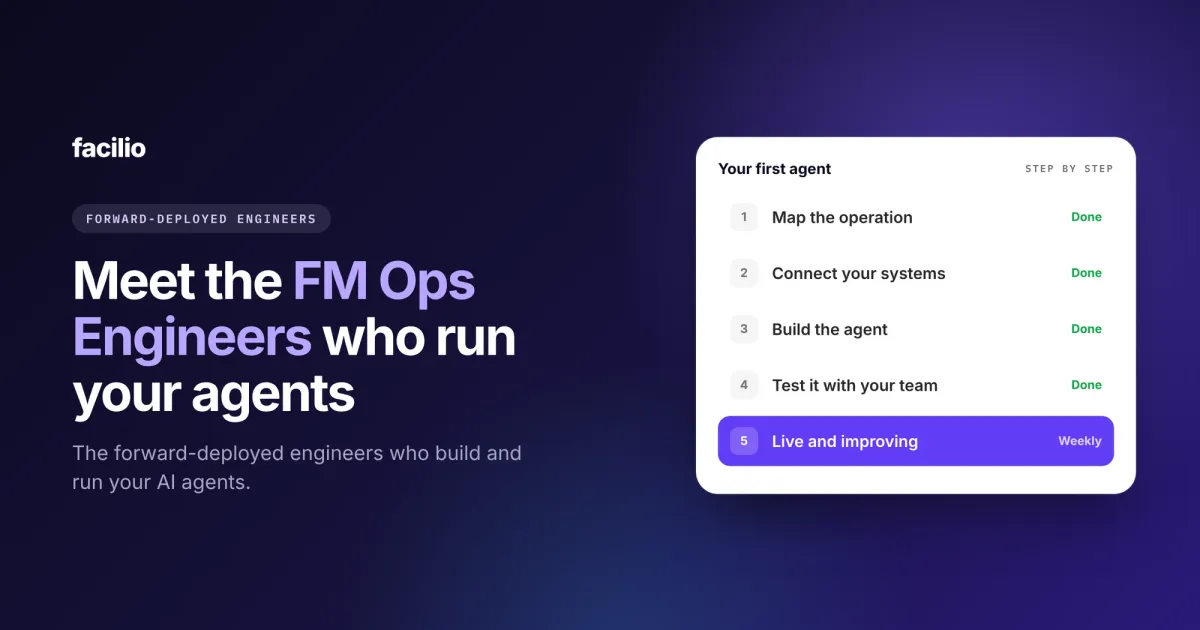

FM Ops Engineers are Facilio's forward-deployed engineers: the people who build, deploy and run your AI agents with you. A small team of two or three sits with your people, maps how your operation really runs, and takes each agent from one clear goal to live work in weeks. Then they stay to keep improving it.
Most AI projects in FM stall in the gap between the demo and go-live. In this guide, we have tried to explain who closes that gap, and what your team does along the way.
Key takeaways
- FM Ops Engineers are forward-deployed engineers who know facilities, in teams of two or three.
- Every rollout follows six stages: map, connect, build, test, go live and improve.
- A ready agent goes live in days to weeks. A new agent for your process takes weeks.
- Your team brings the knowledge and the decisions. We do the building and the tuning.
- The same engineers stay after go-live and review the numbers with you every week.
What are forward-deployed engineers, and what is an FM Ops Engineer?
A forward-deployed engineer works inside the customer's team instead of back at headquarters. They learn how the customer actually works, then build the software around it. Many AI companies now work this way, because AI only pays off once it fits the real process.
An FM Ops Engineer is our forward-deployed engineer, built for facilities. The name says what they do. FM, because they know the work. Ops, because they run it. Engineer, because they build.
Most of them are our own people. They have deployed facilities software for global customers for years, so they know which workflows matter and which ones only look important. Alongside them are hires from the industry, such as technology leads from real-estate facilities teams.
Domain first matters because most of the work is not code. It is knowing that a leak at a hospital is a different job from a leak at a warehouse. It is knowing that a vendor's rate card has three exceptions nobody wrote down. An engineer who has seen that before builds the right rule the first time.
Three things set them apart:
- They sit with your team: a team of two or three works with your people on your operation as it runs today, not as the org chart describes it.
- They build on the platform: agents and apps are assembled from parts that already exist, so nothing starts from zero.
- They stay: the people who take the first agent live carry the lessons to the next site and the next agent.
This is also our answer to one of the most common reasons AI projects in FM stall. Nobody on your side has to become an AI engineer.
How does Facilio take an agent from your objective to live work?
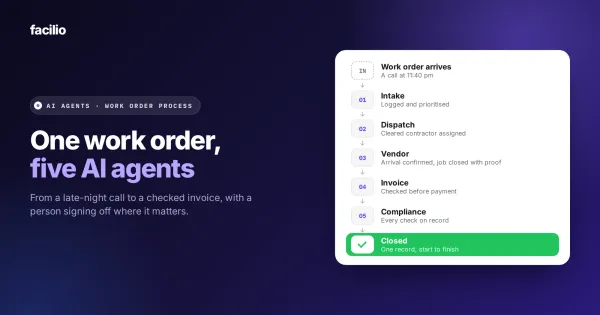
It follows the same six stages every time. The order matters, because it shows the gaps early and keeps risk low.
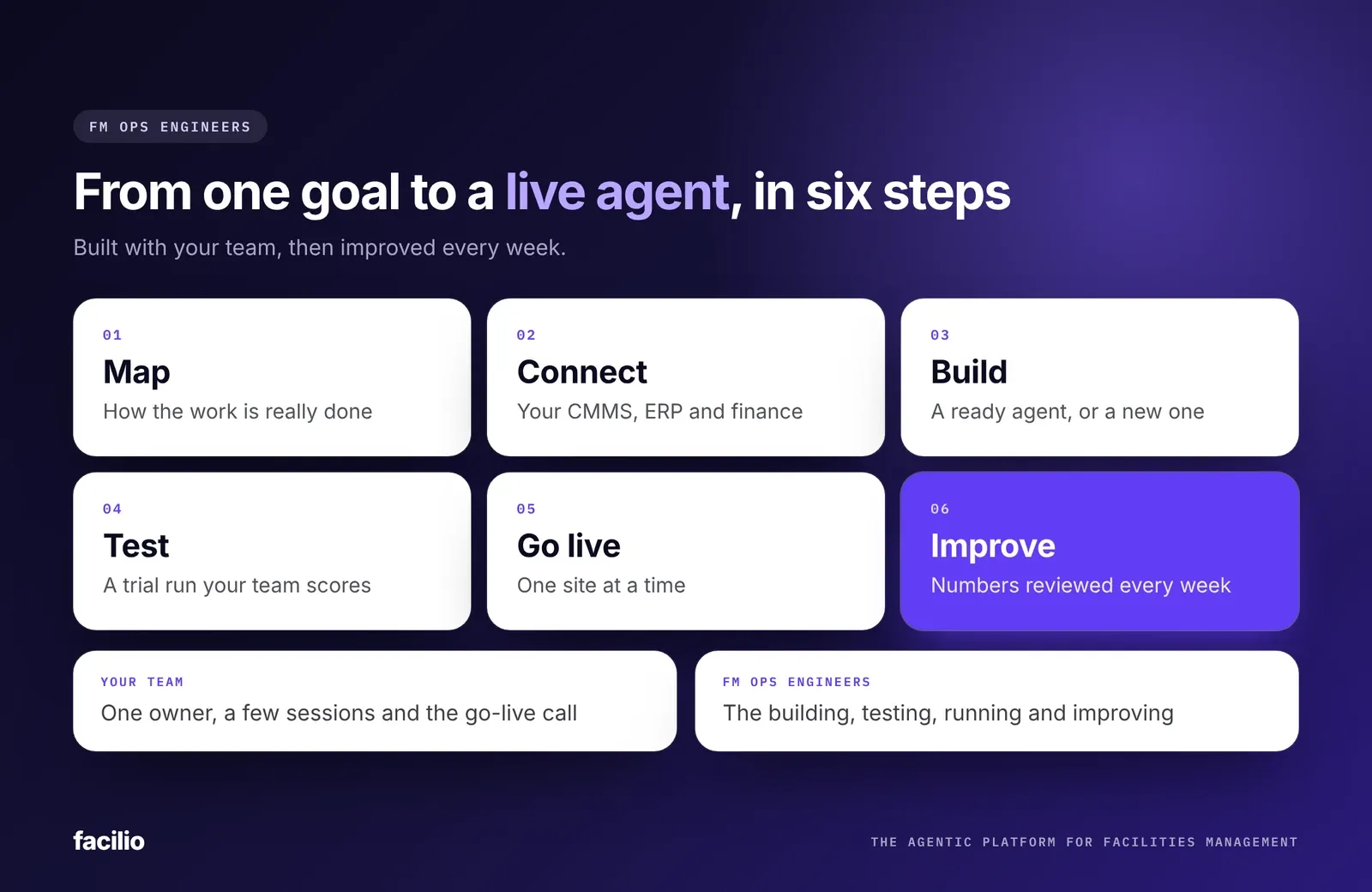
Step 1: Map the operation as it runs
We start with one clear goal, such as "stop invoices being paid with billing errors". Then we sit with the people who do the work today. We map the steps, the systems, the exceptions and the volume. That map becomes the starting point we measure against later.
Step 2: Connect your systems
The agent needs to read and write where your work lives. That can be our connected CMMS, or the CMMS, ERP and finance systems you already run. Ready-made links to more than 40 systems are built in. New ones take days, not months.
Step 3: Set up a ready agent, or build a new one
If a ready agent fits, such as our AI work order dispatch agent, we set it up with your rules, rates and sign-off limits. If your process is unusual, we build a new agent on the platform. Either way, your rules decide what it can do alone and what goes to a person.
Step 4: Test it with your team
First, the agent runs as a trial. It suggests what to do, your team decides, and every suggestion is scored. Nothing changes in your systems yet. It only goes live once it passes the bar we agreed with you.
Step 5: Go live, one site or category at a time
We switch it on where the risk is lowest and the volume is high enough to learn from. Sign-off limits stay in place, and every action is logged.
Step 6: Measure and improve every week
This is where most implementations end. For us, it is where the real work starts. We measure whether the agent is working against that starting point, and fix the data or rule behind any number that slips.
How long does it take to implement AI in facilities management?
Weeks, for most agents. It depends far more on what you are switching on than on the size of your portfolio.
| What you are switching on | Typical time to live | What drives it |
|---|---|---|
| A ready agent, set up on your rules | Days to a few weeks | Access to your systems, and how clear your rules are |
| A new agent, built for your process | A few weeks | How unusual the process is, plus the trial run |
| A custom app on the platform | Days to a few weeks | How many screens, users and integrations it needs |
| A link to a new system | Days | Whether the system can share data with us |
| A full CMMS rollout | Scoped with you | Sites, assets and data migration |
The first agent always takes longest, because it is where your systems get connected and your data gets cleaned. Each agent after that reuses the same connections and the same rules. A full CMMS rollout is a different project, with its own phases, covered in our CMMS implementation guide. At one Australian property group, the invoice agent rollout started with one process and grew from there.
What does your team do before and after go-live?
Less than you might expect, but not nothing. Your team brings the knowledge and makes the decisions. We do the building.
Before go-live
- Name an owner: one person who knows the process and can make calls on rules and exceptions.
- Give access: to the systems the agent needs, through the permissions you already control.
- Walk us through the work: a few working sessions with the people who do it today.
- Score the trial run: your team's verdict on each suggestion decides go-live.
After go-live
- Handle the exceptions: anything above a cost limit, outside the rules or unclear comes to a person, with the context attached.
- Review the numbers: a short review on a regular cadence agreed with you, usually weekly.
- Tell us what changed: a new site, a new vendor or a new contract rule, so the agent changes with it.
Your first agent, built with your team.
Tell us the process you want off your team's plate. Our FM Ops Engineers will map it with you.
How is this different from a typical software implementation?
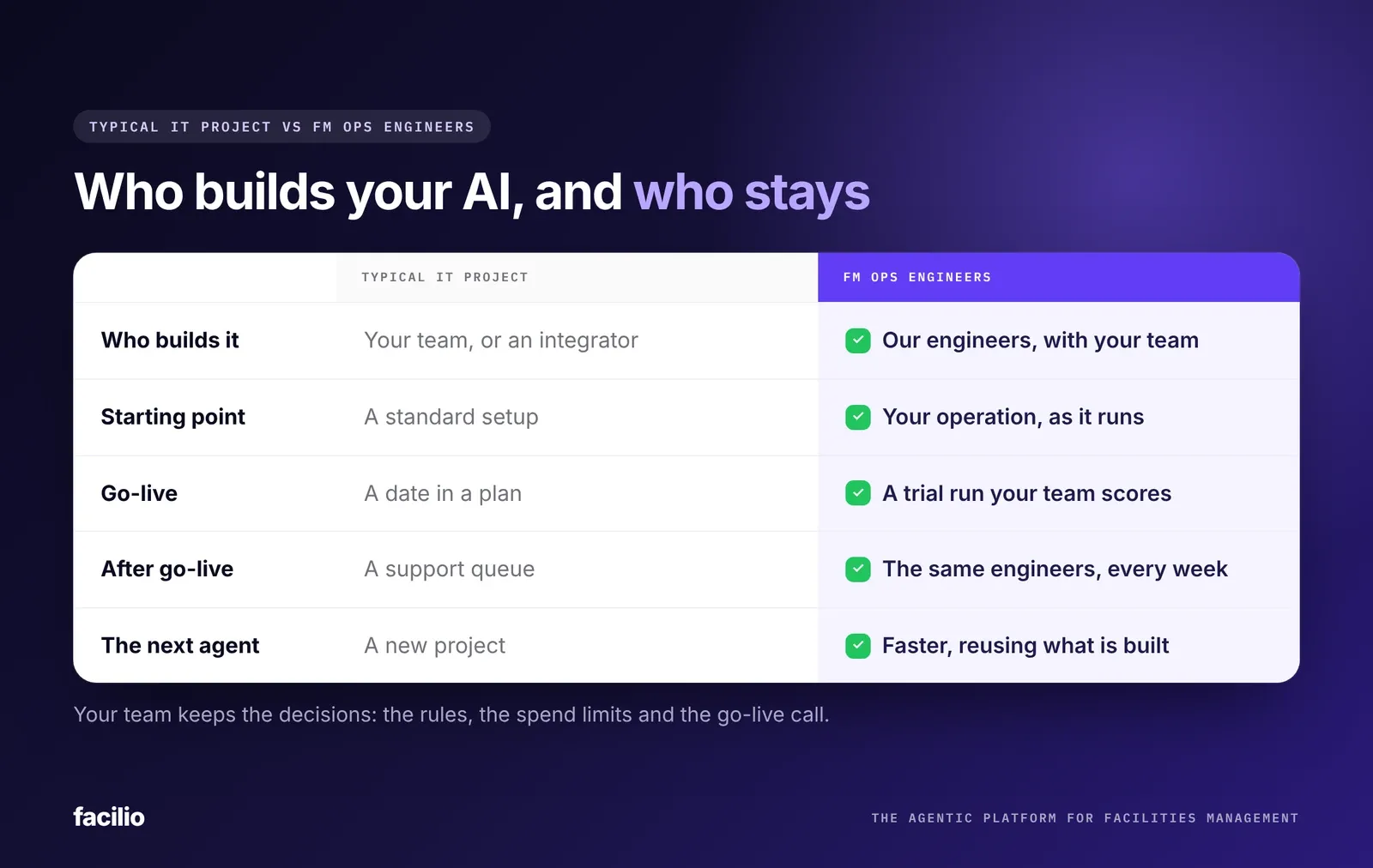
A typical implementation hands you a configured tool and leaves. We hand you a working outcome and stay.
| Area | Typical IT project | FM Ops Engineers |
|---|---|---|
| Who builds it | Your team after training, or a third-party integrator | Our engineers, with your team |
| Starting point | A standard setup | Your operation, mapped as it runs |
| Go-live | A launch date | A trial run your team scores |
| After go-live | A support ticket queue | The same engineers, improving it every week |
| Success measured by | Logins and adoption | Accuracy, exceptions and hours saved |
| Next agent or site | A new project | The same team, reusing what is built |
That matters most for adoption. A new tool usually means change management for your team, with training sessions and new screens. Here, requests still come in by phone, email and WhatsApp, and your team keeps working in the systems it knows.
How does Facilio run your agents with FM Ops Engineers?
We do not hand you software and leave. Every customer gets a team of two or three FM Ops Engineers who build, deploy and run your AI agents for facility operations with your team. They work from our seven offices across the US, UK, UAE, Australia, Singapore and India, and your data stays in your hosting region. It is how every agent we run at enterprise customers today went live.
From goal to live agent
Who does whatWhy it does more than the implementations you are used to
What FM teams see on Facilio
Results our customers have reported on the platform, from published case studies.
Your team keeps the decisions. Our engineers do the building, the connecting and the tuning, and stay for as long as the agents run.
The bottom line: are FM Ops Engineers worth it?
Yes, if you want AI in your operation without hiring an AI team to get it there. The platform does the heavy lifting. Our FM Ops Engineers make sure it fits how your buildings actually run, and they stay to keep it that way.
A simple first step: pick one process your team runs by hand every day, and write down how many items it handles each week. That is the goal and the starting point for your first agent. Connecting your CMMS to ChatGPT or Claude is another easy way to start while the first agent is being built.
Meet the FM Ops team
AI in your operation, without hiring an AI team.
Our FM Ops Engineers map your operation, build the agent, take it live and stay to run it with your team.
Frequently asked questions about implementing AI with FM Ops Engineers
How long does it take to implement AI in facilities management?
Do I need technical people to implement AI in my facilities team?
What is a forward-deployed engineer?
Is an AI agent rollout the same as a CMMS rollout?
What happens after an AI agent goes live?
About the Author

More from Facilio