Connected CMMS

 Connected Buildings
 Connected Refrigeration


 Download ebook

 Read case study


 Watch now


 Retail
 Healthcare
 FM Services
 Commercial Portfolios
 Corporate Facilities
 Education
 Data-driven Portfolio Ops
 Facility Management Software
 360° Asset Lifecycle
 Continuous Sustainability

 Blogs
Blogs
 Help docs
 Knowledge Hub
 ROI Calculator
 Ebooks & Guides
 Webinars
 Videos
 Case studies


 About us
 Newsroom
 Careers
 Contact us
 Partners
 Events



We reviewed Planon by going through its product pages, feature documentation, and user reviews pulled directly from G2, Capterra, and Gartner Peer Insights, with a focus on how it performs for enterprise FM teams managing multi-site, multi-vendor portfolios.
Planon is a serious platform. It has been in the IWMS space for decades and it handles complex real estate portfolio workflows that most CMMS tools cannot touch. But it comes with trade-offs: long implementation cycles, significant licensing costs, and an architecture that was built before AI-first FM was even a category.
If you are searching for Planon alternatives, you are probably in one of three situations. You are shortlisting tools and Planon feels over-engineered or overpriced for your portfolio. You are an existing Planon user who needs autonomous AI capabilities the platform cannot deliver natively. Or you are a growing FM team that has outgrown your current stack and wants to evaluate what the enterprise tier actually looks like.
This list covers the 7 strongest Planon alternatives, each reviewed for feature depth, pricing, deployment model, and AI capability, so you can shortlist with confidence.
What Planon Does Well
Planon is a genuine enterprise IWMS. It earns its place for organisations that need real estate, space, maintenance, and sustainability under one data model.
a) Breadth as a single platform: Lease management, space planning, asset maintenance, and energy reporting coexist natively. For corporate real estate teams that need all four, stitching point solutions together is the alternative.
b) Configurability at scale: Verdantix ranked Planon highest on platform configurability among leading IWMS vendors (2025). Complex workflows, approval chains, and multi-entity structures can be configured without custom code.
c) BMS and IoT integration: Planon has production-grade connections to building management systems and IoT data feeds — relevant for organisations with existing building infrastructure.
Fits well if: You manage a large corporate real estate portfolio across multiple regions, have a dedicated IWMS implementation team, and need compliance-grade reporting on space utilisation and sustainability.
Why Facilities Teams Outgrow Planon
a) Implementation is long and partner-dependent. Deployments typically run 9–18 months and require a certified implementation partner. Organisations that need faster time-to-value consistently flag this as a blocking constraint.
b) UI and mobile are behind: The desktop UI draws consistent criticism for complexity; the mobile app scores 1.6/5 on app stores. For field technicians doing day-to-day work orders, this matters.
c) Operates as a system of record, not an autonomous operator: Planon stores, schedules, and reports. It does not autonomously triage an inbound service request, route it, dispatch a contractor, and confirm SLA resolution without human touchpoints at each step.
Planon Alternatives: Quick Comparison
Before the full reviews, here is a snapshot of how the 7 alternatives stack up against Planon on the metrics that matter most to enterprise FM teams.
All pricing figures sourced from vendor pages, G2, and Capterra as of July 2026. Verify before quoting in procurement conversations.
7 Best Planon Alternatives for Enterprise FM Teams
Here is how the seven alternatives stack up against Planon, starting with the platform built around autonomous AI from the ground up and ending with the options suited for the most demanding industrial and infrastructure environments.
1. Facilio – Best for Enterprise FM Teams That Want Autonomous AI Operations
Planon's depth in real estate and lease management runs decades deep, but its automation still reads as a configuration layer added after the fact, not AI built into the platform from day one.
Facilio is a connected IWMS platform with AI agents embedded right into it, unlike most other platforms where AI is an afterthought. At the core is the system of record FM teams run on daily for work orders, maintenance, assets, vendors, and compliance. Because the AI agents sit directly on top of that same platform rather than a separate bolted-on layer, they read and act on live operational data in real time, with no second system to sync or maintain.
That single architectural choice is what lets the agents take real action: dispatching contractors, validating invoices, flagging suspect closures, not just surfacing dashboards.
The result is faster time to value, lower total cost, and AI that gets more accurate as the same operational data accumulates over time.
Key Features of Facilio
- Connected IWMS covering work orders and field service, assets and PPM, inspections and compliance, vendor and contract management, procurement and invoicing, tenant and service management, and portfolio reporting
- Unified FM data foundation with BMS, ERP, and IoT integrations, built on MCP
- SOC 2 / ISO 27001 compliant with role-based access control
- Single system of record that the embedded AI agents act on directly, with no separate data layer required
- Live in production across portfolios with customers like Dunnes, CBRE, Brookfield, Charter Hall, and Berkeley
AI Capabilities
- Atom Copilot: query live data and trigger actions in natural language, replacing menu navigation and manual report-running
- Work Completion Validator: validates work order sign-off using before and after photos, time on site, and checklist evidence, flagging suspect closures
- Ops Performance Intelligence: surfaces AI-driven insights on asset health, SLA breach risk, and vendor performance across the portfolio
- Contractor Work Tracker and Audit Report Intelligence: captures contractor updates from WhatsApp, email, and photo, and turns inspection data into structured, report-ready findings
- Proven results in production: roughly 80% end-to-end resolution on service intake at Berkeley, and 619 issues caught by the AI invoice validator at Charter Hall
See Facilio's AI agents handle a real helpdesk and invoice workload, not a demo script.
2. IBM Maximo – Best for Heavy Industry and Critical Asset Management
IBM Maximo is one of the oldest names in enterprise asset management. It handles complex maintenance regimes for large, high-criticality asset estates: power generation, manufacturing, oil and gas, transportation. If your portfolio is defined by heavy equipment with long replacement cycles and regulatory maintenance requirements, Maximo is a proven platform.
Where it diverges from Planon is in its orientation. Planon is stronger on the real estate and workplace side. Maximo is built for the physical asset and maintenance side. If your search started with Planon because you need IWMS-level space and lease management, Maximo may not fill that gap.
Maximo Application Suite (MAS) is the current cloud offering, consolidating several legacy products. It includes Visual Inspection AI for image-based defect detection and Health and Predict modules for asset health scoring. These are genuine capabilities, though they require additional licensing and are assistive rather than autonomous: they surface insights, they do not act on them without operator input.
G2 Rating: 4.0 / 5 (300+ reviews)
Pricing: Enterprise licensing. Maximo does not publish pricing publicly. Expect significant configuration and implementation investment.
3. FacilityForce –Best for Government and Public Sector FM
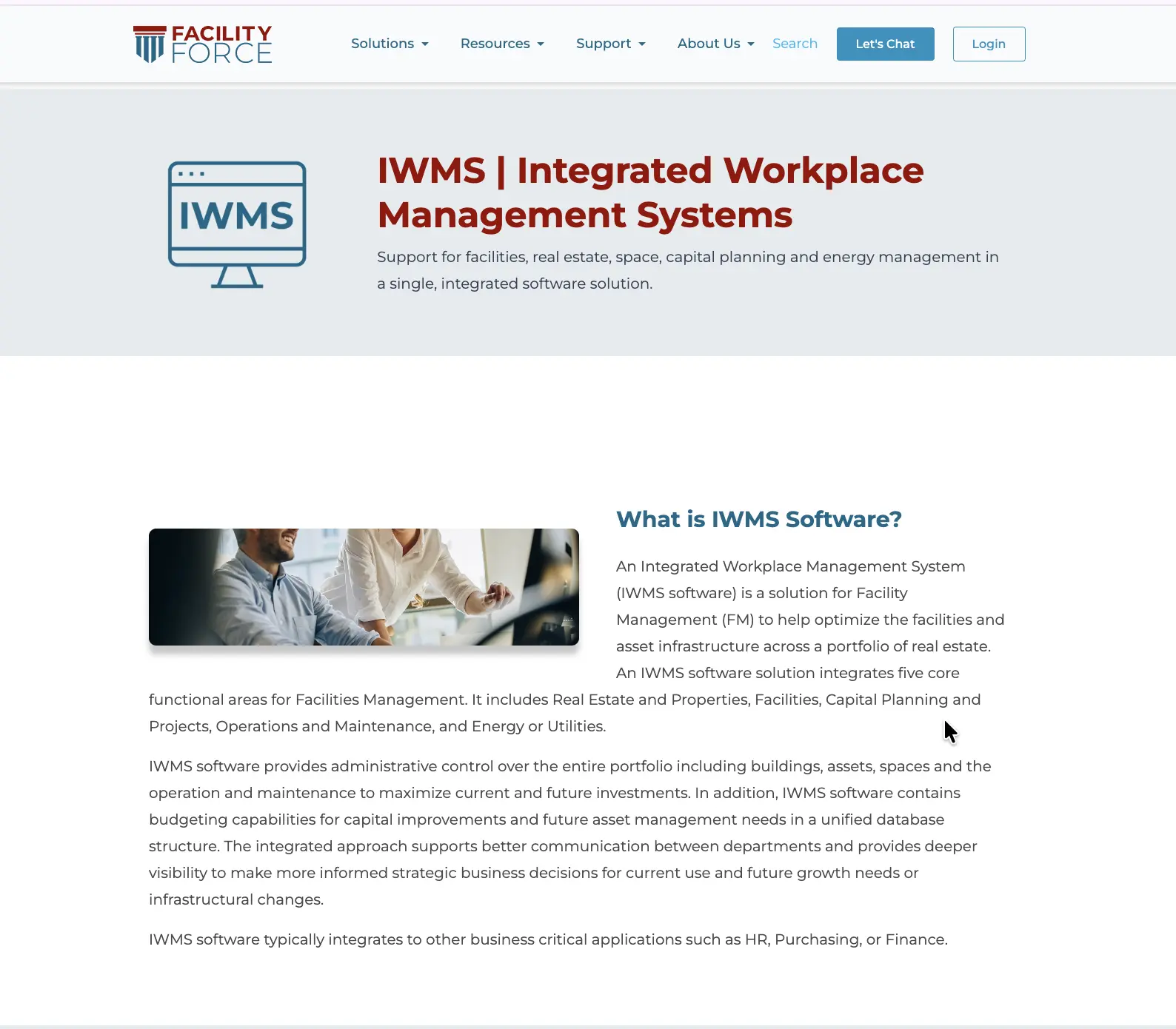
FacilityForce was built from the ground up for government organisations, state agencies, counties, cities, and federal departments. Where most IWMS tools treat fund accounting as an afterthought or an ERP integration, FacilityForce bakes it into the core: split-fund allocation, grant management, chargeback billing, and capital improvement planning governed by appropriations are native to the platform. If your FM operation answers to a public budget cycle, this matters.
Where it diverges from Planon is in its intended buyer. Planon is a commercial and corporate real estate platform that has been adopted by some public sector organisations.
FacilityForce is the inverse, it was purpose-built for government and carries compliance assumptions, budget structures, and reporting hierarchies that commercial tools do not. If your search started with Planon because you need deep fund accounting or GIS-mapped infrastructure management, FacilityForce addresses those gaps directly.
FacilityForce's automation layer handles workflow routing, approval chains, and PM scheduling. Its GIS module, built on Esri ArcGIS, gives field teams map-centric asset and work order management, genuinely useful for organisations managing distributed infrastructure across geographic territories. There is no autonomous AI layer; the platform is a capable system of record and operations management tool, not a self-acting one.
G2 Rating: 4.7 / 5 (50+ reviews)
Pricing: Enterprise licensing through ServiceNow sales. Pricing is not published.
4. Archibus – Best for Real Estate and Space Portfolio Management
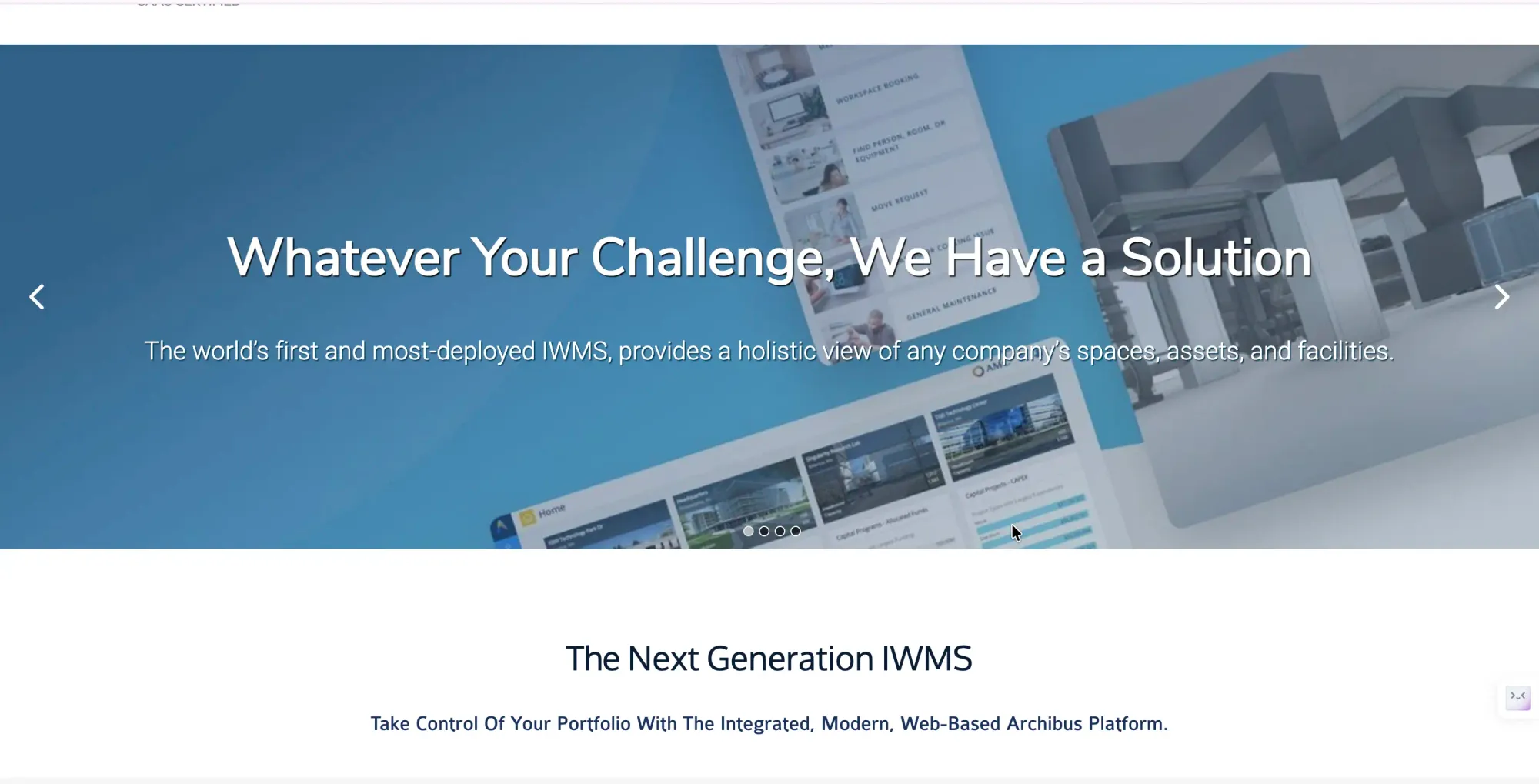
Archibus (now part of Eptura following a series of acquisitions) has a long history in IWMS and CaFM. Its strength is in real estate portfolio management: space allocation, lease tracking, move management, occupancy planning, and capital project management. For organisations with complex space management requirements across large real estate portfolios, Archibus has historically been a strong match for Planon.
The platform's depth on the real estate and space side is real. Where it struggles is in the field: work order management and mobile technician workflows are less polished than purpose-built CMMS tools. Integrations with BMS and IoT systems require significant configuration effort.
Since the Eptura merger, Archibus sits alongside SpaceIQ and iOffice in the same product family. The consolidation is still in progress, and customers have reported some uncertainty about the long-term product roadmap for individual modules. Confirm the current product status before shortlisting.
Pricing: Module-based perpetual license or subscription. Contact Eptura/Archibus for current pricing.
Lease and space management is one piece. See what runs the rest of the portfolio autonomously.
5. MRI Software (Manhattan Active) – Best for CRE Lease and Portfolio Management
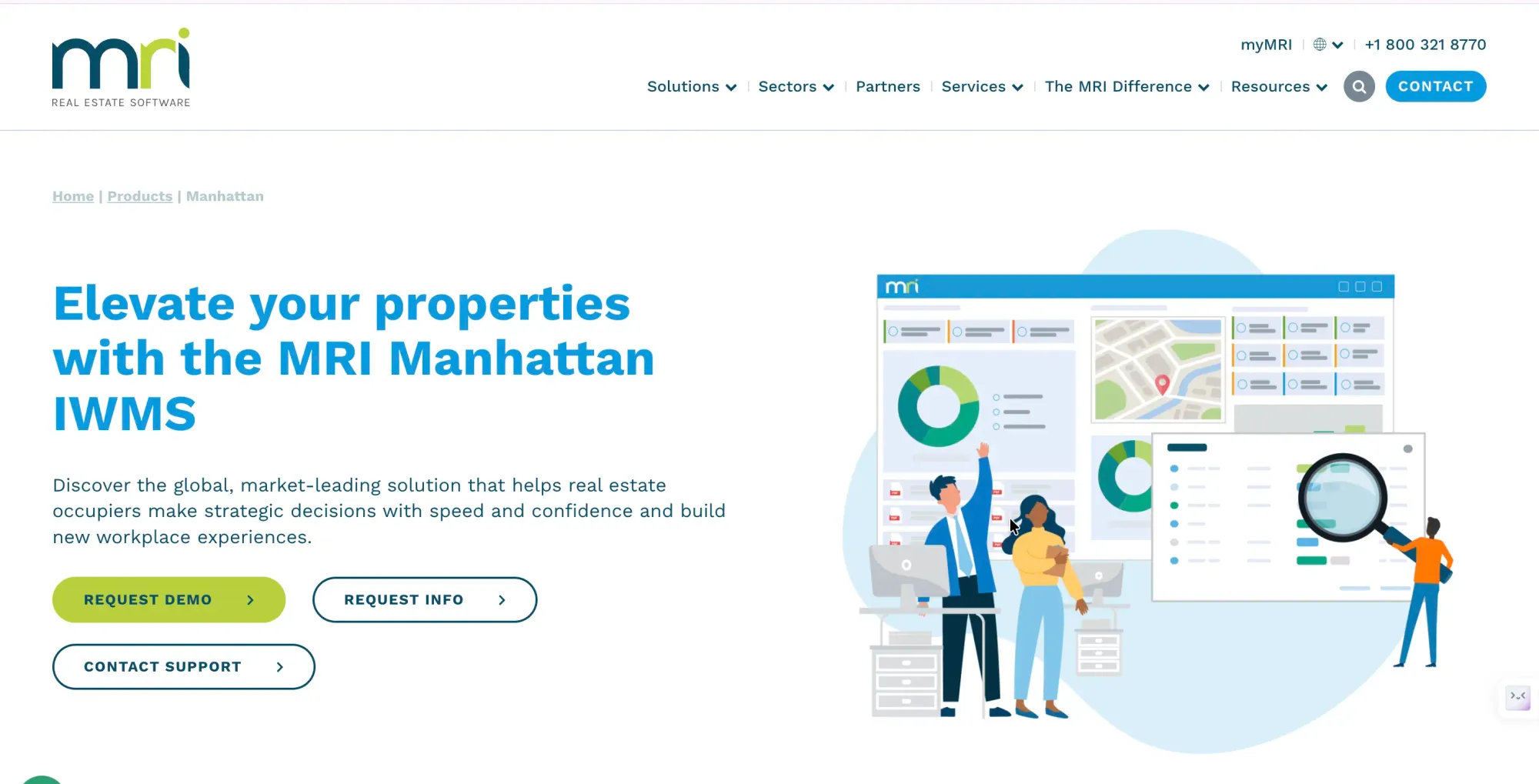
MRI Software, which acquired Manhattan Software's real estate business, is a well-established name in commercial real estate portfolio management. Manhattan Active is the current cloud-native platform. It covers lease administration, lease accounting under ASC 842 and IFRS 16, space management, facilities maintenance, and capital project tracking.
Like Planon, MRI's strength is in the lease and real estate layer. Facilities maintenance functionality is included but not the platform's primary focus. If your search started with Planon because you need integrated lease, space, and maintenance management across a large CRE portfolio, MRI is a credible comparison.
MRI's AI capabilities are primarily in lease abstraction and document extraction. Automated lease data extraction reduces manual entry on complex portfolios. The maintenance AI layer is more limited. If autonomous operations, AI-driven work order handling, or intelligent vendor management are requirements, MRI does not address them at the depth of a purpose-built agentic FM platform.
Pricing: Module-based subscription. Pricing not published publicly.
6. Eptura (iOffice + SpaceIQ) – Best for Workplace and Space Management

Eptura is the combined entity of iOffice, SpaceIQ, Condeco, and Archibus following a consolidation play. The platform focuses on workplace management: desk booking, room reservations, space utilisation analytics, employee workplace experience, and hybrid work management. It has significantly more depth on the workplace and employee experience side than Planon.
Where Eptura does not match Planon is in the hard FM layer: complex preventive maintenance, asset management, vendor and contractor management, and compliance workflows. Eptura was built for workplace teams and corporate real estate functions. It is not the right fit for FM teams managing large technical asset estates or complex maintenance operations.
For organisations that split their IWMS needs between workplace management and hard FM, Eptura handles the former well. If your Planon evaluation was primarily driven by real estate and workplace requirements rather than maintenance, Eptura deserves a place on your shortlist.
Pricing: Module-based, varies by product line. Contact Eptura for current pricing.
Whichever platform you land on, your team still needs an AI layer that acts, not just reports.
7. Accruent Famis 360 – Best for Higher Education and Healthcare FM
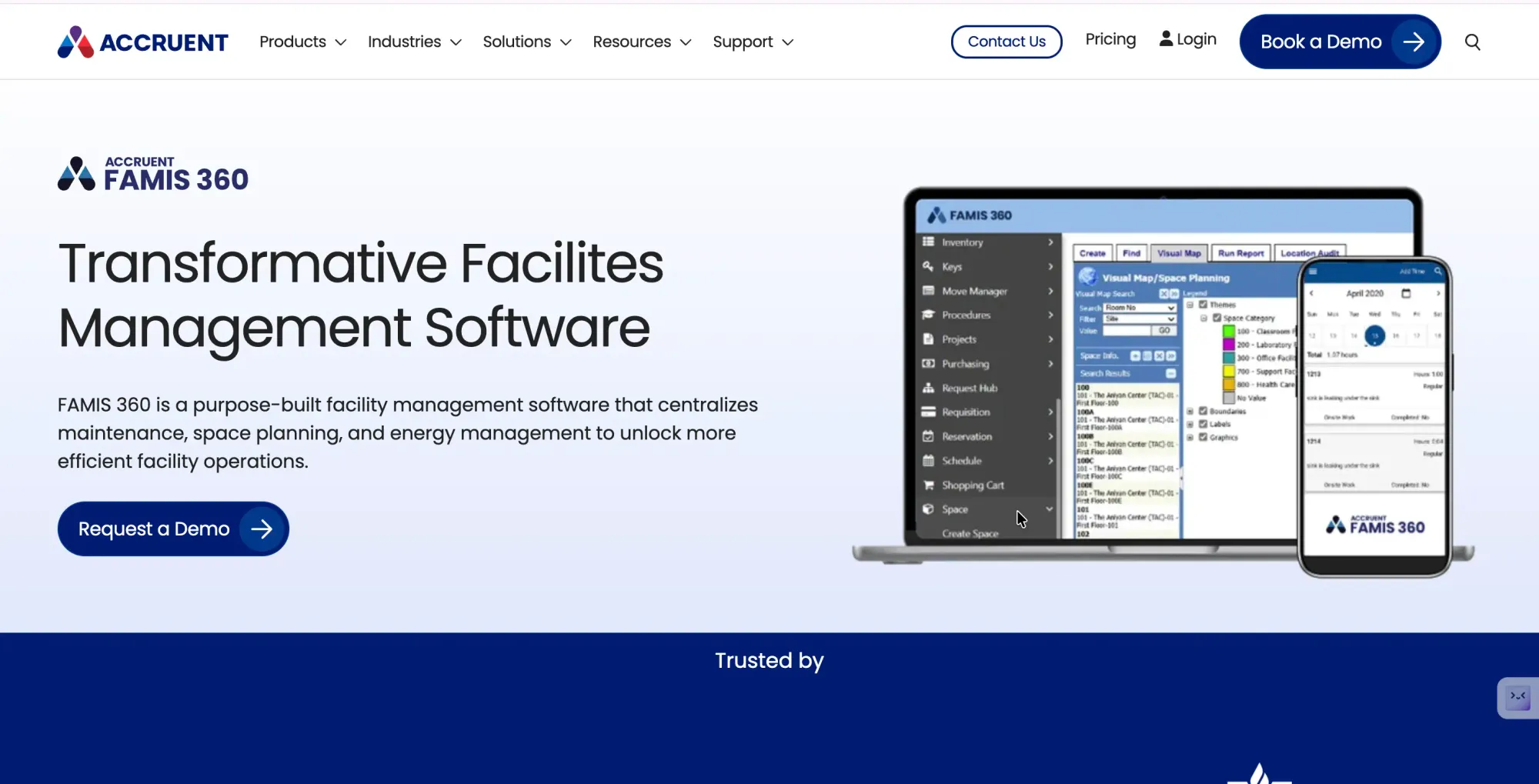
Accruent Famis 360 is the facilities management platform built specifically for higher education and healthcare environments. If your organisation manages a campus portfolio, research facilities, clinical environments, or a hospital estate, Famis 360 has sector-specific workflow support that general IWMS platforms, including Planon, do not always match.
The platform covers space management, capital project tracking, preventive maintenance, compliance management, and deferred maintenance tracking. For environments where regulatory compliance, space utilisation reporting for federal funding, and research infrastructure management matter, Famis 360 has purpose-built features.
Its AI capability is limited to reporting and analytics. It surfaces data and produces dashboards, but does not act on that data autonomously. If intelligent helpdesk management, automated compliance evidence, or AI-driven invoice validation are requirements, Famis 360 will not address them.
Pricing: Module-based subscription. Contact Accruent for pricing.
Two Ways Forward: Switch to Facilio, or Just Add the AI Layer
Most teams reading this far are in one of two positions: Planon, or whatever platform got you here, no longer fits the portfolio you're running, or it still does the job but the manual workload around it has outgrown what your team can keep up with by hand. Facilio is built for both.
If you're ready to move off Planon:
- Facilio replaces the system of record entirely: work orders, assets, vendors, compliance, and reporting
- AI agents are embedded into the platform itself rather than bolted on after the fact
- Atom, Facilio's agentic AI suite, runs service requests, invoice verification, and asset lifecycle tasks autonomously on the same data the CMMS already holds
- Mira, the Helpdesk AI, handles intake, routing, dispatch, and SLA escalation across calls, chat, WhatsApp, and email, the work a helpdesk team currently does by hand
- This isn't reporting on the work, it's doing it
If you're not ready to migrate:
- You don't have to rebuild your stack to get autonomous AI into your operations
- Atom and Mira can run on top of your existing Planon environment, or any other CMMS or IWMS you're already using
- They handle the workflows that platform was never built to run on its own
- Your team keeps working in the system they know
- The AI acts on the data it's already generating, without a migration project, a new system of record, or downtime to get there
That's the actual choice in front of you: switch entirely, or add the AI layer first and decide on migration later. Either way, Atom is part of the answer.
Frequently Asked Questions
1. What is Planon used for?
Planon is an Integrated Workplace Management System (IWMS) used primarily by enterprise organisations to manage real estate portfolios, leases, space planning, facilities maintenance, and sustainability reporting. It is designed for large, multi-site operations with complex property and FM requirements.
2. Why are teams looking for Planon alternatives?
We hear three main reasons from FM teams evaluating Planon alternatives. First, implementation complexity: Planon projects are typically lengthy, require significant IT resource, and carry high consultancy costs. Second, licensing cost: Planon is enterprise-tier pricing that is difficult to justify for mid-market portfolios. Third, AI capability: Planon's automation is rule-based and configuration-heavy; teams that want autonomous AI-driven FM operations find the platform falls short.
3. What is the best Planon alternative for enterprise FM?
That depends on your primary use case. For autonomous AI-driven FM operations across a large multi-site portfolio, Facilio is the strongest alternative. For heavy industrial asset management, IBM Maximo. For CRE lease and space management, MRI Software or Archibus. For higher education and healthcare FM, Accruent Famis 360. For IT-integrated service management, ServiceNow FM.
4. Can I use Facilio alongside Planon without migrating?
Yes. Facilio's Atom agents can operate alongside your existing Planon environment, handling workflows that Planon cannot execute autonomously: helpdesk intake, invoice validation, compliance evidence, and SLA management. Your team keeps working in Planon. The AI agents layer on top of the data Planon already holds.
5. Is Planon good for small businesses?
Planon is not designed for small businesses. The implementation complexity, licensing cost, and configuration overhead make it unsuitable for organisations without a dedicated FM technology team and a large enough portfolio to justify the investment. Teams below 50+ sites or 2M+ sq ft generally find better fit-for-value in mid-market CMMS tools like UpKeep or Limble.
6. What are Planon's biggest limitations?
Based on user reviews on G2 and Capterra, the most frequently cited limitations are: long and expensive implementation, a dated UI that requires significant training, limited native mobile capability for field technicians, and AI functionality that is more configuration-based rule automation than genuine autonomous intelligence.
7. How does Planon compare to Facilio?
Planon is a mature IWMS with depth in real estate, lease, and space management built over decades. Facilio is an AI-first FM operating platform built from the ground up for autonomous agent-driven operations. Planon covers the portfolio management layer comprehensively. Facilio adds the autonomous operations layer that Planon does not provide. See our full comparison at facilio.com/compare/planon-vs-facilio/.
8. How much does Planon cost?
Planon does not publish pricing publicly. Enterprise IWMS implementations typically start from six figures annually when configuration, implementation, and ongoing support are included. Exact pricing depends on portfolio size, modules selected, and deployment model.
About the Author

More from Facilio