Connected CMMS

 Connected Buildings
 Connected Refrigeration


 Download ebook

 Read case study


 Watch now


 Retail
 Healthcare
 FM Services
 Commercial Portfolios
 Corporate Facilities
 Education
 Data-driven Portfolio Ops
 Facility Management Software
 360° Asset Lifecycle
 Continuous Sustainability

 Blogs
Blogs
 Help docs
 Knowledge Hub
 ROI Calculator
 Ebooks & Guides
 Webinars
 Videos
 Case studies


 About us
 Newsroom
 Careers
 Contact us
 Partners
 Events


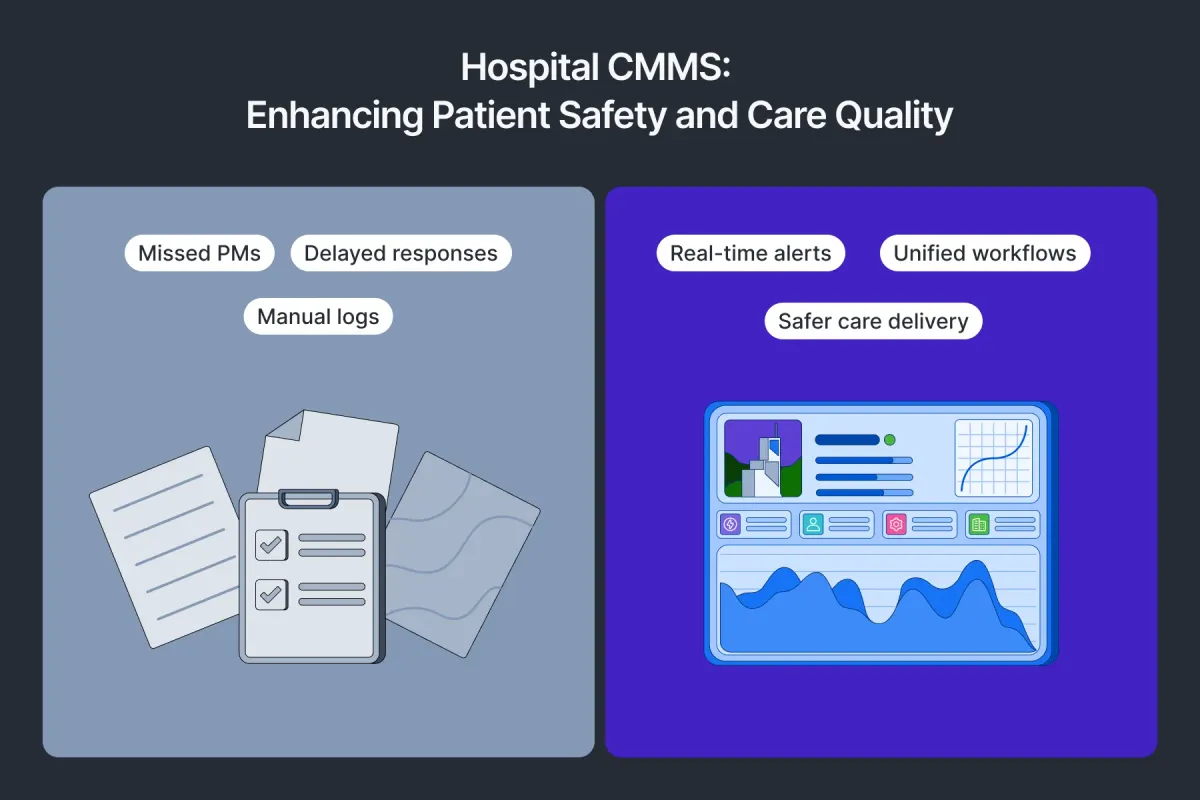

A CMMS for hospitals does a lot more than log work orders. At its core, it's how most US health systems keep track of what needs maintenance, what's due for inspection, and whether they're ready for a Joint Commission survey, all at once, across multiple buildings and teams.
That said, not every hospital CMMS is built for the realities of modern healthcare. Many facilities are still running on legacy platforms designed in a different era, before IoT sensors, before mobile-first workflows, before regulators started expecting audit-ready documentation available on demand.
With equipment downtime costing hospitals as much as $740,000 per incident, and compliance tied directly to facility performance, that gap is getting harder to ignore.
Modern hospital CMMS platforms have moved well past ticket logging. They integrate with building systems, medical equipment, and IoT sensors. They automate compliance documentation. They give your FM, biomed, and clinical support teams a shared view of what's happening, in real time, across every site.
As the market for hospital CMMS platforms continues to grow at 9.5% annually, it's clear this isn't just a tech upgrade, it's a strategic shift.
In this guide, I'll walk through what a hospital CMMS actually does, what separates a modern platform from a legacy one, and what to look for if you're evaluating options for your facility.
See how Facilio works for US hospital and healthcare networks Book a demo →
What is a Hospital CMMS?
A hospital CMMS (Computerized Maintenance Management System) is specialized software built to manage the maintenance operations of healthcare facilities.
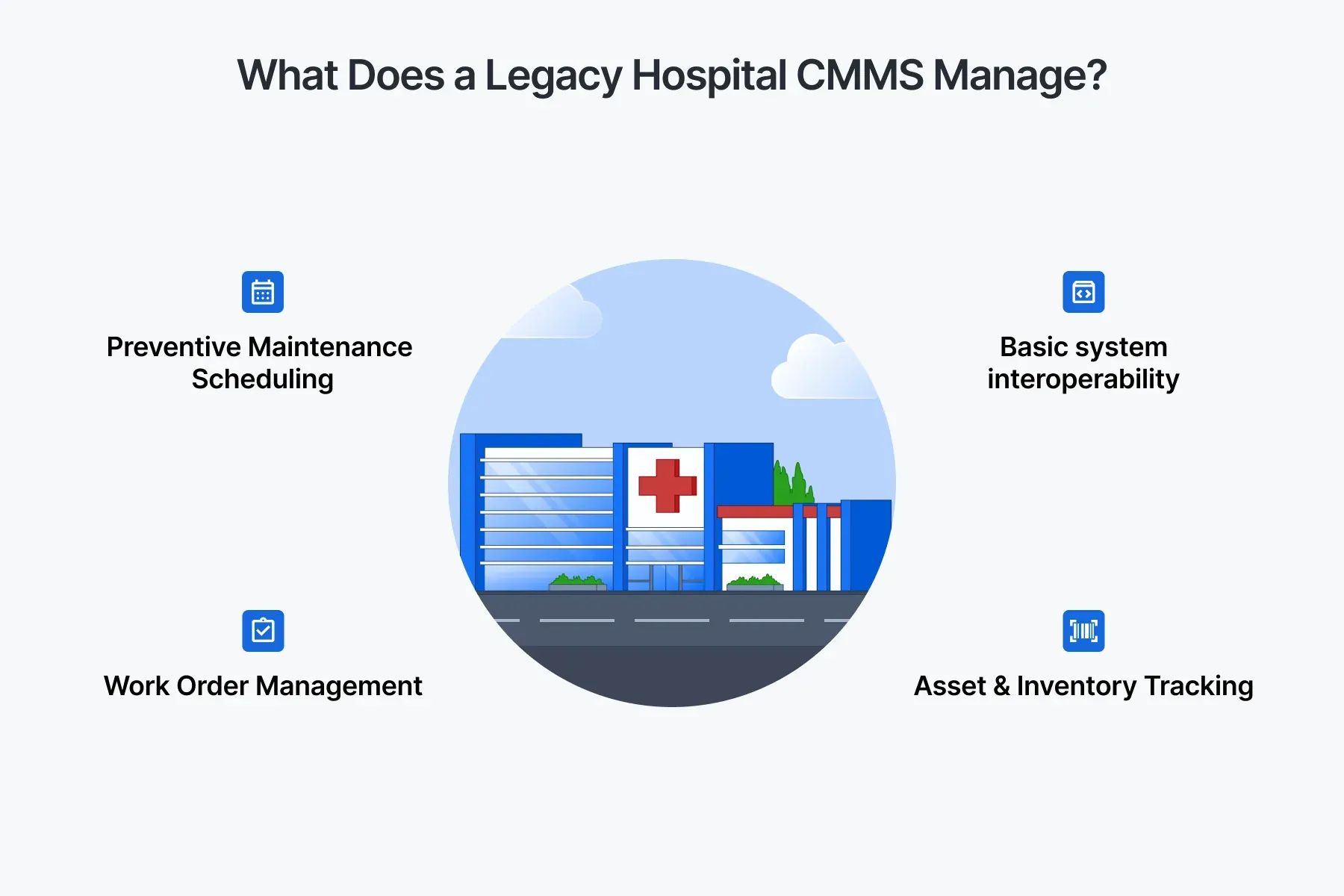
From life-saving medical equipment like MRI machines, CT scanners, ventilators, and infusion pumps to the infrastructure that supports them such as HVAC, emergency power, and water filtration systems, a hospital CMMS helps ensure every system remains functional, safe, and compliant.
Designed for the complexity of healthcare environments, these platforms bring structure, traceability, and visibility to maintenance workflows, so that nothing falls through the cracks, even when operations are under clinical pressure.
Key functions of a CMMS for hospitals
- Preventive maintenance scheduling: Automates recurring maintenance tasks for clinical and facility assets, helping reduce unexpected failures and extend equipment life.
- Work order management: Tracks service requests from start to finish — ensuring technicians are dispatched efficiently and work is completed on time.
- Asset and inventory tracking: Provides real-time oversight of medical equipment and parts inventory, making it easy to locate, monitor, and manage critical resources.
- Basic system interoperability: Legacy CMMS platforms typically support limited integration with hospital infrastructure systems like Building Management Systems (BMS) or inventory tools. However, these integrations are often one-way or manually configured, offering foundational, but not fully connected operational support.
By consolidating these functions into a single platform, a hospital CMMS enables healthcare facilities to minimize downtime, enhance response times, and maintain strict compliance, all while supporting improved patient care behind the scenes.
But here's the catch: not all CMMS platforms are built for the pace, scale, and demands of today's U.S. hospitals.
Many still rely on legacy systems that lack flexibility, integration, and real-time capabilities.
What does a modern, purpose-built hospital CMMS do differently?
A modern healthcare CMMS isn't just software that logs work orders, it's a connected operating system for hospital performance.
Purpose-built for healthcare, it unifies biomedical engineering, facilities management, and clinical support workflows into a single platform. But its true impact goes much deeper.
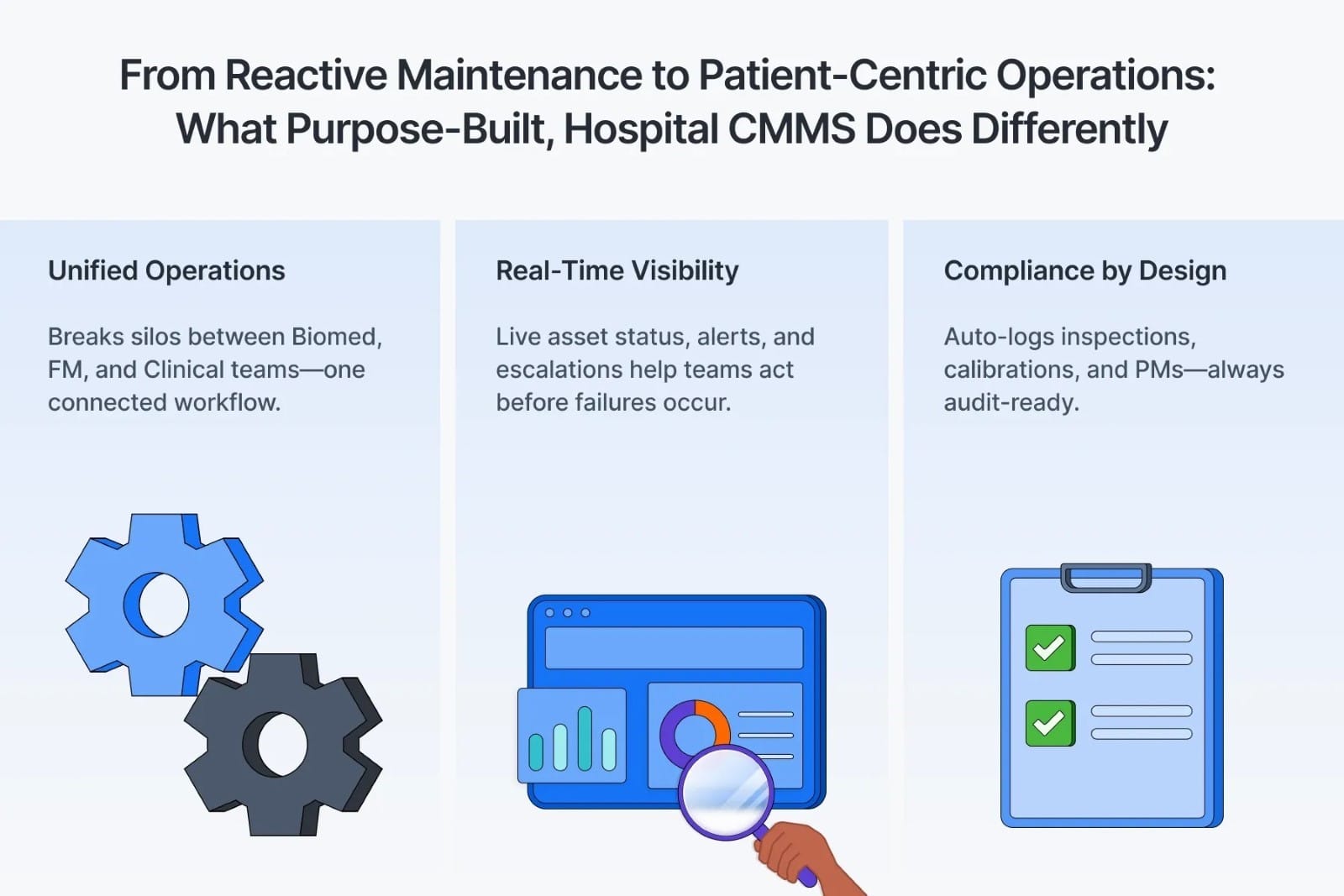
a) It standardizes operations across your entire health system
Most hospitals don't have a CMMS problem, they have 27 different versions of one.
Every site tracks work differently.
Every technician uses their own spreadsheet.
Every audit looks a little different.
A modern CMMS helps hospitals standardize preventive maintenance schedules, compliance protocols, asset categorization, and escalation workflows across every facility. Whether you're managing 3 hospitals or 300, the platform provides a single source of operational truth that everyone aligns to — from FM to Biomed to compliance.
Facilio Insight: With centralized templates, role-based SOPs, and shared asset libraries, Facilio gives health systems the consistency they need to scale safety and performance.
b) It turns real-time data into real-time decisions
Legacy systems bury data in exports and after-action reports. A modern CMMS surfaces live, operational intelligence — what's overdue, what's underperforming, what's about to fail — and makes that data available at the point of action.
- Technicians see which work orders are highest priority
- Managers see risk flags on assets before they break
- Compliance leads see upcoming inspection gaps before surveyors do
Reporting isn't a post-event PDF. It's a dashboard your team acts on — every hour of every shift.
Facilio Insight: From AEM analysis to downtime tracking, Facilio brings clinical risk and compliance visibility into every maintenance and asset decision.
c) It works for every role, not just the admin who configured it
Legacy CMMS platforms are hard to navigate and even harder to adopt. They were built for admins, not frontline users. A modern CMMS is designed for FM techs, Biomed engineers, floor nurses, compliance officers, and contractors alike — with intuitive, mobile-first tools that support fast action and clean documentation.
Raise an issue. Scan an asset. Trigger a checklist. All in a few taps.
Facilio Insight: Facilio's role-based interfaces, QR workflows, and mobile app ensure that everyone — from the boiler room to the OR — uses the system the same way, every time.
d) It's configurable to fit the way you operate, not the other way around
Every hospital operates differently — different workflows, escalation rules, asset classes, and inspection intervals. A modern CMMS gives you the flexibility to configure forms, flows, hierarchies, and triggers based on how your hospital actually runs.
No need for workarounds, third-party bolt-ons, or weeks of vendor change requests.
Facilio Insight: With Facilio, you configure once and scale instantly, across departments, buildings, or the entire health system.
Why does your healthcare facility need a modern hospital CMMS?
A modern, purpose-built hospital CMMS isn't just for tracking repairs — it's an operational command center for clinical safety.
From managing biomedical devices and HVAC systems to coordinating disinfection workflows and enabling real-time technician response, it safeguards care environments at every layer.
1. Alternate Equipment Maintenance (AEM) Program enablement
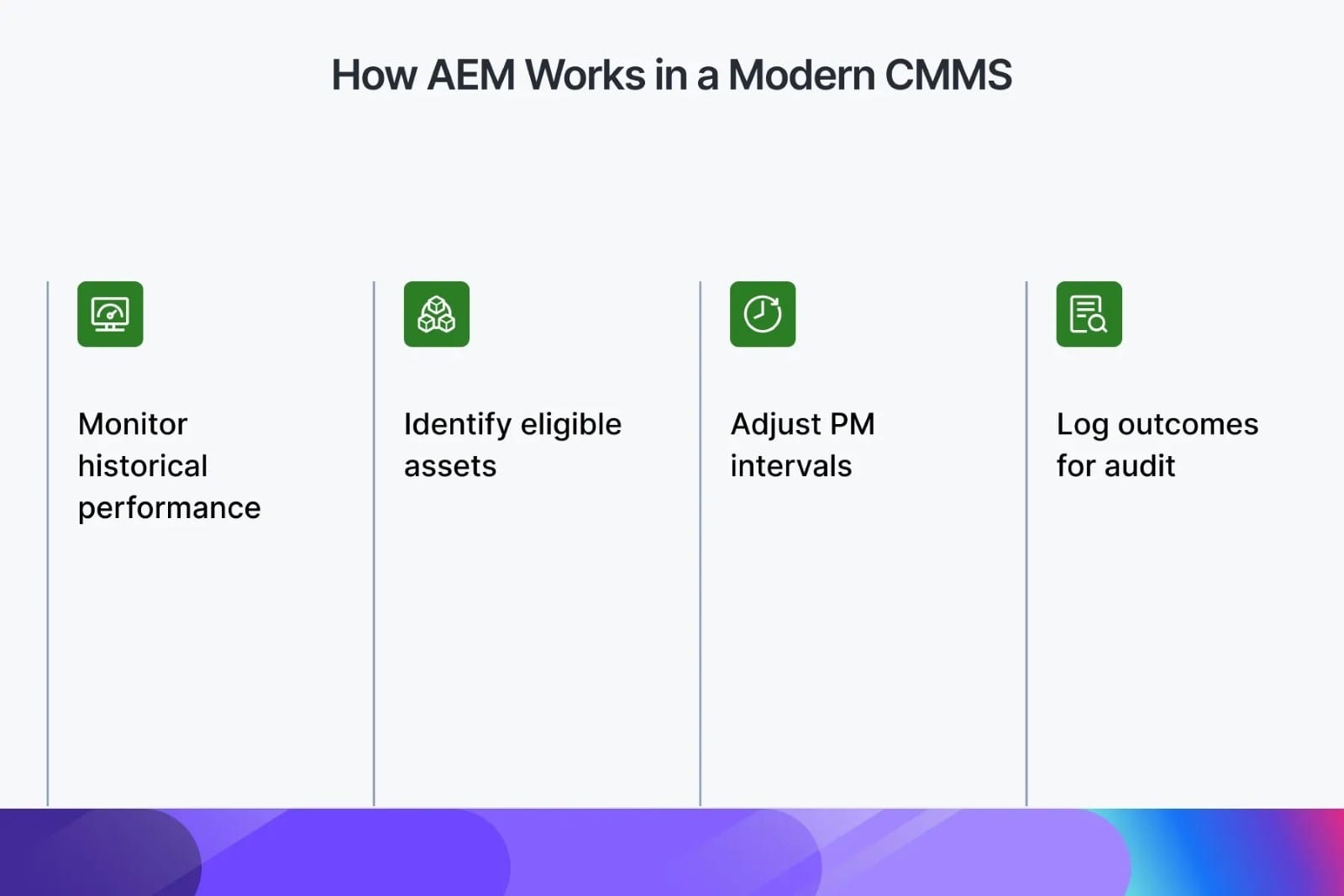
AEM programs are a recognized alternative to manufacturer-prescribed PM intervals — but only if hospitals can prove safety equivalence. A modern CMMS makes this possible by:
- Collecting and analyzing historical failure and service data
- Supporting AEM eligibility criteria as defined by CMS and TJC
- Automatically flagging assets that qualify for AEM
- Logging alternative schedules and outcomes for audit transparency
This allows hospitals to safely optimize PM frequency, lower maintenance overhead, and redirect resources to where they matter most, without compromising compliance.
Facilio Insight: With built-in support for AEM logic and documentation, Facilio helps hospitals stay compliant and efficient.
2. Cross-functional response across FM, HTM & clinical teams
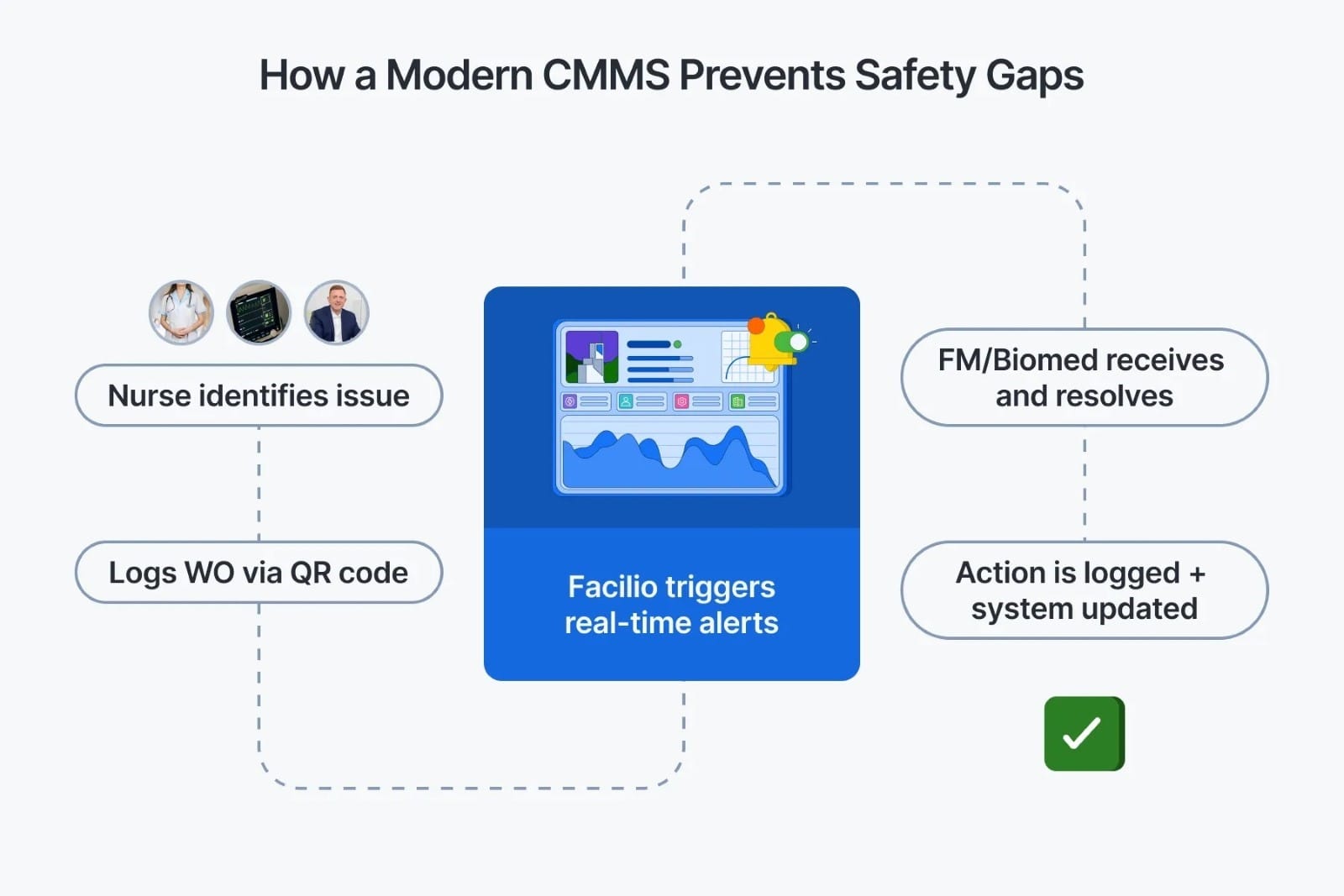
A modern hospital CMMS bridges the gap between clinical staff, Biomed, and Facilities. It enables:
- Instant work order generation by nursing teams
- Live notifications for FM/HTM technicians
- Real-time visibility across teams on issue status and asset condition
This reduces miscommunication, speeds up issue resolution, and helps prevent small operational issues from becoming patient care disruptions.
Facilio Insight: Whether it's a downed IV pump or a faulty air handler, Facilio ensures the right team responds in minutes, not hours.
3. Built-in compliance automation
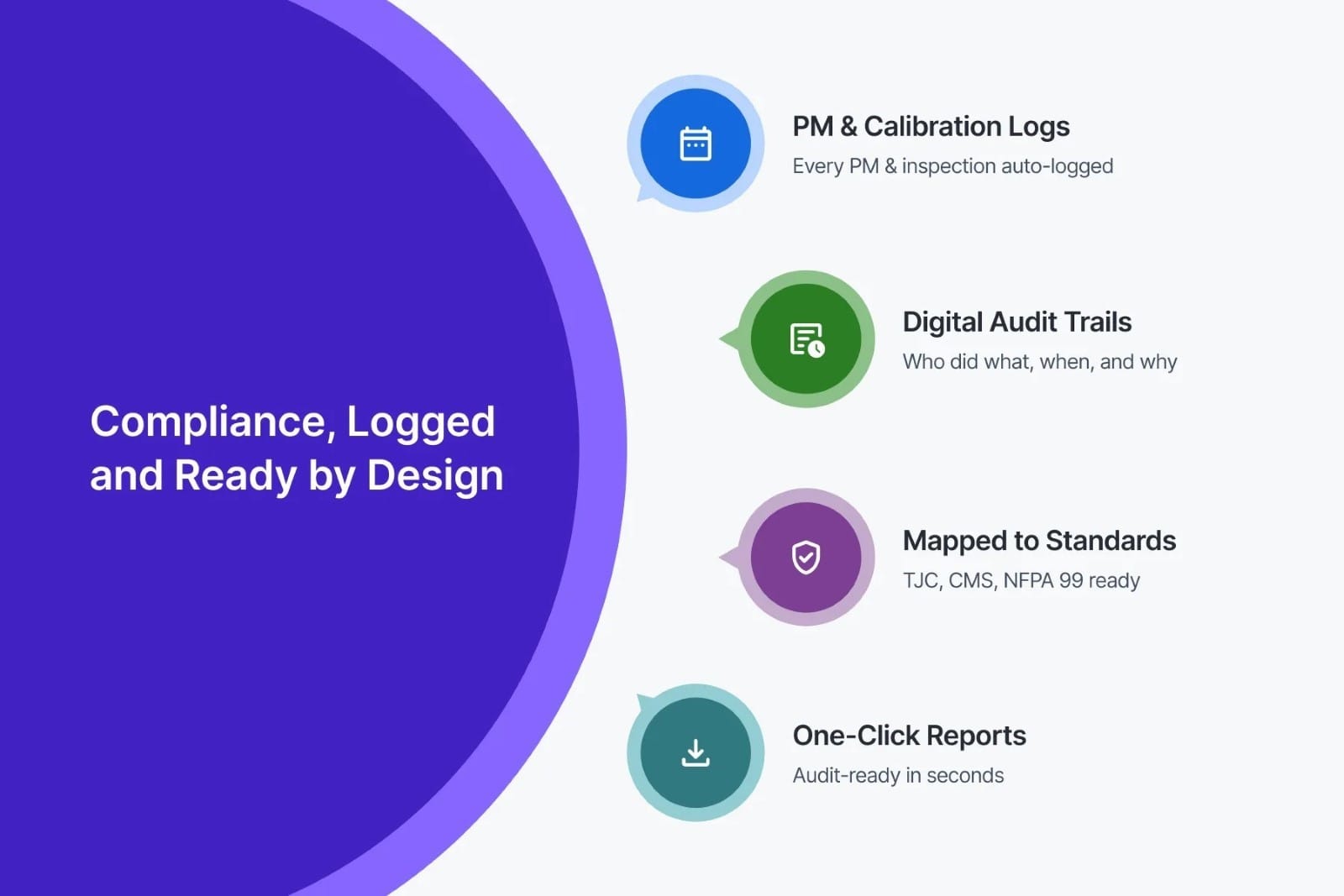
No more reactive scrambling during audits. A hospital CMMS auto-captures:
- PM, CM, calibration, and safety inspections
- Audit trails for every asset and action
- Reports mapped to standards: TJC EC.02.05.01, CMS CoPs, NFPA 99
Your teams are always audit-ready, with clear documentation of who did what, when, and why.
Facilio Insight: With one-click export and fully digital audit trails, Facilio helps hospitals stay inspection-ready 24/7, eliminating the need for spreadsheets.
4. IoT-Driven monitoring of critical facilities and clinical assets
Connected hospital CMMS platforms integrate with IoT sensors and BMS to deliver real-time telemetry on:
- 2Oxygen and medical gas systems
- HVAC units in ORs and isolation rooms
- Dialysis water systems and life-safety infrastructure
When thresholds are breached — temperature, pressure, filtration flow — alerts are sent immediately, allowing teams to intervene before risk reaches the patient.
Facilio Insight: Facilio ingests live telemetry from connected infrastructure and clinical devices, giving your teams a real-time pulse on every critical system across the care environment.
5. Smart preventive maintenance based on risk and utilization
Instead of using static, calendar-based schedules, modern CMMS tools trigger preventive maintenance based on:
- Asset type and criticality
- Usage hours or cycles
- Environmental impact and location
- Failure trends
This ensures high-risk equipment like defibrillators or surgical sterilizers receive proactive servicing, while reducing over-maintenance of low-risk devices.
Facilio Insight: Facilio's condition-based PM engine continuously recalibrates maintenance schedules using real-world usage data, preventing over-servicing and under-protection.
6. Operational visibility into day-to-day clinical enablers
From sanitation to safety, a connected CMMS ensures all "non-clinical" workflows are executed with clinical-level rigor:
- Monitors disinfection and room turnover
- Schedules and verifies safety infrastructure checks
- Documents service activities that impact the patient environment
This brings consistency, traceability, and accountability to hospital operations, directly reinforcing care quality.
7. Mobile + Cloud access for rapid action
Every second counts. A modern CMMS ensures:
- Techs and vendors get live updates and WO alerts via mobile
- Clinical staff can report issues by scanning a QR code
- Status, logs, and asset history are available in real-time
Whether you're fixing a failed bed in an ICU or replacing a suction unit in the surgery prep area, response happens in minutes, not hours.
Facilio Insight: Facilio transforms these "invisible" workflows into measurable care enablers, aligning environmental health with patient outcomes.
What to look for in a CMMS for hospitals
Picking the right hospital CMMS comes down to five questions. Most platforms will say yes to all of them during a demo the answers become clear once you're past the sales process.
1. Does it cover FM and biomed in one system?
Many hospitals still run separate platforms for facilities maintenance and clinical engineering. That means two asset databases, two PM schedules, two audit trails — and coordination gaps between them. A hospital CMMS should handle both from a single data model. If your biomed team and your FM team are working off different systems, you're doubling your compliance risk.
2. Is compliance built into the workflow, or bolted on after the fact?
There's a difference between a CMMS that logs your maintenance data and one that structures it around TJC, CMS, and NFPA requirements from the start. AEM programs in particular require a defensible decision trail: which asset was eligible, which alternative schedule was applied, and what the outcome was. That logic needs to be in the system, not in a spreadsheet beside it.
3. Can it scale across multiple sites without becoming a configuration mess?
Single-site deployments are relatively manageable. Multi-site healthcare systems are not. You need standardized PM schedules, consistent asset naming, role-based access scoped to assigned sites, and portfolio-level dashboards that leadership can trust. A lot of platforms claim multi-site support, but very few execute it cleanly once you have 10 or more locations.
4. Does it connect to the systems already in your facility?
Modern hospitals run BMS, IoT sensors, EHR systems, and equipment monitoring tools. A CMMS that can't receive data from these systems is working with a partial picture. Condition-based maintenance, predictive scheduling, and live asset dashboards all depend on this integration. Ask specifically: not whether integration is possible, but whether it's been done in a comparable healthcare environment.
5. Will your frontline teams actually use it?
The best CMMS doesn't help if technicians find workarounds or fall back to paper. Mobile-first interfaces, QR-based work order creation, and intuitive escalation flows aren't optional in a busy hospital. They're what determines whether the system captures complete records or leaves gaps in your audit trail when a surveyor asks.
Top CMMS for hospitals - Based on User Reviews and Platform Functionalities
Generic CMMS vs modern hospital CMMS: The difference in care outcomes
A hospital's CMMS isn't just a back-end tool, but it directly affects how safely and efficiently care is delivered. Here's how a modern, healthcare-grade CMMS like Facilio stacks up against the legacy systems most hospitals still rely on.
Facilio: A CMMS purpose-built for safer, smarter hospitals
Most healthcare CMMS platforms hospitals use today were never built for healthcare's pace, complexity, or consequences. They track work orders and maintenance logs, but they don't talk to your building systems, can't adapt to clinical urgency, and don't help your teams make better decisions in real time.
Facilio changes that.
It's not just a CMMS, but a unified operations platform designed specifically for hospitals. One that connects facilities, biomed, IT, and clinical teams in one ecosystem. One that turns asset data into action. One that puts patient safety, uptime, and compliance at the core of every maintenance workflow.
a) Real-time intelligence that anticipates risk, not just reports it
Facilio integrates with IoT devices, BMS, and hospital systems to surface live performance data across critical infrastructure, from negative pressure rooms to sterilization equipment.
- Detects deviations and failures before care is impacted
- Prioritizes work orders based on clinical urgency
- Reduces downtime across biomedical and facility assets
When every second counts, Facilio gives your teams the visibility to act fast and the context to act right.
b) Compliance that's continuous, not scrambled
Regulatory audits from TJC, CMS, NFPA 99, or FDA aren't annual events — they're a constant expectation. Facilio automates compliance by:
- Digitally logging every inspection, calibration, and PM task
- Generating audit-ready reports with zero prep time
- Supporting AEM programs with risk-based scheduling and documentation
No more binders, spreadsheets, or scrambling before inspections. With Facilio, compliance is just a byproduct of how you operate.
c) One platform for everyone involved in hospital ops
Legacy CMMS tools create silos between facilities and HTM, vendors and staff, engineering and clinical teams. Facilio breaks those silos by giving everyone:
- A shared platform with role-based access
- Real-time status on work orders and asset health
- Mobile-first tools to raise, track, and resolve issues on the move
From nurse stations to boiler rooms, everyone works off the same source of truth.
Facilio: Proven at scale and trusted by large hospital networks
Facilio isn't theory, it's in production across complex healthcare environments managing hospitals, medical centers, and multi-site clinical operations across four continents.
One US-based integrated healthcare FM provider, managing over 3 million square feet of acute care hospitals, behavioral health facilities, and government healthcare installations across Austin, Chicago, and Washington DC — deployed Facilio and went live in 46 days. Starting from spreadsheet-based asset tracking with no PM automation, they moved to a fully structured CMMS covering 8 modules: asset management, planned maintenance, reactive work orders, inspections, and QR-based service requests.
Over 2,500 asset records were digitized and structured at deployment. Compliance-critical life-safety PMs like emergency power generators, fire safety systems, GFCI receptacles, emergency lighting, and fire dampers were automated from day one, clearing outstanding compliance items that had been blocking a hospital client from opening.
Facilio is trusted by 30,000+ users across healthcare, commercial real estate, and FM services deployed across 4 continents and built for compliance-first operations.
Why settle for a legacy CMMS that's just "Good Enough"?
Facilio is the only hospital CMMS platform that combines real-time data, system-wide visibility, and healthcare-grade compliance tools in one intuitive interface. Purpose-built to keep hospitals safer, smarter, and always one step ahead.
If your current CMMS is only helping you tick boxes, but not elevating the safety, efficiency, and responsiveness of your hospital operations, you're not just behind; you're exposed.
Discover how Facilio helps hospitals like yours deliver safer, smarter care, powered by real-time operations.
Frequently asked questions about CMMS for hospitals
1. What is CMMS for hospitals?
A CMMS for hospitals is software that centralizes maintenance operations across clinical equipment and facility infrastructure: MRI machines, ventilators, HVAC systems, emergency generators, sterilization equipment. It handles PM scheduling, work order tracking, compliance documentation, and asset history in one platform. Most US hospitals use one to meet TJC and CMS requirements, though what these platforms actually do varies significantly.
2. What does CMMS stand for in a hospital?
CMMS stands for Computerized Maintenance Management System. In a hospital context, it's the system your facilities and biomed teams use to manage planned and reactive maintenance, track medical equipment, schedule inspections, and generate the documentation your compliance team needs when surveyors show up.
3. How does a hospital CMMS support Joint Commission compliance?
A hospital CMMS supports Joint Commission compliance by auto-logging every PM, calibration, corrective repair, and safety inspection with timestamps and technician records, creating the audit trail required under standards like EC.02.05.01. It also supports AEM programs by tracking asset performance data and documenting eligibility and scheduling decisions that TJC auditors expect to see. The difference between a compliant facility and a citation is often documentation quality, not the quality of the work itself.
4. What is the best CMMS for hospitals in 2026?
There's no universal answer: it depends on your size, structure, and what's falling short in your current setup. Purpose-built healthcare platforms worth evaluating include Facilio (strong on multi-site, IoT integration, and AEM support), FSI (built specifically for hospital facilities and HTM teams, widely used in the US), Accruent TMS (strong clinical engineering focus), and eMaint (good for facilities-heavy organizations). If you're running multiple sites and need FM and biomed on one platform, the shortlist gets shorter quickly.
5. How long does it take to implement a hospital CMMS?
For a focused deployment covering core modules — assets, PM scheduling, work orders, and compliance documentation — most mid-sized hospitals go live in 6 to 12 weeks. More complex rollouts with IoT integrations and multi-site configurations take longer. One US healthcare FM provider Facilio worked with went live across 3M+ sq ft covering 8 modules in 46 days, that's on the faster end, but achievable when the implementation is scoped well and the data is ready.
6. Can a CMMS for hospitals support an AEM program?
Yes, and this is one of the clearest ways to tell a modern platform from a legacy one. An AEM (Alternative Equipment Maintenance) program lets hospitals deviate from manufacturer-prescribed PM intervals, but only with documented evidence of safety equivalence. A modern CMMS supports this by tracking asset failure history, flagging AEM-eligible equipment, logging alternative schedules, and generating the documentation CMS and TJC require during inspections. Without this built into the system, AEM is a compliance risk, not a cost-saving strategy.
About the Author

More from Facilio