Connected CMMS

 Connected Buildings
 Connected Refrigeration


 Download ebook

 Read case study


 Watch now


 Retail
 Healthcare
 FM Services
 Commercial Portfolios
 Corporate Facilities
 Education
 Data-driven Portfolio Ops
 Facility Management Software
 360° Asset Lifecycle
 Continuous Sustainability

 Blogs
Blogs
 Help docs
 Knowledge Hub
 ROI Calculator
 Ebooks & Guides
 Webinars
 Videos
 Case studies


 About us
 Newsroom
 Careers
 Contact us
 Partners
 Events



If you manage hospital facilities or biomedical assets, you already know the stakes. A missed preventive maintenance schedule on a ventilator isn't a paperwork issue, it's a patient safety event.
A failed Joint Commission compliance survey isn't an inconvenience, it's an accreditation risk.
As Facilio's CPO Raj Subramanian noted in Healthcare Facilities Today, healthcare facility operations today stand at the threshold of the same technology transformation that redefined finance and the platforms driving it are purpose-built healthcare maintenance management software.
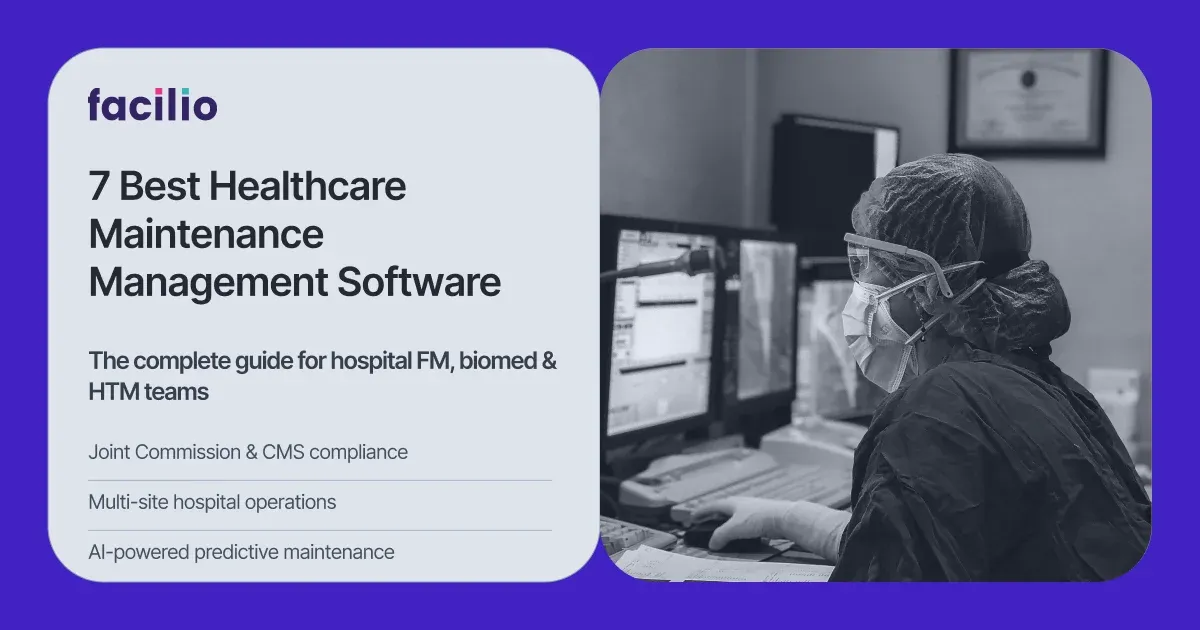
In this guide, I've compared the 7 best platforms for hospital maintenance software in 2026: what each does well, where they fall short, and which type of facility they're built for.
What Is Healthcare Maintenance Management Software?
Healthcare maintenance management software, sometimes called a healthcare CMMS, is a platform built to manage the maintenance, compliance, and asset lifecycle of hospital equipment and facilities.
Unlike a generic CMMS, it handles the regulatory demands of clinical environments: Joint Commission surveys, CMS Conditions of Participation, NFPA 99, and AEM programs.
It centralises work orders, preventive maintenance schedules, asset records, inspections, and audit trails across FM, biomedical, and HTM teams. For hospital networks managing multiple sites, it enables consistent healthcare operational management and portfolio-wide compliance visibility, not just data aggregation.
The core question isn't whether your hospital needs healthcare maintenance software; it's whether your current one is purpose-built for clinical environments or just a generic tool with a healthcare label.
A useful starting point: how the US healthcare facilities management landscape is evolving and what it demands from modern platforms.
How to Choose the Best Healthcare Maintenance Management Software
With 75%+ of healthcare CMMS deals being replacements, not first-time purchases, most hospital teams have already lived through a failed or underperforming implementation.
Here's what to evaluate before committing:
1. Joint Commission and regulatory readiness
Does the platform generate the complete audit trail: work orders, PMs, inspections, calibrations, that a surveyor will ask for?
Environment of Care (EOC) rounds and Life Safety documentation need to be current daily, not assembled before a survey. Look for named support for TJC, CMS, NFPA 99, and HIPAA. January 2026 brought sweeping changes to TJC accreditation standards, consolidating EC and LS requirements into a new Physical Environment (PE) structure.
Platforms that haven't responded to this update are already behind.
2. FM + biomed + HTM in one platform
Most hospitals have facilities engineering, clinical engineering/biomed, and HTM teams running separate systems. A purpose-built healthcare CMMS should unify all three: with role-specific views, shared asset records, and cross-team work order routing. If the vendor only covers one department, it's not a true healthcare solution.
3. Multi-site scalability
If you're managing more than one hospital, the platform must support consistent PM schedules, asset naming conventions, and compliance reporting across all sites. Single-site tools won't scale.
4. US healthcare regulation compliance
The Joint Commission (TJC/JCAHO) surveys every three years, now with new PE standards from January 2026.
CMS Conditions of Participation federal baseline for Medicare/Medicaid certified facilities.
NFPA 99 covers medical gas, electrical, and HVAC in clinical environments.
HIPAA — data security for connected medical devices.
AEM programs — CMS and TJC-approved risk-based PM strategies. For a full breakdown of how these regulations affect healthcare capital planning and asset investment decisions, that's worth reading separately.
5. Implementation track record in healthcare
Ask for healthcare-specific go-live timelines, not generic case studies.
The US healthcare market is unforgiving, buyers who've been through failed implementations won't tolerate a 12-month onboarding cycle.

See how Facilio helps hospitals stay Joint Commission-ready year-round.
Explore with a Live DemoQuick Comparison: Top 7 Healthcare Maintenance Management Software
The 7 Best Healthcare Maintenance Management Software Platforms
We evaluated each platform on healthcare compliance depth, FM and biomed workflow support, implementation track record, and fit for hospital environments; here's how they stack up.
1. Facilio – Best for Multi-Site Hospital Networks and FM Service Providers
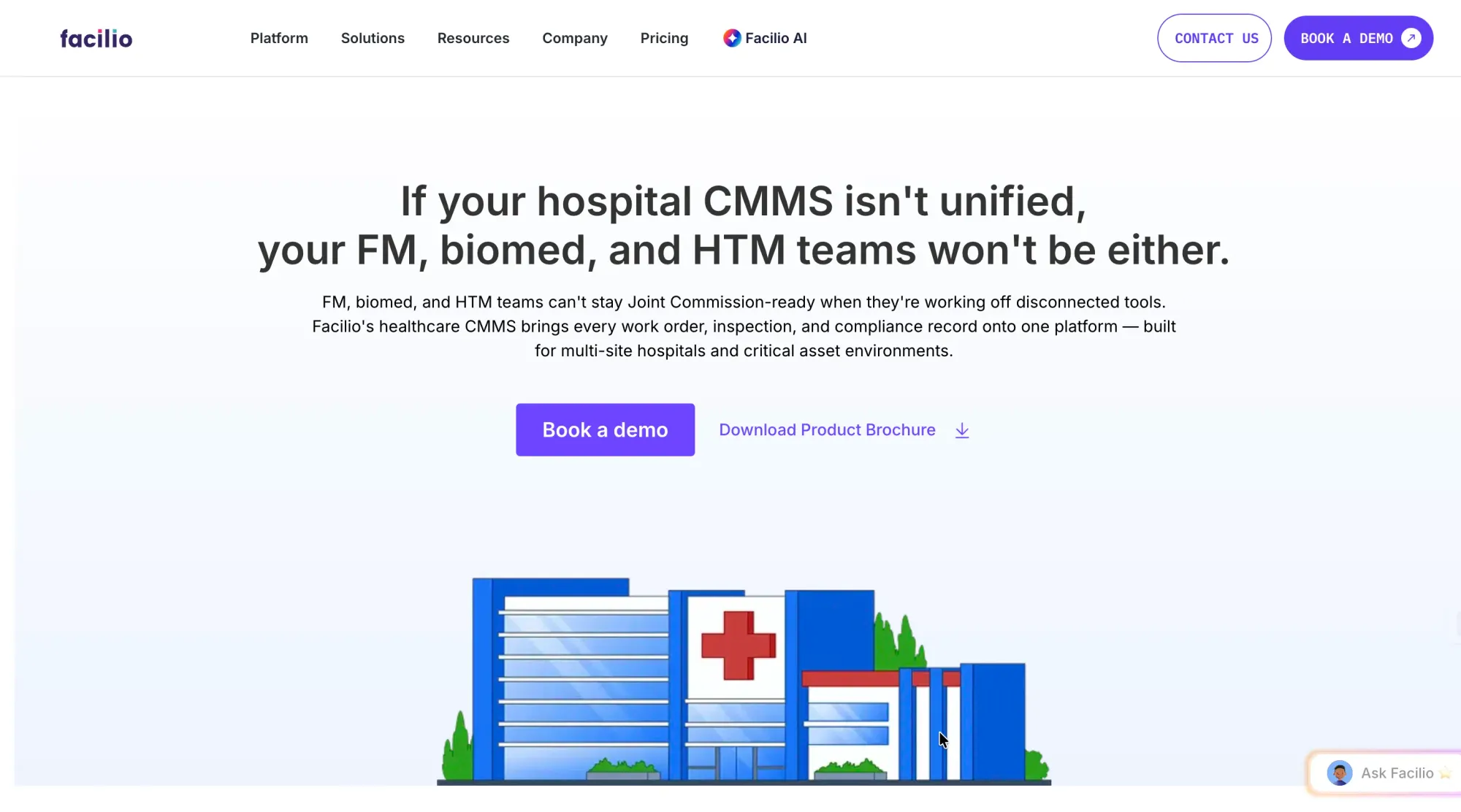
Facilio is a connected, cloud-native healthcare maintenance management software built for FM service providers and multi-site hospital networks managing complex, compliance-driven environments.
It unifies FM, biomedical, and HTM teams on one platform with real-time asset visibility, compliance automation, and an AI suite that predicts equipment failures before they become patient safety events. If your hospital network is managing 5+ facilities with tech silos across departments, Facilio is purpose-built for that scenario.
Facilio's approach to quality improvement in healthcare goes beyond maintenance tracking; it connects operational data, asset health, and compliance workflows to give FM leaders the visibility needed to make proactive decisions, not reactive ones.
Key Healthcare Features in Facilio
- Unified FM + biomed + HTM workflows on a single platform
- Joint Commission, CMS, NFPA 99, HIPAA, and AEM compliance automation
- AI-powered predictive maintenance predicts asset health from historical data and IoT signals
- Automated task generation AI creates maintenance tasks after inspection triage
- Multi-site portfolio dashboard with real-time cross-facility visibility
- 50+ integrations including BAS, BMS, IoT sensors, EHR, and ERP
- No-code workflow automation configure without IT support
- Mobile CMMS for field technicians, online and offline
Pros
- Purpose-built for healthcare with AI capabilities legacy platforms can't match
- Fast implementation, US healthcare FM provider went live across 3M+ sq ft in 46 days
- Genuinely unified FM + biomed + HTM, not a bolt-on
- AI suite reduces manual workload for overstretched maintenance teams
- Strong fit for FM service providers managing outsourced hospital operations
Cons
- Enterprise-grade platform, best suited for multi-site networks; single-site clinics may find it more than needed
- Custom pricing; no self-serve tier
How a US healthcare FM provider deployed compliance-ready maintenance across 3M+ sq ft of hospital facilities in 46 days
Read the full case study →2. FSI Services – Best for US Hospital HTM and HFM Teams
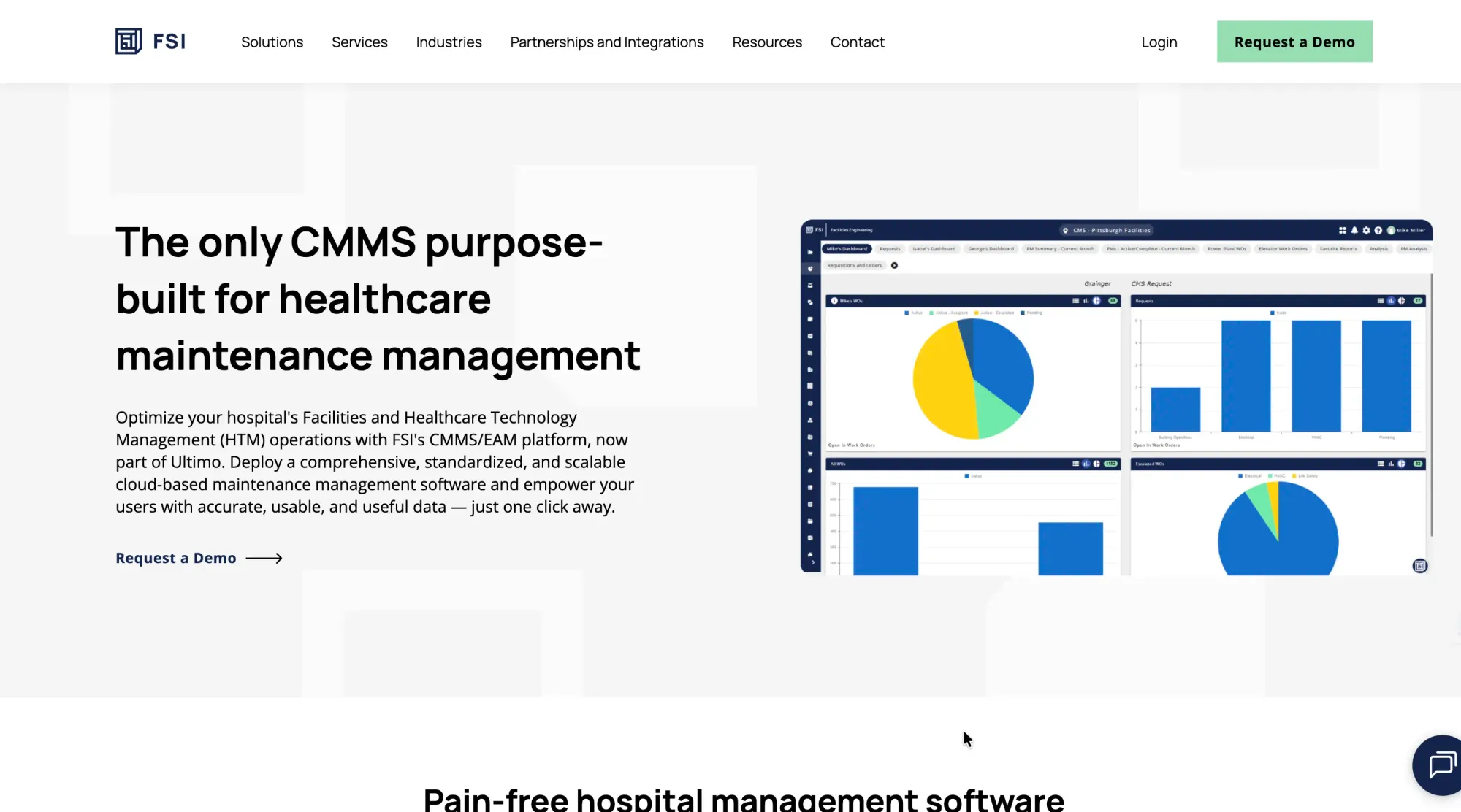
FSI has been a healthcare-first CMMS since 2002, purpose-built for Healthcare Facilities Management (HFM) and Healthcare Technology Management (HTM) teams. Managing over 400 million sq ft of US hospital space annually, FSI pairs its cloud CMMS with on-site data collection services: asset surveys, barcoding, and CAD documentation.
In January 2026, FSI became the first vendor to release a compliance solution specifically addressing the Joint Commission's new Physical Environment accreditation structure.
Key Healthcare Features
- Healthcare-exclusive CMMS, not adapted from a generic platform
- Environment of Care (EOC) and AEM compliance workflows built in
- On-site data collection: asset surveys, barcoding, CAD updates
- Analytics AI+ for natural language maintenance data queries
- Mobile-first technician app with offline capability
- Capital planning linked to asset lifecycle data
- Integrations with ServiceNow, PartsSource, Oracle, and Microsoft Dynamics
Pros
- Deepest US healthcare regulatory expertise in the market
- Vendor relationship consistently described as a 'true partner' by customers
- On-site services remove data-cleansing burden during migration
- First to respond to 2026 Joint Commission accreditation changes
Cons
- Services-and-software model, not a self-serve or low-cost option
- Reporting depth varies by module; some reviews note limitations vs. large EAMs
- Volume of capabilities has a learning curve for new users
3. Accruent TMS – Best for Biomedical and Clinical Engineering Teams
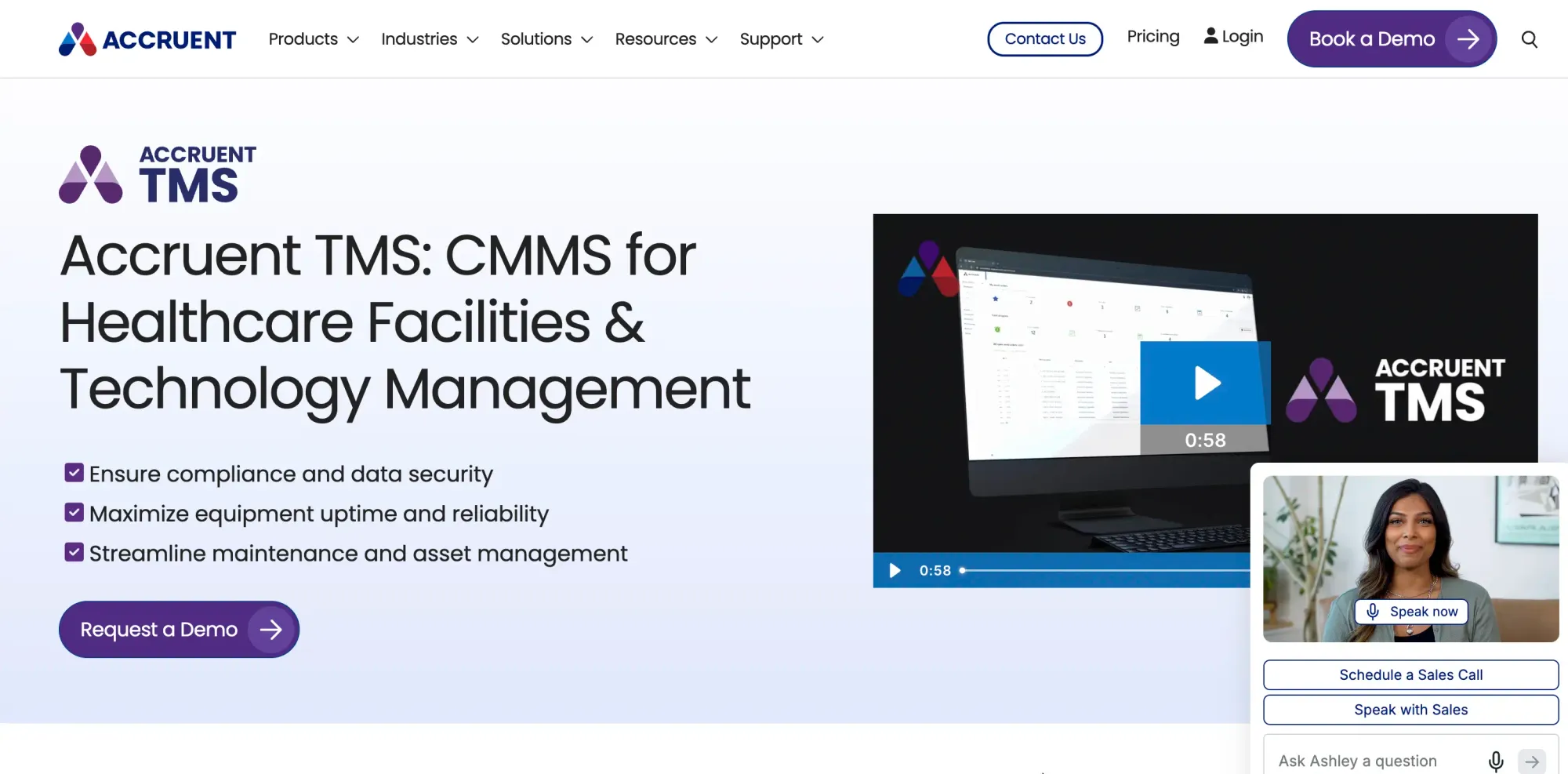
Accruent TMS has been a healthcare CMMS since 1995, trusted by over 800 healthcare organisations globally. It is primarily oriented toward biomedical and clinical engineering operations, with particular depth in complex PM sub-procedures, cybersecurity for connected medical devices, and EHR/ERP integration.
TMS is also built to support healthcare capital planning decisions, linking maintenance history and asset lifecycle data to capital expenditure forecasting. IDC recognised Accruent as a Leader in SaaS Healthcare Maintenance and Facility Management in 2022.
Key Healthcare Features
- Sub-procedure logic for complex PM tasks on imaging and diagnostic equipment
- Cybersecurity tools for connected medical device protection
- IoT integration for predictive asset health monitoring
- EHR and ERP integrations for cross-department data visibility
- Configurable dashboards by user role and department
- Barcode/QR scanning for asset tracking and PM closeouts
- Capital planning module linked to maintenance and lifecycle data
Pros
- Deep clinical engineering functionality, strong for biomed-led operations
- Trusted by large health systems; IDC Leader recognition
- Scalable pricing by bed/department
- Strong regulatory compliance tools and cybersecurity depth
Cons
- User interface described as cluttered and high learning curve by some reviewers
- Custom reporting requires SQL knowledge
- Implementation involves complex workflow mapping, not a fast go-live
- Not ideal for combined FM + biomed operations, primarily biomed-led
4. IBM Maximo – Best for Large Enterprise Health Systems
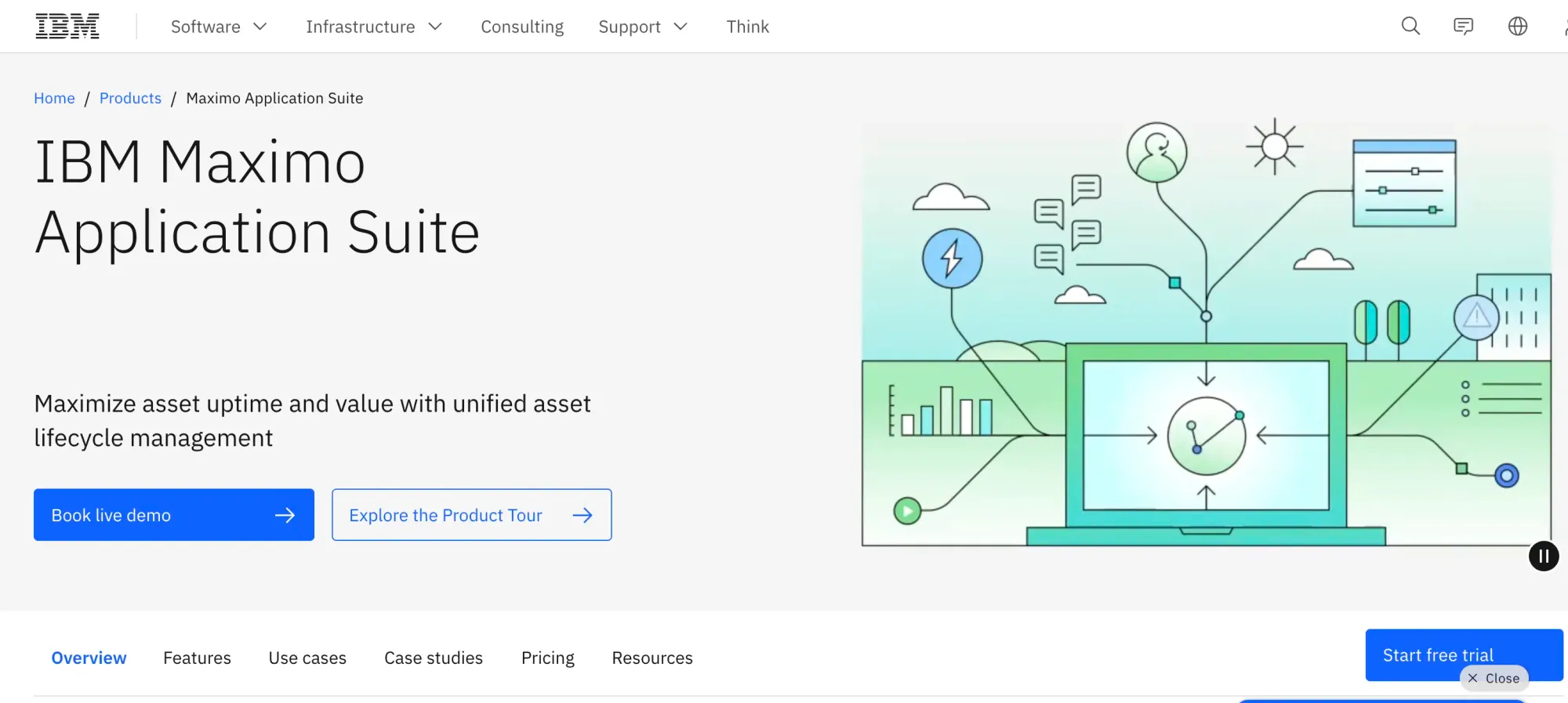
IBM Maximo is an enterprise asset management (EAM) platform deployed in large health systems, particularly those already invested in IBM's technology ecosystem. It is highly configurable across any compliance framework but is not healthcare-specific by design; compliance workflows must be configured rather than pre-built. Maximo is best for very large, technically resourced health systems.
For most hospital FM and biomed teams, it requires significant implementation investment that smaller organisations can't sustain.
Key Healthcare Features
- Configurable to TJC, CMS, NFPA, HIPAA, and any regulatory framework
- IBM AI for predictive maintenance and asset failure analysis
- Extensive enterprise integration ecosystem
- Full asset lifecycle management from procurement to disposal
- Work order management, PM scheduling, and inspection tracking at enterprise scale
- Mobile access for field technicians
Pros
- Unmatched configurability and enterprise scalability
- IBM AI and IoT integration capabilities best-in-class for large deployments
- Strong for health systems already using IBM infrastructure
Cons
- Not purpose-built for healthcare, compliance workflows require custom build
- High implementation cost and long deployment timelines (6–12+ months)
- Requires dedicated IT and admin resources to maintain
- Not suited for mid-size or single-site hospitals
5. eMaint – Best for Mid-Size Hospitals and Clinics
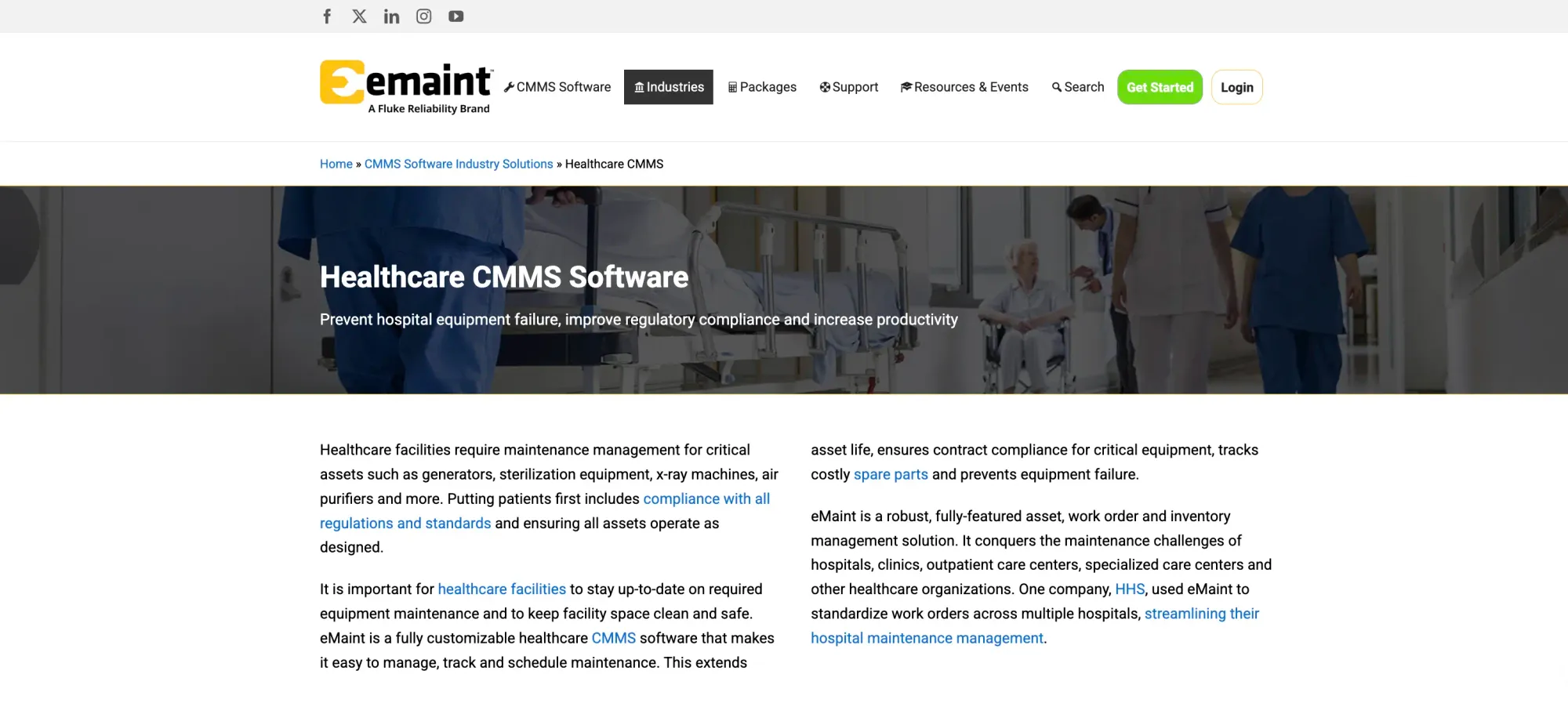
eMaint is a Fluke company cloud CMMS that offers solid asset management, PM scheduling, and compliance tracking at a more accessible price point than enterprise platforms. It supports Joint Commission compliance, NFPA, and CMS documentation, and has built a case study library covering ICU equipment management, HVAC maintenance, and sterilisation tracking. A good fit for mid-size hospitals and multi-specialty clinics that need more than a generic CMMS without the complexity of enterprise platforms.
Key Healthcare Features
- Healthcare-specific PM templates and compliance checklists
- Asset hierarchy with parent-child relationships for imaging systems and equipment groups
- Predictive analytics and condition-based maintenance triggers
- Linked healthcare case studies across ICU equipment and critical utilities
- Configurable dashboards and compliance reporting
- Mobile access and offline technician workflows
Pros
- Accessible per-user pricing, easy to budget
- Good compliance coverage for TJC, CMS, and NFPA
- Strong case study depth in critical clinical utility maintenance
- Fluke's measurement heritage adds credibility for equipment-intensive environments
Cons
- Fewer healthcare-exclusive features than FSI or Accruent
- Biomed/HTM workflow depth limited compared to specialist platforms
- Better for facilities-led operations than combined FM + clinical engineering teams
6. Brightly (TheWorxHub) – Best for Combined Biomed and Facilities Teams
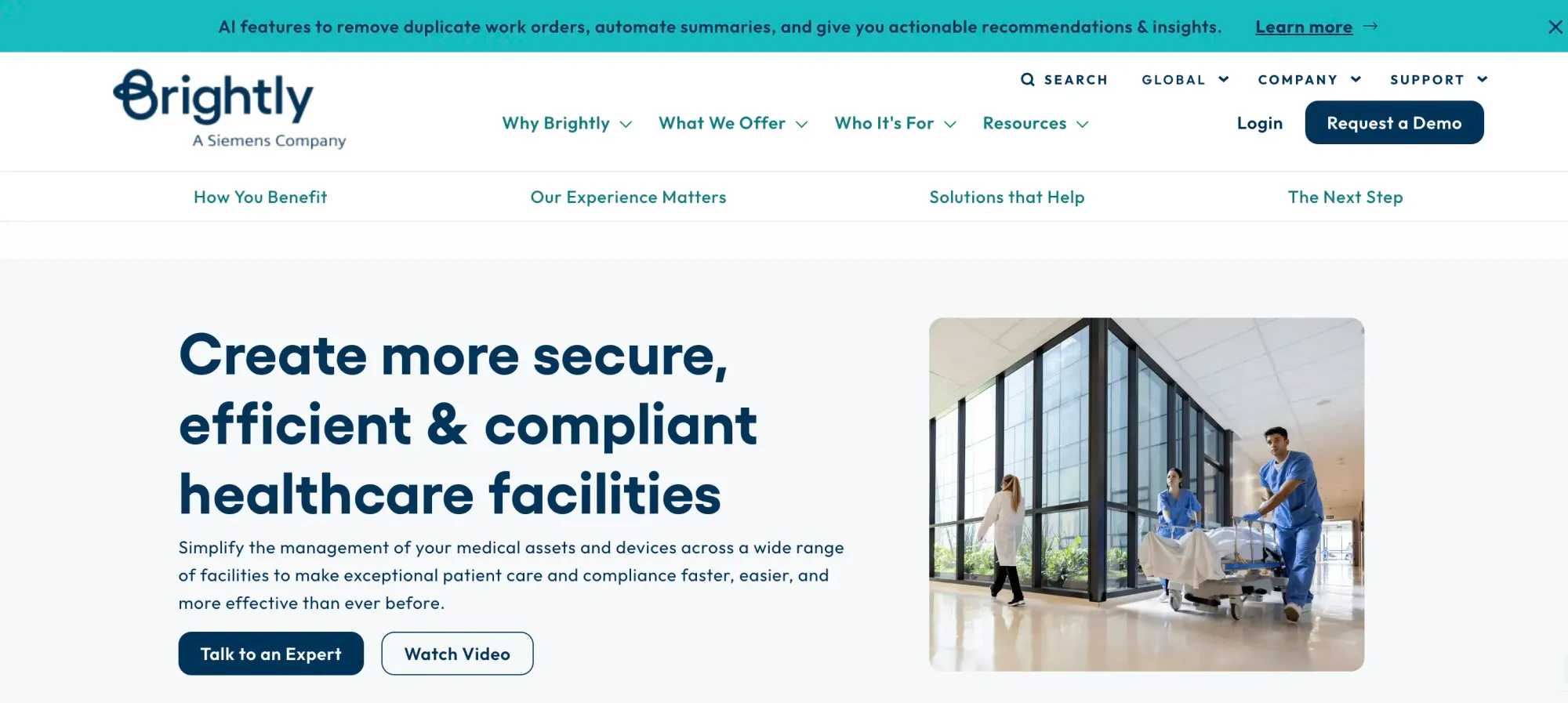
Brightly, a Siemens company, offers TheWorxHub, a cloud-based healthcare CMMS that integrates both biomed and facilities maintenance in a single platform. It's one of the few platforms that genuinely unifies HFM and HTM workflows with role-specific views and shared asset records.
Verdantix's 2025 Industrial CMMS report identified Brightly as a leader, citing its work order management and asset monitoring capabilities.
Key Healthcare Features
- Unified HFM + HTM platform — genuine integration, not just access sharing
- Joint Commission compliance documentation and audit trail
- Asset monitoring with condition-based maintenance triggers
- Mobile-first design with strong technician adoption scores
- Capital planning and asset lifecycle reporting
Pros
- One of the strongest unified FM + biomed platforms available
- Strong mobile UX drives technician adoption
- Siemens backing provides enterprise stability
- Verdantix 2025 Industrial CMMS Leader recognition
Cons
- Less customisable than open-source or legacy enterprise systems
- Compliance automation depth narrower than FSI or Accruent for complex regulatory environments
- Feature updates are vendor-dependent
7. FMX – Best for Smaller Hospitals and Single-Site Clinics
FMX is a user-friendly, cloud-based CMMS designed for facilities teams that are not highly tech-savvy. It covers work orders, PM scheduling, inventory management, and basic compliance tracking at a competitive per-user price point. Its Capital Planner and room/equipment scheduling tools are useful additions for smaller clinical facilities. Best suited for community health centres or single-site clinics transitioning away from spreadsheets.
 Jaihind_GN
Key Healthcare Features
- Work order management with simple, clean interface
- Preventive maintenance scheduling for clinical and facility equipment
- Inventory management with QR code scanning and purchase order integration
- Capital Planner for long-term equipment replacement forecasting
- Room and equipment booking for multi-use clinical spaces
Pros
- Easiest to adopt, low learning curve for non-technical teams
- Competitive per-user pricing
- Capital Planner useful for budget-planning teams
- Good for teams moving off spreadsheets
Cons
- Limited TJC, AEM, and clinical engineering compliance depth
- No dedicated mobile app, mobile-responsive web only, no push notifications
- Not suitable for multi-site health systems or biomed-heavy operations
Why Facilio Stands Apart for Healthcare Maintenance in 2026
Most healthcare maintenance management software was built for either facilities or biomedical teams, but not both.
Facilio was built to unify them. That distinction matters most in two scenarios: multi-site hospital networks where operational consistency across facilities is non-negotiable, and FM service providers managing outsourced hospital maintenance at scale.
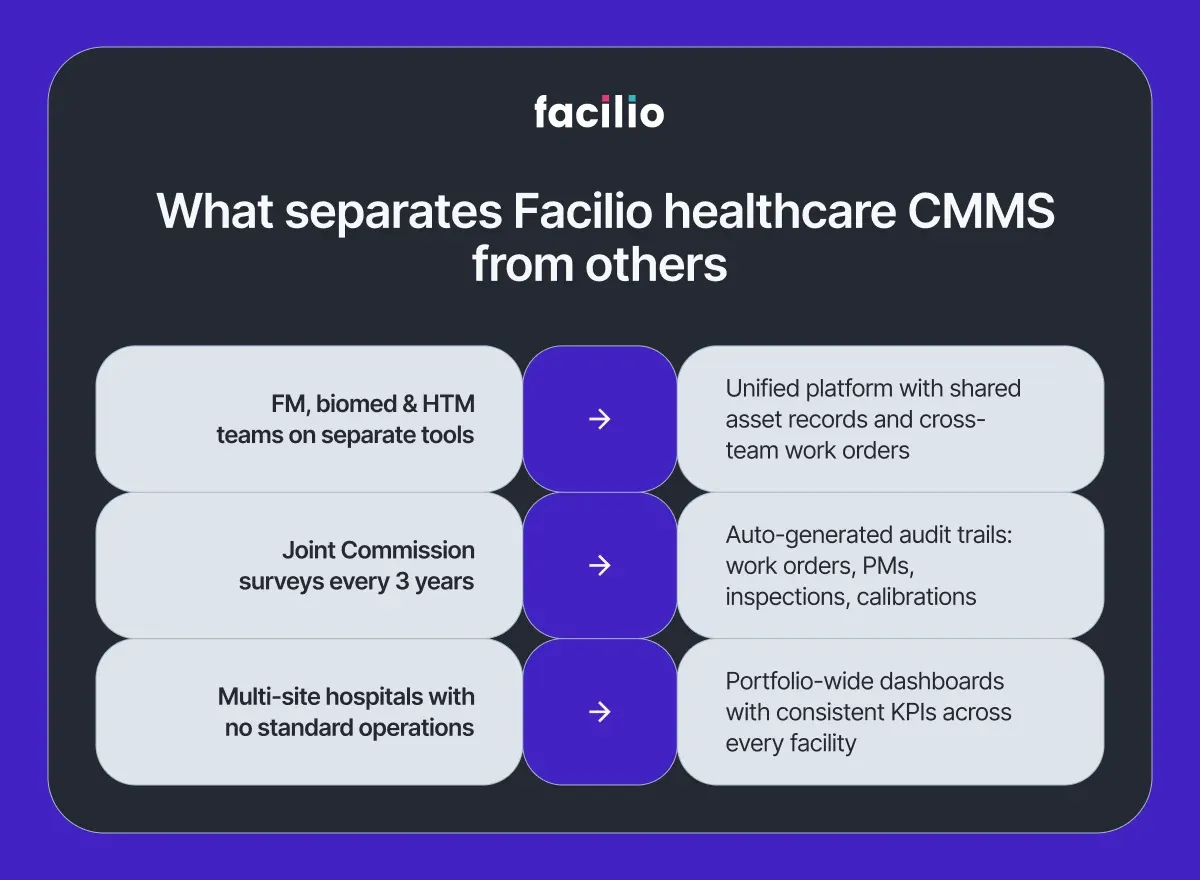
The AI layer is what separates Facilio from every legacy platform in this list.
It predicts asset health before failures occur, and it automatically generates maintenance tasks after inspection triage, reducing manual workload for already overstretched teams.
This is how modern healthcare CMMS operations are being run today, not by adding headcount but by giving the same team better tools.
In practice, a US-based integrated healthcare FM provider managing 3M+ sq ft of hospital facilities went live in just 46 days; compliance-ready from day one. Eurohealth Systems, managing hospital chains across the UAE, credits Facilio with enabling instant visibility and a seamless shift from reactive to proactive maintenance.
These aren't edge cases; but they reflect what happens when healthcare facilities management in the US finally gets a platform built for its complexity.
Book a demo to see Facilio's healthcare maintenance platform in action.
Request a Facilio Demo
Frequently Asked Questions
1. What is healthcare maintenance management software?
Healthcare maintenance management software is a CMMS platform built to manage preventive maintenance, asset lifecycle, work orders, and compliance documentation specifically for hospital facilities and medical equipment, supporting TJC, CMS, NFPA 99, HIPAA, and AEM regulatory frameworks.
2. How is a healthcare CMMS different from a standard CMMS?
A standard CMMS tracks work orders and schedules. A healthcare-specific platform generates Joint Commission-ready audit trails, supports biomed and HTM workflows, manages clinical-grade assets, and integrates with hospital IT systems. Generic tools weren't designed for the consequence of failure in a clinical environment.
3. What US regulations must hospital maintenance software support?
At minimum: TJC/JCAHO (including new 2026 PE standards), CMS Conditions of Participation, NFPA 99, HIPAA, and AEM programs. EOC rounds and life safety compliance are daily operational requirements, not annual checkboxes.
4. Can one platform manage both hospital facilities and biomedical equipment?
Yes — Facilio and Brightly TheWorxHub are built specifically to unify FM, biomed, and HTM teams. Most legacy platforms cover one or the other, creating the tech silos that make Joint Commission preparation difficult.
5. How long does it take to implement a healthcare CMMS?
Purpose-built platforms can go live significantly faster than enterprise EAMs. Facilio deployed a US healthcare FM provider across 3M+ sq ft in 46 days. IBM Maximo typically requires 6–12+ months for healthcare deployments.
6. Is Facilio suitable for US hospitals?
Yes. Facilio supports TJC, CMS, NFPA 99, HIPAA, and AEM and has US healthcare FM provider deployments to back it up.
About the Author

More from Facilio