Connected CMMS

 Connected Buildings
 Connected Refrigeration


 Download ebook

 Read case study


 Watch now


 Retail
 Healthcare
 FM Services
 Commercial Portfolios
 Corporate Facilities
 Education
 Data-driven Portfolio Ops
 Facility Management Software
 360° Asset Lifecycle
 Continuous Sustainability

 Blogs
Blogs
 Help docs
 Knowledge Hub
 ROI Calculator
 Ebooks & Guides
 Webinars
 Case studies


 About us
 Newsroom
 Careers
 Contact us
 Partners
 Events



A strong CMMS request for proposal (RFP) is more than a feature list—it’s a business case, a compliance safeguard, and a roadmap for implementation. This guide shows facilities and operations leaders exactly what to include, how to structure scoring, and what to ask vendors.
What is a CMMS RFP?
A CMMS RFP (Request for Proposal) is a formal document that details your maintenance management needs, project expectations, and selection criteria—inviting vendors to propose solutions that specifically address your pain points.
Think of your RFP as more than a feature list. It’s a structured tool that:
- Describes your organization, operations, and constraints
- States your business, technical, and compliance requirements
- Invites shortlisted CMMS vendors to submit structured proposals
- Provides evaluation criteria and timelines for selection
It’s a bridge between your internal needs and the external market of solutions.When you're ready to evaluate potential solutions, you'll want a CMMS maintenance software that can actually deliver on these requirements, not just promise them.
RFP vs RFI vs RFQ: What’s the difference
Choosing between an RFI, RFP or RFQ shapes how you approach CMMS procurement, whether you’re gathering market info, asking for detailed proposals, or locking in pricing. Let’s clear up exactly what each of these means and when to use them.
Many organizations issue:
- An RFI to understand the landscape and cut down to a shortlist
- A CMMS RFP to evaluate those shortlisted vendors in depth
- Optionally an RFQ for final commercial negotiation with 1–2 finalists
You do not need all three every time, but you should be clear which you are using and why.
When to use a CMMS RFP
A comprehensive CMMS RFP is powerful but demands significant time from maintenance, operations, IT, and procurement teams—so it's not always necessary. However to choose the best CMMS solution for your business and to go beyond surface-level feature comparisons, a good RFP equips you to ask more strategic questions during vendor demos and responses.
When you should use a formal CMMS RFP
- Your maintenance operations are complex — multiple sites, diverse asset types, or complicated workflows.
- You’re consolidating or replacing legacy systems, spreadsheets, or multiple point-solutions — and you need consistency across the portfolio.
- Your organization is in a regulated industry or subject to compliance / audit requirements, which demand documented procurement and vendor evaluation.
- The commitment is significant — high value, long-term, or enterprise-wide (e.g. multi-site rollout, SaaS subscription, strategic license) — requiring stakeholder buy-in and measurable ROI.
- Multiple stakeholders (maintenance, IT, procurement, management) need to weigh in, making structured proposals, transparent comparison, and documented decision-making essential.
When a formal CMMS RFP is not needed
- Your organization is small or maintenance needs are straightforward and limited.
- You are deploying CMMS at a single site or for a simple scope, with little complexity or need for customization.
- You already have a trusted vendor relationship, and are simply expanding usage or renewing—rather than evaluating a fresh selection.
- You need rapid implementation or are under tight time constraints — and a full RFP process would be too slow or resource-intensive.
- Your requirements are well understood, standard, and unlikely to change — meaning a lighter evaluation (demo, checklist, reference check) can deliver what you need faster and with less overhead.
Key Components of a CMMS RFP
A strong RFP isn't just a list of requirements. It's a structured document that gives vendors everything they need to understand your world and respond meaningfully.
1. Introduction and Background
This section tells vendors who you are and why you're looking for a CMMS. Include:
- Organization overview: What you do, who you serve, and your size (number of facilities, employees, assets)
- Current state of maintenance: What system you're using now (if any) and why it's falling short
- Project urgency: Is this a an upgrade or a "critical pain point" situation?
Why it matters: Vendors use this context to understand whether their solution is a good fit. A healthcare facility managing 50 buildings has very different needs than a manufacturing plant with 3 locations.
2. Project Scope and Objectives
Clearly define what "success" looks like. This isn't about features yet—it's about outcomes.
Example outcomes:
- Reduce unplanned downtime by 25%
- Improve work order completion time by 40%
- Achieve 95% preventive maintenance compliance
- Eliminate spreadsheet-based maintenance planning
- Centralize asset data across 12 facilities
This section forces you to think about why you're buying a CMMS, not just what you're buying. When vendors understand your goals, they can speak to how their solution helps you achieve them.
3. Technical and Functional Requirements
This is where specificity matters. Break this into two categories:
Business Requirements (What you need the system to do):
- Work order creation, assignment, and tracking
- Preventive maintenance scheduling and execution
- Asset inventory and lifecycle tracking
- MRO (Maintenance, Repair, Operations) inventory management
- Mobile access for field technicians
- Real-time reporting and KPI dashboards
- Integration with your ERP or accounting system
Technical Requirements (How it needs to work in your environment):
- Cloud-based or on-premise deployment
- Number of concurrent users and user roles
- Operating systems and device types (Windows, Mac, iOS, Android)
- Data security standards and compliance (ISO 27001, SOC 2, etc.)
- Integration capabilities with existing systems (Oracle, SAP, custom APIs)
- Scalability for future growth (additional locations, users, assets)
4. Budget and Timeline
Be transparent about money and deadlines. Include:
- Total budget (or budget range) for software, implementation, training, and first-year support
- Timeline for implementation (3 months? 6 months? 12 months?)
- Go-live date or target date
- Key milestones (requirements gathering, data migration, training, cutover)
Vendors appreciate knowing your parameters. It prevents them from proposing oversized solutions or unrealistic timelines.
5. Evaluation Criteria
How will you judge proposals fairly? Establish a weighted scoring system:
Share this rubric with vendors. It keeps evaluation objective and gives vendors clarity on what matters most to you.
6. Submission Instructions and Timeline
Tell vendors exactly how to submit and when:
- Submission deadline — typically 3-4 weeks after RFP distribution
- Format — PDF, Word, or both?
- Submission method — email, portal, or hardcopy?
- Point of contact — one person for all vendor questions
- Q&A process — will you hold a vendor conference call? When do questions need to be submitted by?
- Decision timeline — when will finalists be notified? When will demos happen?
7. Compliance and Legal Requirements
Outline any non-negotiables:
- Data privacy compliance (GDPR, CCPA, HIPAA, etc.)
- Industry-specific standards (EPA refrigerant management, OSHA requirements, medical device tracking)
- Security certifications (ISO 27001, SOC 2, etc.)
- Standard terms and conditions — will you accept their terms or require modifications?
- Insurance and liability — what coverage do they maintain?
For regulated industries, this section prevents vendors from proposing solutions that won't pass compliance audits.
Step‑by‑Step CMMS RFP Process
Think of your CMMS RFP as a project, not a document. The process matters as much as the end result.
Step 1: Conduct a Needs & Pain Assessment
Start by understanding why you’re changing or implementing a CMMS now:
- What’s breaking down in your current process (or current system)?
- What regulatory or audit gaps are you worried about?
- What’s the cost of current downtime, emergency repairs, or asset failures?
- Where are technicians, planners, and managers wasting time?
Practical actions:
- Review 6–12 months of maintenance history, work orders, and unplanned downtime.
- Interview technicians, supervisors, and operations managers.
- Capture both hard metrics (downtime hours, backlog, overtime costs) and soft issues (poor usability, double data entry, lack of visibility).
Link each pain point to desired outcomes, e.g.:
- Reduce unplanned downtime by 20% in 18 months
- Achieve 95% preventive maintenance compliance
- Maintain full documentation for life safety assets per NFPA 101
- Eliminate standalone spreadsheets and local databases
This becomes your anchor for the entire RFP.
Step 2: Engage Cross‑Functional Stakeholders
Your CMMS will sit at the crossroads of many teams:
- Maintenance & facilities – daily users, workflow owners
- Operations & production – impacted by downtime and scheduling
- IT & information security – responsible for architecture, access, and risk
- HSE / EHS / Compliance – safety inspections, environmental reporting, permits
- Procurement & finance – sourcing, contracts, budgets, ROI
- Executive sponsors / Board – strategic alignment and risk appetite
Bring them together early, even if only for a working session.
Key questions to cover:
- What does success look like for each group?
- What’s non‑negotiable (compliance, cybersecurity, auditability)?
- What are realistic timeline and budget boundaries?
- What internal constraints (e.g., IT resources, change management capacity) must the vendor work within?
Appoint a CMMS Steering Group with a clear decision‑maker (e.g., Director of Facilities or VP Operations). This group will approve the RFP, participate in evaluations, and own the final recommendation.
Step 3: Research the Market & Shortlist Vendors
Next, explore CMMS / maintenance platforms that could realistically serve your needs.
Sources:
- Peer recommendations from your industry
- Independent analyst reports (e.g., Verdantix, Gartner, IDC)
- Software review sites (G2, Capterra, etc.)
- Industry associations and events
Focus on:
- Fit for your industry and asset profile
- Support for multi‑site or portfolio‑wide operations
- Proven integrations with your ERP, BMS/BAS, sensors, or other core systems
- Evidence of security and compliance (SOC 2, ISO 27001, GDPR/HIPAA readiness, etc.)
For larger, distributed portfolios, you’ll likely look at connected CMMS platforms that centralize data and workflows across sites and service providers.
For example, platforms like Facilio are designed to orchestrate maintenance across large portfolios, external vendors, and building systems in a single, connected environment.
Aim to narrow down to a shortlist of 3–6 vendors before issuing your RFP.
Step 4: Draft the CMMS RFP Document
Using your needs assessment and stakeholder input, you can now structure the RFP.
We’ll break down the full structure in Section 6, but at a high level, you should include:
- Company and operations overview
- Project goals and success metrics
- Scope (sites, asset classes, volumes)
- Functional requirements (work orders, PM, assets, inventory, mobile, etc.)
- Technical requirements (hosting, integrations, security, SSO, data model)
- Compliance and regulatory needs (audit trails, EHS, standards)
- Service and support expectations (implementation, training, SLAs)
- Budget guidance and commercial expectations
- Evaluation criteria and scoring approach
- Timelines and submission guidelines
This is where you decide what’s mandatory vs. nice‑to‑have. Use a priority scale, such as:
- M = Must‑have (critical)
- S = Should‑have (important)
- C = Could‑have (nice‑to‑have)
Step 5: Issue the RFP & Manage Vendor Q&A
Once approved internally:
- Send the RFP to your shortlisted vendors.
- Set clear dates for:
- Confirmation of participation
- Deadline for clarification questions
- Final proposal submission
- Define the channel for questions (e.g., all questions via email to procurement; answers shared with all vendors).
This ensures fairness and also protects you from claims of unequal treatment — important under many public procurement laws and internal policies.
Step 6: Evaluate Responses & Shortlist Finalists
When proposals come back, use your scoring rubric, not gut feel.
Typical categories:
- Functional fit (e.g., out‑of‑the‑box support for your workflows)
- Ease of use and user experience
- Integration and data model fit
- Implementation approach and customer success model
- Security, privacy, and compliance posture
- Total cost of ownership (TCO) over 3–5 years
- Vendor stability and roadmap
If possible, conduct independent scoring (each stakeholder scores separately, then you aggregate and discuss).
You should then narrow to 2–3 finalists for deeper evaluation.
Using a connected platform like Facilio as an example: during evaluation, your IT team might pay special attention to its open APIs and data model, while operations care more about how it routes work orders to third‑party service providers across sites.
Step 7: Demos, Proof of Concept & Reference Checks
Static proposals only go so far. You need to see and feel the platform in action.
For each finalist:
- Provide realistic use‑case scripts ahead of the demo:
- “Dispatch a contractor for a failed rooftop unit at Site A and track SLA.”
- “Schedule regulatory inspection for fire doors across all facilities and generate proof reports.”
- “Create a portfolio‑level view of CAPEX‑qualified asset replacements.”
- Invite cross‑functional attendees, including at least:
- Maintenance leadership
- Power users / supervisors
- IT / security
- Operations or production leaders
- Compliance / HSE (where relevant)
- Ask to see specific capabilities linked to regulations or mandates, such as:
- Audit logs showing who changed which asset records and when
- Electronic signatures and approvals for critical activities
- Data export and retention policies (important for public records and regulators)
- Support for inspections aligned with OSHA, NFPA, or local safety codes
- Request a short proof of concept (POC) or sandbox where a subset of your users can try real workflows for a few weeks.
- Conduct reference checks with organizations similar to yours in:
- Industry
- Size and complexity
- Regulatory environment
Ask directly about implementation quality, support responsiveness, and how well the platform stands up under audits.
Step 8: Selection, Negotiation & Final Decision
By this point you should have:
- Scored proposals
- Seen demos & POCs
- Conducted reference checks
Now you can:
- Update your scoring to reflect demonstrated capability and real‑world fit
- Engage in commercial and contractual negotiations with your top choice(s)
- Ensure legal, procurement, and IT/security sign off on:
- Master SaaS agreement
- Data protection / data processing agreement (for GDPR or similar)
- SLAs, uptime commitments, and support models
- Term, renewal, and exit clauses
Your CMMS will likely hold years of maintenance, asset, and compliance data. Your RFP and contract should explicitly cover:
- How you can export all data (format, cost, support)
- What happens at contract termination
- How long data is retained and how it is securely deleted
With a vendor selected, you can then move into implementation planning—which should be a formal workstream, not an afterthought.
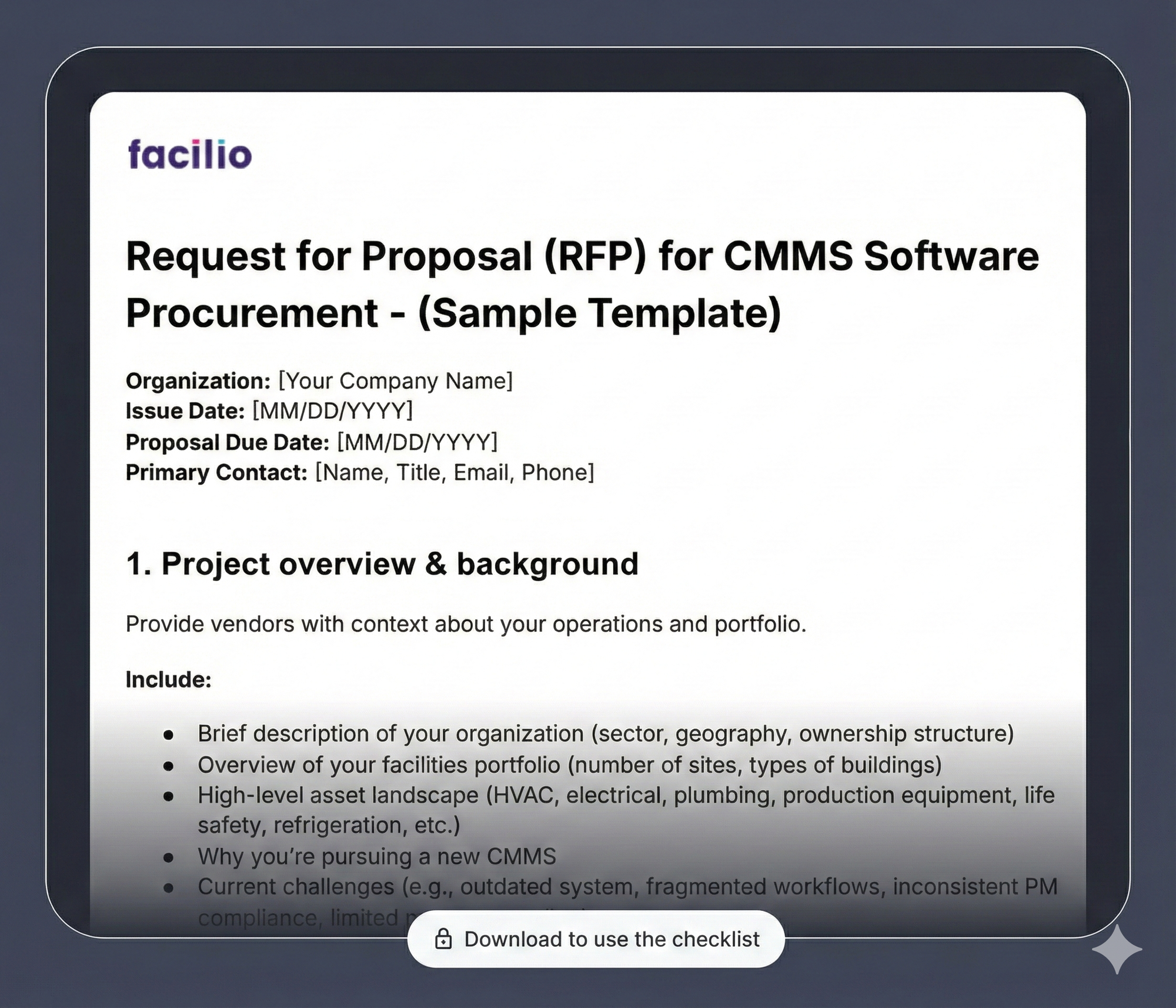
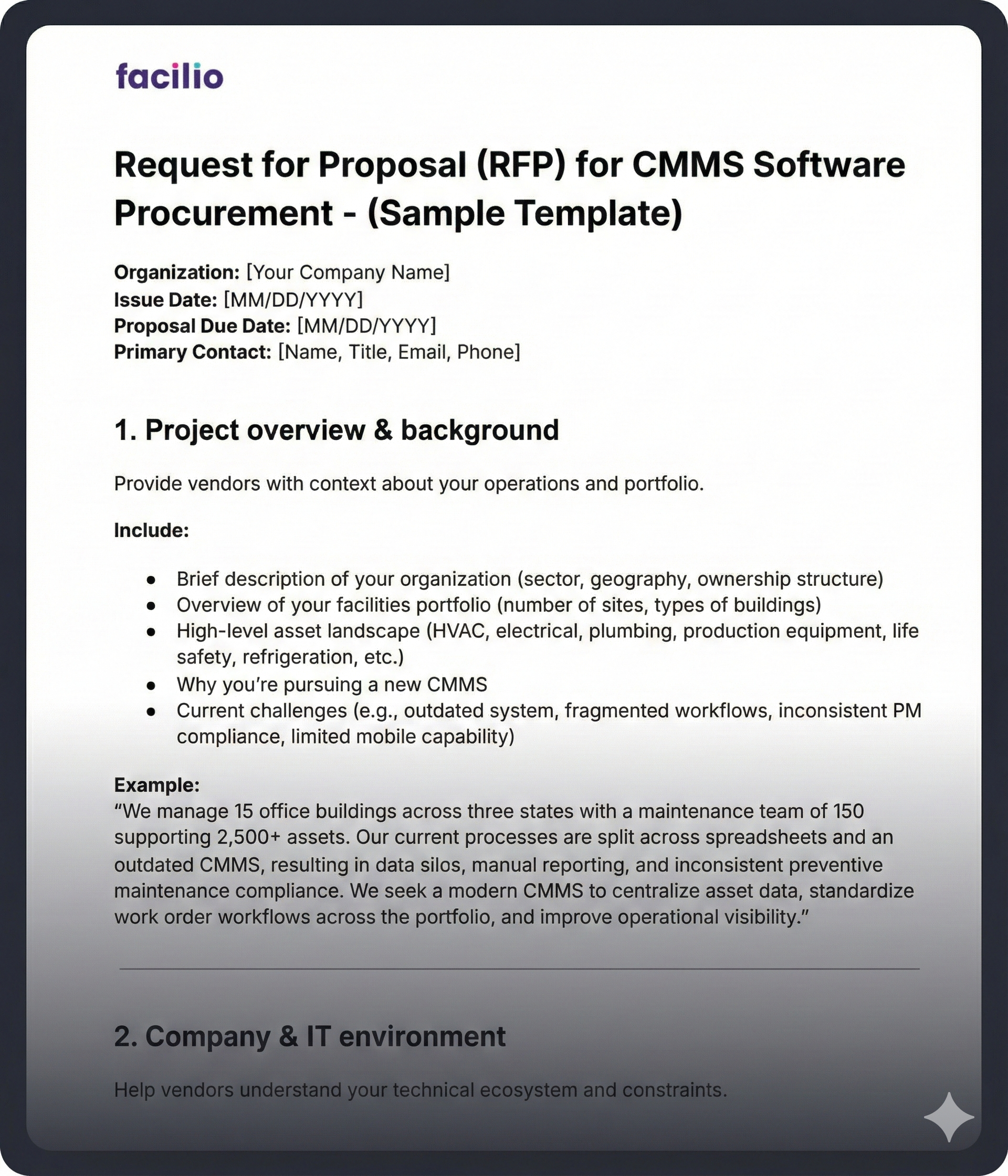
Download your CMMS RFP Template
Evaluating maintenance software is easier with a clear, standardized framework. This ready-to-use CMMS RFP template helps you compare vendors, capabilities, and implementation expectations in one place.
Key Questions to Ask during RFP Drafting
Internal Assessment Questions
- What’s broken (or inefficient) with our current maintenance workflows?
- What systems do we need this CMMS to integrate with? (HRIS, ERP, BMS)
- Do we require regulatory reporting (OSHA, EPA, local codes)?
- Is real-time portfolio visibility and mobile field access a must?
- How many users, roles, and sites will the platform support now and in 3 years?
Vendor Questions Checklist
- What security certifications does your product maintain (SOC2, ISO 27001)?
- Can your platform manage assets, work orders, and contractors at portfolio scale?
- How do you handle data migrations and integrations?
- What’s the typical implementation timeline for organizations like ours?
- Describe your ongoing support, change management, and user training approach.
- Is your system API-driven? Does it support open integrations?
- What’s your approach to compliance tracking and regulatory change (e.g., EPA, OSHA updates)?
- Can you provide references from similarly sized or regulated organizations?
Common CMMS RFP Pitfalls
If you operate in healthcare, pharma, public sector, food, or critical infrastructure, regulators will expect auditable maintenance records. Your CMMS RFP should explicitly ask about:
- Audit trails and electronic signatures
- Role‑based access control
- Retention policies and exportability of data
- Support for inspections, permits, and safety procedures
Finalizing Your RFP and the Next Steps
You've invested significant effort in the RFP process. Now comes the disciplined work of vendor evaluation.
Evaluating responses requires three steps: a desk review for completeness, objective scoring with your weighted rubric, and team discussion to surface disagreements. Narrow to 2-3 vendors for final demos.
Watch for red flags that signal misalignment or capability gaps—vendors who ignored requirements, quoted suspiciously low prices, gave vague technical answers, lacked references, or pursued aggressive follow-up despite your structured process.
After selection, the momentum shifts to execution. Negotiate terms and SLAs, execute the contract, establish clear governance, plan implementation with data migration strategy, and communicate the change to your team.
Note: Understanding how to structure a CMMS implementation ensures your deployment succeeds with proper change management, governance, and team adopti
A thorough RFP process takes time, but it pays dividends in vendor alignment, user adoption, and long-term system success.
FAQs
Q: How long does the CMMS RFP process typically take?
A: From initial requirements gathering to final vendor selection, expect 2-4 months. Sending the RFI, receiving responses, shortlisting, then distributing the formal RFP, waiting for responses (allow 3-4 weeks), evaluating, conducting demos, and negotiating. Don't rush it. A thoughtful process prevents costly mistakes later.
Q: Should we use an RFP template, or create our own?
A: Start with a template to avoid missing key sections, but customize heavily for your situation. Generic templates often miss industry-specific requirements or compliance considerations that matter for your organization.
Q: What if a vendor doesn't meet all requirements? Can we still consider them?
A: Yes, but understand the tradeoff. If they miss on a "high priority" requirement but excel elsewhere, ask them detailed questions during demos. Sometimes a vendor's strength in other areas compensates for a minor shortfall. But if they miss multiple "high priority" requirements, seriously question whether they're the right fit.
Q: How many vendors should we include in the RFP?
A: Typically 3-6. Fewer than 3 limits your options. More than 6 makes evaluation overwhelming. Use the RFI to narrow your field first.
Q: Can we change requirements after we send the RFP?
A: Avoid it if possible — it creates confusion and looks disorganized. But if critical needs emerge, notify all vendors simultaneously in writing. Give them extra time to address the changes in their proposals.
Q: Should we tell vendors our budget in the RFP?
A: Yes. Being transparent prevents vendors from oversizing solutions or wasting time on proposals outside your range. Vendors appreciate clarity.
Q: How do we handle vendor questions during the RFP period?
A: Set a Q&A deadline (typically 1-2 weeks before proposal due date). Collect all questions and answers, then share everything with all participating vendors simultaneously. This ensures everyone's working with the same information.
What if the cheapest vendor wins our evaluation but doesn't feel right?
A: Trust that instinct. Your scoring system should account for implementation support, vendor stability, and ease of use — not just price. If price is winning but other factors are weak, reweight your criteria. You'll live with this decision for 5+ years. Make sure you're comfortable with it.
Q: What should we do if we're evaluating CMMS vendors for the first time?
A: Take time upfront to understand what makes a CMMS successful in your environment. Consider working with a consultant or conducting initial research to establish realistic expectations. Don't let vendors define your requirements — define them yourself, then find the vendor that fits. This prevents expensive misalignment post-implementation.
Q: How do we ensure our RFP attracts quality responses?
Be specific about your needs, clear about your process, and transparent about your timeline and budget. Vague RFPs get vague responses. The better your RFP, the better quality proposals you'll receive. Also, engage with vendors early through RFI conversations. They'll invest more effort in formal RFP responses if they understand your situation.
About the Author

More from Facilio