Connected CMMS

 Connected Buildings
 Connected Refrigeration


 Download ebook

 Read case study


 Watch now


 Retail
 Healthcare
 FM Services
 Commercial Portfolios
 Corporate Facilities
 Education
 Data-driven Portfolio Ops
 Facility Management Software
 360° Asset Lifecycle
 Continuous Sustainability

 Blogs
Blogs
 Help docs
 Knowledge Hub
 ROI Calculator
 Ebooks & Guides
 Webinars
 Videos
 Case studies


 About us
 Newsroom
 Careers
 Contact us
 Partners
 Events




Key Takeaways
- Planon is a capable IWMS, but it was built to record operations, not act on them. The gap between data captured and action taken is where FM teams still carry unnecessary manual load.
- Agentic AI connects to your existing Planon environment without migration, reconfiguration, or disruption and starts working from the data Planon already holds.
- Four agents close the four gaps that Planon teams consistently carry: reporting lag, after-hours coverage, invoice leakage, and CAFM navigation time.
- The shift FM teams describe after running agents on top of Planon: less time inside the system, more time ahead of it.
Running a mature Planon environment means managing genuine organisational depth like multiple sites, active vendor contracts, occupants with competing service expectations, compliance obligations across teams, and invoice volumes that long ago outgrew the bandwidth of the people approving them.
We work with FM teams who have spent years configuring Planon carefully. It earns that investment.
The friction is not in what Planon captures. It is in what still requires a person to carry it forward.
- Someone assembles the portfolio report because the data does not surface itself
- Someone is on call at midnight because the platform does not field requests autonomously
- Someone cross-checks invoices against work order records because the validation chain does not close without them
- Someone navigates five screens on a mobile device to log a job update that should take ten seconds
That coordination overhead, the human bridges between data and action, is what agentic AI is built to remove. But before specifically covering the gaps that AI can address, it is worth being precise about what agentic AI actually means.
What Agentic AI Is in FM (and What It Isn't)
Agentic AI is not a chatbot. It is not a smarter dashboard. It is not a reporting upgrade that surfaces the same data in a cleaner format.
Inside a CAFM platform, AI agents are the operational layer that acts on what the system knows. They read asset data, service requests, vendor records, and compliance logs continuously and take defined actions without waiting for a person to intervene.
An AI agent perceives a situation, a missed SLA, an invoice that does not match the work order, a service request coming in at 2am, decides on the appropriate action, and executes it.
Without a human triggering it. Without waiting for someone to log in and review a notification.
The distinction matters because most AI sold to FM teams stops at the insight layer. It tells you something is wrong. You still have to act on it. Agentic AI closes that loop. The action happens as part of the same sequence as the detection.
If you want to see how Facilio sits alongside Planon at a platform level, this comparison covers that in full. This page is specifically about the AI layer, what it does on top of the Planon environment you already run.
We built a suite of agents specifically for the gaps FM teams running mature platforms still carry. The next section covers how they connect to Planon without touching what you have already built.
See Facilio's AI agents handle a live FM scenario.
See a Live DemoHow Agentic AI Connects to Your Planon Environment
The first question we hear from Planon teams is almost always the same: does this mean reconfiguring what we have already built?
It does not.
Planon stays exactly as it is. Your asset records, work order histories, lease data, PM schedules, vendor contracts, and compliance logs remain where they are. Your teams keep working in the interface they know. Nothing is overwritten, migrated, or rebuilt.
Planon stays exactly as it is. Your asset records, work order histories, lease data, PM schedules, vendor contracts, and compliance logs remain where they are. Your teams keep working in the interface they know. Nothing is overwritten, migrated, or rebuilt.
Facilio's AI agents connect to Planon through the data infrastructure it already exposes:
- REST API, the standard route for most Planon environments. Real-time, bidirectional where the workflow requires it
- SQL database connector, for environments where direct API access is not the preferred path
- File / SFTP, for configurations that export structured data on a scheduled basis
For Planon environments already running an ERP, BMS, or third-party tools alongside it, the agents normalise data across all of them. The intelligence layer reads your full stack, not just Planon in isolation.
From the moment integration is live: no data preparation phase, no parallel-running period, no disruption to operations.

Your Planon environment is already ready. Let us show you how the agents connect.
Book a 30-minute walkthroughWhat Planon Does Not Do and Where the Agent Layer Begins
Planon is one of the most capable IWMS platforms in the market. It manages asset lifecycles, space, lease obligations, sustainability reporting, and maintenance workflows with genuine depth. What it was not built to do is act on what it holds.
- It does not answer a tenant's call at midnight
- It does not flag that a vendor has missed SLA on four consecutive callouts before someone runs the report
- It does not cross-validate an invoice against a work order and a contract rate before the payment clears
- It does not tell a field technician in plain language why an asset keeps failing
That is not a criticism of Planon. It is a description of what IWMS platforms are built for. The action layer — continuous, autonomous, operating across every data stream Planon produces is a different capability entirely.
That is what these agents bring.
4 Ways Facilio Atom Turns Your Planon Data Into Decisions
Planon gives you the operational record. What it does not give you is the layer that reads that record continuously, spots what needs attention, and acts without waiting to be asked.
The four agents below each address a specific gap that FM teams running mature Planon environments consistently carry and each one connects directly to the data Planon already holds.
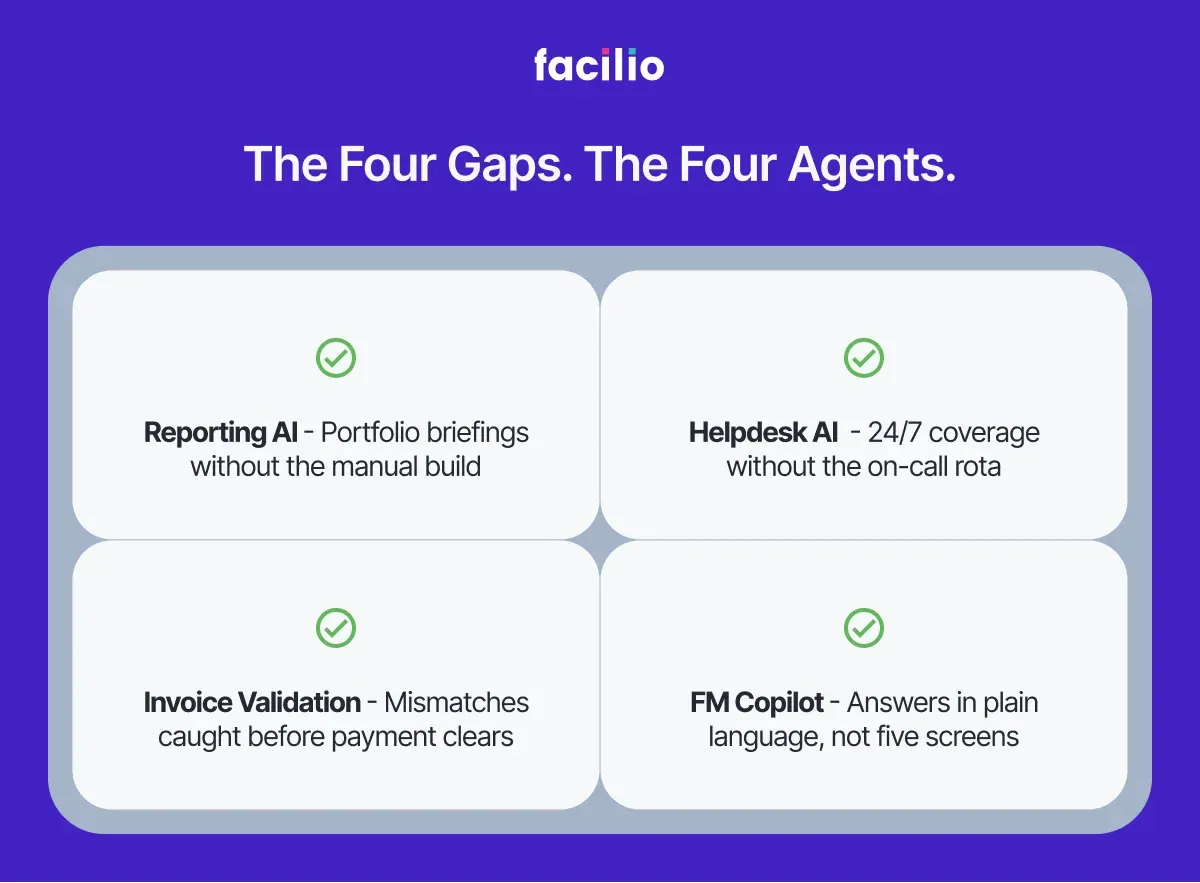
1. Reporting AI Agent: From Data Holder to Decision Engine
Planon holds years of structured operational data. The gap is not access, it is activation. Non-standard reports still require IT involvement or a specialist who knows the system well enough to build them. By the time the briefing reaches the FM Director, the window it was meant to inform has often passed.
The Reporting AI Agent monitors your Planon data continuously and surfaces what matters without anyone assembling it:
- Tracks performance patterns across sites, vendors, and asset classes and flags anomalies ranked by cost or risk impact, not by whoever remembered to check
- Generates portfolio-level briefings automatically: SLA compliance trends, contractor performance drift, reactive vs planned maintenance ratios by site
- Connects pattern to cause; so the question shifts from "what happened last month?" to "what is building toward a problem next month?"
For teams managing large portfolios where AI work order analytics and FM Copilot sit alongside reporting, the compounding effect is significant: the same data that generates the alert also powers the follow-up action.
2. Helpdesk AI Agent: 24/7 Coverage Without the On-Call Rota
Planon manages the service request workflow from the moment a ticket exists. It does not manage the moment before, the tenant call at 11pm, the contractor message on WhatsApp, the facilities request that lands outside business hours and waits until morning.
In portfolios with active occupant populations, that gap is a relationship risk as much as an operational one. Every unacknowledged request is a complaint waiting to form.
The Helpdesk AI covers every intake channel around the clock:
- Handles voice, chat, WhatsApp, and email in multiple languages with no human in the loop
- Triages the request, captures the required information, creates the work order, and dispatches to the right technician based on skills, location, and current availability
- Follows up through to resolution autonomously; the occupant receives an update without anyone manually chasing it
Live deployments: 80% end-to-end autonomous resolution. For Planon teams managing multi-tenanted portfolios, that number translates directly into fewer escalations, cleaner SLA records, and a service experience that does not depend on who is rostered that night.
3. Invoice Validation Agent: Catching Leakage Before It Leaves the Building
Planon tracks costs accurately across contracts, purchase orders, and vendor records. What it does not do is close the validation loop automatically. Someone still has to verify that each invoice matches the work order, reflects the contracted rate, and covers only the scope that was actually completed.
At portfolio scale, multiple active vendors, complex contracts, rate card variations by site or service type that manual step is where leakage concentrates. Discrepancies surface after payment. Disputes take weeks to resolve. Recovery is slow and damages vendor relationships that took years to build.
The Invoice Validation Agent runs three-way matching on every invoice before it reaches approval:
- Completion record against purchase order against invoice automatically, every time
- Discrepancies flagged with the specific mismatch identified, not just a flag requiring human investigation
- Clean invoices clear without anyone touching them, accelerating payment for vendors with accurate submissions
From a live deployment: 2,100 invoices processed in 4 months. 30% mismatches caught before approval. 70+ hours of manual FM work eliminated.
For FM service providers running complex multi-vendor contracts through Planon, the cost case extends beyond recovery. It changes how vendor governance operates at scale.
Your invoices are next. See the validation agent run on a real portfolio.
Schedule Facilio AI Demo4. FM Copilot: Cutting the Time Between Data and Action
Planon's operational depth is also its navigation challenge.
Accessing information mid-workflow on site, between jobs, under time pressure means working through a system built for completeness rather than speed.
A technician confirming asset history, a supervisor checking open work orders by priority, an FM manager trying to understand why a specific site keeps generating reactive callouts: each requires navigating multiple screens in an interface designed for desktop, not field use.
FM Copilot replaces navigation with conversation:
- Ask an operational question in plain language and get a direct answer like recurring faults by asset, SLA performance by contractor, work order backlog by site, without running a single report.
- Close work orders, reassign jobs, add notes, and trigger follow-ups through natural language rather than multi-step menu navigation
- Surfaces cross-portfolio patterns from Planon data that would take hours to piece together manually, in seconds
For field teams and FM managers who spend more time inside the system than ahead of it, FM Copilot is the capability that changes the daily experience of running a Planon environment fastest.
What FM Leadership Looks Like When the Coordination Overhead Is Gone
Planon has done the hard work. The asset records are structured, the maintenance history is deep, the vendor contracts are tracked, and the compliance obligations are documented. That foundation took years to build and it is not something you walk away from.
What agentic AI adds is the layer that makes it work when it matters most:
- At 2am, when a tenant calls and no one is rostered to answer
- On a disputed invoice, before the payment has already cleared
- Mid-shift, when a technician needs to know why an asset keeps failing without navigating five screens to find out
- Before the board review, when portfolio performance drift should already be visible, not assembled the night before
We are not asking you to replace Planon. We built an agent layer for teams who already have a solid platform and want to stop doing the manual work it still leaves behind.
Here is what that shift looks like in practice across a Planon environment:
| Before Agentic AI | After Agentic AI |
|---|---|
| Monthly report takes 4-6 hours to compile | Reporting AI generates portfolio briefings automatically |
| After-hours calls missed or delayed to next day | Helpdesk AI provides 24/7 coverage — zero dropped requests |
| Invoice discrepancies found weeks after service completion | Invoice Validation Agent flags mismatches before payment approval |
| Asset failure investigated reactively post-breakdown | Anomaly patterns surfaced and ranked before failures escalate |
| Work order status requires IWMS navigation to confirm | FM Copilot responds in plain language across all modules |
| SLA compliance reviewed in retrospect | Real-time SLA tracking with automated escalation triggers |
We are not asking you to replace Planon. We built an agent layer for teams who already have a solid platform and want to stop doing the manual work it still leaves behind.
Ready to move from the left column to the right? Let's show you how.
See AI in ActionPlanon + Facilio Atom: Built for What Your FM Operations Demand Next
Your Planon environment is not going anywhere.
The asset records, the lease data, the compliance history, the vendor contracts that operational foundation took years of careful configuration to build. It is not something you replace, and it is not something you should have to.
What agentic AI adds is not a replacement. It is the layer that makes everything Planon holds work harder for you, surfacing what matters, automating what is repetitive, and freeing the people running your operations to focus on decisions only they can make.
The FM teams we work with who have made this shift describe the same change: less time inside the system, more time ahead of it. Less assembling reports on what happened, more acting on what is about to.
That shift is available now without a migration, without reconfiguring what you have built, and without asking your team to start over.
The operational record you have built in Planon is the foundation. Agentic AI is what you build on top of it.
Ready to see what changes when the agents take the repetitive work?
Your Planon data is ready. The only thing missing is the agent layer.
Schedule a Facilio AI Demo
Frequently Asked Questions
1. We have spent years configuring Planon. Does adding AI agents undo any of that?
No. Every configuration, workflow, and customisation you have built in Planon stays intact. The agents connect to your existing data through standard integration methods and read from what Planon holds. Nothing is overwritten, restructured, or reconfigured.
2. Planon already has reporting built in. What does the Reporting AI Agent add that Planon's dashboards do not?
Planon's dashboards show you what has happened when you go and look. The Reporting AI Agent monitors your data continuously and surfaces what needs attention without you asking, anomalies ranked by cost impact, vendor performance drift, backlog concentration by site. The difference is between a record you consult and an intelligence layer that works while you are not watching.
3. Our portfolio includes regulated environments, healthcare and public sector. How does the agent layer handle compliance sensitivity?
Our AI agents (Facilio Atom) operate within the data boundaries and access controls you define. Your operational data is never used to train public AI models, and all data processed on your behalf remains under your ownership. For regulated environments, the agents can be scoped to specific workflows and sites, with human approval required for any defined intervention type.
4. Planon is already connected to our ERP and BMS. Do the agents work across all of those, or only with Planon?
Across all of them. The agents normalise data from your full stack, Planon, ERP, BMS, IoT, and third-party tools into a single intelligence layer. Planon does not need to be the only source. Most of the enterprise FM environments we work with run mixed stacks, and that is exactly the setup these agents were built for.
5. How long does it take to go live in a Planon environment?
For API-enabled Planon setups, typically a few weeks. Facilio's team handles the integration configuration. Your IT team is not required to build anything independently, and there is no operational disruption during the setup period.
6. Our FM team is already stretched. Does adopting AI agents add to their workload before it reduces it?
No ramp-up period is required from your operations team. The agents connect to what Planon already holds and begin working from day one. The experience for field teams and FM managers is subtraction, not addition — fewer manual steps, fewer screens to navigate, fewer tasks that currently land on a person because nothing else caught them first.
About the Author

More from Facilio