Connected CMMS

 Connected Buildings
 Connected Refrigeration


 Download ebook

 Read case study


 Watch now


 Retail
 Healthcare
 FM Services
 Commercial Portfolios
 Corporate Facilities
 Education
 Data-driven Portfolio Ops
 Facility Management Software
 360° Asset Lifecycle
 Continuous Sustainability

 Blogs
Blogs
 Help docs
 Knowledge Hub
 ROI Calculator
 Ebooks & Guides
 Webinars
 Videos
 Case studies


 About us
 Newsroom
 Careers
 Contact us
 Partners
 Events


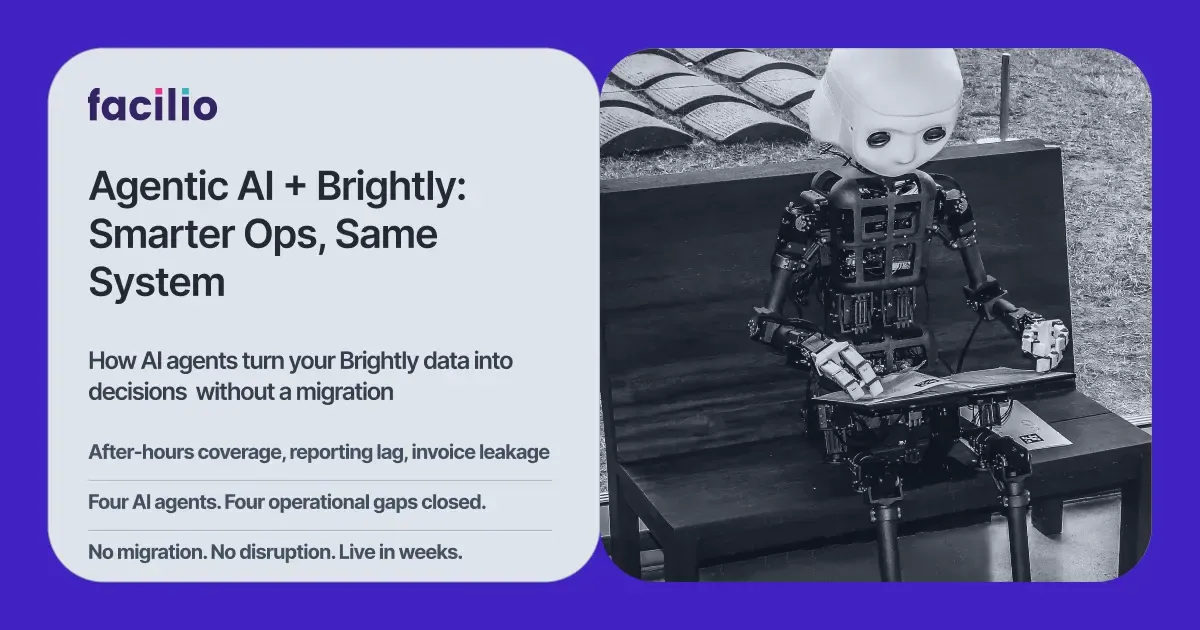

Most Brightly environments are not underperforming. They are underleveraged.
Every work order is logged. Every asset is tracked. Every vendor interaction is recorded. The data is there. What is missing is someone or something that reads it continuously, spots what is going wrong, and acts before you have to ask.
That is the gap we built AI agents to fill. Not to replace Brightly. To do what Brightly was never designed to do: close the loop between data captured and action taken.
Across the FM teams we work with, the same four gaps keep appearing like after-hours coverage, reporting lag, invoice leakage, and the hours lost navigating a CMMS for answers it already holds. This piece covers what changes when agents handle each one.
What Agentic AI is and What it is Not?
A useful distinction before we go further.
Brightly CMMS is a system of record. It captures what happened like the work order raised, the asset inspected, the PM completed, the vendor called. It does this reliably, across every site, every team, every shift. That is exactly what it was built to do.
What it was not built to do is read that record and act on it.
Spot that Site 4 has logged the same HVAC fault six times in ninety days.
Flag that a vendor has missed SLA on three consecutive callouts before the contract review.
Answer the phone at midnight and log the request before it becomes a complaint.
That is what AI agents do. They sit on top of Brightly, connect to the data it has accumulated, and work continuously in the background like surfacing what matters, automating what is routine, and escalating what needs a human decision.
The distinction we find most useful with Brightly teams:
Neither replaces the other. Brightly without AI agents is still a capable CMMS. AI agents without Brightly have no operational data to work from. The value is in the combination.
If you want to see how the two platforms compare across specific capabilities, here is a full breakdown of Brightly vs Facilio.
Brightly records it. AI agents act on it. Both are needed. What changes is what happens to the data after it is captured — instead of sitting in dashboards waiting for someone to interpret it, it gets surfaced, analysed, and actioned by AI agents purpose-trained for FM operations.
How Agentic AI Connects to Your Brightly CMMS Without a Migration
The first question we hear from almost every Brightly team is the same: does this mean we have to move our data?
It does not.
Brightly stays exactly as it is. Here is what that means in practice:
- Your work orders, asset records, PM schedules, and vendor histories stay where they are; nothing moves
- Your technicians keep working in the interface they know
- Your workflows are not reconfigured
- Nothing is overwritten
We connect to Brightly through standard integration methods and the right one depends on your environment:
- REST API, the cleanest route for modern Brightly setups. Direct, real-time, bidirectional where the workflow requires it
- SQL database connector, for environments where direct API access is not the preferred route
- File / SFTP, for legacy or on-premise configurations that export structured data
For Brightly environments with ERP, BMS, or third-party tools already in the stack, the agents normalise data across all of them. Brightly does not need to be the only source. Most of the FM teams we work with run mixed stacks — that is exactly the environment these agents were built for.
From the moment integration is live:
- No data preparation phase
- No migration project
- No period where operations are disrupted
The operational record stays in Brightly. The intelligence layer sits on top of it.
See how AI agents connect to Brightly in a live environment.
Book a demo4 Ways Agentic AI (Facilio Atom) Turns Your Brightly Data Into Decisions
Your Brightly CMMS gives you the operational record.
But Facilio's Atom, our purpose-built AI agents for facility operations, give you the intelligence to act on it.
Here is where that combination makes the biggest difference.
1. Reporting AI Agent: From Data Holder to Decision Engine
Brightly has got your reports.
What we have built in the Reporting AI Agent is something different; it’s an engine trained on FM operational data that monitors patterns across every module and surfaces signals without waiting to be asked.
The gap we see consistently: the data exists, but the intelligence does not.
- The monthly board report is still built by a person pulling exports
- Vendor performance is still compared manually, usually the day before a review
- Cost anomalies surface after the fact, not before the decision
What the Reporting AI Agent produces automatically, not assembled:
- Monthly Maintenance Reports across every site
- Vendor SLA compliance and performance trends
- Technician productivity and workload distribution
- Backlog risk flags and cost anomaly alerts
The shift we see in practice: FM leaders stop spending half a day assembling a briefing and start spending twenty minutes reviewing one — with anomalies already ranked by cost impact. What AI root cause analysis changes is the direction of investigation. Instead of asking "what happened?", the question becomes "what is about to happen?" and the agent answers it before you have to ask.
2. Helpdesk AI: From Missed Requests to Round-the-Clock Coverage
Brightly captures requests when someone submits them. It does not answer the phone at 11pm. That is where the missed request becomes a complaint.
The Helpdesk AI fills that gap across voice, chat, WhatsApp, and email, in multiple languages, around the clock. Here is how AI handles maintenance calls end-to-end.
Here is what happens when a request comes in, at any hour:
- The request is acknowledged before any human has seen the ticket
- It is triaged automatically using defined escalation logic, not based on who is at the desk
- The work order is created only once the required fields are captured
- The right technician is dispatched based on skills, location, and availability
- Progress is tracked and updated autonomously through to resolution
Where context is missing like no asset reference, unclear location, ambiguous fault description, the agent asks clarifying questions before proceeding. The work order is not created on incomplete information.
The outcome in live deployments: 80% end-to-end autonomous resolution. That is not a projection, it is what we see from teams running this in production. The missed request that turns into a complaint disappears almost entirely. For teams managing SLA compliance across multiple sites, the impact compounds quickly.
3. Invoice Validation Agent: From Leakage to Closed-Loop Accuracy
Manual invoice cross-referencing at scale does not work. The volume makes it structurally impossible like hundreds of vendor invoices per month, each requiring someone to verify completion against PO against contract rate. Things get missed. Disputes happen after payment. Recovery is slow.
The Invoice Validation Agent performs 3-way matching automatically:
- Completion record against purchase order against invoice
- Discrepancies flagged before approval, not after
- No chasing the work order to verify scope
- No after-the-fact disputes with vendors
From a live deployment: 2,100 invoices processed in 4 months. 30% flagged for mismatches before approval. 70+ hours of manual FM work eliminated. That is not a projection, that is what one FM team caught in their first four months running automated validation on top of their existing CMMS.
The shift goes beyond cost recovery.
When validation runs automatically, payments move faster, clean invoices clear without anyone touching them, vendors get paid sooner on accurate submissions, and the dispute cycle shrinks from weeks to a conversation. We have written about how AI reduces invoice disputes in FM and what margin leakage actually looks like at portfolio scale for teams who want to go deeper on the cost case.
4. FM Copilot: From Report-Running to Real-Time Answers
The question "why does Site 12 keep generating reactive work orders?" still takes an afternoon to answer in most Brightly environments. FM Copilot answers it in seconds and if action is needed, it takes it.
This is not a search tool. It reasons across your operational data work orders, asset histories, vendor records, compliance logs and returns a narrative explanation, not a list of results.
 Jaihind_GN
What FM Copilot handles on a typical day:
- Operational questions answered in plain language like recurring faults by site, SLA performance by contractor, asset downtime history
- Work orders created, updated, or closed via natural language
- Technicians reassigned, due dates adjusted, follow-ups triggered
- Patterns identified across data that would take hours to surface manually
The use case we hear most often from Brightly teams: "I just want to ask the system a question and get a straight answer without running three reports."
That is exactly what this does and it is the capability that changes the daily experience of running an FM operation the fastest.
Watch Agentic AI run on a real Brightly environment.
Shcedule a live walkthroughWhat FM Leaders Are Actually Gaining With Agentic AI
The shift agentic AI creates is not about features. It is about where FM leaders spend their attention. When the routine is automated and the anomalies are surfaced, the role of the FM leader moves from operational firefighter to strategic portfolio manager.
Brightly CMMS + Facilio Atom: Built for What Your FM Operations Demand Next
So your Brightly CMMS is not going anywhere.
The asset records, the work order history, the PM schedules that operational foundation took years to build and it is not something you replace lightly.
What agentic AI adds is not a replacement. It is the layer that makes everything Brightly holds work harder for you like surfacing what matters, automating what is repetitive, and freeing up the people running your operations to focus on decisions only they can make.
The FM teams we work with who have made this shift describe the same change: less time inside the system, more time ahead of it. Less reactive, more anticipatory. Less reporting on what happened, more acting on what is about to.
That shift is available now: without a migration, without disrupting your team, and without starting over.
The operational record you have built in Brightly is the foundation. Agentic AI is what you build on top of it.
See what your Brightly environment looks like with AI agents running on top of it.
Schedule a Walkthrough Now
Frequently Asked Questions
1. Does adding AI agents mean we have to migrate away from Brightly?
No. Your Brightly CMMS stays exactly as it is. AI agents connect to it through standard APIs and read from your existing data. Nothing is overwritten, reconfigured, or moved.
2. Do our technicians need to change how they work in Brightly?
No. Technicians keep working in the interface they know. The changes happen at the operations and leadership layer in how data is surfaced, how requests are handled, and how invoices are validated, not in how field teams log work.
3. How long does it take to go live?
For API-enabled Brightly environments, typically a few weeks. Facilio's team handles the integration configuration. Your IT team is not required to build anything independently.
4. Can AI agents connect to our ERP and BMS as well, not just Brightly?
Yes. The agents normalise data from your full stack — CMMS, ERP, BMS, IoT sensors, and third-party tools — into a single intelligence layer. Brightly does not need to be the only source.
5. Is our operational data used to train public AI models?
No. Your data is never used to train public models. Contracts with AI providers enforce this explicitly, and all data processed on your behalf remains under your ownership.
6. We already have Brightly reports. Why do we need a Reporting AI Agent?
Your Brightly reports tell you what happened. The Reporting AI Agent tells you what is happening now and what is likely to happen next — automatically, without someone pulling exports. The difference is between a record and an intelligence layer.
About the Author

More from Facilio