






 Service intake














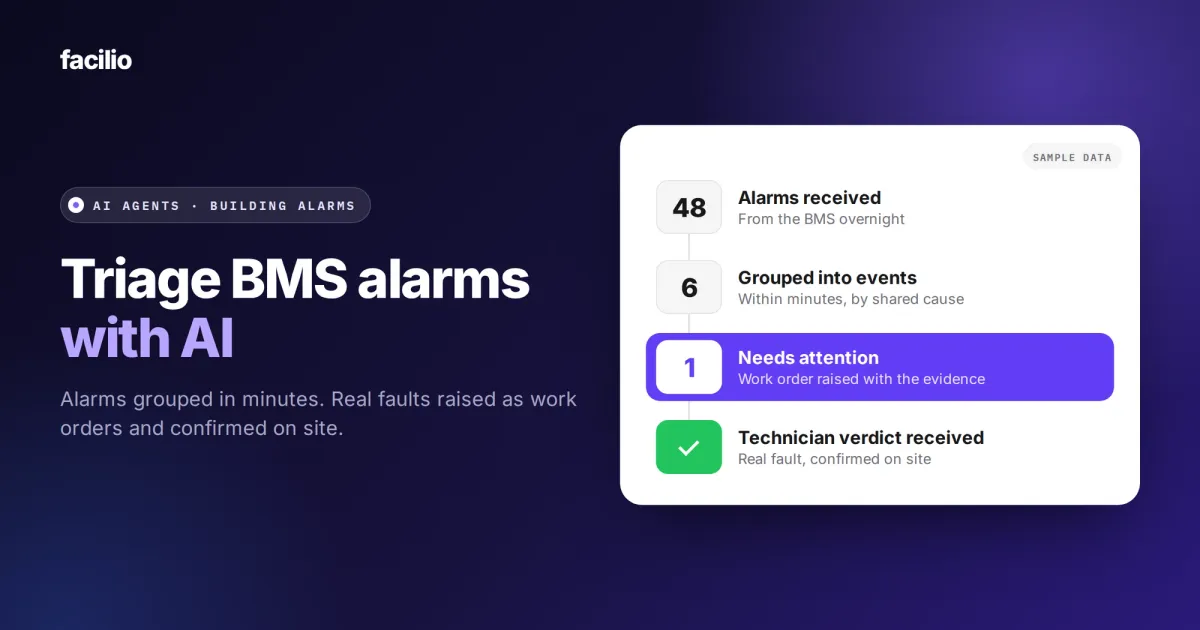

If you want AI alarm triage in facilities management, you want an agent that reads every BMS alarm, groups the ones that share a cause, quiets the noise, confirms the real faults and raises a work order only when a technician needs to go. It does not predict failures. It sorts what your building is already telling you, and its accuracy is measured against what the technician finds on site.
A single site can send hundreds of alarms a day, and across a portfolio that climbs into the thousands. Most are routine or duplicates, and only a few need someone to act, as anyone running remote monitoring across a portfolio knows. In this guide, we have tried to explain what alarm triage is, how the agent decides, how its accuracy is measured and what stays with your team.
Key takeaways
- AI alarm triage sorts BMS alarms into a short list of real faults. It does not predict failures.
- The agent groups related alarms, holds back nuisance alarms and confirms a fault before raising a work order.
- Every work order carries its evidence: readings, trend, asset history and linked alarms.
- Accuracy is checked against the technician's verdict on each work order the agent raises.
- Your team decides which alarms always go to a person, and owns the alert rules.
What is AI alarm triage, and what is it not?
AI alarm triage is an agent that sits between your building management system and your work orders, and decides which alarms need a person. It reads each alarm as it arrives and sorts it: a real fault, part of something already known, a short spike that cleared itself, or something to watch.
It is not:
- Not a failure forecast: it works on the alarms and readings your systems already produce. It does not claim to know what will break next month.
- Not a new BMS: your controls, setpoints and alert rules stay where they are.
- Not a replacement for your engineers: they set the rules, check the results and own anything that affects safety.
An example: 48 alarms after 10 pm in one building
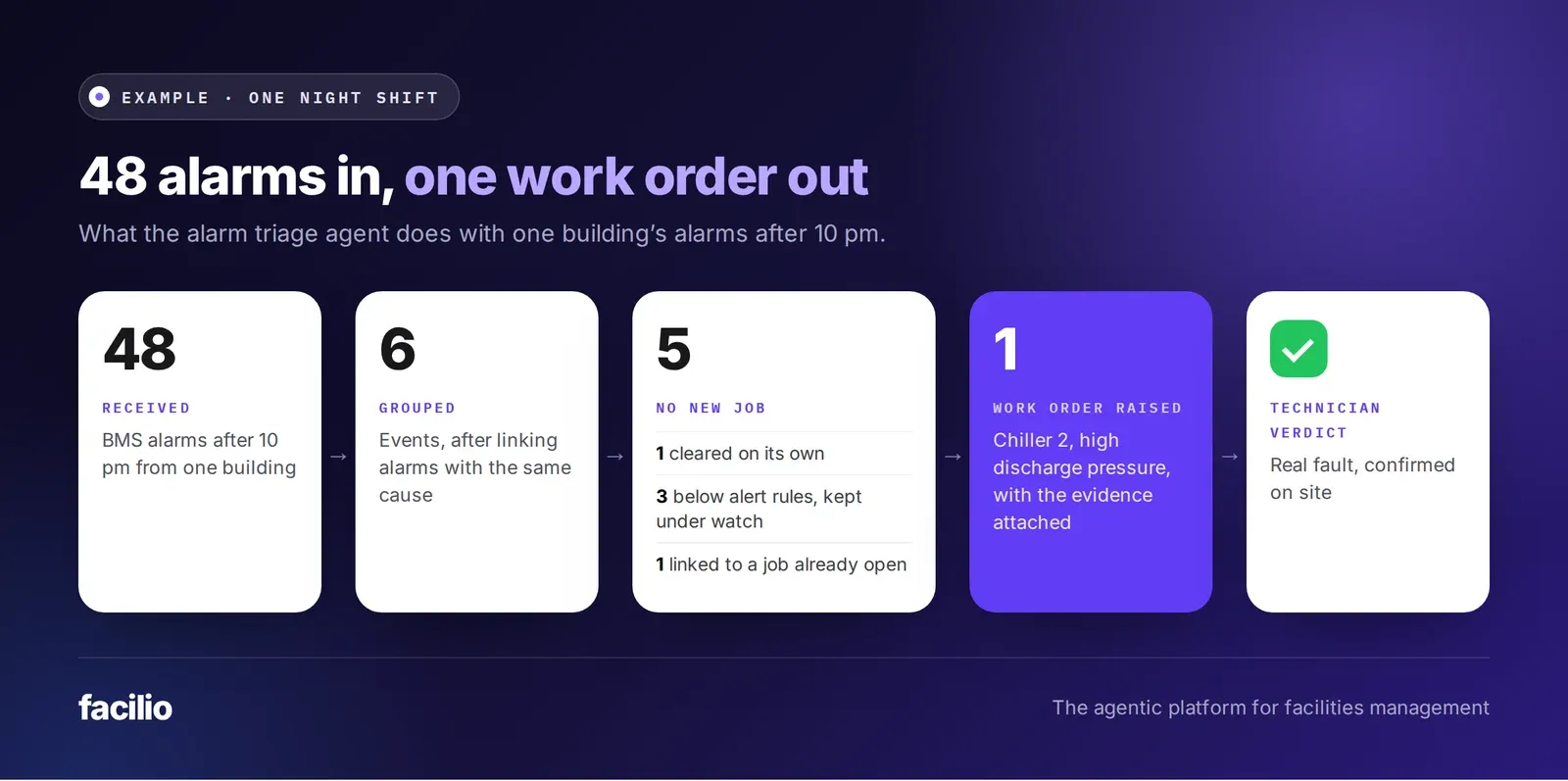
Say a building sends 48 alarms after 10 pm. The agent groups them into 6 events. One closes on its own because a pump's communications came back within two minutes. Three sit below the site's alert rules, so the agent holds them and keeps watching. One belongs to a job that is already open, so it is linked to that job. That leaves one real fault: high discharge pressure on chiller 2.
By morning, your team has one work order to act on, not 48 alarms to read.
How does an AI agent sort thousands of BMS alarms?
The agent works in three passes: correlate, suppress and confirm. Only then does it raise a work order. Inside the rules you set, the agent decides on its own. Anything outside those rules, or anything it is unsure about, goes to a person.
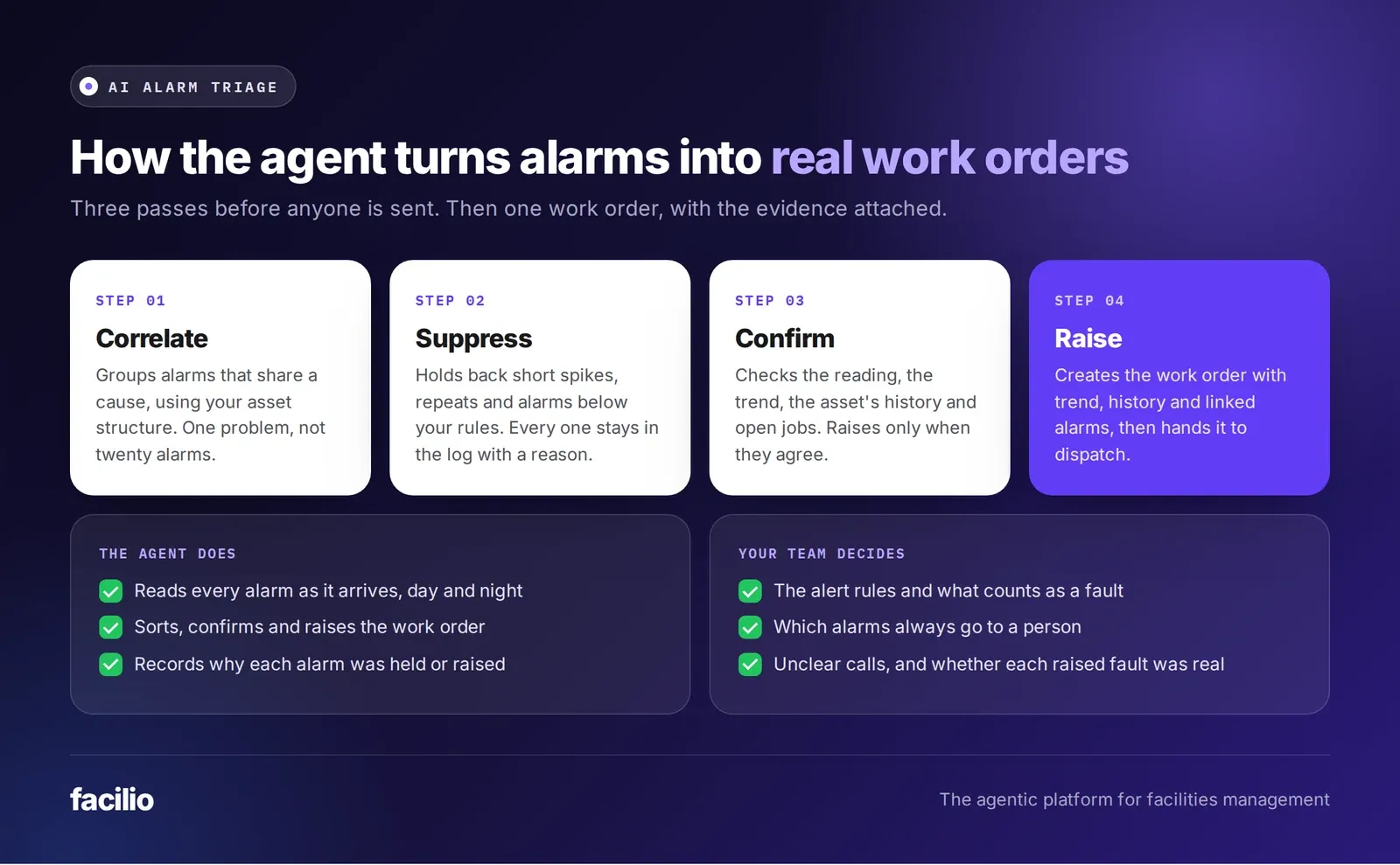
Step 1: Correlate the alarms that share a cause
A chiller trip can set off alarms on the chiller, the pumps and every air handler it serves. The agent groups those into one event using your asset structure.
Step 2: Suppress the noise, without deleting it
Alarms that clear within a set time, sit below your alert rules, or repeat an event already being worked on are held back from the desk. Nothing is deleted. Every held alarm stays in the log with the reason it was held.
Step 3: Confirm the fault before anyone is sent
The agent checks what is left. Is the value still out of range? Is the trend getting worse? Is there already an open job on it? A fault is confirmed only when the evidence agrees.
Step 4: Raise the work order with the evidence attached
The work order goes into your work order management system with the alarm, the trend data, the asset's recent history and the linked alarms.
What does an alarm triage agent need before it can confirm a fault?
It needs your live alarms, your asset structure and enough history to tell a real fault from a short spike.
| What the agent needs | Why it needs it | Where it usually lives |
|---|---|---|
| Live BMS alarms and readings | To see each alarm and the values around it as they happen | Your BMS or controls system |
| Asset structure | To know which chiller serves which pumps, air handlers and floors, so it can group alarms | Asset register in your CMMS |
| Trend history | To tell a passing spike from a value that keeps getting worse | BMS trend logs |
| Open and recent work orders | To link alarms to jobs already in progress and avoid duplicates | Your CMMS |
| Alert rules per site | To know what counts as a fault at each building and how urgent it is | Agreed with your engineers |
| Technician close-out notes | To record whether each raised fault was real, which is how accuracy is measured | Work order close-out in your CMMS |
Most of this already sits in your BMS and your CMMS. The first weeks go into connecting it and agreeing the alert rules for each site.
How accurate is AI alarm triage, and how is it measured?
Accuracy is measured against the technician's verdict. When a work order raised by the agent is closed, the technician records whether the fault was real.
We report alarm triage on the same three numbers we use for measuring AI agent performance across every agent:
- Accuracy: the share of raised work orders the technician confirmed as a real fault.
- Exception rate: the share of alarms the agent handed to a person instead of deciding itself.
- Hours back: desk time no longer spent reading and sorting alarms.
Before go-live, we take a starting point from your current alarms and work orders, and your team checks the agent's calls. After go-live, the numbers are reported against that starting point. We do not quote one accuracy figure for every building, because it depends on each site's alarm set-up.
What happens after a fault is confirmed, and what stays with a person?
Once a fault is confirmed, the work order goes to dispatch. A person stays in charge of anything unclear or safety-related.
Our service dispatch agent picks the technician or vendor by SLA fit, skills, location, workload and past performance, the same way it does when you dispatch work orders with AI. If the job goes to a contractor, AI vendor coordination chases arrival, collects photos and closes the loop.
What stays with your team:
- The rules: your engineers decide what counts as a fault at each site, and which alarms always go to a person. The agent only acts inside those rules.
- Anything outside the rules: it goes to a person by design, not to the agent.
- Low-confidence calls: when the agent is not sure, it hands the alarm to a person with what it found, rather than guessing.
- The record: every action the agent takes is traced, so your team can see why each alarm was raised or held.
See which of your alarms are real faults.
Of all the alarms your buildings raise, see which ones actually need attention.
How does AI alarm triage work with fault detection and diagnostics?
Fault detection and diagnostics finds faults in equipment data. Alarm triage decides which alarms, including those fault alerts, need a person, then turns them into work.
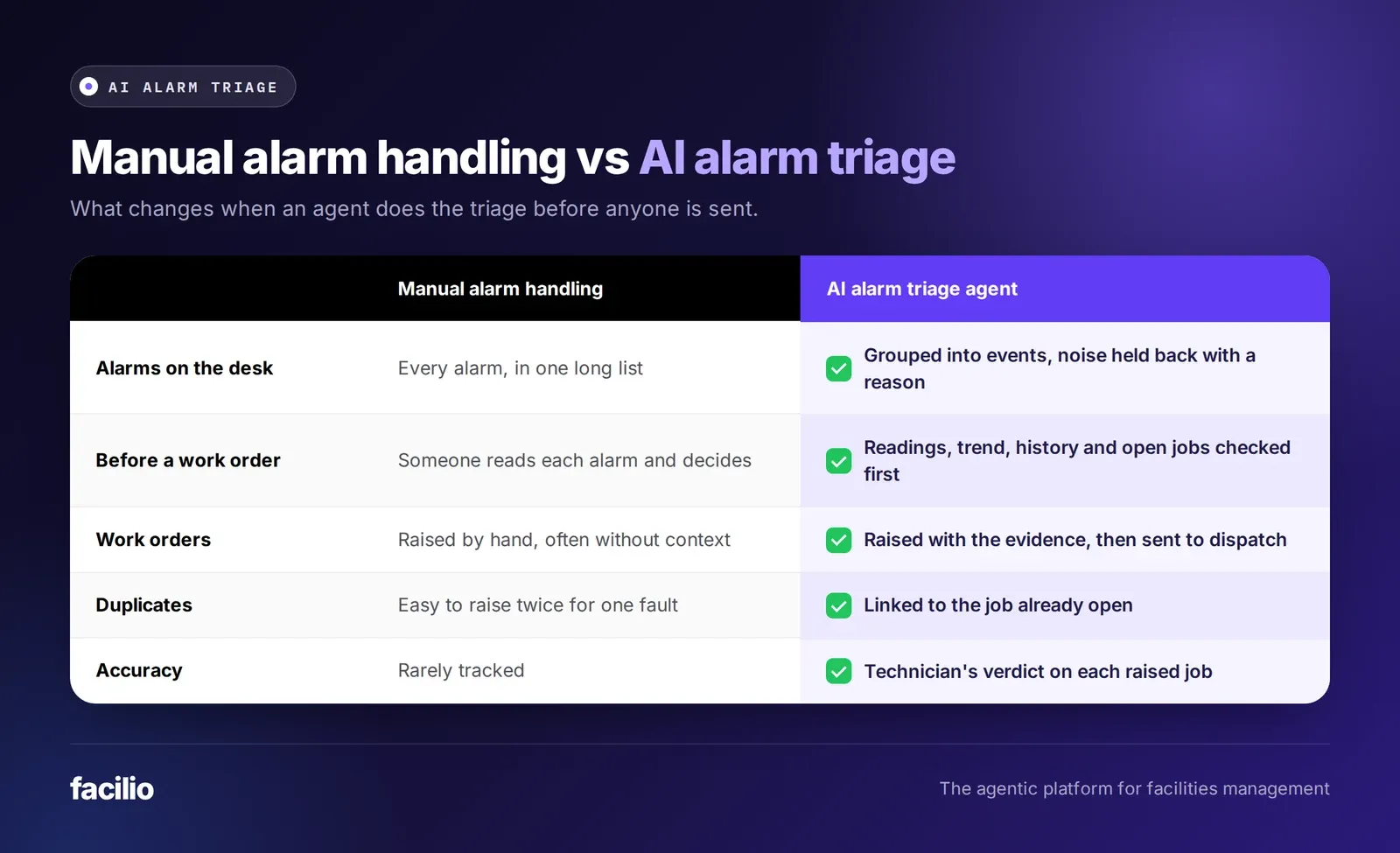
Fault detection and diagnostics software spots problems such as a valve stuck open. The alarm triage agent takes those fault alerts alongside your BMS alarms and raises the real ones as work orders. Here is how alarm handling changes when an agent does the triage:
| Area | Manual alarm handling | AI alarm triage agent |
|---|---|---|
| Alarms on the desk | Every alarm, in one long list | Grouped into events, with noise held back and the reason logged |
| Before a work order | Someone reads each alarm and decides | Readings, trend, asset history and open jobs checked first |
| Work orders | Raised by hand, often without context | Raised with the evidence attached, then handed to dispatch |
| Duplicates | Easy to raise a second job for the same fault | Linked to the job already open |
| Accuracy | Rarely tracked | Checked against the technician's verdict on each raised job |
How does Facilio run alarm triage with AI agents?
Facilio is the agentic platform for facilities management. Trusted by 150 customers across four regions, it already runs live AI agents for facility operations for service intake, dispatch, vendor coordination, invoice processing and building compliance. Alarm triage is an agent our FM Ops Engineers, Facilio's forward-deployed engineers for FM, build for your sites in weeks, because the platform already holds the pieces: your assets, work orders and the agents it hands work to.
It sits on top of your current BMS and CMMS, so nothing is replaced. Our AI also works inside the CMMS itself: once the work order is open, a supervisor can ask what the likely cause of the alarm is and get an answer drawn from the asset's readings and past jobs.
Why it does more than the alarm handling you run today
What FM teams see on Facilio
The agent does the sorting. Our FM Ops Engineers keep the rules tuned to each site. Your engineers decide what counts as a fault. That split keeps the list short and the trust high.
The bottom line: is AI alarm triage worth it?
Yes, if your team gets more alarms than it can read, if work orders from alarms are often false or arrive without context, or if you run several sites from one desk. It matters less if a building sends a handful of alarms a day and someone already reads every one.
A good first step is small. Pick one site and one system, usually HVAC. Pull a month of alarms and the work orders that followed, and count how many alarms became real jobs. That is your starting point. Then have our FM Ops Engineers build the agent for that site and compare its calls with your team's.
See the AI agents live
See your own alarms sorted into real faults
Our FM Ops Engineers build the agent for your sites in weeks, run it with your team and show you the numbers.
Frequently asked questions about AI alarm triage
What is AI alarm triage in building management?
AI alarm triage is an agent that reads every BMS alarm, groups the related ones, holds back the noise and confirms real faults before raising a work order. It sorts the alarms your building already produces. It does not forecast failures.
Can an AI maintenance agent troubleshoot alarms before creating work orders?
Yes. Before raising a work order, our agent checks whether the reading is still out of range, whether the trend is getting worse, the asset's recent history and whether a job is already open. It raises a work order only when that evidence points to a real fault, and attaches the evidence for the technician.
How accurate is AI alarm triage?
It is measured site by site against the technician's verdict on each raised work order. We report accuracy, exception rate and hours back against a starting point taken before go-live. We do not quote one figure for every building, because it depends on each site's alarm set-up.
Is AI alarm triage the same as fault detection and diagnostics?
No. Fault detection and diagnostics spots equipment faults from rules and readings. Alarm triage decides which alarms, including those fault alerts, need a person, then raises and routes the work. They work best together.
Does AI alarm triage work across multiple sites?
Yes. Each site keeps its own alert rules, and confirmed faults from every connected site arrive as work orders in one place, so one desk can work across the portfolio rather than one alarm list per building.
About the Author

More from Facilio