Get jobs to the right person faster
Get jobs to the right person faster as the agent matches technicians or vendors by skills, location and SLA.

Once a work order exists, someone has to decide who does it. That usually means a coordinator reading the job, checking who's on shift, who has the right skills and who's nearest, then phoning round. The service dispatch agent does that matching as each job arrives, by skills, location and SLA, and assigns the right technician or contractor using your rules.
These five short videos follow one emergency at Acme Facilities, work order #27, from the moment it's created to the moment the technician has it on WhatsApp. You decide how much the agent does on its own: it can assign the top match straight away, or line up a ranked shortlist for a coordinator to confirm.
Reads each job against your rules
Every job arrives with different needs. A generator fault at a busy retail site at 6 pm is not the same as a dripping tap in an office, and your dispatch rules say so: which trades can take it, how fast someone must respond and what matters most when choosing. Today those rules often live in a coordinator's head or a spreadsheet, so they're applied well on a quiet afternoon and less well during a busy evening or a shift handover. New jobs can also sit unnoticed in the queue while the coordinator is on the phone, and the SLA clock keeps running either way.

In this demo
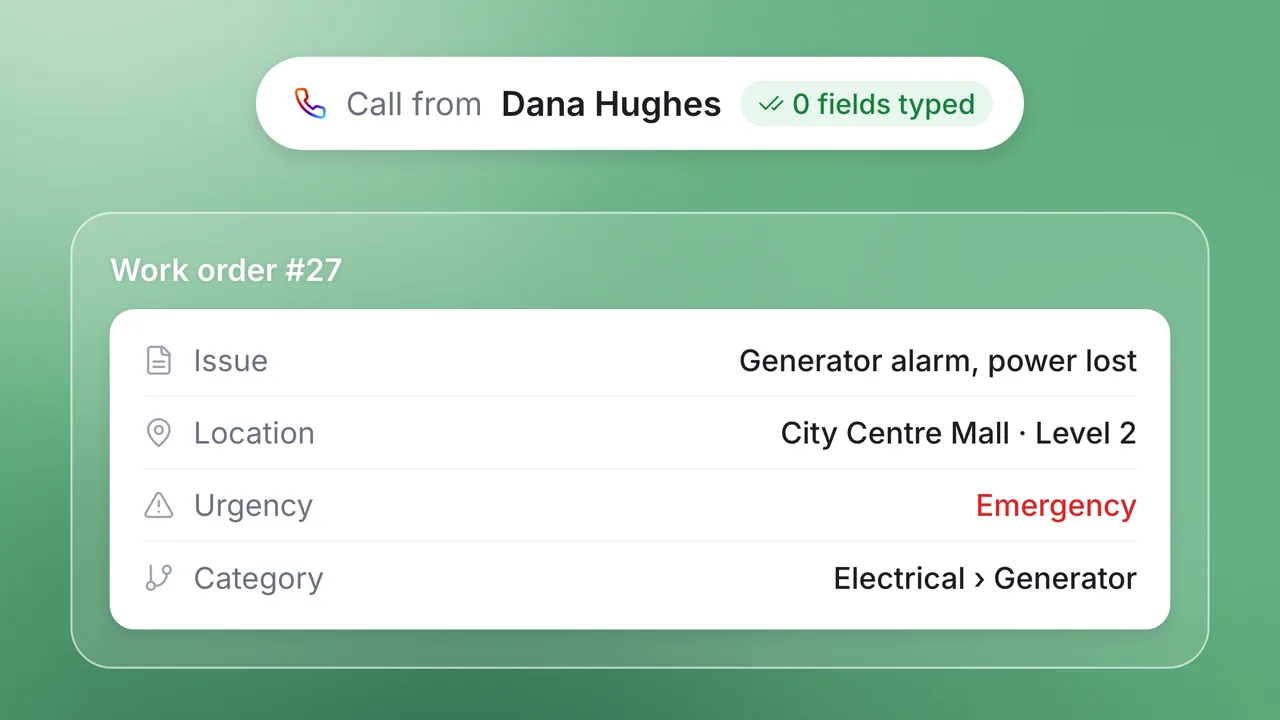
0:00 It's 6:05 pm at Acme Facilities. Work order #27 has just been created: generator alarm and loss of main power at Harbour Point, level 2. It's marked as an emergency, and nobody is assigned yet.
0:18 The service dispatch agent picks it up straight away. Nobody has to spot it in the queue.
0:36 First it reads the job the way a good coordinator would: the category, electrical; the urgency, emergency; the site and floor; the asset, Generator 1; and the SLA, which says someone must respond within the hour.
1:00 Then it checks your dispatch policies. Each one is a rule your team wrote in plain words: which jobs it covers, which technicians qualify and what matters most when choosing between them.
1:20 Work order #27 matches the policy for emergency electrical work at retail sites. A routine electrical job at the same site would have matched a different one.
1:40 The agent notes on the job what it read and why that policy applies, in plain language. If no policy had fitted, it would say so and leave the job for a person to decide.
A coordinator reads each work order and decides from memory which rules apply.
Each job is read the moment it's created and matched to the dispatch policy your team wrote.
Narrows the team by skill and shift
Of the technicians on shift on any evening, only some can work on a generator, and fewer still are free right now. Finding them usually means checking a roster, a skills sheet and certification records, then making a few phone calls to see who is actually available. It's slowest exactly when time matters most, and it's where plenty of dispatch mistakes start: the nearest person gets sent and turns out not to be qualified, or the right person is already tied up on another job. Each wrong call costs time against the SLA and, often, a second visit.

In this demo
0:00 Work order #27 needs a generator specialist at Harbour Point, fast. Fourteen technicians are on shift across Acme's sites this evening.
0:14 Plenty of dispatch mistakes start here: the nearest person gets sent, and it turns out they aren't qualified for the job.
0:30 The agent's first filter is skill. Only technicians with generator experience and a current electrical certification stay on the list. That leaves six.
0:56 Those requirements come from the dispatch policy your team wrote, so the agent applies them the same way on every job, at 6 pm or at 3 am.
1:12 Next, availability. The agent checks who is on shift right now, who's on a break and who's already busy. Two of the six are mid-job across town and one is on a break.
1:40 Three technicians are left: Sam, Omar and Carla.
1:52 The agent also looks at who knows the building. Sam and Carla both work at Harbour Point regularly. Omar has never been there.
2:18 Fourteen down to three, each one qualified and free, with a note on the work order explaining how the list was narrowed.
A coordinator checks the roster, the skills sheet and who's free, often by phoning around.
The list is narrowed to technicians who can do the job and are free to go, with the reasons noted on the work order.
Ranks matches the way you would
When three people could do the job, choosing between them is a judgement call. Who's closest, who has the best record on this kind of work, and whether to send your own engineer or call in a contractor all pull in different directions. Different coordinators weigh those things differently, and the same coordinator weighs them differently at the end of a long shift. The result is uneven response times, contractors called out when an in-house engineer was free, or the reverse, and no consistent way to explain the choice afterwards.

In this demo
0:00 Three Acme technicians could take work order #27: Sam, Omar and Carla. Acme also has an electrical contractor on call for Harbour Point. So who should go?
0:20 A coordinator would weigh it up in their head. The agent weighs it the same way every time, using the factors your team set.
0:40 Acme's policies score five things: skill, distance to the site, availability, past performance on similar jobs and cost. Each policy weights them differently, and for emergency electrical work, distance and availability count most.
1:04 Sam is 1.4 km away and has a strong record on generator faults. Carla is 4 km away. Omar is free, but further out and newer to this kind of work.
1:28 The contractor is scored on exactly the same terms. Tonight, the higher cost and longer travel time put them below Sam and Carla. On a job none of Acme's team could take, they would come out on top.
1:52 When more than one policy applies to a job, the agent weighs each by the priority your team gave it, so your most important rules carry the most weight.
2:10 The result is a ranked shortlist: Sam first, then Carla, Omar and the contractor, each with a score and a sentence explaining it.
2:34 The same weightings on every job, whoever happens to be on duty.
The coordinator picks whoever seems best, and the reasoning depends on who's on duty.
Every qualified candidate, in-house or contractor, is scored on the same weightings and ranked, with the reasoning written down.
Assigns and notifies the technician
Once the right person is chosen, the job still has to reach them. A coordinator sends the details by text or phone call, waits to hear back, then updates the work order by hand so everyone else can see who has it. Details get lost between the message and the record, and the work order can say unassigned long after someone is on the way. If the first choice can't go, the whole process starts again from a blank page, usually while the clock on an emergency is already running.

In this demo
0:00 Sam is the top match for work order #27. What happens next depends on a setting your team controls.
0:12 With auto-dispatch on, the agent assigns the top match itself. With it off, the ranked shortlist waits on the work order for a coordinator to confirm. Acme has it switched on.
0:30 So the agent assigns Sam. The work order in your CMMS updates straight away: assigned to Sam, and marked as assigned by the agent, so anyone looking can see how it got there.
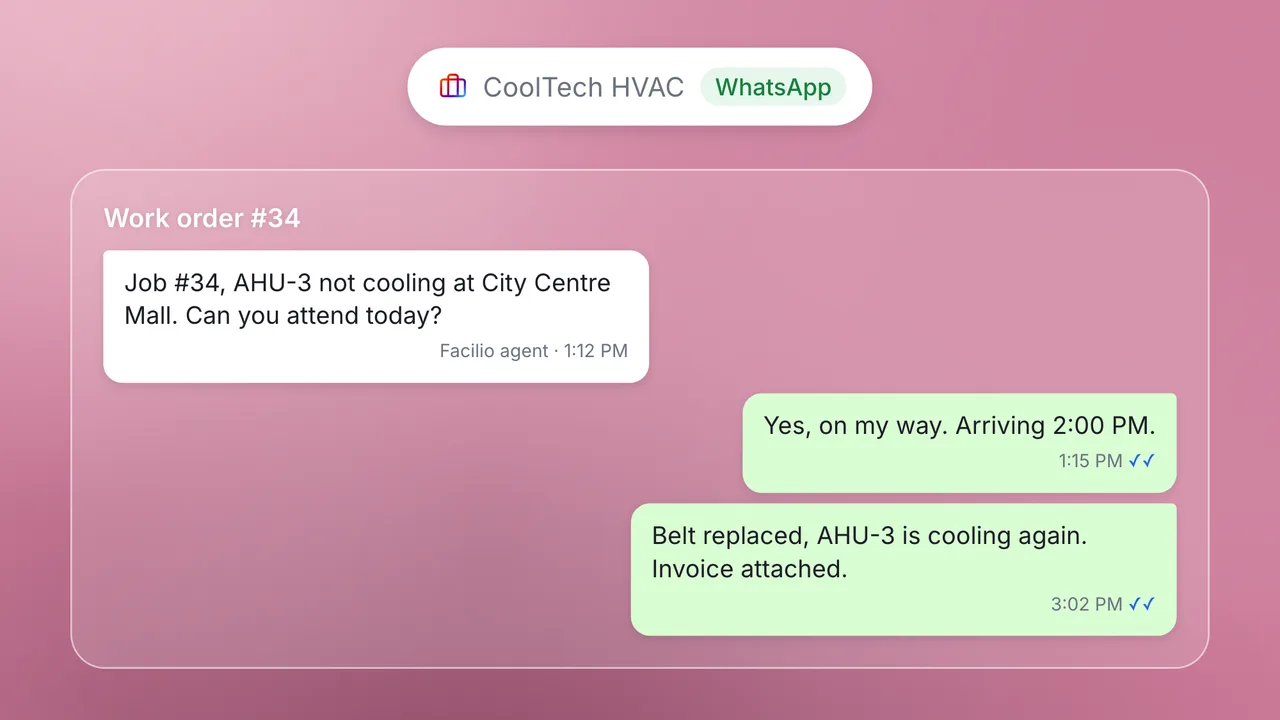
0:58 Sam gets the job on WhatsApp: generator alarm and loss of main power, Harbour Point, level 2, emergency, with the work order attached.
1:18 Work order #27 has gone from unassigned to assigned without anyone picking up a phone.
1:36 If Sam can't go, the coordinator opens the work order, sees Carla and Omar next on the list with their scores, and assigns one of them in a click. The thinking has already been done.
1:58 You decide how much the agent does alone. You can start with recommendations only and switch on auto-dispatch once you trust the ranking.
A coordinator texts or calls the technician, then updates the work order by hand.
The top match is assigned in the CMMS and gets the job on WhatsApp, with the next names lined up if plans change.
Explains every assignment it makes
When a client asks why a job took as long as it did, or a technician asks why they were sent, the honest answer is often that they were free at the time. The real reasons sit in a coordinator's head and a phone log, and they're gone by the next shift. Without a record of each decision, there's nothing to check when a client questions a response time and nothing to learn from when an assignment goes wrong. Improving dispatch then becomes a matter of opinion rather than evidence.

In this demo
0:00 It's 8:30 the next morning. Lena, Acme's operations lead, opens work order #27 to see how last night's emergency was handled.
0:12 Next to the assignment, the agent has left a record of each decision it made.
0:24 First, what it read from the job and the policy it matched: emergency electrical work at a retail site, a generator fault and a one-hour response.
0:42 Then how it narrowed the team: fourteen on shift, six with the right skills and certification, three free at the time.
0:58 Then how it scored the shortlist, and why Sam came out on top: closest to the site, a strong record on generator work and free straight away.
1:14 If Lena disagrees with a decision, she doesn't argue with the agent. She changes the policy or its weightings, and the next job follows the new rule.
1:30 Every assignment, explained in words your team can check.
Assignment decisions live in a coordinator's head and a phone log, so they're hard to review or improve.
Every assignment carries a plain-language record of how the job was read, filtered and scored.
How the service dispatch agent goes live with your team
Our FM Ops Engineers build the service dispatch agent around your policies, trades, contractors and SLAs, then run it with you and keep fine-tuning it. Your coordinators need no training, and jobs reach the right person from the day it goes live.
- 01 We learn your operation Our FM Ops Engineers sit with your team and map how work is assigned today.
- 02 We build the agent Your rules, sites and vendors, built into the agent with you.
- 03 We run it Deployed, maintained and fine-tuned by our team. Your team gets the outcome.