Connected CMMS

 Connected Buildings
 Connected Refrigeration


 Download ebook

 Read case study


 Watch now


 Retail
 Healthcare
 FM Services
 Commercial Portfolios
 Corporate Facilities
 Education
 Data-driven Portfolio Ops
 Facility Management Software
 360° Asset Lifecycle
 Continuous Sustainability

 Blogs
Blogs
 Help docs
 Knowledge Hub
 ROI Calculator
 Ebooks & Guides
 Webinars
 Videos
 Case studies


 About us
 Newsroom
 Careers
 Contact us
 Partners
 Events



The top CMMS software in 2026 are 1. Facilio, 2. IBM Maximo, 3. MaintainX, 4. Fiix, 5. Limble CMMS, 6. eMaint, 7. UpKeep, 8. Corrigo (JLL), 9. FMX, 10. TMA Systems, 11. Accruent Maintenance Connection, and 12. Brightly Asset Essentials.
The best CMMS software for 2026 depends on what you are actually trying to fix. If the problem is technician scheduling, MaintainX and UpKeep solve it cleanly. If it is deep asset lifecycle tracking across heavy infrastructure, IBM Maximo is still the benchmark. But if you run a multi-building portfolio and need the data from your BMS, your finance system, your vendor network, and your field teams talking to each other, you are in different territory.
A computerized maintenance management system (CMMS) tracks work orders, preventive maintenance, and asset records for a maintenance team. Some tools below stay inside that job; others go wider into portfolio operations. Facilio's cmms software sits in that second group. The 12 platforms here span three categories: Connected CMMS built for enterprise portfolios, legacy EAM platforms, and current-generation SMB tools. What follows is how they separate, and how to choose on your actual operating model rather than a feature checklist.
Quick overview
- Price spread: SMB tools run $20 to $120 per user per month; every enterprise platform here is quote-based.
- Where the gaps open: Not work orders, but IoT and BMS integration, no-code configuration, and stakeholder portals.
- Time to live: Days for SMB tools; 12 to 18 months for complex IBM Maximo deployments.
My top CMMS software picks
The fastest read before the detail: match the platform's strongest capability to the pain that costs you most.
- Facilio: Best connected CMMS for enterprise FM, FM service providers, and multi-site portfolios that need vendor and occupant workflows plus AI agents that run in production.
- IBM Maximo: Best for capital-heavy infrastructure and asset-intensive enterprises that need deep EAM and compliance.
- MaintainX: Best for mobile-first distributed teams that need fast technician adoption.
- Fiix: Best for manufacturing and mid-market teams focused on asset tracking and preventive maintenance scheduling.
- Limble CMMS: Best for SMB and smaller FM service providers that want fast setup and strong mobile uptake.
- eMaint: Best for mid-market manufacturing and reliability teams that want configurable, condition-based maintenance.
- UpKeep: Best for small operations prioritizing speed of onboarding and a phone-first workflow.
- Corrigo (JLL): Best for facilities managed inside the JLL service-delivery ecosystem.
- FMX: Best for education and government teams that run on calendar-based scheduling.
- TMA Systems: Best web-based CMMS for higher education and healthcare with established compliance needs.
- Accruent Maintenance Connection: Best for multi-site healthcare and biomedical asset management.
- Brightly Asset Essentials: Best for public sector and municipal asset management at an accessible price.
CMMS software comparison: the top platforms compared
This CMMS software comparison places all twelve tools side by side so you can position each before the full reviews. Read it as a ranked list of the top CMMS software and systems, sorted by category, best fit, pricing, and verified rating, with Facilio first.
| # | Platform | Category | Best for | Starting price | Rating (Capterra · G2) |
|---|---|---|---|---|---|
| 1 | Facilio | Connected CMMS | Enterprise FM, FMSPs, multi-site portfolios | Quote, portfolio-based | 4.0/5 (25) · 4.4/5 (4) |
| 2 | IBM Maximo | Legacy EAM | Capital-heavy infrastructure, large enterprises | Quote (licence + implementation) | 4.2/5 (82) · 4.4/5 (633) |
| 3 | MaintainX | SMB CMMS | Mobile-first distributed teams | From $21/user/mo | 4.8/5 (1,062) · 4.8/5 (1,595) |
| 4 | Fiix | SMB CMMS | Asset tracking, PM scheduling | Free, then from $75/user/mo | 4.5/5 (632) · 4.6/5 (484) |
| 5 | Limble CMMS | SMB CMMS | SMBs and smaller FMSPs | From $28/user/mo | 4.8/5 (757) · 4.8/5 (696) |
| 6 | eMaint | Mid-market CMMS | Manufacturing, mid-market asset mgmt | From $69/user/mo | 4.5/5 (432) · 4.5/5 (301) |
| 7 | UpKeep | SMB CMMS | Mobile-first, quick deployment | From $20/user/mo | 4.6/5 (1,331) · 4.5/5 (1,106) |
| 8 | Corrigo (JLL) | Legacy FM platform | JLL-managed facilities | Quote | 4.4/5 (28) · 4.5/5 (140) |
| 9 | FMX | Mid-market CMMS | Education, government, multi-facility | From $35/user/mo | 4.7/5 (426) · 4.8/5 (46) |
| 10 | TMA Systems | Mid-market CMMS | Higher education, healthcare | Quote | 4.7/5 (28) · 4.5/5 (38) |
| 11 | Accruent Maintenance Connection | Mid/Enterprise CMMS | Healthcare, multi-site portfolios | Quote | 4.4/5 (444) · 4.4/5 (73) |
| 12 | Brightly Asset Essentials | Mid-market CMMS | Public sector, education, municipalities | Quote | 4.4/5 (285) · 4.2/5 (240) |
Pricing and ratings as of October 2026; verify on vendor and review sites before procurement, since CMMS pricing at the enterprise tier changes with contract scope.
How each platform handles the core jobs
Ratings tell you who is liked. This matrix tells you where platforms diverge on the capabilities that decide enterprise FM outcomes: native IoT and BMS integration, no-code configurability, stakeholder portals beyond the internal team, and offline mobile. Yes means native, Partial means available with limits or add-ons, Limited means thin or absent.
| Platform | IoT / BMS integration | No-code config | Stakeholder portals | Offline mobile |
|---|---|---|---|---|
| Facilio | Yes, native | Yes, full drag-and-drop | Vendor, occupant, executive | Yes, offline-first |
| IBM Maximo | Partial (via MAS IoT) | Limited | Limited | Yes |
| MaintainX | Limited | Limited | None | Yes |
| Fiix | Partial (API) | Limited | None | Yes |
| Limble CMMS | Limited | Limited | Vendor only | Yes |
| eMaint | Partial (Fluke) | Partial | None | Yes |
| UpKeep | Limited | Limited | Requesters only | Yes |
| Corrigo (JLL) | Partial (JLL) | Limited | Vendor (within JLL) | Yes |
| FMX | Partial (API) | Partial | Staff request portal | Partial |
| TMA Systems | Limited | Limited | Limited | Partial |
| Accruent Maintenance Connection | Partial (API) | Limited | Limited | Partial |
| Brightly Asset Essentials | Limited | Limited | None | Yes |
Most platforms handle mobile and core maintenance well. The gaps open at IoT and BMS integration, no-code configurability, and multi-stakeholder portals, the capabilities that separate a maintenance tool from an operating system, and the ones worth probing when you plan your cmms integrations.
How I ranked these CMMS platforms
I scored every platform for enterprise and multi-site operations, the teams most likely to be weighing this list, against two scorecards rather than one feature grid.
Capability depth: This scorecard weighs work order and preventive maintenance workflow, automation across calendar, meter, condition-based, and autonomous triggers, integration and no-code configurability, multi-site reporting with stakeholder portals, and mobile-first field usability. Capability claims describe what each product does as its vendor documents it.
Evidence: This scorecard weighs published pricing, current ratings and review counts pulled from G2 and Capterra, recurring review themes, and named customer outcomes traced to a specific deployment. Evaluative claims trace to customer reviews and the vendor's own materials.
How to read the scores: A high placement reflects fit for connected, multi-site operations, not a universal verdict, so a platform ranked lower here can still be the right call for a single site or a specific vertical. Ratings and quotes were checked on G2 and Capterra as of October 2026, so verify every price and rating with the vendor and review profile before you buy.
The 12 best CMMS software platforms, reviewed
Each profile runs the same shape: a snapshot, an overview, the key features, plain strengths and limitations, and what reviewers report. Competitors and Facilio get equal depth.
1. Facilio
Overview: Across deployed portfolios, Facilio customers report 97 percent SLA adherence and a 40 percent reduction in asset downtime, and a US integrated healthcare FM provider went live in 46 days across more than 3 million square feet.
Facilio is a cloud-native Connected CMMS built on a different premise from the rest of this list: where legacy tools manage maintenance in isolation, it connects maintenance with energy, finance, vendor networks, and occupant experience in one operating layer, overlaying the BMS, HVAC, and ERP already in the building rather than replacing them.
Key features
- No-code configuration: Drag-and-drop stateflows let FM teams change workflows, approval chains, and reports without an IT ticket, so the platform adapts to the operation instead of the reverse.
- Work order management: Requests, assignments, SLAs, and closeout run in one lifecycle, so a job is owned and tracked from the moment it is raised to the moment the work is verified.
- Preventive and condition-based maintenance: Schedules fire from calendar, meter, and live equipment data in one engine, which lets a team shift recurring upkeep away from fixed intervals toward real asset condition.
- Native BMS and IoT integration: Fault detection and diagnostics read building-system data directly, so a detected fault becomes an assigned, SLA-tracked work order with no middleware.
- Vendor and occupant portals: Separate portals for vendors, occupants, and executives run on one data layer, a gap most CMMS tools leave to email, and the backbone of Facilio's vendor management software.
- Portfolio-wide dashboards: Real-time SLA, asset performance, and cost visibility roll up across every site in a single view without an analyst or an enterprise-tier upsell.
- Energy and sustainability tracking: Meter and consumption data sit in the same layer as maintenance, so a team can tie equipment health to energy cost rather than reading them from two disconnected systems.
- AI agents in production: Named agents for helpdesk intake, invoice validation, and reporting execute whole workflows end to end rather than drafting text for a person to action.
- Offline-first mobile: Technicians raise and close work without connectivity, and data syncs when the connection returns.
- One platform runs maintenance, vendors, occupants, and energy across every site, removing the tool-stitching portfolio teams otherwise live with.
- Portfolio-based pricing on sites and square footage keeps cost predictable as headcount grows.
- The AI agents close intake, invoice validation, and reporting on their own, so work finishes without a person in the loop.
- Native BMS and energy connectivity turns live building data into maintenance action, which lighter CMMS tools reach only through add-ons.
- Fast multi-site deployment suits FM service providers rolling out client site by client site.
- It is more platform than a single small site with a small team needs, and the value shows only across multiple locations.
- Pricing is quote-based, which is a different model to evaluate than a simple per-user rate.
- Agentic AI is newer to market than legacy EAM tooling, so buyers should see the specific agents live before signing.
What reviewers say: Reviewers coming off heavier or IT-centric systems single out how little training the platform needs, on a smaller, enterprise-specific review base.
“Facilio is super easy to use especially when compared to what we used to use which was more of an IT ticketing system.”
— Dan B., VP Real Estate & Construction (G2, Jul 2025)
Verdict: If you are leaving a legacy EAM that has become too rigid to configure, or stitching several SMB tools together across sites, Facilio is the one option here built for the operating portfolio rather than the maintenance team.
See what a portfolio looks like when one platform runs it
Maintenance, vendors, occupants, and energy across every site, with AI agents, in one demo.
2. IBM Maximo
Overview: IBM Maximo is the longest-established name in enterprise asset management, now delivered as web-based software through the Maximo Application Suite while still supporting on-premise and hybrid deployment. Its strength is asset lifecycle depth: depreciation, capital planning, regulatory compliance, and predictive maintenance through the suite's IoT layer. If an asset costs millions and runs for 25 years, Maximo has the depth for it.
Key features
- Deep asset lifecycle: A single work and asset record spans millions of assets with full lifecycle cost and history, the capability that defines enterprise asset management software.
- Work order management: Job plans, safety plans, and labor scheduling attach to every work order, so a complex industrial job carries its procedures and resources with it.
- Predictive maintenance: Sensor and analytics data drive condition-based strategies through the Maximo Application Suite IoT module.
- Reliability engineering: Failure-mode analysis and asset performance management support programs lighter CMMS tools do not attempt.
- Inventory and MRO management: Storerooms, spare-parts planning, and procurement tie maintenance demand to stock across many sites at once.
- Compliance and audit trails: Strong regulatory support for utilities, defence, and heavy industry.
- Deployment flexibility: The Maximo Application Suite runs in the cloud, on-premise, or hybrid, so a regulated operator keeps data where its policy requires.
- Broad ecosystem: Established connectors integrate with virtually every major ERP.
- The deepest asset and reliability functionality on this list, from lifecycle tracking to FMEA.
- Stable and dependable for large, complex asset estates under regulatory scrutiny.
- Highly configurable to specialized industrial workflows.
- Enterprise-grade scalability across millions of assets and many sites.
- Per Gartner Peer Insights, users flag steep learning curves and costly customization.
- Implementation runs 12 to 18 months for complex deployments.
- The interface across modules is widely described as dated.
- For mid-market FM teams, you pay for industrial-scale complexity and use a fraction of it.
What reviewers say: Teams running Maximo at utility scale praise its depth; the recurring knock is complexity and the cost of configuration.
“The platform is extremely feature-rich, but that also means onboarding can take significant time and planning.”
— Arkajit D., CTO (G2, May 2026)
Verdict: Maximo earns its reputation for industrial asset management at scale. For FM-led operations that do not need that depth, the cost and timeline are hard to justify, which is why most teams reach the ibm maximo alternative question within the first year.
3. MaintainX
Overview: MaintainX built its reputation on one thing: making work orders easy for frontline technicians. A chat-style interface, visual SOPs, and fast mobile onboarding mean teams are productive in days. For operations managers who have failed at a CMMS rollout before because technicians would not use the tool, adoption is the pitch.
Key features
- One-minute mobile work orders: Technicians create, assign, and close jobs from a phone in under a minute.
- Threaded work-order messaging: Real-time chat attaches to each work order, keeping the conversation and the job history in one place.
- Digital SOPs and safety checklists: Procedures become interactive, AI-assisted checklists that standardize recurring tasks.
- Preventive maintenance: Time and meter-based schedules with templates for common asset types.
- Asset management: Asset records carry history, documents, and QR codes, so a technician scans an item and sees its full maintenance trail on site.
- Parts and inventory: Spare-parts tracking ties consumption to work orders.
- Reporting and dashboards: Prebuilt reports on work-order status, cost, and technician workload give supervisors a live read without a spreadsheet export.
- The easiest mobile app and onboarding in this group, which drives fast frontline adoption.
- Communication threaded onto the work order keeps job context in one place.
- A usable free tier and free requester accounts lower the barrier to entry.
- Advanced reporting and customization sit behind higher tiers.
- Asset hierarchies flatten on complex, multi-site structures.
- No vendor or occupant portals; communication stays internal.
- Per-user pricing climbs as the team and tier grow.
What reviewers say: Ease of use and visibility draw consistent praise; tier-gated reporting is the recurring complaint.
“It has improved visibility across all work orders, allowing us to track status, prioritize tasks, and manage workload more effectively.”
— Jason L., Director of Solutions (G2, Mar 2026)
Verdict: A strong fit for a lean, mobile-first team on one site or a few. The maintainx cmms alternatives question tends to arrive the moment you need clean multi-site reporting or external intake.
4. Fiix
Overview: Fiix, now part of Rockwell Automation, offers a clean, approachable CMMS with solid asset management and preventive maintenance scheduling. A free plan makes it accessible for teams new to CMMS, and Rockwell's backing adds credibility in manufacturing contexts.
Key features
- Deep PM scheduling: Triggers on calendar, usage, or events, with nested multi-asset tasks that bundle an inspection route into one job.
- Work order management: A central work-order board tracks requests, priorities, and status, so a maintenance lead sees the full plant backlog at a glance.
- Asset management: Structured records with downtime tracking and maintenance history built for industrial plants.
- ERP and industrial integrations: An integration hub connects maintenance to the ERP, MES, and production systems a plant runs.
- Foresight AI insights: Machine-learning analytics flag asset risk and recommend PM-frequency changes on higher tiers.
- Parts and inventory: Storeroom tracking ties spare-parts consumption to work orders.
- Mobile maintenance app: Technicians scan assets, log work, and attach photos from the floor, though reviewers rate the app below the desktop product.
- Reporting and dashboards: Configurable dashboards report on asset health, PM compliance, and maintenance cost for reliability reviews.
- Preventive maintenance scheduling is deep and flexible, the capability plants pick it for.
- An intuitive interface with a manageable learning curve.
- A free plan for small teams.
- ERP and industrial integrations connect maintenance to finance and production.
- Configurability does not scale to enterprise FM complexity.
- Reporting customization and vendor management are thin.
- There are no occupant or stakeholder portals.
- The mobile app rates below the desktop product.
- Advanced analytics such as Foresight sit on higher tiers, so the AI story costs more than the base plan suggests.
What reviewers say: Reviewers find it capable for mechanics once configured; the mobile app trails the desktop scores, a pattern the fiix cmms review breaks down in detail.
“The system's layout is intuitive, and the functionality is well designed to support daily operations without unnecessary complexity.”
— Marvin B., Millwright (G2, Apr 2024)
Verdict: A strong pick for structured preventive maintenance and ERP integration in manufacturing. The wrong tool for an FM or real estate portfolio, or a mobile-primary team.
5. Limble CMMS
Overview: Limble consistently scores among the highest in the category on usability, with drag-and-drop scheduling, a clean mobile app, and onboarding fast enough to be live in days. A vendor portal at this price point is a genuine differentiator, and for smaller FMSPs managing a handful of client sites it gives reasonable multi-site visibility without enterprise complexity.
Key features
- Mobile work orders: Technicians create, assign, and close work with photos and QR scanning, the heart of its fast adoption.
- Preventive maintenance: Calendar and meter-based schedules automate recurring tasks.
- Work request portal: Staff and residents submit requests through a simple URL with no login, which keeps intake open without buying seats.
- Asset management: An asset hierarchy with downtime and cost tracking backs reliability decisions.
- Parts and inventory: Spare-parts tracking links stock to work orders and flags low counts before a job stalls.
- Vendor portal: Included at a lower tier than most SMB tools offer it.
- Dashboards and reporting: Custom KPI and audit-trail reports that managers call out.
- Fast to set up and train, the most consistent theme in its feedback.
- A well-liked mobile app technicians use willingly.
- A vendor portal rare at this price point.
- No-login work request URLs widen intake from staff and residents without extra seat cost.
- Responsive customer support.
- The architecture is SMB-first; reporting depth hits a ceiling at scale.
- Multi-site and benchmarking sit at the enterprise tier.
- No occupant or executive portal.
- Default roles cannot be removed, which some administrators find rigid.
What reviewers say: Usability and support draw the praise; reporting depth is the upgrade trigger, as the limble cmms review covers tier by tier.
“The work request URLs are easy for both staff and residents to use.”
— Eric S., Senior Director of Maintenance (G2, Aug 2026)
Verdict: A strong pick for an SMB or smaller FMSP that wants speed and adoption over enterprise breadth. Portfolio-scale operations with multi-stakeholder workflows will reach its ceiling.
6. eMaint
Overview: Part of Fluke Reliability, eMaint sits between SMB CMMS and enterprise EAM. It is highly configurable, with custom workflows, detailed asset hierarchies, compliance reporting that satisfies regulators, and a native tie-in to Fluke condition-monitoring hardware. The cost of that flexibility is a heavier setup and a learning curve.
Key features
- Configurable work orders: Routing and statuses bend to match regulated processes rather than forcing the process to the tool.
- Preventive maintenance: Time and meter-based schedules keep recurring upkeep on plan across detailed asset hierarchies.
- Asset hierarchies: Multi-level asset records track cost, history, and parent-child relationships for reliability analysis.
- Condition-based maintenance: Fluke sensor and vibration data feed condition data straight into maintenance decisions.
- Audit trails by default: Every action is logged, so compliance reporting is a print job rather than a reconstruction.
- Inspections and compliance rounds: Scheduled routes capture regulated checks, the kind of inspection management software an audit program depends on.
- MRO and inventory: Storeroom and purchasing workflows keep stock aligned to demand.
- Interactive dashboards: Configurable KPI dashboards surface reliability and cost trends, though administrators usually build them.
- Highly configurable to specific reliability workflows.
- Strong asset-history and maintenance-cost tracking.
- The Fluke integration ties condition-monitoring hardware into maintenance.
- Well-regarded customer support.
- A steep learning curve and complex setup, the flip side of its flexibility.
- An interface that feels dated next to newer mobile-first tools.
- No FM portfolio layer for occupants or energy.
- Reporting often needs administrator help to use well.
What reviewers say: Configurability and depth draw the praise; the dated interface draws the knock, a trade the emaint cmms review weighs in full.
“X5 is a big improvement in UI, functionality and overall performance of the app.”
— Felix W., Manager, Business Process Management (G2, Apr 2024)
Verdict: The right answer when configurability and audit depth decide the purchase and you have time to set it up well. Teams that prize fast adoption and a modern interface will feel the learning curve.
7. UpKeep
Overview: UpKeep's strength is simplicity. A clean mobile interface, fast setup, and a low learning curve mean teams are working within days, and free requester accounts widen intake at no per-seat cost. For a single site or small multi-site operation that needs to move fast and keep technician adoption high, it delivers on its core promise.
Key features
- Mobile-first work orders: The phone is the primary interface, so technicians work a full day without a laptop.
- Unlimited free requesters: Anyone in the organization reports problems at no per-seat cost.
- Preventive maintenance: Recurring time and meter-based PMs with templates for common assets.
- Asset management: Asset records hold history, documents, and status, so a technician sees what an item needs before starting a job.
- Parts tied to jobs: Spare-parts tracking links consumption to work orders.
- Field documentation: Photos, barcode and QR scans, and asset history attach to the job on site.
- Reporting and analytics: Dashboards track work-order volume, cost, and downtime, with the deeper analytics gated to higher tiers.
- The mobile experience is the product's center of gravity and its strongest asset.
- Onboarding is fast and requester accounts are free and unlimited.
- Work-order and parts management are clean for field teams.
- Analytics and automation sit behind higher tiers.
- Per-user pricing gets expensive as the team grows.
- No vendor or occupant portals; multi-site reporting is thin.
- IoT and predictive features are separate products.
What reviewers say: The mobile app is the standout praise and per-user cost at scale the standout complaint, the pattern behind the best upkeep alternatives search.
“Logging findings on the spot during an inspection, with photo attachments, and routing them directly to the responsible team ensures nothing goes astray.”
— Sebastian T., Field QA Specialist (G2, Sep 2026)
Verdict: A clean pick for a field-heavy team that lives in the app. Watch the per-seat math and the tier jumps as you grow.
8. Corrigo (JLL)
Overview: Corrigo is JLL's cloud-based CMMS and work-order platform, and it is strong within that context. The vendor management and work-order dispatch functionality are purpose-built for JLL's service-delivery model, so for organizations already embedded in the JLL ecosystem it is the path of least resistance.
Key features
- Work order and dispatch: Strong management and vendor dispatch for JLL-managed operations.
- Preventive maintenance: Scheduled PM keeps equipment upkeep on plan across the managed portfolio.
- Vendor network: Predefined integrations within the JLL vendor ecosystem.
- SLA tracking: Solid tracking for outsourced FM models.
- Mobile work order app: Technicians and dispatched vendors receive, update, and close jobs from the field.
- Analytics: Power BI reporting tracks the full equipment lifecycle.
- Enterprise scale: Established across JLL's client base.
- Purpose-built work order and vendor dispatch for outsourced FM.
- Predefined vendor-network integrations within JLL.
- Reliable SLA tracking for managed-services delivery.
- Proven at enterprise scale inside the JLL base.
- The platform is shaped by JLL's operating model, so configuration outside it carries cost.
- Integrations beyond the JLL vendor network need custom work.
- Organizations operating independently of JLL often find it rigid.
- Reporting outside predefined processes is limited.
What reviewers say: Reviewers value the reporting and lifecycle tracking; limited customization outside JLL-defined processes is the recurring complaint, which drives most corrigo alternatives searches.
“Power BI is one of the most valuable features Corrigo offers, and we track the full lifecycle of our equipment.”
— Daniel M., Facilities Support Specialist (G2, Mar 2025)
Verdict: The natural choice inside the JLL ecosystem. Independent operators that need to configure beyond JLL's model should weigh the rigidity carefully.
9. FMX
Overview: FMX is built around a calendar, which makes scheduling and event-based facility work intuitive, with particular strengths in education and government. It has grown into transportation and fleet management, which differentiates it for public-sector buyers, and its support consistently earns high marks.
Key features
- Calendar-based scheduling: The operation runs from one shared calendar, making event-based and recurring work easy to plan.
- Staff request portal: Teachers, staff, and occupants submit requests through a simple branded form.
- Preventive maintenance: Time-based PM scheduling keeps recurring building work on track.
- Asset and equipment tracking: Asset records hold warranty, cost, and maintenance history for the facilities a district runs.
- Maintenance and transportation: Combined maintenance, scheduling, and fleet management in one system.
- Inventory management: Parts and supply tracking ties consumption to work orders and flags reorder points.
- Mobile access: Staff and technicians submit and update work from a phone or tablet across campus.
- Board-ready reporting: Activity rolls into summaries a facilities director can take into a budget conversation.
- Calendar-based scheduling is intuitive for facilities and event-driven work.
- Maintenance, scheduling, and transportation live in one system.
- Transparent pricing and high-touch support.
- It fits education and government workflows specifically.
- A simple branded request portal makes intake easy for non-technical staff like teachers and office managers.
- It does not scale to enterprise FM complexity.
- BMS integration and no-code workflow automation are limited.
- Multi-stakeholder portals, reporting, and API depth trail enterprise-tier platforms.
What reviewers say: Support quality and calendar scheduling are the most-cited strengths among education and facilities teams, as the fmx cmms review details.
“A great tool for keeping our operations organized and responsive.”
— Johnny P., Director, Facilities Operations (Capterra, Sep 2025)
Verdict: A natural fit for a school, district, or facilities team built around a calendar. Not the tool for industrial reliability or a global multi-site portfolio.
10. TMA Systems (WebTMA)
Overview: TMA Systems has a long track record in higher education and healthcare, two sectors with specific compliance and regulatory maintenance requirements. Its flagship WebTMA is a web-based CMMS that can be vendor-hosted or self-hosted depending on your data policy, covering work orders, preventive maintenance, and inventory with accreditation compliance reporting.
Key features
- Work order and PM: Core management with inventory and compliance reporting.
- Asset and space management: Equipment and room-level records track assets across the buildings a campus operates.
- Institutional ERP integration: Established ties to Banner and PeopleSoft.
- Compliance reporting: Built for accreditation and regulatory maintenance.
- Inventory and parts: Storeroom tracking keeps spare parts aligned to scheduled and reactive work.
- Deployment choice: Vendor-hosted or self-hosted to match data policy.
- Support organization: Solid support for complex implementation contexts.
- A strong track record in higher education and healthcare.
- Work order, PM, and inventory with compliance reporting.
- Established integration with institutional ERP systems.
- A deployment choice that suits data-residency requirements.
- It is not a modern, no-code platform; configuration needs technical involvement.
- The interface reflects an older generation of enterprise software.
- Real-time IoT integration is limited.
- Mobile capability trails newer tools.
What reviewers say: Institutions value the depth and the move off legacy databases, as detailed guides on cmms for schools describe for the education segment.
“Compared to our previous maintenance database software, we are light years ahead.”
— Mark S., Facilities Coordinator (Capterra, Jun 2026)
Verdict: A sound choice for a university or hospital with established CMMS needs and moderate complexity. Teams prioritizing modern UX or real-time IoT will feel its age.
11. Accruent Maintenance Connection
Overview: Accruent's Maintenance Connection focuses on healthcare and asset-intensive multi-site portfolios. Its strength is the depth of preventive-maintenance and compliance tracking that healthcare biomedical teams need for regulatory inspections and Joint Commission requirements, with a choice of cloud or on-premise deployment.
Key features
- Work order management: Requests, assignments, and completion run in a central board built for multi-site maintenance teams.
- Biomedical workflows: Purpose-built maintenance for healthcare equipment.
- Preventive maintenance: Scheduled PM keeps regulated upkeep on plan across facilities.
- PM compliance tracking: Detailed scheduling for regulatory requirements.
- Asset-lifecycle depth: Structured hierarchies track assets across their full lifecycle, a deeper take than most CMMS tools and the heart of asset lifecycle management.
- Multi-site reporting: Native multi-facility support with centralized reporting.
- MRO inventory: Storeroom management with demand forecasting.
- Reporting and dashboards: Configurable reports surface PM compliance, cost, and asset performance for inspections.
- Deployment flexibility: A cloud or on-premise choice suits regulated environments and data-residency rules.
- Strong healthcare and biomedical maintenance workflows.
- Detailed PM compliance tracking for regulators.
- Asset and MRO inventory depth beyond most mid-market tools.
- A cloud-or-on-premise choice for regulated environments.
- Outside healthcare and asset-intensive contexts, the complexity is hard to justify.
- Implementation typically requires consulting support.
- The interface is dated and click-heavy for routine tasks.
- The mobile app is a paid add-on.
- Pricing is quote-based, so budgeting takes a sales conversation rather than a published rate.
What reviewers say: Asset depth and support draw the praise; onboarding complexity is the recurring friction, which is why the best accruent alternative question comes up for teams outside its core verticals.
“I have used eight different CMMS systems, and Maintenance Connection is the easiest system to use, while providing the most usable information.”
— Tracy B., Director of Maintenance & Engineering (Capterra, Feb 2026)
Verdict: A fit for a healthcare network or asset-intensive operation that needs compliance depth, or an on-premise option. For broader FM, lighter and more modern platforms fit better.
12. Brightly Asset Essentials
Overview: Brightly, formerly Dude Solutions and now a Siemens company, built its reputation in public-sector FM, and that remains its home turf. Asset Essentials offers solid work order management, preventive maintenance, and asset tracking at an accessible price point, with established support for public-sector procurement.
Key features
- Work order management: Solid core management for smaller portfolios.
- Preventive maintenance: Reliable PM scheduling and asset tracking.
- Asset management: Asset records hold condition, cost, and history for public-sector estates.
- Inventory and parts: Parts tracking ties stock to work orders for teams with lean storerooms.
- Mobile app: Field staff log and close work from a phone across dispersed municipal sites.
- Public-sector fit: Established relationships and procurement support.
- Ease of use: Minimal IT overhead for teams with limited resources.
- Reporting: Standard dashboards for operations and budgets.
- A strong public-sector track record and established procurement relationships.
- Easy to use with minimal IT overhead.
- Good asset tracking and PM scheduling for smaller portfolios.
- It is not built for enterprise complexity.
- IoT and BMS integration is limited or absent.
- Advanced analytics and multi-stakeholder portals are thin.
- Reporting flexibility becomes a constraint as organizations grow.
What reviewers say: Reviewers value the public-sector fit and cost; the interface and reporting flexibility are the recurring knocks, which the brightly cmms review covers in full.
“Interface needs updating and a refresh. Cost is average, and other options are cheaper depending on specific needs.”
— Mark D., Director of Facilities (Capterra, Sep 2025)
Verdict: A sound choice for a municipality or small public-sector team on a budget. Growing or enterprise portfolios will outgrow its ceiling.
Which CMMS fits your operation
The right CMMS depends on three things: your scale, your stakeholder complexity, and where you sit on the reactive-to-predictive maturity curve. Match your profile to the pick, and let the shortlist collapse.
- Single-site or small multi-site, fast adoption: MaintainX, UpKeep, or Fiix get you live quickly. Do not over-engineer the choice.
- Mid-market (10 to 50 sites, moderate complexity): Limble, eMaint, FMX, or Accruent depending on your vertical. Run a proof-of-concept with your own data first, since mid-market tools vary more in practice than on paper.
- FM service provider or enterprise portfolio with multi-client, real-time client reporting: The SMB tools here surface as limitations within 18 months. Facilio is purpose-built for this operating model (see the FMSP section below).
- Legacy EAM replacement (Maximo, Oracle EAM, SAP EAM): The question is connect-and-unify versus rip-and-replace. The automate facility management workflows guide covers the integration-first approach replacing big-bang migrations.
- Sustainability and energy-driven: Selection has to account for BMS and energy connectivity from the start, not as an add-on, and the best energy management software guide covers the overlap with CMMS.
The platforms that win in 2026 are the ones that make data from across your operation usable, not just stored. That is the test worth applying to any demo you run.
Best CMMS software for small business
For a small business or single-site team, the best CMMS software is the one your technicians will actually open on a phone, not the one with the longest feature list.
The clearest starting points are UpKeep and MaintainX, both built for fast onboarding and mobile-first work, with Limble close behind for teams that want slightly deeper reporting out of the box. All three onboard in days, publish per-user pricing, and offer free tiers or free requester accounts, so a small team can prove value before committing budget.
Model the bill at the size you are growing into, since per-user pricing that looks cheap at ten seats climbs at sixty, and the cmms pricing breakdown shows where the tier jumps land. Skip the enterprise-grade platforms here until multi-site reporting, vendor governance, or BMS integration becomes a hard requirement rather than a nice-to-have.
Best web based CMMS software for facility management and FM service providers
FM service providers and integrated facilities management companies have different requirements than in-house teams, and this is where web based CMMS software stops being a deployment preference and becomes a requirement: a client portal only works if your customers can reach the system from outside your network. For a provider, the CMMS is not an internal tool, it is client-facing.
What FMSPs need that most CMMS platforms do not address:
- Multi-client, multi-site architecture: Each site belongs to a different client with its own SLA, budget visibility, and reporting.
- Vendor management at scale: Contractor dispatch, performance tracking, compliance verification, and invoice reconciliation across hundreds of vendors.
- Client transparency portals: Clients want to see their own site status without a phone call or a month-end report.
- Fast client deployment: Providers cannot spend a year implementing before delivering value to a new client.
- Margin visibility: The CMMS must link work completed and SLA met to cost per site and profitability per contract.
Most platforms in this list are built for a single-organization buyer. Facilio was designed with FMSP operations as a first-class use case, which is why providers on the platform report 97 percent SLA adherence and a 30 percent reduction in reactive call volumes across deployments, and its facility management software carries the client-portal and multi-tenant layer most SMB tools lack. The single question that eliminates most of this list: can a client log in and see their site's maintenance status, SLA compliance, and open work orders in real time, without calling you? For the operating model behind that, the client retention for facility management service providers guide covers it in depth.
How to compare CMMS software
Most CMMS comparisons score features. A better CMMS comparison scores operating-model fit, because two platforms can both list work order management and deliver completely different outcomes. Five factors separate a tool that gets used from one abandoned after six months, and each is a subtopic to weigh in the demo.
Core maintenance workflow: Look for fast assignment, custom statuses, priority tagging, and a clean request portal so nothing lives in an inbox. On a strong tool, a request becomes an owned, tracked job in seconds, the core of any work order software. Weak workflow here undermines everything built on top of it.
Automation depth: Calendar and meter-based preventive maintenance is table stakes. Condition-based triggers that fire work from live equipment data move a program from reactive to predictive, and autonomous agents move it from predictive to hands-off. Ask where a tool sits on that ladder today, not on its roadmap.
Integration and configurability: Check whether you can change a workflow without an IT ticket, and whether the tool connects to your BMS, ERP, and energy systems natively or through costly custom work. This is where enterprise outcomes are won or lost, and where a headline price hides the real bill.
Multi-site reporting and stakeholder portals: Portfolio rollups, per-site SLA profiles, and portals where vendors, occupants, and executives each see their own view separate a portfolio platform from a single-site tool. Most CMMS tools stop at single-site dashboards, so confirm this runs across your whole estate.
Mobile usability and evidence: Offline capture, photo uploads, and QR scanning through a full shift decide field adoption, the strongest predictor of whether a rollout sticks, so test the mobile cmms app in a technician's hands before you sign. Weigh published pricing and current G2 and Capterra ratings alongside what you see.
Keep one demo scorecard: ask each vendor to show every capability live, in a production customer environment, not a sandbox, and walk the cmms implementation guide before you accept any first-year number.
Common mistakes when choosing CMMS software
Most CMMS decisions go wrong before the demo, in how the requirement is framed. These are the six errors that surface most consistently in enterprise evaluations, and what to do instead of each.
- Evaluating on features instead of operating-model fit: Two platforms can both check work order management and deliver completely different outcomes, because what decides the result is how work actually flows in your operation, not how long the feature list runs. The fix: Start from a written description of how maintenance moves from request to close, who the stakeholders are, and how you report across sites, then test whether each tool supports that natively or forces a workaround.
- Underestimating total cost of ownership: Licence fees are visible; implementation consulting, data migration, integration development, training, and ongoing IT support are not, and for legacy EAM the first-year total is routinely three to five times the headline licence. The fix: Ask for a fully loaded cost model covering licence, implementation, integrations, data migration, and year-one IT overhead, then ask for references who can confirm the estimate held.
- Buying for today's headcount, not tomorrow's scale: The tool that fit at 10 sites or 50 vendors becomes a constraint within 18 to 24 months, when the portfolio reporting, multi-client architecture, and automation the larger operation needs turn out not to be there. The fix: Ask each vendor to walk through the platform at three times your current scale, naming portfolio dashboards, multi-site SLA management, and the cost of adding sites and users, and treat an inability to show it at that size as a signal.
- Treating implementation as a technical project, not change management: Failed rollouts are rarely about the technology. They are about technicians who never adopted the mobile app, supervisors who kept their spreadsheets, and procurement teams that kept raising POs outside the system. The fix: Ask how the vendor supports adoption during rollout and for evidence that technician uptake was high in comparable deployments, then budget for the internal change work the cmms change management playbook lays out step by step.
- Choosing a platform that does not match your vendor-management complexity: Operations with large contractor networks often pick a tool that handles internal work orders well but has no real vendor portal, so vendor communication falls back to email, invoice reconciliation turns manual, and compliance tracking ends up in a spreadsheet beside the CMMS. The fix: If vendor management is central to your operation, make it central to the evaluation, and ask to see the vendor portal demoed from the contractor's side: how they receive work, update status, submit invoices, and track compliance documents.
- Accepting an AI pitch without a production proof point: Every vendor has an AI story in 2026, and most describe capabilities that are configuration-dependent, still in beta, or on a roadmap with no firm date. The fix: For any AI capability that factors into the decision, ask to see it running in a live customer environment, not a sandbox or a demo tenant, and ask for a reference customer using that exact capability today who will take a call.
What is CMMS software, and how it differs from EAM, CaFM, and IWMS
It pays to fix the terminology first. Buyers in 2026 routinely conflate four overlapping categories, and the wrong label leads to the wrong shortlist, the wrong demos, and a tool that solves a problem you do not have.
| Category | Full name | Primary focus | Typical buyer |
|---|---|---|---|
| CMMS | Computerized Maintenance Management System | Maintenance, work orders, asset records | Facility managers, O&M teams |
| EAM | Enterprise Asset Management | Full asset lifecycle, capital planning, compliance | Asset-heavy industries (manufacturing, utilities, infrastructure) |
| CaFM | Computer-Aided Facility Management | Space, leases, occupancy, moves and changes | Corporate real estate, workplace teams |
| IWMS | Integrated Workplace Management System | All of the above in one suite | Large enterprises with complex FM and real estate portfolios |
Each of the four sits at a different altitude of the building operation.
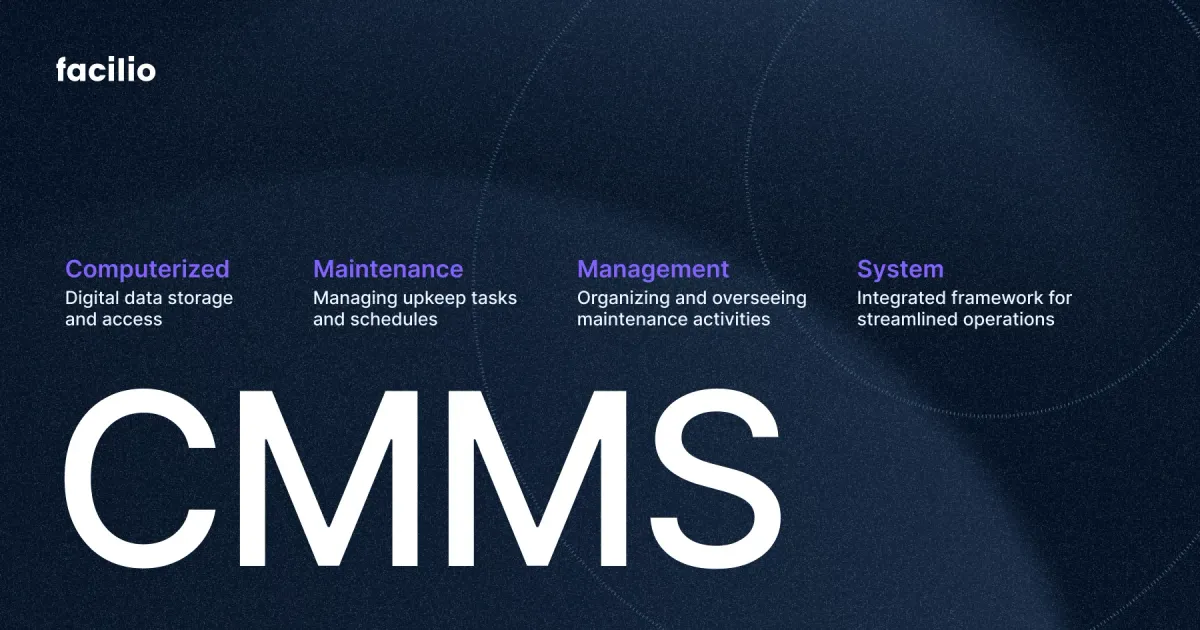
CMMS (computerized maintenance management system) is the operational core. It runs work orders, preventive maintenance schedules, asset records, and the maintenance history that tells you what broke, who fixed it, and what it cost. Its buyer is the facility manager or the operations and maintenance team, and its job is to keep equipment running and the backlog under control. Most of the platforms on this list are CMMS tools at heart.
EAM (enterprise asset management) starts where a CMMS ends. It keeps everything a CMMS does, then extends into the full asset lifecycle: capital planning, depreciation and book value, reliability engineering, and the compliance trail regulated industries answer to. Its buyer runs asset-intensive operations, manufacturing plants, utilities, and transport networks, where an asset costs millions and runs for decades, so the cost of its failure dwarfs the cost of the software. IBM Maximo is the reference point here.
CaFM (computer-aided facility management) looks at the building rather than the equipment. It manages space and floor plans, leases, occupancy, and the moves, adds, and changes a corporate real estate or workplace team handles daily. A CaFM tool answers how the space is used and who sits where, a question a pure CMMS never asks.
IWMS (integrated workplace management system) tries to hold all three in one suite, maintenance, assets, space, leases, and sustainability, for a large enterprise that wants a single system of record across facilities and real estate. The breadth is real, and so is the historical cost: long implementations, heavy configuration, and a price only a large portfolio can absorb.
If you are weighing two of these before you shortlist, the difference between cafm cmms is worth reading, and the cmms vs eam split settles most of the rest.
Here is the trap. These four labels describe what a tool covers, not how it runs, and in 2026 the coverage question matters less than it used to. A modern CMMS can reach into the space, energy, and vendor data that once belonged to CaFM or IWMS, and a legacy EAM can leave you more disconnected than a lightweight CMMS that integrates well. So the sharper question is not which category you are buying. It is which operating model you are buying into: a system that records maintenance in isolation, or one that connects it to everything around it. That distinction decides more outcomes than the acronym on the box, and it is the one the next section draws out.
Legacy CMMS vs cloud based CMMS: why the operating model beats the feature list
The deepest divide in this market is not between two vendors. It is between two eras. A legacy CMMS and a cloud based CMMS can list the same features and still run your operation in completely different ways, because the difference is architectural, not cosmetic.
A legacy CMMS was built for a building that ran in silos. Maintenance data lived in the CMMS. Energy data lived in the building management system. Finance lived in the ERP. Vendors were handled by email, phone, and the occasional fax. Each system was accurate on its own and blind to the others, so the CMMS became a reliable system of record that could not see past its own four walls.
That architecture produced a predictable set of problems. Reactive work stayed high, because nothing warned you before equipment failed. SLA reporting lagged, because the numbers had to be exported and stitched together by hand after the month closed. Technicians carried clipboards and keyed the results in later, if at all. Invoices were disputed, because no one could tie a charge back to a completed, verified job. And portfolio decisions came down to gut feel, because benchmarking one site against another took a week of spreadsheet work.
A cloud based, connected CMMS is a different operating model, not the same software moved to a browser. It connects three things a legacy tool keeps apart:
- People: Technicians, vendors, occupants, and executives all work through the same system, each with their own view, instead of through a chain of emails and handoffs.
- Processes: Workflows are automated through no-code configuration an FM admin can change in an afternoon, rather than through IT tickets that take a quarter.
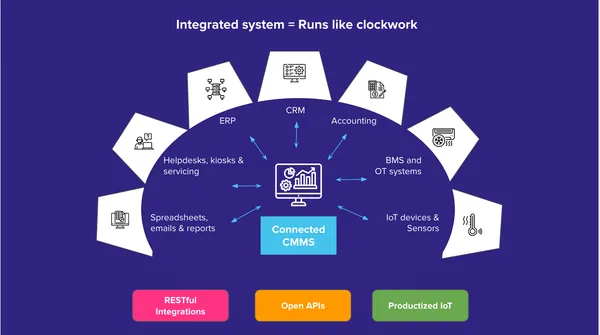
- Systems: The platform overlays and integrates with the building management system, HVAC controls, energy meters, and the ERP already in place, connecting them rather than ripping them out.
The shift is not finished. According to Verdantix smart-building research, a large share of enterprise FM teams still run disconnected point solutions, and the cost shows up exactly where the legacy model predicts it: missed SLAs, high reactive volumes, and no way to compare performance across sites. The teams moving off it are the ones who have decided the era of legacy cmms is over, and that a web based platform their vendors and occupants can reach is now a requirement, not a convenience.
The one-line test that separates the two: a legacy CMMS tells you what happened, a connected one shapes what happens next.
Why enterprise teams choose Facilio
Enterprise FM leaders who chose Facilio over legacy EAM and SMB CMMS tools cite the same handful of reasons.
- It fits the operating model without customization: No-code, drag-and-drop configuration means the platform adapts to a mix of hard and soft services, in-house and contracted labor, and a stakeholder set from technician to C-suite, without the IT dependency that makes legacy changes slow.
- It connects systems rather than replacing them: The connect-and-unify architecture overlays existing BMS, energy, and ERP infrastructure, avoiding the migration cost and lock-in of a rip-and-replace.
- It gives executives the data they need: Portfolio-wide dashboards serve the technician, the FM director, the CFO, and the owner from one data layer in real time.
- The proof is in deployed outcomes: The numbers below come from named customers in production, not benchmark studies, and the benefits of cmms guide covers the wider operational case.
- Berkeley UAE: 80 percent of interactions resolved autonomously
- Charter Hall: 619 invoice errors caught
- Skeens: 100 percent of manual check-ins eliminated
Customer proof: At Berkeley UAE the Helpdesk AI Agent handled 276 calls in 30 days, opened 175 service requests, and resolved roughly 80 percent of interactions without a person involved. At Charter Hall the Invoice Validation Agent caught 619 errors across 2,117 invoices and removed more than 70 hours of manual reconciliation a month. At Skeens it eliminated manual contractor check-ins entirely. Facilio runs across more than 150 million square feet globally and is SOC 2 and ISO 27001 certified.
What AI is changing in CMMS in 2026
Most CMMS platforms added some flavor of AI to their marketing in 2026, and the reality varies. What most tools actually offer is anomaly detection on sensor data where BMS integration exists, suggested PM schedules from historical patterns, and basic predictive alerts on specific asset classes.
What agentic AI looks like is different: agents that handle maintenance intake, triage, and dispatch, validate and reconcile invoices, and answer natural-language portfolio questions, completing a workflow rather than assisting a person through one. The distinction matters because AI in a marketing PDF and an AI agent that removes a category of manual work are different claims. Before accepting any vendor's AI pitch, ask to see it running in a live customer environment, and read the cmms maintenance data ai insights guide on the data foundation good outcomes require.
“Ask any vendor: show me this AI working in a live customer environment, not a demo.”
The bottom line
The best CMMS software in 2026 is the one that matches your operating model, so match the platform's strongest capability to the pain that costs you most. A single-site team that wants fast adoption has MaintainX, UpKeep, and Fiix. A mid-market operation has Limble, eMaint, FMX, and Accruent by vertical. An asset-intensive enterprise has IBM Maximo. And an FM service provider or multi-site portfolio that has outgrown single-team maintenance, now running vendors, occupants, and real-time client reporting, has Facilio, the one platform here that executes the work rather than only tracking it.
Related reads
Related reading
Frequently asked questions
What is the top CMMS software in 2026?
The top CMMS software are Facilio, IBM Maximo, MaintainX, Fiix, Limble, eMaint, UpKeep, Corrigo, FMX, TMA Systems, Accruent Maintenance Connection, and Brightly Asset Essentials. Facilio leads for connected, multi-site enterprise FM; MaintainX and UpKeep lead for mobile-first SMB teams.
What is the top-rated CMMS software?
MaintainX and Limble carry the highest user ratings in this list at 4.8/5 on Capterra and G2; for connected multi-site enterprise FM, Facilio is the pick despite a smaller review base.
What are the best CMMS programs for enterprise FM?
For enterprise and multi-site FM, the best CMMS programs are Facilio for connected portfolio operations, IBM Maximo for asset-intensive EAM, and Accruent for healthcare asset depth. The right one depends on whether maintenance, enterprise assets, or compliance is the core job.
What are the best CMMS systems for small business?
The best CMMS systems for a small business are UpKeep, MaintainX, and Limble. All three onboard in days, publish per-user pricing, and offer free tiers or free requester accounts, so a small team can prove value before committing budget.
What is the best CMMS maintenance software?
The best CMMS maintenance software depends on scale: MaintainX and UpKeep for mobile-first single-site teams, Fiix and eMaint for manufacturing reliability, and Facilio for multi-site portfolios that need maintenance connected to vendors, energy, and BMS data.
What is the best CMMS software for small business specifically?
UpKeep and MaintainX are the two clearest picks on adoption speed and price, with Limble a close third for deeper reporting. They avoid the enterprise complexity a small team does not need while covering work orders, preventive maintenance, and asset records.
How much does CMMS software cost?
SMB tools run roughly $20 to $120 per user per month; mid-market platforms run $35 to $120; enterprise platforms like Facilio, IBM Maximo, Accruent, and Corrigo are quote-based and vary by portfolio size and integration scope. Verify every figure with the vendor.
What is the difference between CMMS and EAM?
CMMS focuses on maintenance operations, work orders, PM schedules, and asset history. EAM extends that to full asset lifecycle, including capital planning, depreciation, and compliance. Most FM teams need CMMS; capital-heavy industries need EAM.
What is a Connected CMMS?
A Connected CMMS links people (technicians, vendors, occupants, executives), processes (no-code automation), and systems (BMS, ERP, energy, security) in one operating layer, in contrast to legacy platforms that manage maintenance in isolation.
Can CMMS software integrate with a BMS?
Enterprise and Connected CMMS platforms like Facilio support native BMS integration without middleware. Most SMB platforms offer limited or no BMS integration. IBM Maximo integrates through the Maximo Application Suite IoT module.
What is the best web-based CMMS software for FM service providers?
FMSPs need multi-client architecture, vendor portals, real-time client transparency, and fast deployment, which rules out most SMB tools. Facilio is purpose-built for this, with deployed providers reporting 97 percent SLA adherence and 30 percent fewer reactive calls.
About the Author

More from Facilio