Connected CMMS

 Connected Buildings
 Connected Refrigeration


 Download ebook

 Read case study


 Watch now


 Retail
 Healthcare
 FM Services
 Commercial Portfolios
 Corporate Facilities
 Education
 Data-driven Portfolio Ops
 Facility Management Software
 360° Asset Lifecycle
 Continuous Sustainability

 Blogs
Blogs
 Help docs
 Knowledge Hub
 ROI Calculator
 Ebooks & Guides
 Webinars
 Videos
 Case studies


 About us
 Newsroom
 Careers
 Contact us
 Partners
 Events



Enterprise Asset Management (EAM) platforms are gaining serious traction among organisations looking to stay ahead of operational complexity. If you're planning to modernise your maintenance strategy or streamline how you manage assets across sites, you're in the right place.
A system that manages the full lifecycle of physical assets - enabling proactive maintenance, inventory control, and real-time operational insight.
These platforms help organisations reduce downtime, optimise resource allocation, and extend asset life through data-driven decision making. By integrating IoT, AI, and mobile capabilities, modern EAM software delivers enhanced visibility and control over your entire asset ecosystem.
According to a study by the Aberdeen Group, unplanned downtime costs between $10,000 and $250,000 per hour for industrial plants. EAM maintenance software aims to reduce such costs by maintaining asset health
In this guide, we’ve ranked the best EAM software platforms of 2026, designed to help you reduce downtime, automate workflows, and gain real-time visibility into asset performance
Top 10 Enterprise Asset Management Platforms
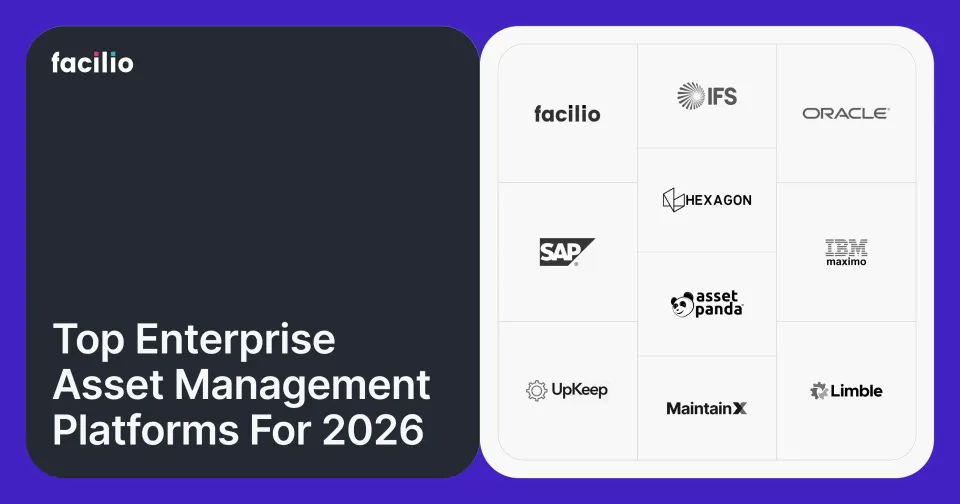
To help you choose the right fit, here are the top 10 enterprise asset management (EAM) software platforms in 2026, ranked by innovation, scalability, industry fit, and usability: Facilio, IFS, IBM Maximo, SAP EAM, Oracle EAM, HxGN, Limble, UpKeep, MaintainX, and Asset Panda.
1. Facilio
The IoT-powered, connected EAM platform for real-time building operations
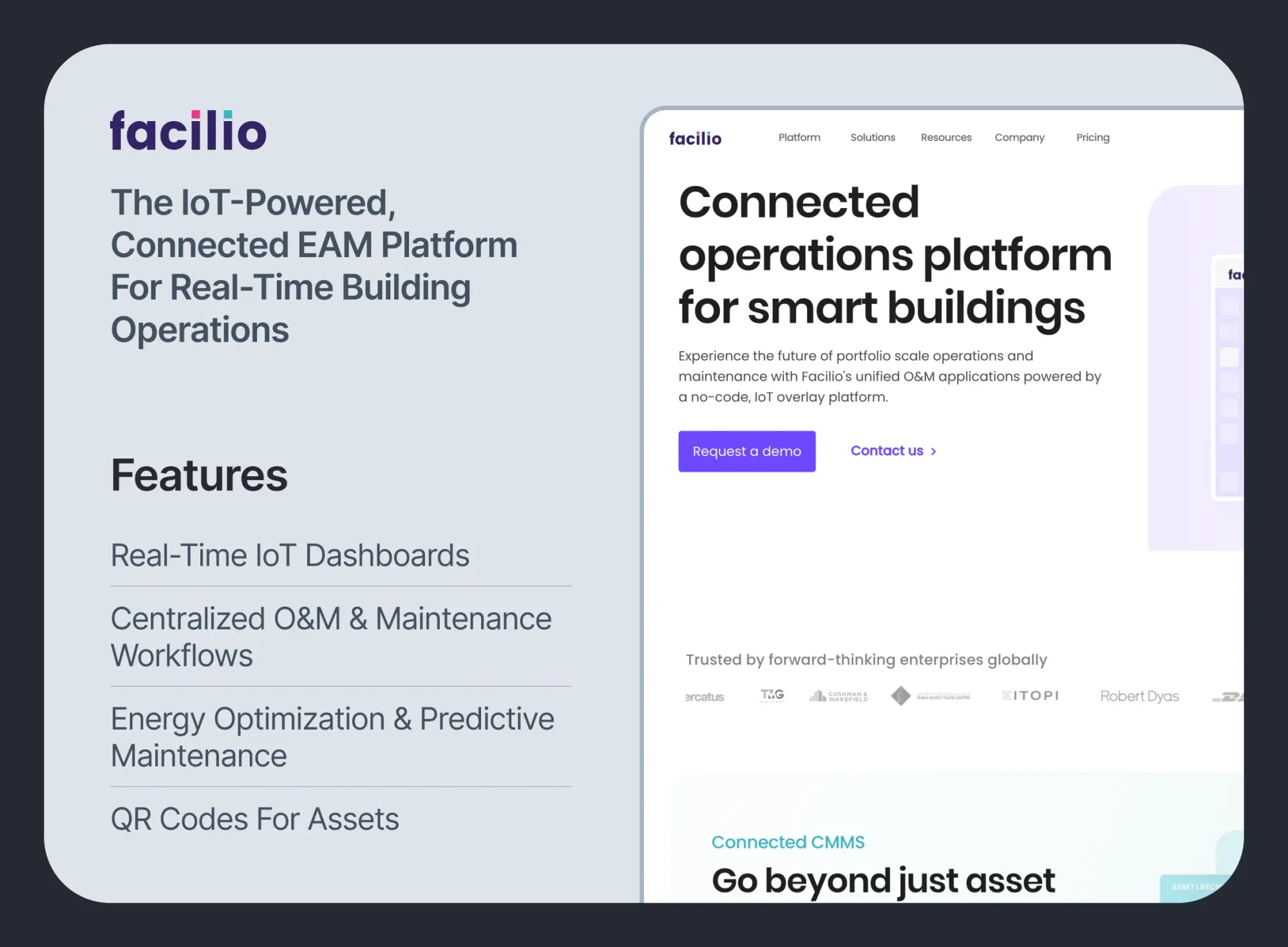
Facilio is an IoT-powered CMMS platform that includes Enterprise Asset Management (EAM) capabilities such as real-time asset tracking, preventive maintenance scheduling, automated work order management, and AI-powered predictive maintenance. It also embeds AI agents within maintenance workflows to help teams interpret operational data, surface insights, and act faster across assets and sites.
Facilio unifies operations, maintenance, sustainability, and vendor workflows into a single cloud platform, combining connected data with AI-driven insights to improve visibility and decision-making across portfolios in industries such as commercial real estate, healthcare, and education. Its API-first architecture supports seamless integration with IoT devices for smart energy optimisation and multi-site control.
Well-suited for organisations seeking modern, scalable, and flexible asset management solutions. Investa, a leading real estate management company in Australia, reduced asset downtime by 40% with Facilio.
User Reviews:
- 4.0/5 from 24–25 users; praised for ease of use and customer support, with minor complaints about mobile app performance - Capterra
- 4.0/5 overall, with solid scores in ease of use and support. - Softwareadvice
- Users highlight significant visibility gains via integrated systems - G2
Pros:
- Strong in IoT, energy, and multi-site control
- Highly modular, flexible deployment
- Designed for FM, CRE, and healthcare
Cons:
- Fewer long-term legacy reviews (newer platform)
- Custom pricing model
Specifications:
- Platform: Web, Mobile
- Industries: Commercial Real Estate, Healthcare, Education, Retail
- Geographies: Global presence, strong in the Middle East and the US
- Pricing: You'll find flexible pricing options at Facilio, each customised to suit different business segments.
2. IFS EAM
Best for asset-heavy, sustainability-driven organisations
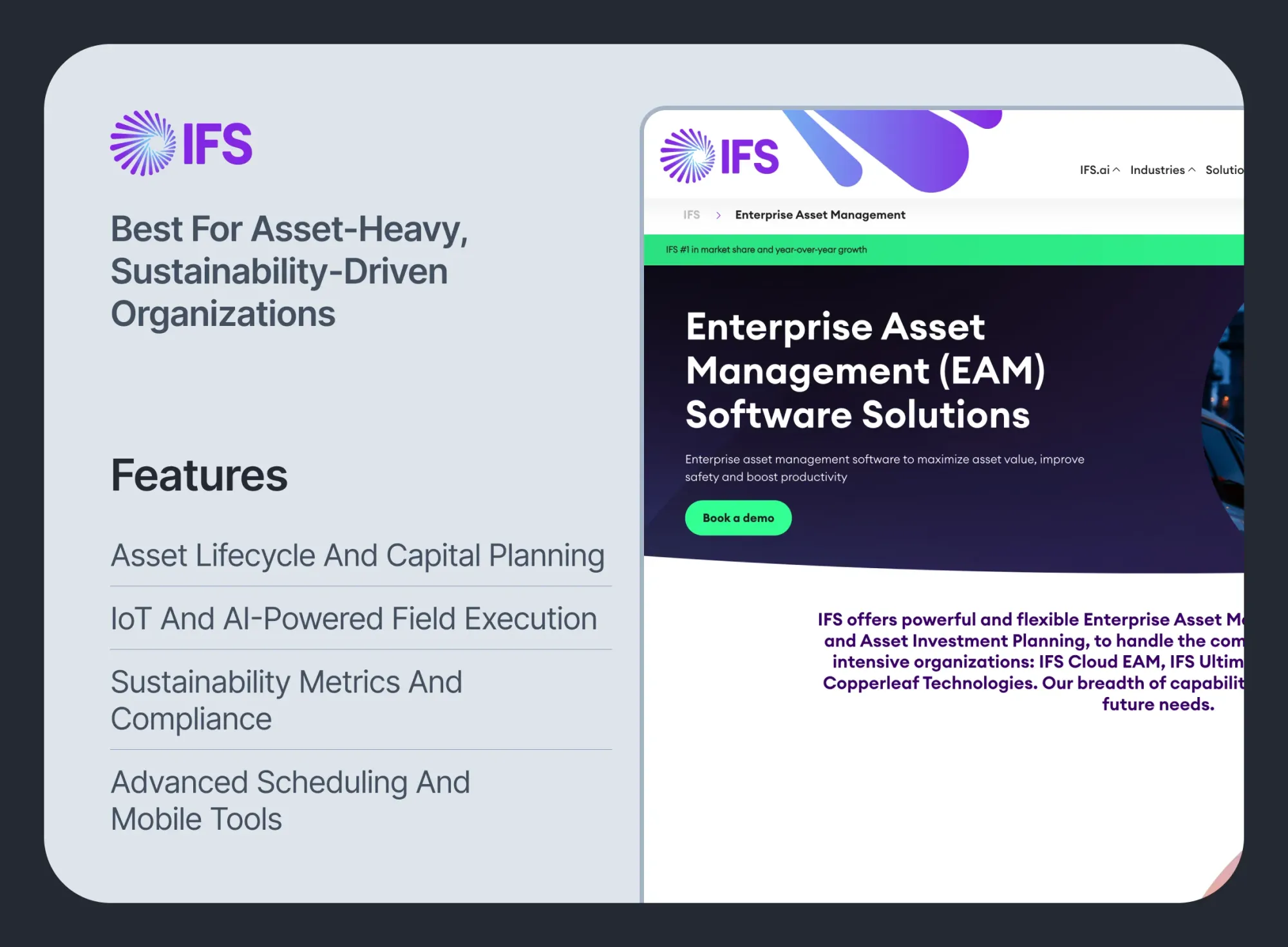
IFS EAM is a powerful, scalable enterprise asset management suite built for asset-intensive industries with strong sustainability goals. Part of IFS Cloud, it supports complex asset lifecycles, capital planning, and ESG compliance with advanced AI-powered field execution and IoT integrations.
The platform excels in utilities, aerospace, energy, and manufacturing sectors, offering global reach across 80+ countries. Although it requires careful implementation and change management, its modular cloud-native design delivers robust performance for large enterprises. Ideal for organisations prioritising scalability and sustainability in asset management.
User Review: "IFS EAM is a powerful EAM solution with a wide range of features. However, it can be expensive and complex to implement, requiring significant IT resources." - G2
Pros:
- Global EAM market share (Gartner)
- Strong in utilities, aerospace, and energy
- Modular and cloud-native
Cons:
- Complex implementation
- Requires change management
Specifications:
- Platform: IFS Cloud (modular SaaS)
- Industries: Energy, Utilities, Aerospace, Manufacturing, Telecom
- Geographies: 80+ countries (global)
- Pricing: Custom enterprise pricing
3. IBM Maximo Application Suite
The industry-leading, AI-powered EAM for asset-intensive operations
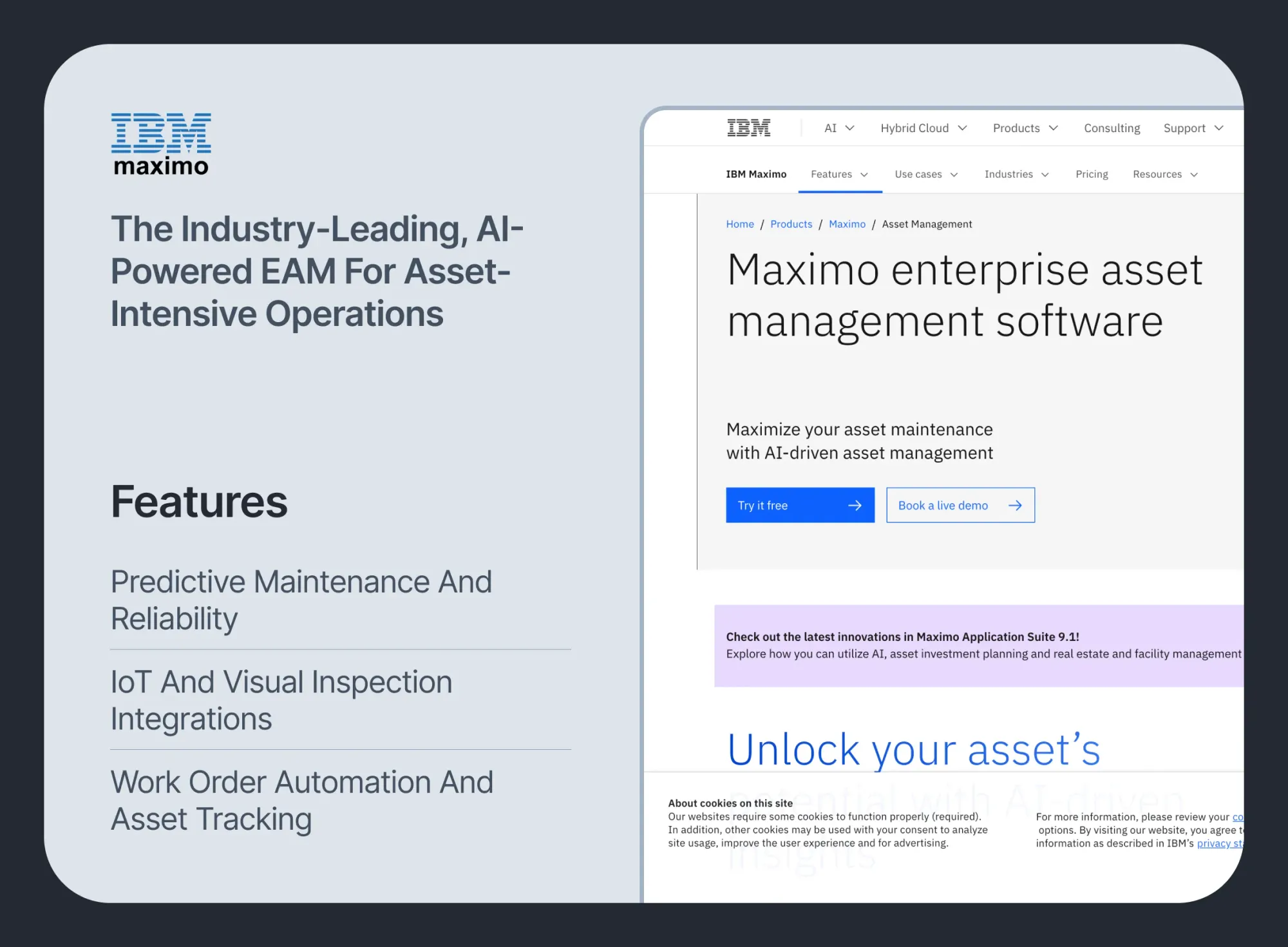
IBM Maximo is a leading AI-powered EAM platform renowned for managing asset-intensive operations with hybrid cloud flexibility. It integrates predictive maintenance, IoT-enabled monitoring, and advanced reliability data management to optimise asset performance and reduce downtime.
With automated work order management and visual inspection capabilities, Maximo serves sectors like utilities, transportation, manufacturing, and government. The platform offers enterprise-level scalability and advanced AI/ML insights, making it suitable for organisations seeking a comprehensive, future-ready EAM solution.
User Review: "IBM Maximo is a powerful EAM solution with a wide range of features. However, it can be expensive and complex to implement, requiring significant IT resources." - Capterra
Pros:
- Proven enterprise scalability
- Advanced AI/ML insights
- Broad industry ecosystem
Cons:
- Steep learning curve
- Higher TCO for small orgs
Specifications:
- Platform: Hybrid (SaaS/OpenShift)
- Industries: Utilities, Transportation, Manufacturing, Government
- Geographies: Global
- Pricing: AppPoints credit system (custom)
4. SAP EAM
Most integrated EAM within the SAP ERP ecosystem
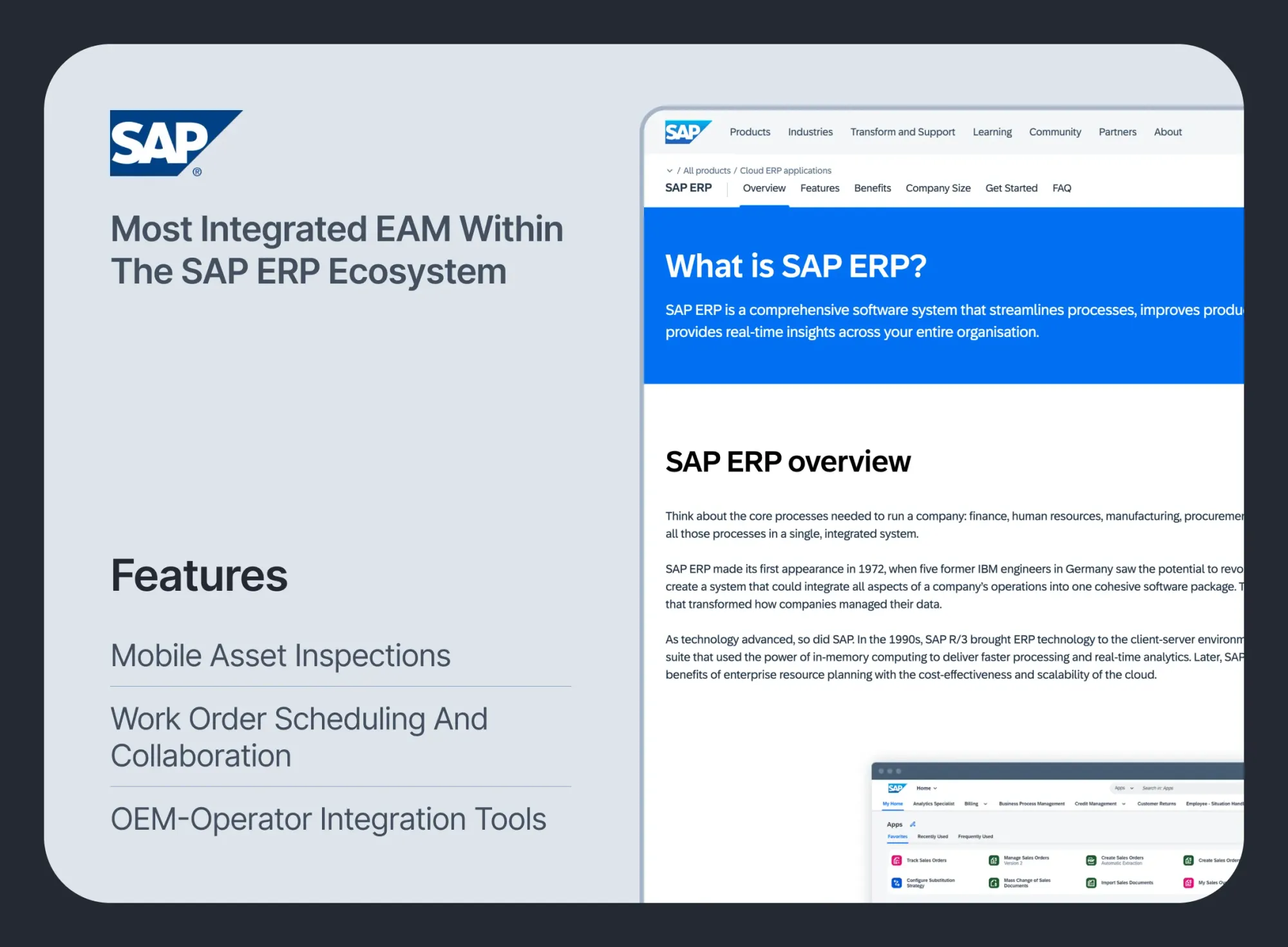
SAP EAM delivers fully integrated asset management within the SAP S/4HANA ERP ecosystem, providing organisations with good field service, work order scheduling, and asset lifecycle visibility. It supports mobile asset inspections and OEM-operator collaboration, enabling proactive maintenance and operational continuity.
Primarily used by manufacturing, utilities, and oil & gas industries, SAP EAM scales across global enterprises with deep ERP integration for comprehensive asset and resource management. While customisation can be complex, it offers reliable enterprise-grade support for SAP-centric organisations.
User Review: "Across all worldwide locations, our company uses SAP EAP to track asset maintenance, predict when assets will need to be replaced, and ensure delays, setbacks don't occur due to asset availability issues" - Capterra
Pros:
- Deep SAP integration
- Enterprise-scale support
Cons:
- Customization complexity
- UI/UX is not as modern
Specifications:
- Platform: SAP S/4HANA (on-prem/cloud)
- Industries: Manufacturing, Utilities, Oil & Gas
- Geographies: Global (SAP-centric enterprises)
- Pricing: Custom pricing based on deployment scale
5. Oracle EAM
Cloud-ready EAM with condition-based and predictive maintenance
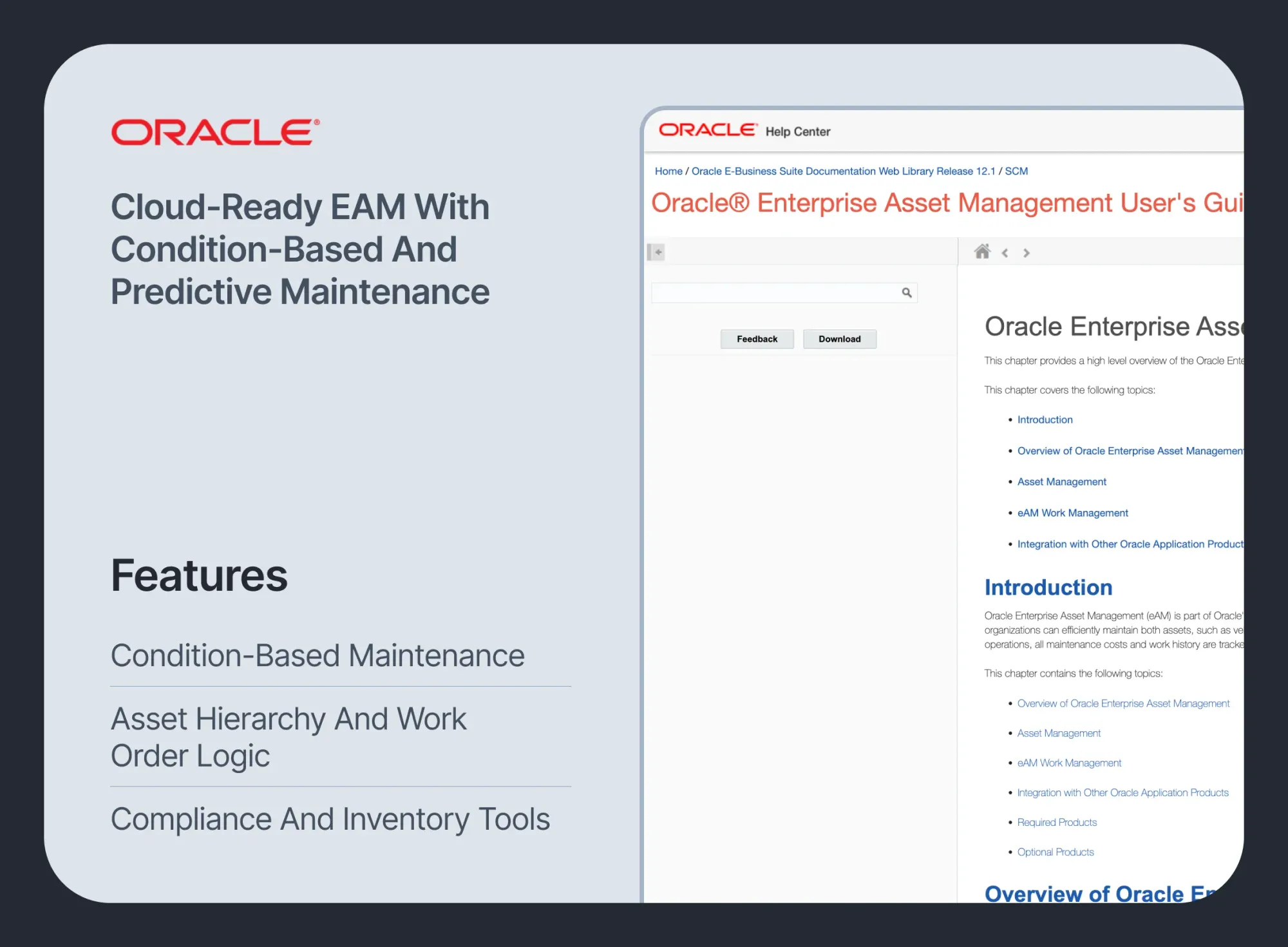
Oracle eAM is a robust, cloud-ready enterprise asset management solution designed for infrastructure-intensive organisations. Integrated within Oracle Cloud ERP, it supports condition-based and predictive maintenance to enhance asset reliability and compliance.
Oracle eAM provides advanced asset hierarchy management, work order automation, and comprehensive inventory control. It is well-suited for utilities, manufacturing, and infrastructure sectors looking for scalable, mature asset management within a trusted ERP platform. Though complex at the enterprise level, it delivers dependable performance and long-term value.
User Review: 4.3/5 rating from 31 reviewers, praised for ease of use, setup, and features - G2
Pros:
- Built-in with Oracle ERP
- Scalable and mature
Cons:
- Enterprise-level complexity
- Long deployment timelines
Specifications:
- Platform: Oracle Cloud or EBS
- Industries: Utilities, Infrastructure, Manufacturing
- Geographies: Global
- Pricing: Custom enterprise pricing
6. HxGN EAM (formerly Infor EAM)
Flexible, mobile-first EAM for regulated industries
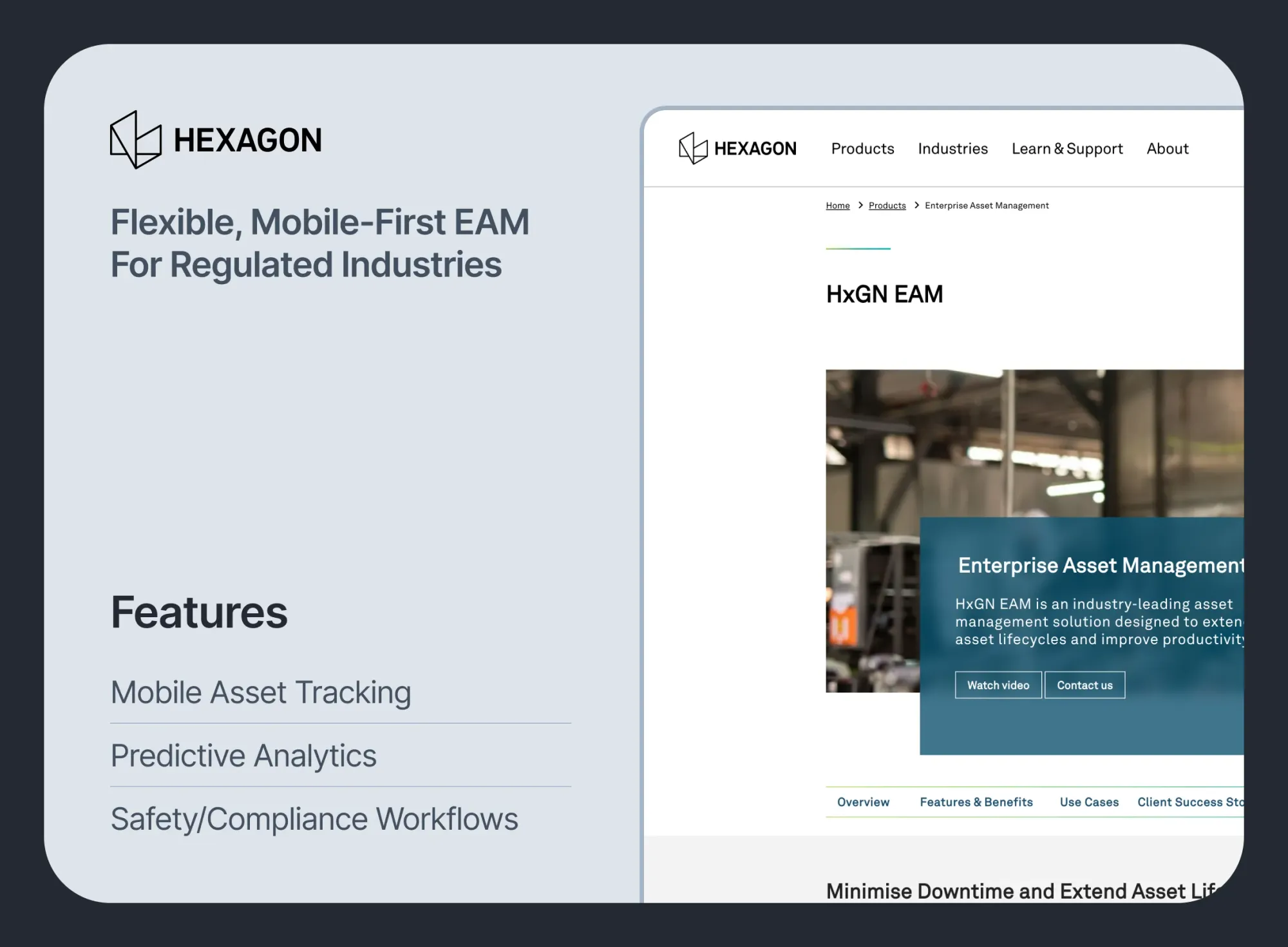
HxGN EAM is a flexible, mobile-first enterprise asset management platform made for regulated industries like healthcare, manufacturing, and energy. It offers comprehensive asset monitoring, safety compliance workflows, and predictive analytics to optimise asset lifecycle management.
The platform emphasises data centralisation and regulatory adherence, making it a preferred choice for public sector and energy companies. While its interface appears dated and it favours the Infor ecosystem, HxGN provides customizable solutions focused on improving operational efficiency and ensuring asset reliability across global deployments.
User Review: "HxGN EAM is a powerful EAM solution with a wide range of features. However, it can be expensive and complex to implement, requiring significant IT resources." - Capterra
Pros:
- User-friendly and customizable
- Built for regulated sectors
Cons:
- Limited outside Infor ecosystem
- Interface feels dated to some
Specifications:
- Platform: Cloud & mobile
- Industries: Healthcare, Manufacturing, Energy
- Geographies: Global
- Pricing: Custom per deployment
7. Limble CMMS
Top-rated preventive maintenance and asset tracking for SMBs
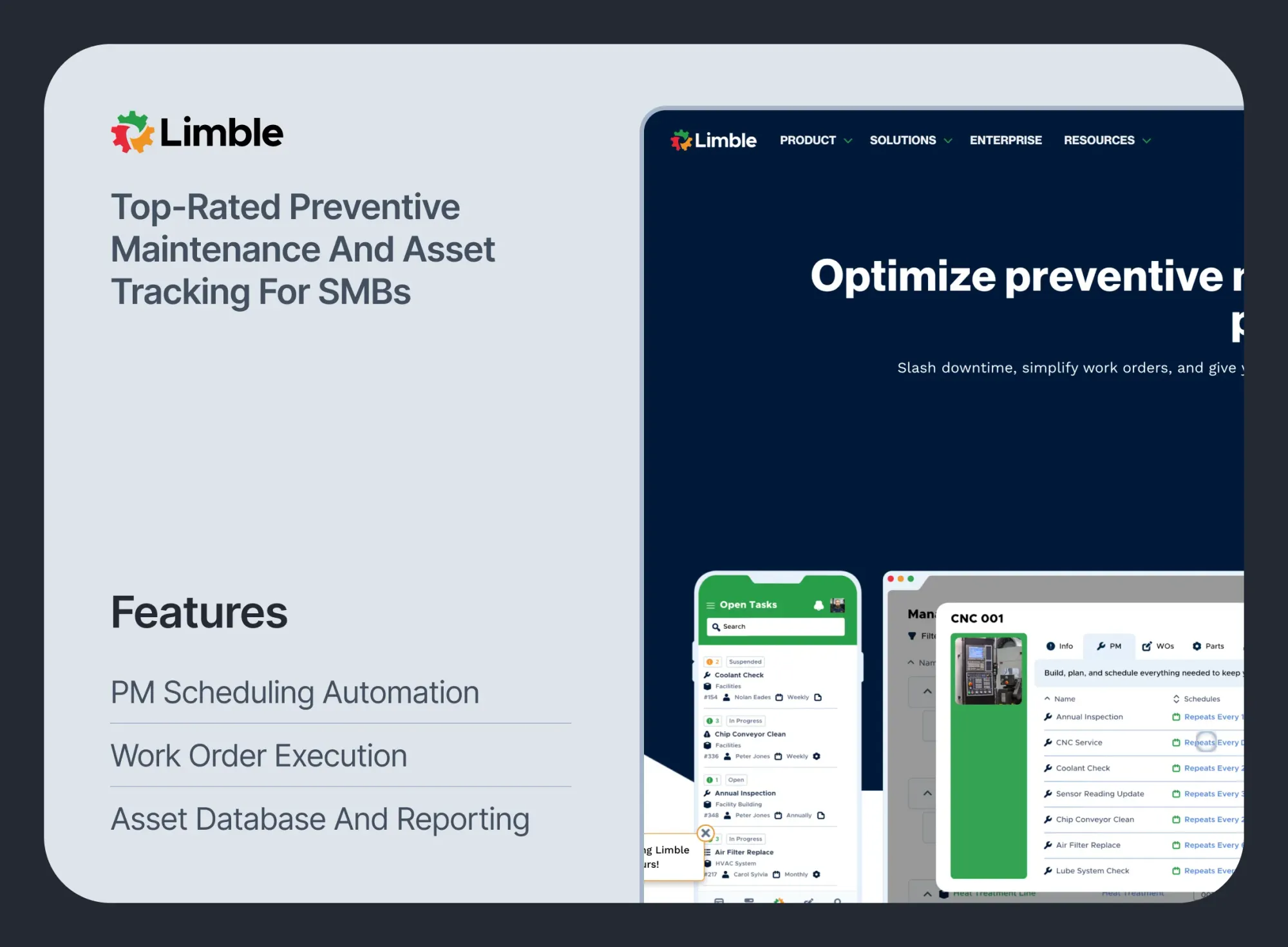
Limble CMMS is a top-rated preventive maintenance and asset tracking software designed specifically for small and mid-sized businesses. Its intuitive interface allows quick onboarding and simplifies maintenance workflows with automated PM scheduling, work order management, and detailed reporting.
Limble serves diverse sectors, including manufacturing, education, construction, and healthcare, providing cloud and mobile accessibility for teams managing day-to-day operations. Known for its strong customer support and ease of use, it’s an affordable EAM option for companies aiming to enhance asset reliability without complex enterprise features
User Review: Users on Capterra award Limble a stellar 4.8 from 685+ reviews, earning multiple shortlists and “Best of” badges; valued for ease of use and overall value - Capterra
Pros:
- Simple UI, fast onboarding
- Strong support and documentation
Cons:
- Lacks deep enterprise features
Specifications:
- Platform: Cloud, Mobile
- Industries: Manufacturing, Education, Construction, Healthcare
- Geographies: Global (SMB focus)
- Pricing: Starts at $40/user/month (billed annually)
8. UpKeep
Mobile-first CMMS with EAM features for operational teams
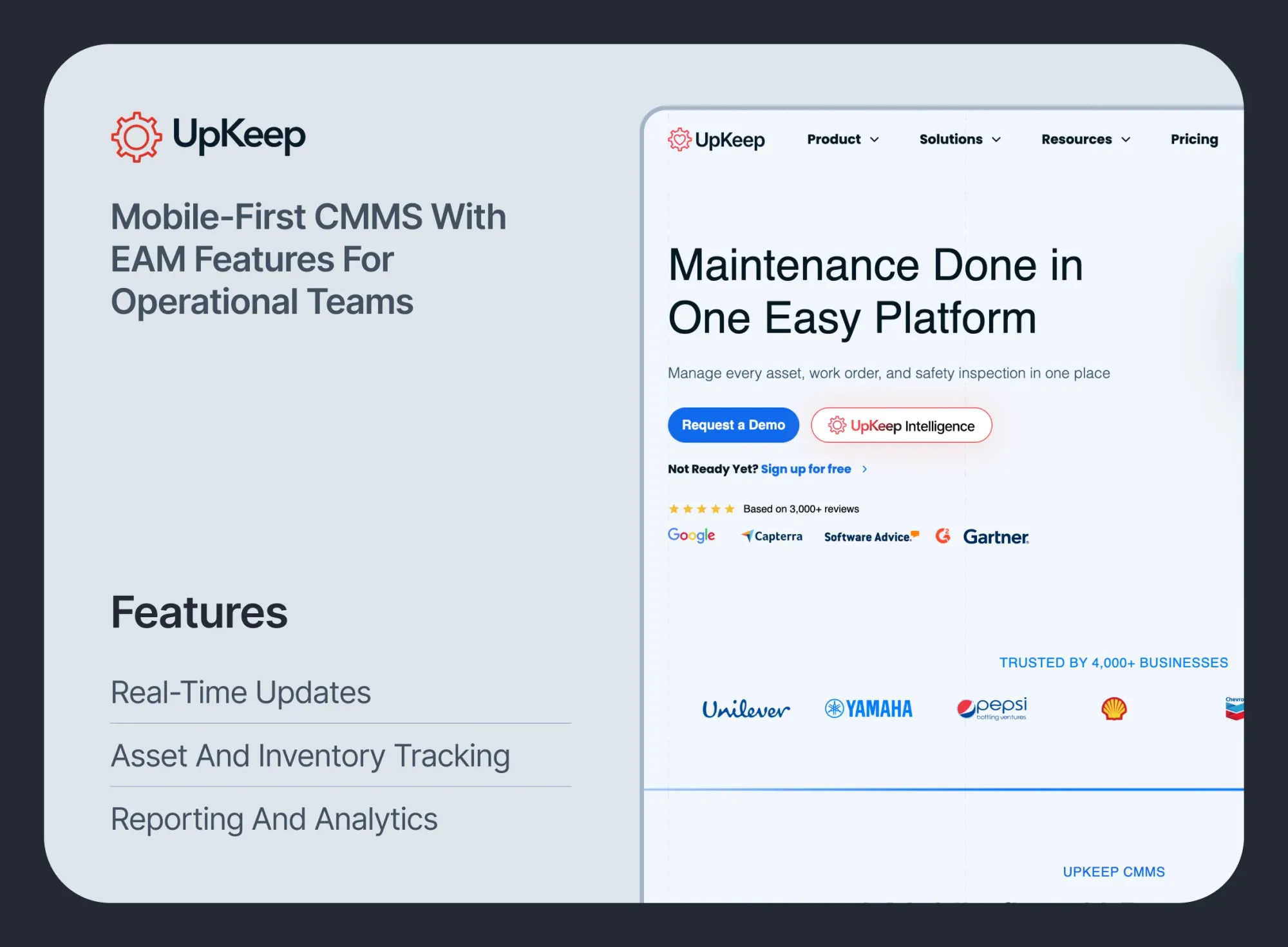
UpKeep is a mobile-friendly, cloud-based CMMS that is suitable for industries including manufacturing, construction, and healthcare. This platform makes maintenance management and work orders accessible on the go, enhancing operational mobility and asset tracking.
With features like work order creation, prioritisation, and inventory management, UpKeep simplifies maintenance operations significantly.
User reviews: "Upkeep is a great tool for managing our field technicians. The mobile app is easy to use, and the offline functionality is essential for our operations. However, the reporting features are quite basic." - Software Advice
Pros:
- Great mobile UX
- Affordable tiers for growing teams
Cons:
- May not scale for large enterprises
Specifications:
- Platform: Cloud, iOS, Android
- Industries: Facilities, Retail, Hospitality, Education
- Geographies: Primarily US, expanding globally
- Pricing: $20-$75/user/month (Lite to Professional plans)
9. MaintainX
The easiest mobile-first EAM for frontline maintenance
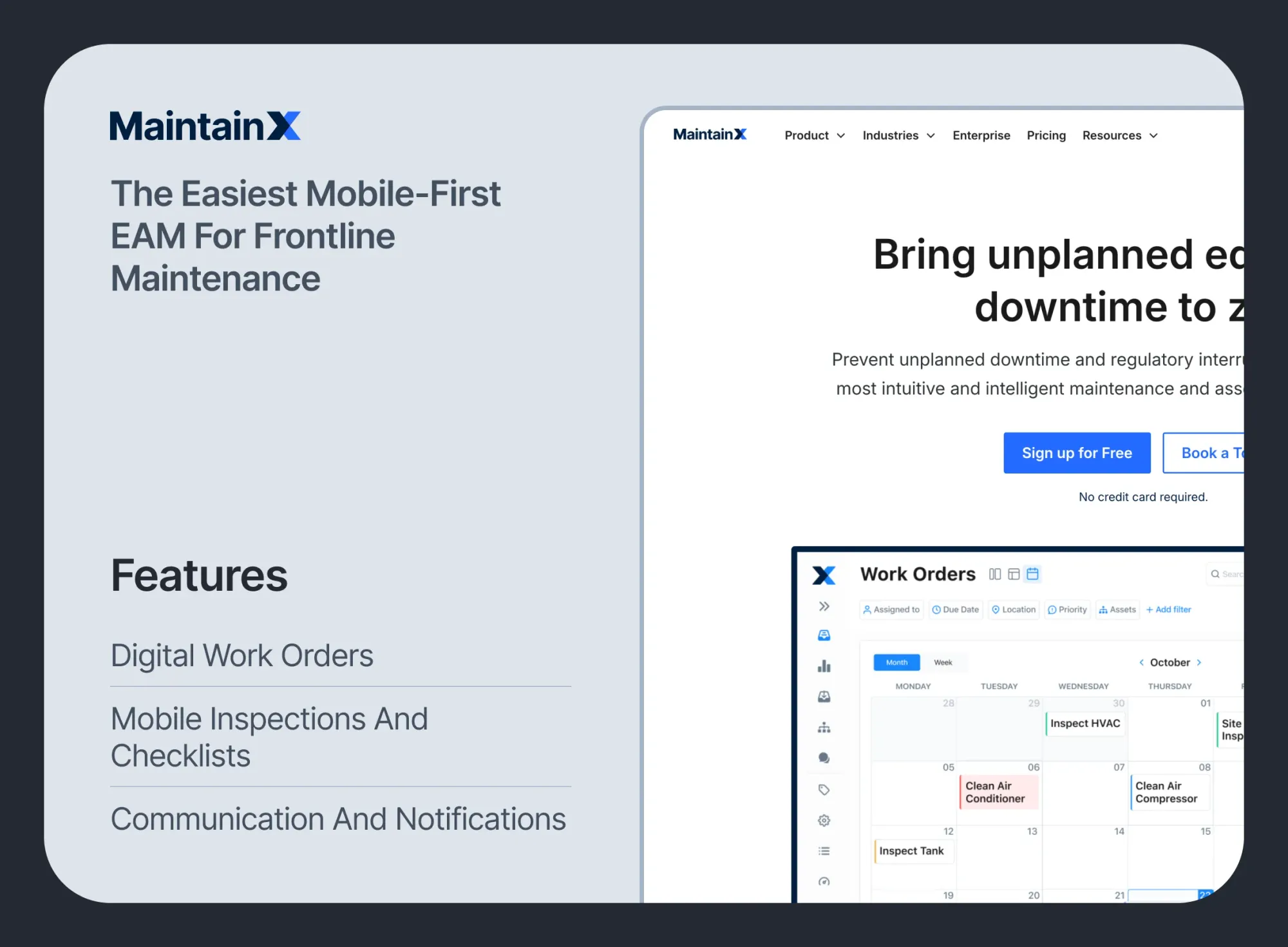
MaintainX is a mobile-first EAM platform designed for frontline maintenance and operations teams requiring fast, intuitive tools for inspections and work orders. It offers digital checklists, real-time communication, and built-in collaboration features that simplify maintenance workflows for SMBs and field service providers.
MaintainX excels in manufacturing, field services, and other operational environments where ease of use and rapid adoption are critical. While it delivers a streamlined user experience, it may lack the depth of functionality found in larger EAM platforms, making it ideal for businesses prioritising simplicity and mobile access.
User reviews: Per SoftwareAdvice, its usability and customer service score top marks: Ease-of-use: 4.8, Customer Support: 4.8, Value for Money: 4.7, Functionality: 4.6 - Software Advice
Pros:
- Fast adoption
- Built-in collaboration tools
Cons:
- Feature-light compared to larger platforms
Specifications:
- Platform: Mobile-first (iOS, Android)
- Industries: Manufacturing, Field Services, SMBs
- Geographies: North America with global reach
- Pricing: Tiered subscription plans; specifics on demo
10. Asset Panda
Highly customizable, barcode-enabled asset tracking software
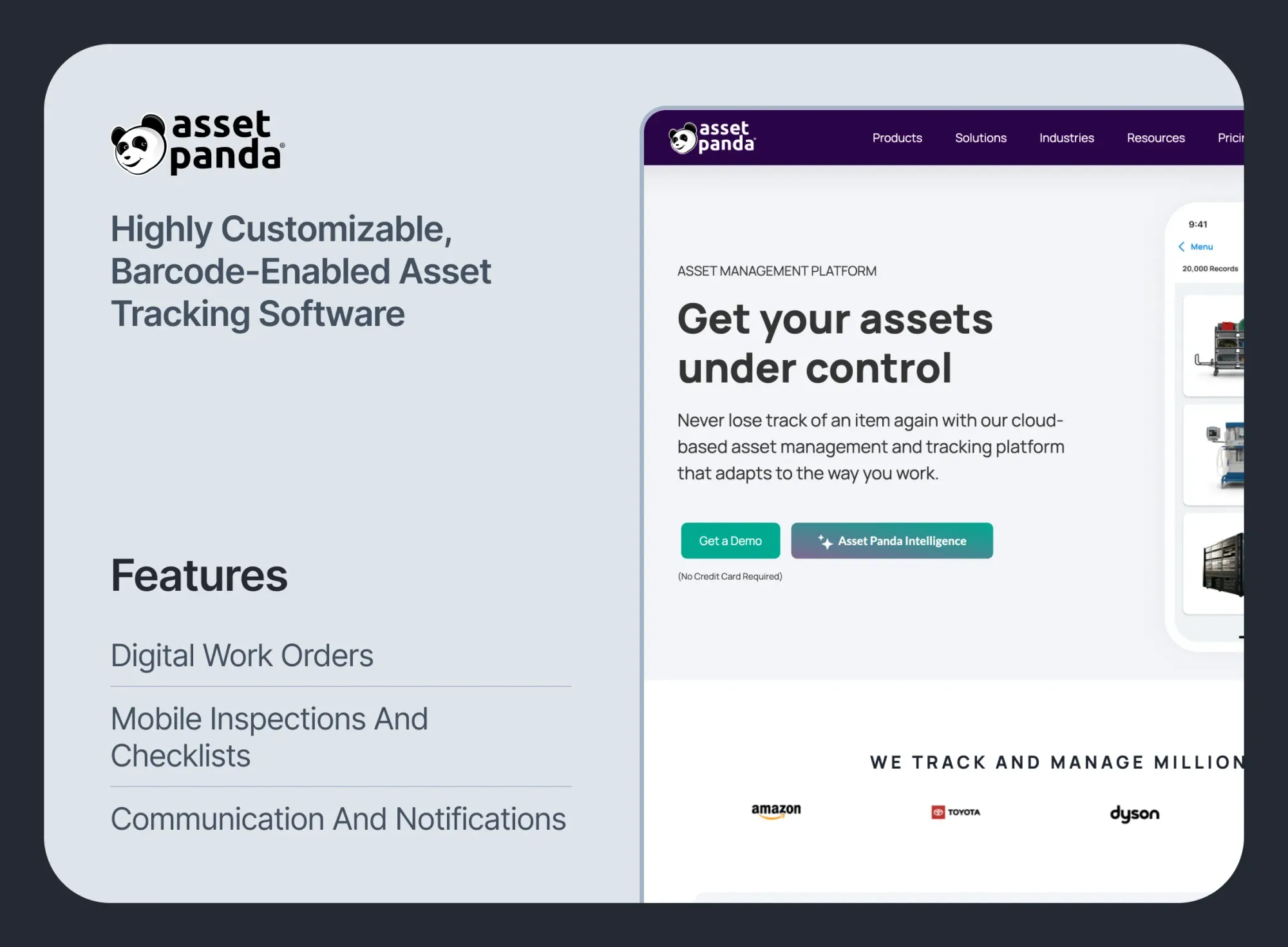
Asset Panda is a highly customizable, barcode-enabled asset tracking software focused on real-time visibility across the asset lifecycle. It supports mobile audits, configurable workflows, and enhanced asset tracking with QR code and barcode scanning.
Serving industries such as education, non-profit, construction, and IT, Asset Panda offers a cloud and mobile platform designed for organisations needing flexible asset audits rather than full-scale EAM capabilities. Praised for usability and customer support, it’s well-suited for businesses that require scalable asset tracking with extensive customisation options.
User reviews: Capterra lists Asset Panda with a 4.6/5 from 1,398 reviews, scoring highly on usability, support, features, and value - Capterra
Pros:
- Unlimited users
- Highly customizable
Cons:
- Not a full-scale EAM
- Pricing not transparent
Specifications:
- Platform: Cloud + Mobile apps
- Industries: Education, Non-profit, Construction, IT
- Geographies: Global, strong in North America
- Pricing: Starting approx. $125/month (basic tier)
Here is a concise comparison of the EAM software platforms discussed above:
In summary, each EAM software platform listed offers unique strengths—from real-time operational control and predictive maintenance to scalable, industry-specific workflows and deep ERP integrations.
While many platforms excel in various aspects, Facilio stands out by combining comprehensive IoT-powered asset management with flexible, cloud-based deployment tailored for facility operations. Its ability to unify maintenance, sustainability, and vendor workflows into a single intuitive platform offers a level of real-time visibility and operational efficiency that is difficult to match.
By combining connected data with AI-driven insights and embedded AI agents, the platform helps teams move from reactive maintenance to faster, more informed decision-making across assets and operations.
Organisations looking for a modern, adaptable solution may find Facilio’s combination of innovation and usability particularly valuable as they modernise their asset management strategies. Carefully evaluating demos, deployment models, and integration capabilities will help ensure the chosen platform delivers lasting value.
How to Choose the Best Asset Management Software for Smart Buildings: 7 Factors That Matter
The right asset management software isn't the one with the longest feature list, it's the one that fits how your team actually operates and what your assets actually demand. Most evaluation processes focus on pricing and UI. The teams that end up replacing their asset management software within three years usually skip the harder questions.
Here are the seven criteria that consistently separate platforms that deliver from platforms that disappoint:
1. Does it connect to your building systems or just sit alongside them?
The most common EAM failure mode in smart building environments is isolation: the asset management platform has no live connection to the BMS, SCADA, or IoT sensors that generate the actual performance data. Maintenance teams end up running on scheduled inspections and reactive work orders, while the building's own systems are silently flagging issues no one acts on.
Ask every vendor: does your platform ingest real-time data from our building automation systems natively, or does it require a separate integration layer? The answer tells you a lot about whether the platform was designed for connected buildings or adapted for them after the fact.
2. How does it handle multi-site portfolio management?
A platform that works well for one site often breaks down at ten. Portfolio-level asset management software requires consolidated dashboards, standardised asset taxonomies across sites, the ability to compare performance between buildings, and workflows that can be configured globally but executed locally.
Before committing, ask to see a live demo of the portfolio view. Specifically: how does the platform surface an underperforming asset at Site 7 to a head-of-operations who isn't logging into that site's dashboard every day?
3. Is predictive maintenance genuinely AI-driven or just rule-based alerting?
Almost every asset management software vendor claims AI-powered maintenance today. In practice, most are delivering threshold-based alerts, if temperature exceeds X, trigger a work order. That's rules-based automation, not predictive intelligence.
True predictive maintenance builds a performance baseline for each asset over time and flags degradation before any threshold is crossed. The distinction matters: threshold alerts still generate reactive work orders (just earlier). Predictive maintenance gives you a window to plan, schedule, and batch maintenance before anything fails.
4. What's the actual data ownership model?
In facilities management, one of the most persistent problems is vendor-owned data. When your building performance data lives in a vendor's proprietary system and you have limited export capability, you lose negotiating leverage, benchmarking ability, and continuity if you switch platforms.
Ask specifically: can we export all asset data and historical performance records at any time, in a standard format, without vendor involvement? If the answer is hedged, that's the answer.
5. Does the mobile experience work in the field, not just on Wi-Fi?
Field technicians aren't using your EAM from a conference room. They're scanning assets in plant rooms, logging work orders in basements, and completing inspections in areas with no connectivity. A platform with a beautiful web interface that requires constant internet connectivity will see low adoption in the field and low adoption means dirty data, which undermines every other capability.
Test the mobile experience in offline mode before you evaluate anything else. Check whether completed work orders sync reliably when connectivity returns, and whether the mobile interface covers full functionality or is a stripped-down companion app.
6. How does it support sustainability and energy tracking?
Sustainability reporting is no longer optional for commercial real estate portfolios. Investors, tenants, and regulators are all requiring verifiable energy performance data and the days of estimating from utility bills are ending.
EAM platforms with native energy monitoring can track consumption at the asset level, generate ESG-aligned reports, and flag energy anomalies as maintenance issues. Platforms without it will require a separate energy management system, creating another data silo to manage.
7. What does implementation actually look like?
Time-to-value varies enormously across EAM platforms, from six weeks to eighteen months. The variance is driven by three factors: data migration complexity, integration requirements, and configuration flexibility. A platform that requires extensive custom development to fit your workflows will take longer and cost more than the initial quote suggests.
Ask the vendor for three recent customer references at a similar scale and complexity to your deployment. Specifically ask those references: how long did go-live actually take, and what was the biggest surprise during implementation?
Why Facilio for Enterprise Asset Management
Most asset management platforms were built to track assets.
Facilio is built to operate them.
Facilio's connected asset management platform covers the full asset lifecycle, from commissioning through planned maintenance, sustainability tracking, and end-of-life, unified in a single interface with a native IoT data layer. Building systems, sensors, and BAS connect directly, so maintenance is driven by live asset behaviour, not inspection schedules.
On top of that foundation sits a purpose-built AI suite that handles what used to require constant manual coordination. A Helpdesk AI manages service request intake, routing, and dispatch across calls, chat, WhatsApp, and email, around the clock.
Agentic AI automates work order management, invoice verification, reporting, and asset lifecycle workflows without staff intervention.
And with Facilio's MCP integration, facility teams can manage operations directly from conversational AI tools they already use.
The result: fewer reactive failures, lower operational costs, and a portfolio that runs on data, not gut feel and scheduled walk-throughs.
Want to see how Facilio’s EAM platform works in real-world operations?
Try Facilio's EAM in action
1. What asset management software works best for building automation integration?
Facilio is the strongest option for teams that need genuine building automation integration rather than a surface-level connector. Its architecture is built on a real-time IoT data layer that pulls directly from BAS, SCADA, and third-party sensors, meaning maintenance workflows are triggered by live building data, not scheduled inspection cycles.
IBM Maximo Application Suite also supports IoT data ingestion through its MAS extensions, but configuration is significantly more complex and typically requires dedicated IT involvement. For most facility teams that aren't running a large IT function, Facilio's out-of-the-box BAS connectivity is the more practical path.
2. Which asset management software is best for facilities management teams?
The best fit depends on portfolio scale and operational complexity. For facility teams managing connected building portfolios across multiple sites, Facilio combines EAM depth with IoT-native building operations, covering asset lifecycle, predictive maintenance, sustainability tracking, and vendor management in one platform.
For smaller, single-site maintenance teams, MaintainX and UpKeep offer strong mobile-first work order management at lower cost and complexity. For enterprise-scale deployments with existing IBM infrastructure, Maximo remains the reference standard. The key question is whether your buildings generate real-time performance data you need to act on, if yes, the platform needs to be able to receive and respond to that data natively.
3. What are the top asset management platforms for multi-site portfolios?
Facilio, IBM Maximo, and Planon are the three platforms most commonly deployed across multi-site portfolios, each with a different profile. Facilio leads for commercial real estate and smart building portfolios where IoT integration and sustainability tracking are priorities. IBM Maximo is the standard for asset-intensive industrial environments where regulatory compliance and lifecycle documentation depth matter most. Planon suits corporate real estate organisations that need integrated workplace management combining space, lease, and facilities data.
For teams evaluating across these three: run a portfolio-view demo with live data before shortlisting. The difference in how each platform presents cross-site asset performance is often more revealing than any feature comparison document.
4. What features should I prioritize when choosing EAM software?
Key features to look for include:
- Predictive and preventive maintenance
- Mobile access and usability
- Integration with ERP, IoT, and BMS tools
- Scalable workflows and reporting
- Compliance and audit readiness
5. What is the best asset management software in 2026?
There is no single best option, the right EAM depends on what kind of assets you manage, at what scale, and with what operational model. That said, a few patterns hold across most evaluations:
- For IoT-connected commercial real estate and smart building portfolios: Facilio
- For large enterprise with complex compliance requirements and existing IBM infrastructure: IBM Maximo
- For corporate real estate with integrated workplace management needs: Planon
- For SMB maintenance teams moving off paper or spreadsheets: MaintainX or UpKeep
The platforms that tend to disappoint are those chosen for brand recognition or price alone, without validating fit against the three factors that drive EAM success: integration with existing building systems, portfolio-level reporting capability, and a mobile experience field teams will actually use.
5. How does EAM software differ from a standard CMMS for smart buildings?
Key features to look for include:
- Predictive and preventive maintenance
- Mobile access and usability
- Integration with ERP, IoT, and BMS tools
- Scalable workflows and reporting
- Compliance and audit readiness
5. What features should I prioritize when choosing EAM software?
A CMMS (Computerised Maintenance Management System) focuses on maintenance workflows, work orders, preventive maintenance schedules, parts inventory. An EAM (Enterprise Asset Management) system covers the full asset lifecycle: procurement, commissioning, performance tracking, maintenance, and disposal.
For smart buildings specifically, the distinction that matters most is data connectivity. Most CMMS platforms manage maintenance as a process: you schedule a task, a technician completes it, the system records it. EAM platforms designed for smart buildings manage maintenance as a response to live building data, the system detects a performance anomaly from a connected sensor, generates a work order, routes it to the right technician, and tracks resolution against an asset's performance baseline. That feedback loop is the difference between reactive and truly predictive operations.
About the Author

More from Facilio