










 Service intake















The top enterprise CMMS software in 2027 are 1. Facilio, 2. IBM Maximo, 3. SAP EAM, 4. Infor EAM, 5. Accruent Maintenance Connection, 6. Planon, 7. eMaint, 8. Fiix, 9. MaintainX, and 10. Limble.
A maintenance director running 40 sites across three regions does not have a work order problem. They have a visibility problem. The portfolio looks healthy on a monthly report, yet on the ground three buildings are silently missing SLAs, two vendors are overbilling, and the finance team still cannot say what reactive maintenance actually cost last quarter. Enterprise CMMS software exists to close that gap, and the right pick depends far more on how your operation is shaped than on any single "best" badge.
The global CMMS market is growing fast for exactly this reason. According to Fortune Business Insights, the computerized maintenance management system market is projected to grow from USD 1.62 billion in 2026 to USD 3.82 billion by 2034, an 11.3% compound annual rate. More vendors now claim to be "enterprise-ready" than can actually deliver it across multiple sites, so the platforms below are scored on the axes that decide an enterprise rollout: multi-site control, deployment time, integration depth, and total cost.
Top 10 enterprise CMMS software in 2027
- Facilio: AI-native Connected CMMS for enterprise multi-site facilities, FM service providers, and real estate portfolios, with the Atom agentic AI layer, native BMS and IoT integration, and 4 to 6 week deployment.
- IBM Maximo: The established enterprise asset management benchmark for asset-intensive industry, utilities, and infrastructure, with deep lifecycle and predictive maintenance but long implementations.
- SAP EAM: Plant maintenance and asset management for enterprises already standardized on SAP S/4HANA, with native ERP depth and specialist-led rollouts.
- Infor EAM: Asset lifecycle and predictive maintenance for manufacturing and infrastructure, strongest inside the Infor ecosystem.
- Accruent Maintenance Connection: Multi-site CMMS and EAM for healthcare, commercial real estate, retail, and the public sector, including FAMIS 360 portfolio tracking.
- Planon: An integrated workplace management suite with CMMS for large real estate and workplace portfolios that need maintenance, space, and lease in one system.
- eMaint: A configurable CMMS from Fluke Reliability, strong where condition monitoring and reliability programs sit together.
- Fiix: A cloud CMMS from Rockwell Automation, suited to manufacturers connecting operational technology to maintenance.
- MaintainX: A mobile-first work execution CMMS for distributed teams that need fast technician adoption.
- Limble: A modern, practical CMMS for mid-to-large operations that want quick deployment and clean preventive maintenance workflows.
Enterprise CMMS software is the system a large, multi-site organization uses to plan, execute, and report maintenance across hundreds of assets and many locations from one platform, with the scale, security, and integrations a single-site tool cannot offer. It is the backbone that connects technicians, vendors, occupants, and executives to the same live data. If you are weighing general options first, our guide to the best CMMS software covers the full market, and the dedicated CMMS software product page shows how an enterprise deployment is structured.
The ranked list is the easy part. The real decision sits underneath it, in how each platform behaves when you push it across a portfolio.
What is enterprise CMMS software?
Enterprise CMMS software is built for organizations that manage maintenance at portfolio scale, not for a single plant or building. A standard CMMS tracks work orders, assets, and preventive maintenance for one team. An enterprise CMMS adds what large operations cannot run without: a multi-site asset hierarchy, role-based permissions by location, security and audit controls, integrations into the corporate systems that already run the business, and reporting that rolls up from a single technician to the whole estate.
In practice, "enterprise-grade" means five things working together. The platform handles many sites and thousands of assets without slowing down. It gives each site autonomy while head office keeps a portfolio view. It automates work beyond basic reminders, through configurable workflows and approvals. It connects to building management, ERP, and IoT systems rather than sitting in a silo. And it proves compliance through audit trails and dated records. A tool that misses any of these will stall the moment a second region comes online. For the full breakdown of what to expect, see our guide to enterprise CMMS software.
Comparing the top enterprise CMMS platforms for 2027
The table groups the field into three categories so the trade-offs are clear: legacy enterprise asset management, current-age CMMS scaling up from the mid-market, and AI-native Connected CMMS. Figures are typical ranges as of 2027 and should be confirmed with each vendor.
| Platform | Category | Best for | Multi-site / portfolio | Deployment | ERP + BMS / IoT | Offline mobile | Pricing model |
|---|---|---|---|---|---|---|---|
| Facilio | AI-native Connected CMMS | Enterprise multi-site facilities, FM providers, real estate | Native portfolio hierarchy with per-site roles | 4 to 6 weeks | Native: BACnet, Modbus, OPC UA, Niagara, REST API, ERP | Offline-first with auto-sync | Quote, portfolio-based |
| IBM Maximo | Legacy EAM | Asset-intensive industry, utilities, infrastructure | Yes, enterprise scale | 12 to 18 months | Strong IoT; ERP via add-ons | Limited offline | Quote (license + implementation) |
| SAP EAM | ERP-suite EAM | Enterprises standardized on SAP | Yes, within SAP | 9 to 16 months | Native SAP | SAP Fiori mobile | Within SAP license |
| Infor EAM | Legacy EAM | Manufacturing, asset lifecycle | Yes | 8 to 12 months | Infor ERP native; moderate IoT | Limited offline | Quote |
| Accruent Maintenance Connection | Legacy CMMS / EAM | Healthcare, CRE, retail, public sector | Yes, FAMIS 360 portfolio | Several months | API-based ERP; moderate | Mobile, limited offline | Quote |
| Planon | IWMS with CMMS | Large real estate and workplace portfolios | Yes, portfolio and space | Several months or more | IoT and smart-building; API | Mobile | Quote |
| eMaint | CMMS scaling up | Reliability and condition monitoring | Multi-site with configuration | 3 to 5 months | API; Fluke sensors | Offline mobile | From about $69 / user / month |
| Fiix | CMMS (Rockwell) | Manufacturing OT and IT | Limited at portfolio scale | 6 to 10 weeks | API; Rockwell OT; ERP | Full offline | Free tier; from about $75 / user / month |
| MaintainX | Mobile-first CMMS | Distributed teams, fast adoption | Limited at portfolio scale | 2 to 4 weeks | Limited ERP and BMS; API | Mobile-first offline | From about $21 / user / month |
| Limble | Modern CMMS | Mid-to-large practical operations | Scales to mid multi-site | 2 to 3 weeks | API; weaker BMS | Mobile offline | From about $28 / user / month; quote for enterprise |
Two patterns jump out. The legacy EAM platforms win on asset-lifecycle depth but cost quarters, sometimes years, to deploy across sites. The current-age CMMS tools deploy in weeks but thin out at portfolio scale. The opening for an enterprise FM team is a platform that keeps the fast deployment and adds the portfolio control, integration, and automation that legacy systems reserve for seven-figure rollouts.
The 10 best enterprise CMMS software, reviewed
Every platform below gets the same treatment: an honest definition, the features that matter at scale, and real strengths balanced against sourced limitations. Facilio appears first, with its own watch-outs stated plainly.
1. Facilio
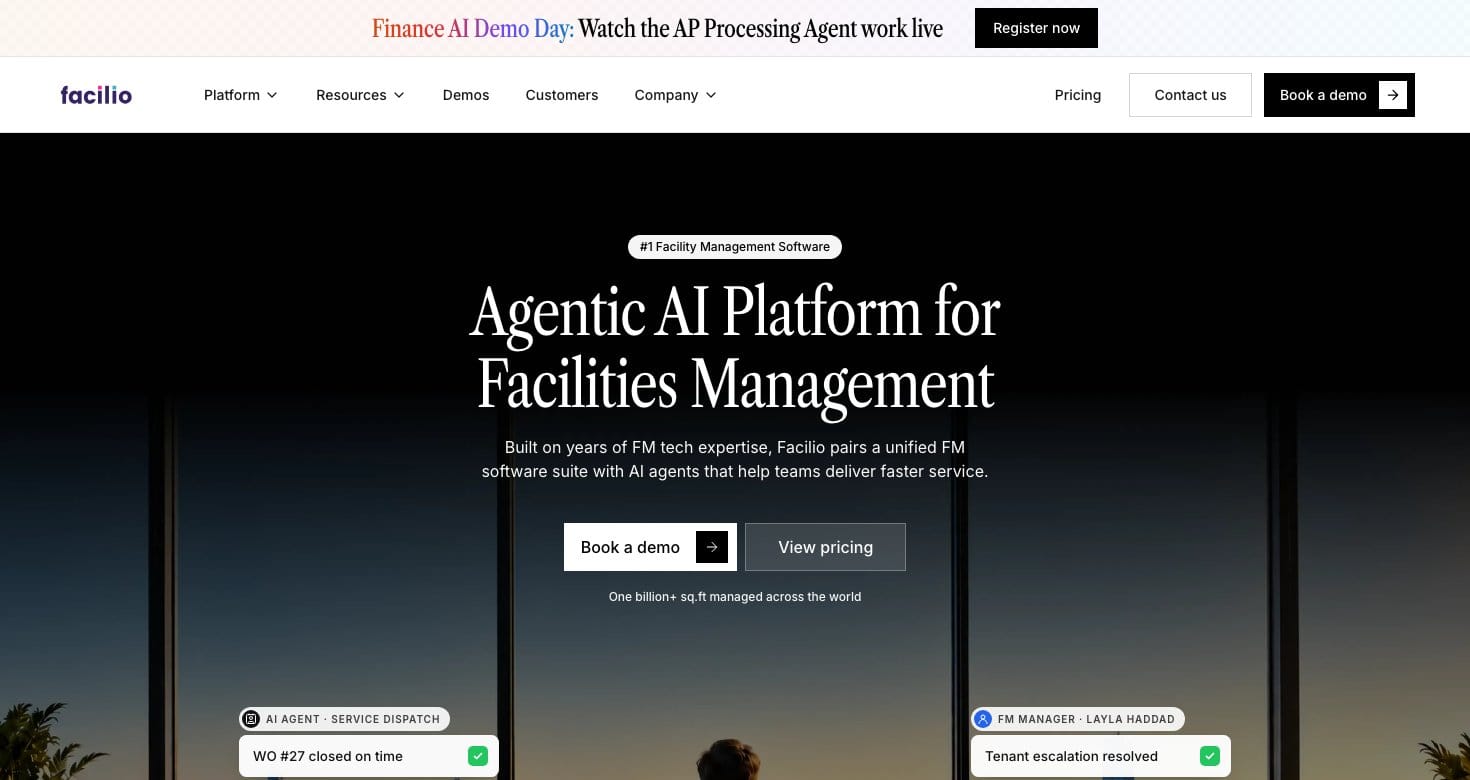
Best for: Enterprise multi-site facilities teams, FM service providers, and real estate owner-operators who need portfolio control, deep integration, and fast deployment without a year-long project.
Facilio is an AI-native Connected CMMS that unifies maintenance, vendors, occupants, and building systems on one platform rather than sitting beside them. Its own category framing is "AI-Native CMMS for Enterprise Facilities Management," and it extends a standard CMMS with the Atom agentic AI layer, so routine intake, invoice validation, and reporting move from manual to autonomous. Independent analyst Verdantix named Facilio a Leader in its 2025 Green Quadrant for Commercial Buildings CMMS, citing real-time spatial intelligence and deep system integrations tailored for commercial real estate portfolios.
Key features:
- Portfolio operations: A native multi-site hierarchy lets head office compare performance across the estate while each site keeps role-based autonomy, its own SLAs, and local reporting.
- Connected integration: The platform connects ERP, BMS, and IoT through BACnet, Modbus, OPC UA, Niagara, and REST API, so a building fault can create and route a work order automatically.
- Agentic AI layer: The Atom suite includes Mira for help desk triage and dispatch, Luca for three-way invoice validation and reconciliation, and FM Copilot for natural-language operations, applied on top of the live CMMS.
- No-code configuration: Approval chains, SLA escalations, and routing rules are built through a drag-and-drop interface, so process changes do not wait in an IT queue.
- Offline-first mobile: Technicians update work, capture photos, and manage assets and inventory without connectivity, and everything auto-syncs when the signal returns.
- Vendor and occupant portals: Branded self-service portals keep subcontractors accountable to SLAs and give occupants a direct channel, which legacy and SMB tools rarely include.
- Energy and sustainability: Fault detection and diagnostics and energy monitoring sit on the same platform, so operations and ESG reporting draw from one source.
Pros:
- Fast enterprise rollout: Facilio gets multi-site FM teams fully live in 4 to 6 weeks, a fraction of the legacy EAM timeline, so value starts in the first quarter.
- One connected system: Maintenance, compliance, vendors, occupants, and energy run on one platform, which removes the swivel-chair work between disconnected point tools.
- Proven at portfolio scale: The platform supports 150+ enterprise clients and more than 350 million square feet optimized across 7+ regions as of 2027.
- Analyst-validated: Recognition as a Verdantix Green Quadrant Leader for Commercial CMMS, alongside names like Planon, IBM, and ServiceNow, signals maturity beyond marketing claims.
- Automation that compounds: The agentic AI layer removes repetitive intake and finance work, so the same team handles more sites without adding headcount.
Cons:
- More platform than a single small site needs: A one-building team with a handful of assets will not use the portfolio and integration depth it pays for.
- Quote-based pricing: Facilio prices by portfolio rather than a public per-user rate, so buyers need a scoping call to compare total cost against list-price SMB tools.
- Agentic AI is newer than legacy predictive maturity: The Atom agents are current and expanding, but some, such as the OpsVision reporting agent, are still rolling out, so confirm which are live for your use case.
- Industrial-asset depth is not the focus: For heavy manufacturing with complex asset lifecycles, a dedicated EAM such as Maximo may still track engineering detail Facilio does not target.
Customer proof: Investa, which manages more than $8.5 billion in prime Australian commercial office, reports 99 percent SLA adherence and manages 5,000+ service contractors on Facilio. CIT, overseeing national landmarks and critical infrastructure, runs 300+ sites with 72 percent more efficient compliance monitoring. Kingsmede unified 30 buildings with 100% automated compliance tracking and under 24-hour average work order resolution.
Verdict: For an enterprise whose "assets" are buildings and whose problem is multi-site visibility, vendor accountability, and speed to value, Facilio is the strongest fit for a building-first operation, and the agentic AI layer is a genuine step past the system-of-record model.
2. IBM Maximo
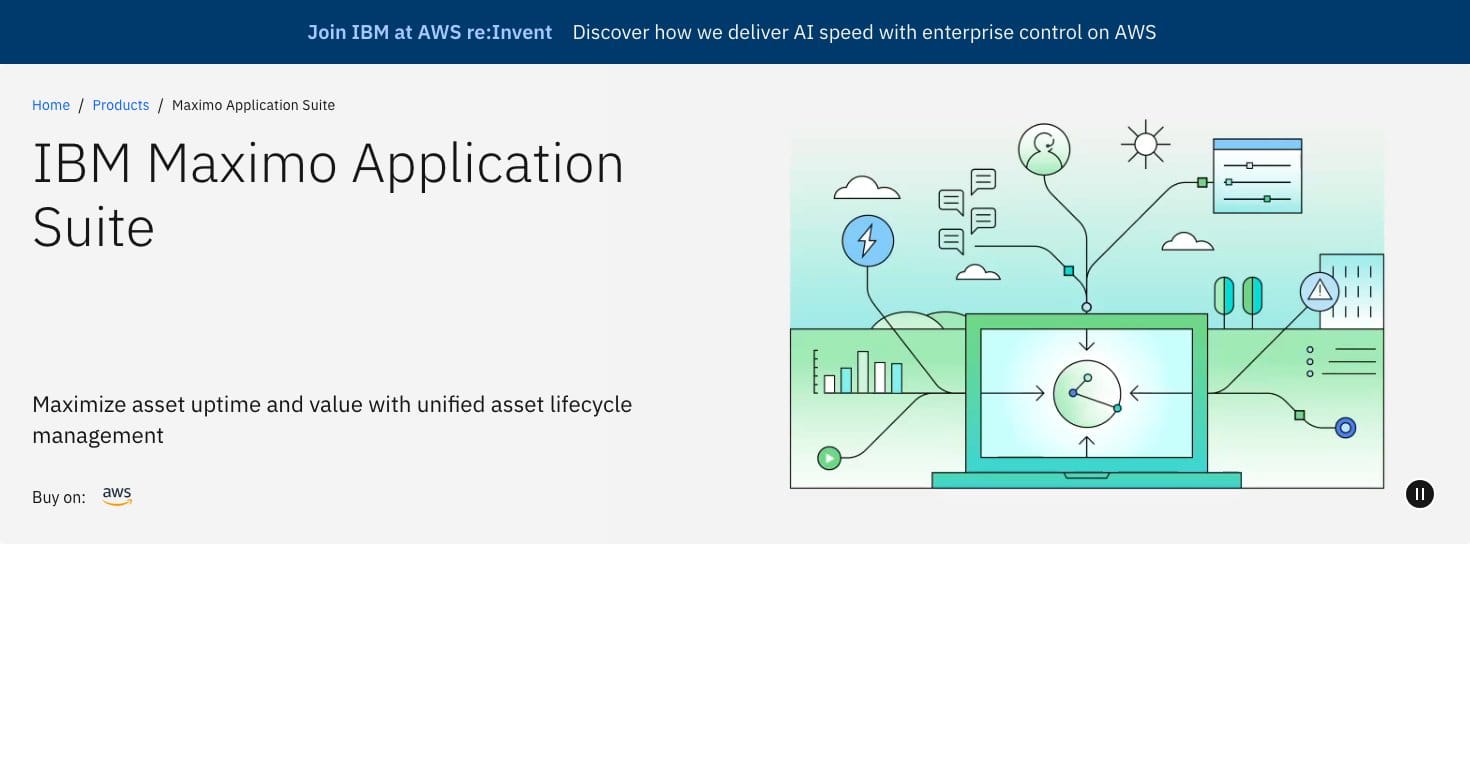
Best for: Asset-intensive enterprises in utilities, oil and gas, transportation, and heavy infrastructure that need deep asset-lifecycle management and can resource a long implementation.
IBM Maximo Application Suite is the heavyweight of enterprise asset management, the platform asset-intensive industries have standardized on for decades to run maintenance as engineering-grade asset-lifecycle work. Where most CMMS tools manage tasks, Maximo manages the asset itself, from capital planning through end-of-life.
Key features:
- Deep asset lifecycle: Maximo tracks assets from procurement to disposal with engineering-grade detail that critical infrastructure and regulated industries depend on.
- Predictive and condition-based maintenance: Maximo Health and Predict use IoT and analytics to flag failures before they happen on instrumented, high-value assets.
- Industry solutions: Pre-configured modules for utilities, transportation, oil and gas, aviation, and nuclear reflect decades of hard-won vertical depth.
- Containerized deployment: The Application Suite runs on Red Hat OpenShift, so large enterprises can deploy across cloud, on-premise, or hybrid environments.
- Enterprise scale and compliance: The platform handles very large asset counts and global user bases while meeting the audit and regulatory demands of asset-intensive sectors.
Pros:
- Unmatched asset depth: For complex engineered assets, Maximo captures lifecycle and reliability detail that few platforms even attempt, which is why it remains the industry benchmark.
- Mature predictive maintenance: Its reliability and IoT tooling is proven across utilities, energy, and heavy industry over many years.
- Vendor stability and ecosystem: IBM backing and a wide partner network give large enterprises long-term platform confidence and deep integration options.
- Regulated-industry fit: Strong audit, safety, and compliance capability suits nuclear, aviation, and utility operators.
Cons:
- Long, costly implementation: Multi-site Maximo rollouts commonly run 12 to 18 months and need dedicated IT resources, so value arrives in year two, not the first quarter.
- Steep learning curve: The interface and configuration demand specialist skills, which slows technician adoption and raises the cost of change.
- EAM overkill for building FM: For real estate and facilities operations, much of Maximo's industrial depth goes unused while the cost and complexity stay high.
- Dated user experience: Buyers frequently note an interface that trails modern cloud CMMS tools, which hurts frontline uptake. For teams weighing a lighter platform, see our IBM Maximo alternative comparison.
3. SAP EAM
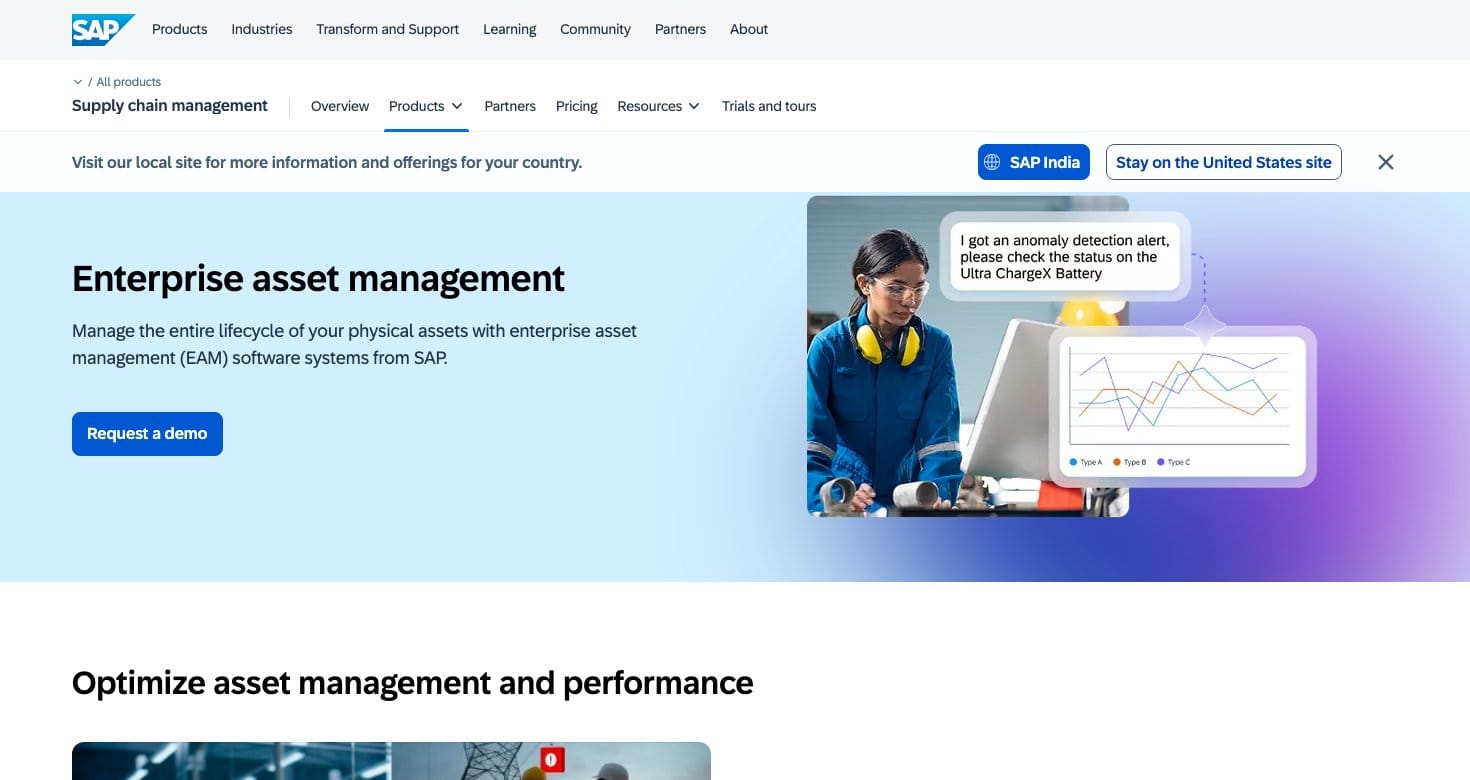
Best for: Large enterprises already standardized on SAP S/4HANA that want plant maintenance and asset management native to their ERP.
SAP EAM, delivered through SAP Plant Maintenance and SAP Asset Performance Management, is the natural choice when an enterprise already runs its business on SAP and wants maintenance inside the same system of record as finance and procurement. Its advantage is data gravity, not a standalone maintenance experience.
Key features:
- Native SAP integration: Maintenance, inventory, procurement, and finance share one data model, so maintenance cost flows directly into enterprise financials with no connector to maintain.
- Asset and work management: Comprehensive notifications, work orders, and asset master records handle the maintenance needs of large, complex plants.
- Predictive maintenance: SAP Asset Performance Management adds condition-based and predictive capability on top of the maintenance core.
- Global multi-country scale: SAP is proven across the largest multi-plant, multi-country enterprises with consistent process control.
- Fiori mobile: Modern mobile access through the SAP Fiori interface brings work orders to technicians in the field.
Pros:
- Single source of truth: For SAP shops, maintenance data lives beside finance and procurement, which tightens cost control and reporting.
- Enterprise-proven scale: SAP EAM handles the largest asset bases and user counts without architectural strain.
- Strong financial integration: Maintenance spend rolls directly into enterprise financial reporting, which finance teams value.
- Process standardization: One platform across global plants supports consistent, auditable maintenance process.
Cons:
- Expensive, specialist-led rollout: SAP EAM implementations run many months and depend on specialist consultants, which pushes total cost high.
- Low value outside SAP: The advantage collapses for organizations not already on SAP, and configuration is inflexible once set.
- Industrial bias: Like other EAM tools, it is shaped for plant assets more than real-time, people-heavy facilities operations.
- Adoption friction: The sheer breadth of SAP can overwhelm frontline maintenance teams without sustained training investment.
4. Infor EAM
Best for: Manufacturing and infrastructure enterprises that want strong asset-lifecycle management, especially within the Infor ecosystem.
Infor EAM is a mature asset-lifecycle platform with deep reliability roots, most compelling for manufacturers and asset-heavy operations already invested in the Infor CloudSuite stack. It competes on asset depth rather than facilities breadth.
Key features:
- Asset lifecycle management: Full tracking of asset condition, performance, and maintenance history across complex hierarchies.
- Predictive maintenance: AI and analytics support condition-based maintenance programs on instrumented assets.
- Industry depth: Configurations for manufacturing, public sector, transportation, and energy reflect long vertical experience.
- Integrated inventory and procurement: Spare-parts and purchasing management sit inside the maintenance workflow.
- Infor ecosystem fit: Native connection to Infor CloudSuite and ION integration adds value for existing Infor customers.
Pros:
- Strong asset depth: Infor EAM handles complex asset hierarchies and lifecycle data as well as any dedicated EAM.
- Mature reliability tooling: Its predictive and condition-based features suit asset-intensive, uptime-critical sites.
- Deep ecosystem value: For Infor CloudSuite customers, the integration advantage is significant.
- Enterprise scalability: It supports large, multi-site industrial operations without strain.
Cons:
- Complex implementation: Deployments are lengthy and resource-intensive, in line with other legacy EAM platforms.
- Limited real-time FM automation: It is built for asset tracking more than live, people-centric facilities workflows.
- Learning curve: Reviewers note a less intuitive interface relative to modern cloud CMMS.
- Best value inside Infor: Outside the Infor stack, the integration advantage that justifies it narrows sharply.
5. Accruent Maintenance Connection
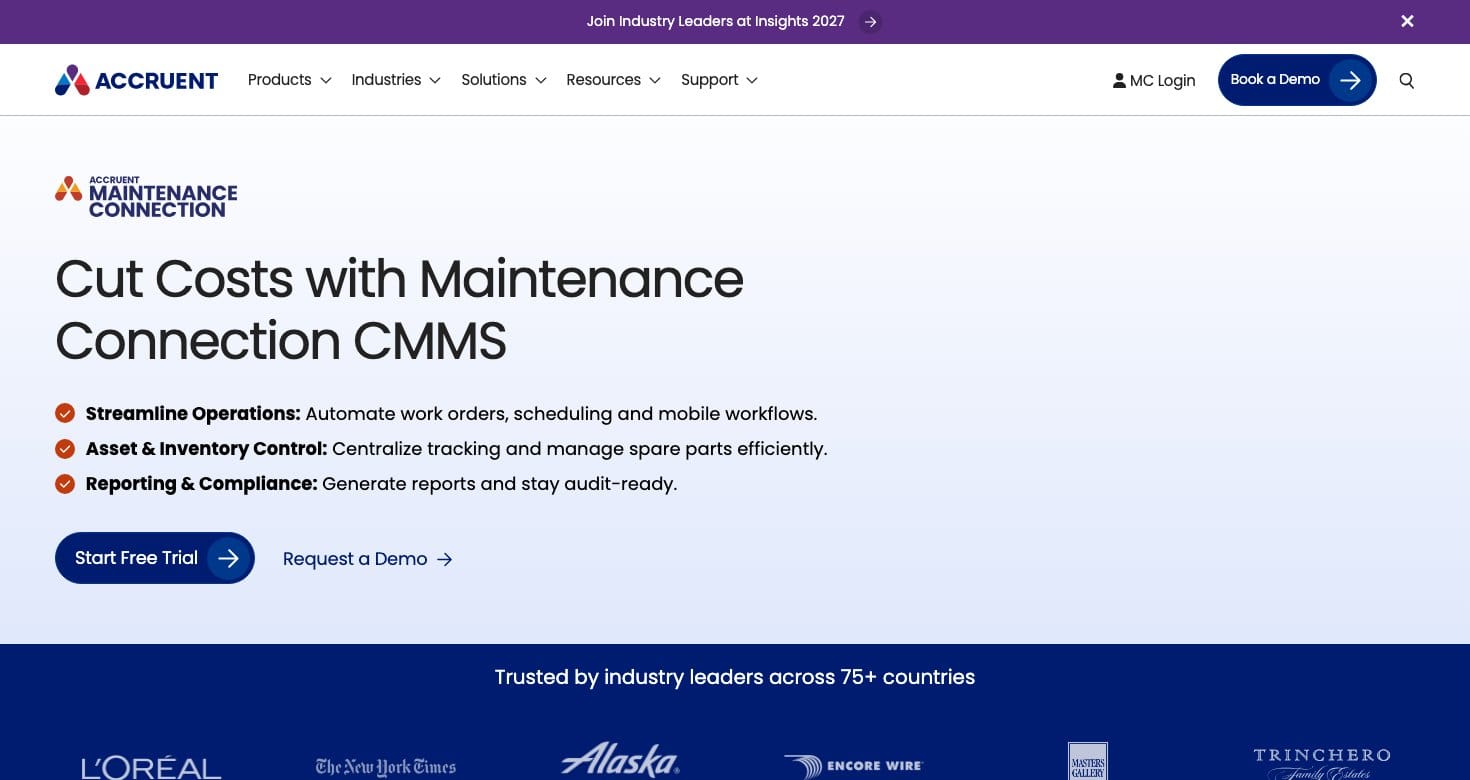
Best for: Healthcare systems, commercial real estate, retail, and public-sector organizations that need multi-site CMMS and EAM with strong compliance tracking.
Accruent Maintenance Connection is a long-established enterprise CMMS and EAM built for asset-heavy, compliance-sensitive sectors, and paired with Accruent FAMIS 360 it extends into space and facilities management for large real estate portfolios. It is a known, dependable choice in healthcare and the public sector.
Key features:
- Multi-site asset tracking: Centralized asset and work management across large, distributed portfolios.
- Compliance and audit depth: Regulatory and audit capability suited to healthcare, life sciences, and the public sector.
- Work order and PM management: Comprehensive preventive maintenance and work order workflows for complex estates.
- FAMIS 360 pairing: Space and facilities management alongside maintenance serves real estate and campus portfolios.
- Enterprise reporting: Reporting across sites, asset classes, and compliance programs for head-office oversight.
Pros:
- Vertical depth: A strong fit for healthcare, retail, and public-sector compliance requirements built up over years.
- Portfolio scale: It handles large multi-site asset bases that smaller CMMS tools cannot.
- Established vendor: Accruent is a mature provider with broad enterprise deployments and support.
- Compliance automation: Useful audit and regulatory tracking for heavily regulated estates.
Cons:
- Licensing complexity: Reviewers cite multiple cost codes and pricing that is hard to model before a scoping exercise.
- Dated experience: The interface trails newer cloud CMMS platforms, which affects adoption.
- Configuration effort: Tailoring the system to a specific operation often requires paid vendor services.
- Narrower real-time integration: Live BMS and IoT depth is thinner than connected platforms built around building data. Our Accruent CMMS breakdown covers where it fits and where it does not.
6. Planon
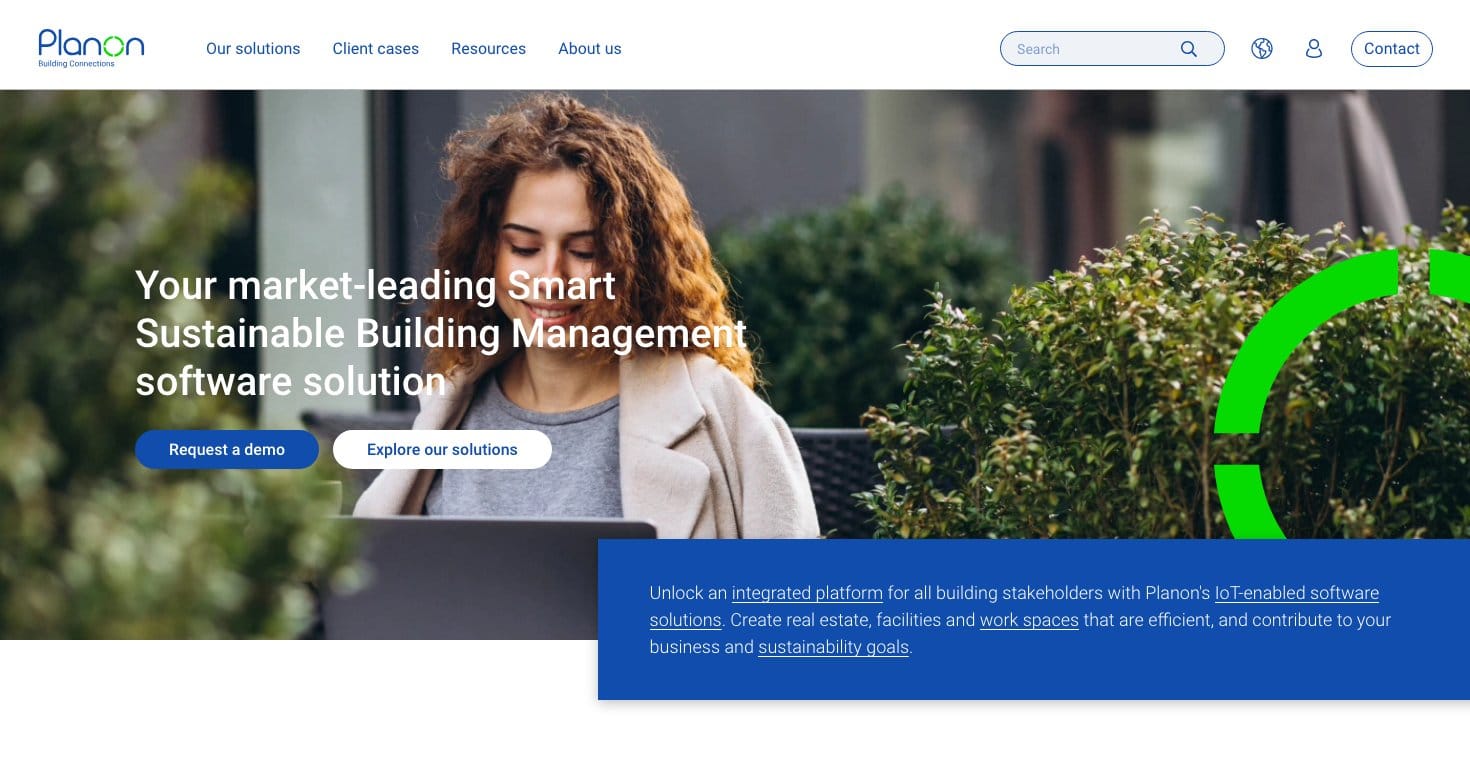
Best for: Large real estate and workplace organizations that want maintenance, space management, and lease operations unified in one integrated workplace management system.
Planon is an integrated workplace management system (IWMS) with CMMS at its core, suited to enterprises that must run maintenance, space, and lease operations together across a large real estate portfolio. It competes on breadth, not deployment speed.
Key features:
- Unified IWMS: Maintenance, space, lease, and workplace management live on one platform rather than in separate tools.
- Smart-building support: IoT and building-data integration suit connected, sensor-rich portfolios.
- Real estate and lease management: Portfolio, lease, and property operations across many properties in one system.
- Configurable workflows: Process configuration spans maintenance and workplace functions for large organizations.
- Sustainability reporting: Energy and ESG reporting serve large estates with corporate reporting obligations.
Pros:
- Rare breadth: Few platforms combine maintenance, space, and lease as fully as Planon does.
- Real estate fit: It is strong for large commercial real estate and corporate workplace portfolios.
- Smart-building integration: Good IoT and building-system support for connected estates.
- Enterprise scale: It is proven across large, multi-site, multi-country organizations.
Cons:
- Long implementation: IWMS breadth brings lengthy, high-cost deployment cycles.
- High total cost of ownership: The suite carries enterprise pricing plus a services overhead.
- Limited no-code: Configuration leans on the vendor more than on drag-and-drop self-service.
- Heavier upgrades: Reviewers note slower, more monolithic platform updates than modern cloud tools.
7. eMaint
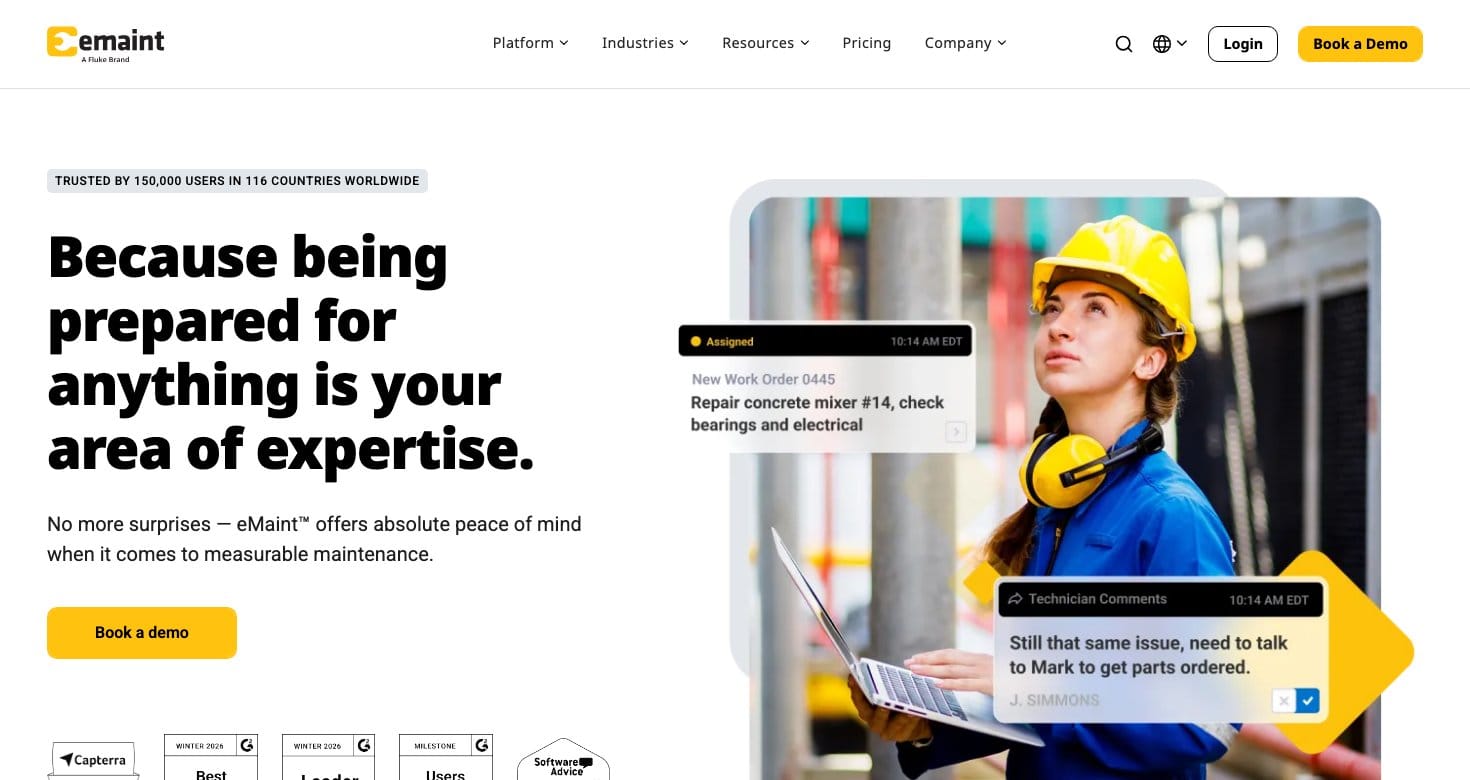
Best for: Mid-to-large reliability teams, especially those that pair maintenance with Fluke condition-monitoring hardware.
eMaint, part of Fluke Reliability, is a configurable CMMS that shines where condition monitoring and formal reliability programs live together, letting teams buy maintenance software and sensor hardware from one vendor. Its sweet spot is the reliability engineer, not the facilities manager.
Key features:
- Configurable dashboards: Flexible reporting and KPI tracking that reliability teams can shape to their programs.
- Native condition monitoring: Direct pairing with Fluke sensors brings condition data and maintenance into one view.
- Preventive maintenance: Strong PM scheduling and asset management underpin formal reliability practice.
- Multi-site reporting: Standardized cross-site reporting is available with configuration.
- Interactive asset mapping: Image and interactive mapping help locate and manage assets across facilities.
- Mobile: Offline-capable mobile keeps technicians productive in the field.
Pros:
- Reliability focus: It is excellent for teams running formal, data-driven reliability programs.
- Fluke ecosystem: Condition monitoring and CMMS from one vendor simplify the reliability stack.
- Highly configurable: It adapts to varied maintenance processes and reporting needs.
- Proven mobile and support: Solid field usability and a good support reputation.
Cons:
- SMB roots: Enterprise multi-site and stakeholder features need configuration to reach parity with purpose-built enterprise platforms.
- No drag-and-drop stateflows: Workflow automation is less flexible than no-code platforms offer.
- No vendor or occupant portals: It lacks the stakeholder portals enterprise FM relies on for transparency.
- Scaling effort: Larger multi-site rollouts take meaningful configuration work. See our eMaint CMMS review for detail.
8. Fiix
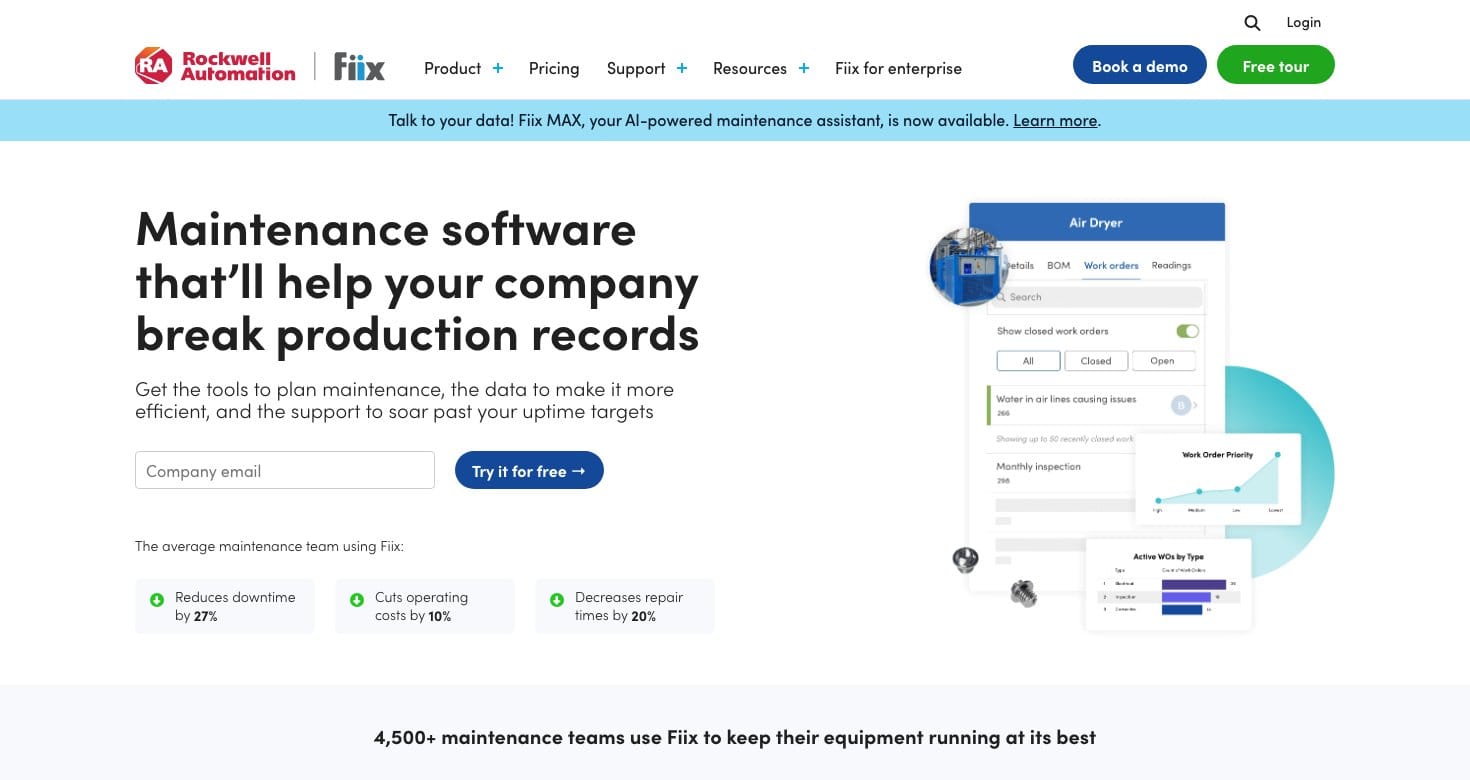
Best for: Manufacturers and industrial operations connecting operational technology to maintenance, especially within the Rockwell Automation ecosystem.
Fiix, part of Rockwell Automation, is a cloud CMMS built to bridge operational technology and maintenance, a natural fit for manufacturers that want factory-floor signals to drive work orders. It is a plant tool first and a facilities tool second.
Key features:
- OT and IT connectivity: Native strength linking factory systems and Rockwell automation to maintenance.
- Asset and PM management: Core work order and preventive maintenance workflows for industrial assets.
- AI maintenance insights: Analytics and AI surface maintenance patterns and recommendations.
- Integrations: API and ERP connectivity, plus the Rockwell OT ecosystem.
- Full offline mobile: Technicians work without connectivity and sync when back online.
Pros:
- Industrial fit: It is strong for manufacturing that wants an OT-to-IT maintenance flow.
- Faster to start: It deploys more quickly than legacy EAM platforms.
- Rockwell backing: It is a compelling choice for existing Rockwell Automation customers.
- Free tier: A free plan lets smaller teams start before committing.
Cons:
- Limited config depth: Reporting and form configuration thin out at enterprise scale.
- No stakeholder portals: It lacks vendor and occupant self-service portals.
- Facilities gaps: It is shaped for plant assets more than multi-site building FM.
- Enterprise workflow limits: Deep enterprise workflow automation is narrower than EAM or connected platforms. Our Fiix CMMS review covers the detail.
9. MaintainX
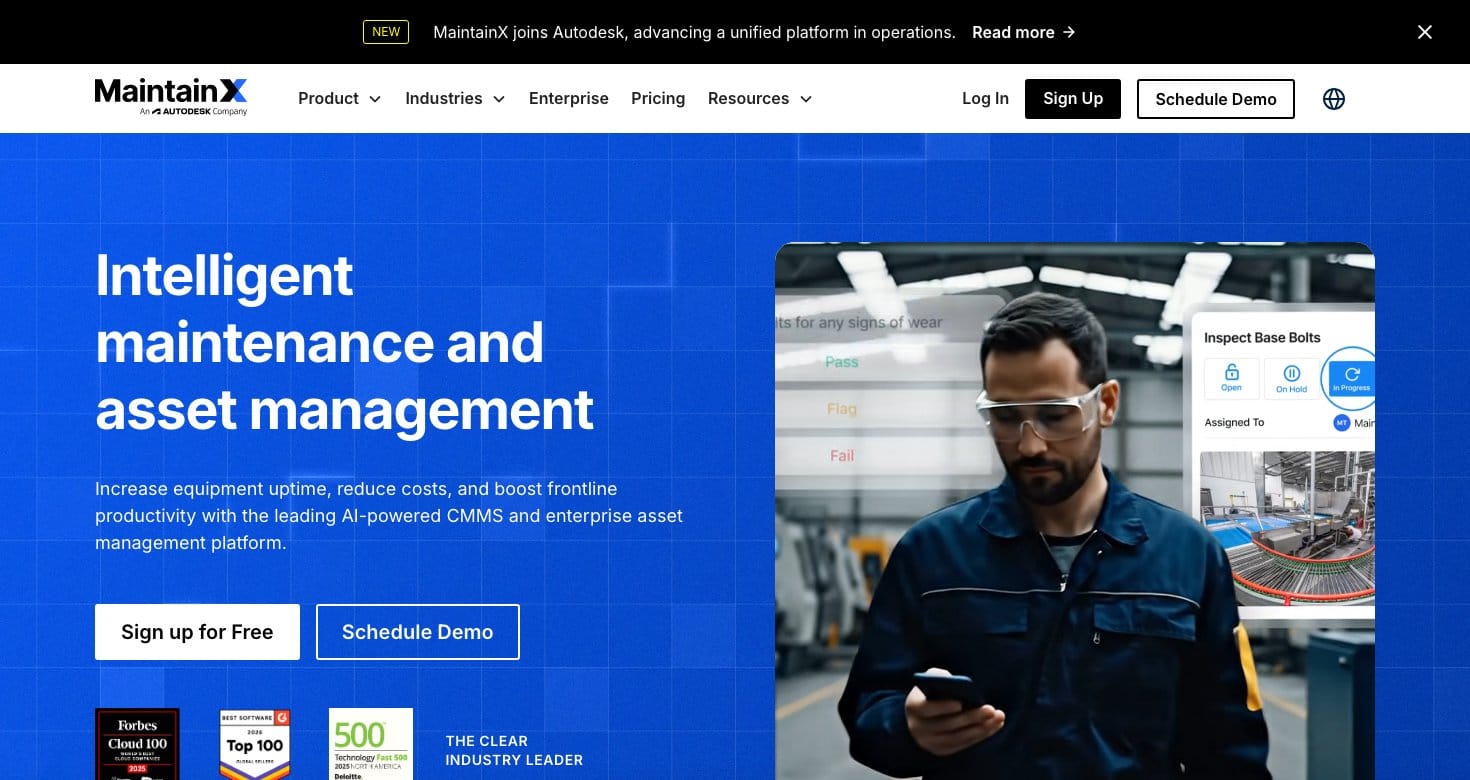
Best for: Distributed teams and frontline-heavy operations that prioritize fast mobile adoption over deep enterprise configuration.
MaintainX is a mobile-first work execution CMMS that wins on frontline adoption, built so technicians, operators, and hourly teams can run work orders and procedures from a phone with almost no training. It is the easiest tool here to roll out and the hardest to stretch to portfolio governance.
Key features:
- Mobile-first execution: A clean, fast app that frontline teams adopt with little training.
- Procedures and SOPs: Digital checklists and procedure libraries standardize how work gets done.
- Team messaging: Built-in communication keeps conversation tied to the work order.
- Assistive AI: AI helps generate work orders and procedures to speed setup.
- Fast onboarding: Quick configuration gets distributed teams live in days to weeks.
Pros:
- Rapid adoption: Frontline teams become productive faster than on almost any other platform here.
- Strong mobile experience: It offers one of the best field apps in the category.
- Quick deployment: It goes live in weeks, not months.
- High-volume execution: It is clean and efficient for high work order throughput.
Cons:
- Not portfolio-scale: Multi-site reporting and head-office control thin out for large estates.
- No drag-and-drop stateflows: Workflow automation stays basic compared with enterprise platforms.
- Limited ERP and BMS integration: Deep building-system and enterprise-system connectivity is narrow.
- No vendor or occupant portals: It lacks the enterprise stakeholder features FM providers need. See our MaintainX CMMS review.
10. Limble
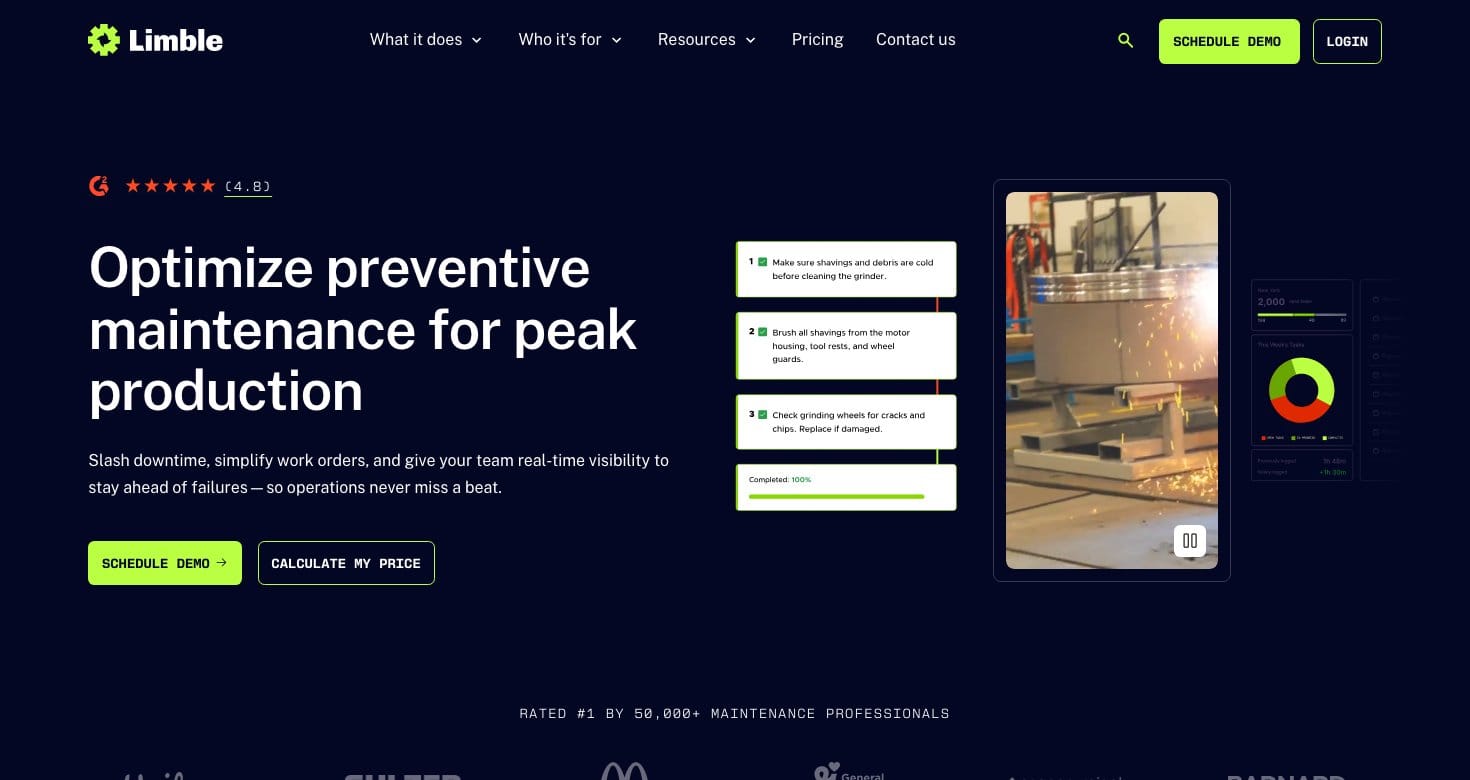
Best for: Mid-to-large operations that want a modern, practical CMMS with quick deployment and clean preventive maintenance.
Limble is a modern CMMS praised for usability, built for mid-to-large maintenance teams that want clean preventive maintenance and fast rollout without an enterprise implementation project. It is the comfortable middle ground between SMB simplicity and enterprise depth.
Key features:
- Structured preventive maintenance: Clean PM and asset hierarchy that teams learn quickly and actually use.
- Fast deployment: It is among the quickest platforms here to go live.
- Strong offline mobile: A capable mobile app keeps technicians working without connectivity.
- Custom dashboards: Flexible reporting covers maintenance KPIs without heavy setup.
- Parts and inventory: Spare-parts control ties directly to work orders, and QR scanning speeds asset lookup.
Pros:
- High usability: It earns strong ease-of-use and adoption scores from reviewers.
- Quick time to value: Fast setup and onboarding get teams productive early.
- Clean PM control: Preventive maintenance workflows are well designed and intuitive.
- Scales to mid multi-site: It works well for growing, multi-location operations.
Cons:
- Enterprise ceiling: Portfolio governance and security stretch it as site and asset counts climb.
- No occupant or tenant portal: It lacks the enterprise stakeholder portals FM operations rely on.
- Weaker BMS depth: Real-time building-system integration is lighter than connected platforms offer.
- Per-user cost at scale: Pricing can climb meaningfully as sites and users grow. Our Limble CMMS review has the full picture.
Best enterprise CMMS by use case
No single platform wins every enterprise scenario. Matching the tool to the operation matters more than the overall ranking.
Best for multi-site facilities and real estate portfolios: Facilio. When the assets are buildings and the challenge is portfolio visibility, vendor accountability, and tenant experience, a Connected CMMS beats an industrial EAM. Corrigo, part of JLL, also serves multi-location facilities, though it is shaped around the JLL ecosystem.
Best for FM service providers: Facilio. Providers delivering FM across many client sites need fast per-client deployment, branded portals, and SLA transparency, which the enterprise facility management software category is built around.
Best for healthcare and regulated estates: Facilio or Accruent Maintenance Connection, where compliance automation and audit trails are non-negotiable.
Best for heavy manufacturing and asset-intensive industry: IBM Maximo, SAP EAM, or Infor EAM, where engineering-grade asset lifecycle depth outweighs deployment speed.
Best for fast frontline adoption on a budget: MaintainX or Limble, for distributed teams that need mobile execution quickly and can accept lighter portfolio control.
What makes an AI agentic CMMS different
Most enterprise CMMS software is still a system of record. It stores work orders and waits for a human to act. An AI agentic CMMS adds a layer of autonomous agents that do the repetitive work themselves, which is the shift Facilio builds its agentic AI for facility operations around.
In practice this looks like three moves, as of 2027. A help desk agent, Mira, triages incoming requests across email, phone, and chat, then dispatches and tracks them without a coordinator keying anything in. An invoice validation agent, Luca, runs three-way matching across work orders, vendor invoices, and contracted rates, catching overbilling before it is paid. An operations copilot, FM Copilot, closes work orders, reschedules jobs, and answers portfolio questions in plain language. Reporting automation is rolling out next, so confirm which agents are live for your scope before you commit.
The point is not novelty. Unplanned downtime already costs industries an estimated $50 billion a year, according to Deloitte, and reactive maintenance runs materially more expensive than planned work, with Siemens estimating reactive costs at three to five times preventive. Agents that remove intake and finance drag let the same team prevent more of that loss across more sites. For a side-by-side on applying agents to an existing tool, see AI agents for IBM Maximo.
How to choose an enterprise CMMS
Before shortlisting, require a proof of concept that covers the axes an enterprise rollout lives or dies on. Treat this as the buyer checklist.
- Multi-site hierarchy and permissions: Can head office see the portfolio while each site keeps role-based control and its own SLAs?
- Integration depth: Does it connect ERP, BMS, IoT, and tenant systems through standard protocols, or does every integration need custom IT work?
- Deployment time: Is the vendor committing to weeks, or quietly to a year? Our fast CMMS deployment guide shows what a quick rollout actually requires.
- Automation beyond reminders: Can you build approval chains, escalations, and routing without code?
- Offline mobile and adoption: Will technicians use it in the field, including without connectivity?
- Compliance and audit: Are records dated, traceable, and audit-ready across sites?
- Total cost of ownership: What is the full five-year cost, including implementation, integration, and support, not just the license?
A platform that cannot evidence all seven in a pilot will not hold up when the second region goes live.
Enterprise CMMS implementation time and total cost of ownership
Implementation time is the quiet deal-breaker. Legacy EAM platforms commonly take 12 to 18 months to roll out across sites, because the depth that makes them powerful also makes them slow. Modern connected and mobile-first platforms deploy in weeks. Facilio, for example, gets multi-site FM teams fully live in 4 to 6 weeks, which moves value into the first quarter instead of the second year.
Total cost of ownership follows the same split. Enterprise EAM pricing is quote-based and dominated by license plus implementation plus multi-year support, so the sticker rarely tells the real story. Current-age CMMS tools publish per-user rates that look cheaper until you multiply them across hundreds of users and add the integrations an enterprise needs. For a structured view of what drives the number, see our breakdown of CMMS pricing. The honest rule: compare five-year total cost and time-to-value together, because a platform that is live in six weeks starts returning value while a cheaper tool is still in implementation.
Why enterprise FM and multi-site teams choose Facilio
The legacy operating model made facilities a cost center: a maintenance repository, rigid workflows, year-long rollouts, and reporting locked inside the vendor. A Connected CMMS flips that into a system that keeps operations moving across the whole portfolio, and the agentic AI layer moves it one step further toward autonomous. This is not theory. As covered in the era of legacy CMMS is over, the shift is already happening in enterprise portfolios.
The proof is in the deployments. Investa, managing more than $8.5 billion in prime commercial office, reports 99 percent SLA adherence while managing 5,000+ service contractors. CIT runs 300+ sites with 72 percent more efficient compliance monitoring and half the manual effort. Kingsmede unified 30 buildings with 100% automated compliance and under 24-hour work order resolution. Across the platform, 150+ enterprise clients run more than 350 million square feet, and independent analyst Verdantix named Facilio a Leader in its 2025 Green Quadrant for Commercial Buildings CMMS.
For an enterprise whose buildings are the business, the question is no longer which system stores your work orders best. It is which platform keeps your portfolio moving while your competitors are still waiting on an implementation. If that is the decision in front of you, book a 30-minute demo and we will show you how a multi-site operation goes live in weeks.
Frequently asked questions
What is the best enterprise CMMS software?
There is no single best; the right pick depends on your operation. For multi-site facilities and real estate, Facilio leads on portfolio control, integration, and 4 to 6 week deployment. For asset-intensive industry, IBM Maximo, SAP EAM, and Infor EAM lead on asset-lifecycle depth.
What is the best enterprise CMMS for multi-site operations?
Facilio is built for multi-site portfolios, with a native site hierarchy, role-based permissions per location, and head-office rollups. Accruent Maintenance Connection and Planon also serve large portfolios, with longer deployments.
What is the best enterprise CMMS for facilities management?
Facilio, an AI-native Connected CMMS, is designed for enterprise facilities and FM service providers, unifying maintenance, vendors, occupants, and building systems, with analyst recognition from Verdantix in 2025.
What is the best CMMS for FM service providers?
FM service providers need fast per-client deployment, branded portals, and SLA transparency across many sites. Facilio is shaped for this model, which is why providers like CIT and Q3 Services run on it.
What is the best enterprise CMMS for manufacturing?
For heavy manufacturing and asset-intensive sites, IBM Maximo, SAP EAM, Infor EAM, Fiix, and eMaint lead, because engineering-grade asset lifecycle and condition monitoring matter more than deployment speed.
What is an AI agentic CMMS?
An AI agentic CMMS adds autonomous agents to a standard CMMS that do repetitive work themselves, such as triaging and dispatching requests, validating invoices, and answering operations questions, instead of waiting for a human to act.
How long does an enterprise CMMS take to implement?
Legacy EAM platforms commonly take 12 to 18 months across sites. Modern connected and mobile-first platforms deploy in weeks; Facilio gets multi-site FM teams live in 4 to 6 weeks.
How much does enterprise CMMS software cost?
Enterprise CMMS pricing is usually quote-based, driven by license plus implementation plus multi-year support. Mid-market tools publish per-user rates from roughly $20 to $75 per user per month. Compare five-year total cost, not the sticker.
Does SAP or IBM have a CMMS?
Yes. SAP offers plant maintenance and asset management through SAP EAM, native to SAP S/4HANA. IBM offers Maximo Application Suite, an enterprise asset management platform with CMMS capability for asset-intensive industries.
About the Author
