Connected CMMS

 Connected Buildings
 Connected Refrigeration


 Download ebook

 Read case study


 Watch now


 Retail
 Healthcare
 FM Services
 Commercial Portfolios
 Corporate Facilities
 Education
 Data-driven Portfolio Ops
 Facility Management Software
 360° Asset Lifecycle
 Continuous Sustainability

 Blogs
Blogs
 Help docs
 Knowledge Hub
 ROI Calculator
 Ebooks & Guides
 Webinars
 Case studies


 About us
 Newsroom
 Careers
 Contact us
 Partners
 Events




Lockout tagout (LOTO) is a safety procedure that controls hazardous energy during equipment maintenance and servicing. Before any work begins, energy sources are isolated, locked, and tagged, so the machine physically cannot be switched on while someone is working on it.
The "lockout" part means physically securing the energy-isolating device with a padlock or lockout device. It keeps the equipment in a safe, off position.
The "tagout" part is the warning signal — a tag attached to the device that tells everyone else: don't touch this. Someone is working on it.
Together, they protect workers from unexpected startup, accidental re-energization, and stored energy release — things like residual electrical charge, compressed springs, hydraulic pressure, or trapped steam.
LOTO applies to any equipment that stores or transmits hazardous energy — electrical, mechanical, hydraulic, pneumatic, thermal, or gravitational.
In facility management, that means HVAC systems, pumps, chillers, conveyor belts, electrical panels, essentially anything your maintenance team regularly services.
Why LOTO matters: OSHA stats, fines & real consequences
Lockout tagout is not just a safety best practice. It is one of the most strictly enforced workplace safety standards.
OSHA’s lockout/tagout standard (CFR 1910.147) consistently appears among the top 10 most cited violations every year. The average fine per citation is around $19,000, and willful or repeat violations can exceed $150,000 per incident.
But the bigger concern is not the fine. It is a risk to people.
According to OSHA, proper LOTO compliance could prevent roughly 120 fatalities and 50,000 injuries each year in the United States. (Source)
Maintenance technicians, machine operators, and craft workers carry the highest risk and when hazardous energy goes uncontrolled, the injuries are serious: amputations, crush injuries, electrocution, severe burns, and fractures.
Worth noting: OSHA inspections aren't only triggered by accidents. Routine audits, employee complaints, and industry-wide enforcement programs can all bring an inspector to your facility. LOTO documentation is typically one of the first things they check.
A written program, trained employees, and documented procedures aren't just compliance requirements. They're what separates a controlled maintenance operation from a serious liability.
LOTO Program vs. LOTO Procedure: Key differences
These two terms get used all the time interchangeably. They're not the same thing, and confusing them is one of the most common gaps OSHA inspectors find during audits.
The simplest way to think about it:
Think of it like a preventive maintenance program versus a maintenance checklist. The program sets the rules. The procedure executes them.
You need both.
A program without procedures is just a policy document nobody follows. Procedures without a program mean no training, no auditing, and no accountability.
Manage LOTO procedures across every asset with Facilio.
See how it works →Lockout vs. Tagout devices: What are the key differences?
Both devices serve the same goal: keeping equipment from being accidentally energized during maintenance. But they work differently, and one is significantly stronger than the other.
The key difference between the two devices is this: a lockout device prevents re-energization. A tagout device warns against it. That's a meaningful difference when you're the one with your hands inside the machine.
OSHA's default requirement is lockout. Tagout is only permitted when the equipment design genuinely doesn't allow for a physical lockout. And even then, the tagout must be just as effective, which usually means additional precautions on top of the tag itself.
In practice, most modern facilities use both together. The lock secures the energy source. The tag communicates who locked it, when, and why.
6 LOTO procedure steps (In exact OSHA standard order)
OSHA's energy control standard — 29 CFR 1910.147 — defines the exact sequence that authorized employees must follow before servicing any equipment with hazardous energy. There are six steps, and the order matters.
Step 1: Prepare for shutdown
Before anything else, the authorized employee identifies all energy sources connected to the equipment — electrical, mechanical, hydraulic, pneumatic, thermal, or gravitational. This step also includes notifying all affected employees that a lockout is about to begin.
Step 2: Shut down the equipment
The machine is powered down following the manufacturer's or equipment-specific shutdown procedure. This is an orderly, controlled shutdown — not an emergency stop.
Step 3: Isolate the energy source
All energy-isolating devices — switches, valves, breakers — are moved to the off or closed position. Every single energy source connected to the equipment must be isolated, not just the primary one.
Step 4: Apply Lockout/Tagout devices
The authorized employee applies their personal lock and tag to each energy-isolating device. The tag must include the employee's name and contact information. If multiple workers are involved, each one applies their own lock.
Step 5: Release or restrain stored energy
This step catches people off guard. Even after isolation, energy can remain stored in capacitors, springs, elevated components, pressurized lines, or hydraulic systems. All residual energy must be discharged, blocked, or bled off before work begins.
Step 6: Verify isolation
Before touching the equipment, the authorized employee verifies it is fully de-energized — typically by attempting to start it using normal controls. The equipment must show a zero energy state before work proceeds.
How to build a full LOTO program: An 8 Step guide
Having individual LOTO procedures is a good start. But without a program holding everything together, you're one audit — or one accident — away from serious exposure.
Here's how to build one that actually works.
Step 1 — Get leadership buy-in
A LOTO program only works if the organization is behind it. Before writing a single policy, align with leadership on scope, budget for lockout devices and training, and clear ownership of the program. Without this, implementation stalls.
Step 2 — Conduct an equipment inventory
Walk every area of your facility and document all equipment that requires LOTO during servicing. Include every energy source connected to each machine — electrical, pneumatic, hydraulic, thermal, mechanical. This becomes the foundation of your equipment-specific procedures.
Step 3 — Write your LOTO policy
Your written policy needs to cover scope, roles and responsibilities, rules for applying and removing lockout devices, and how the program will be enforced. OSHA requires this to be documented — a verbal policy doesn't cut it.
Step 4 — Develop equipment-specific procedures
For each piece of equipment identified in Step 2, write a dedicated procedure. It should include the shutdown sequence, every energy isolation point, the type of lockout device required, and how to verify a zero-energy state. Generic procedures don't satisfy OSHA's requirements.
Step 5 — Procure lockout tagout devices
Stock your facility with the right hardware — padlocks, hasps, valve lockouts, circuit breaker lockouts, and standardized tags. Each authorized employee should have their own assigned lock. Shared locks undermine accountability.
Step 6 — Train your team at every level
OSHA requires three levels of LOTO training:
- Authorized employees — those who perform the lockout. Full procedural training required.
- Affected employees — those who operate the equipment. Must understand why LOTO is applied and what they cannot do while it's active.
- Other employees — anyone who works in areas where LOTO is used. Awareness-level training required.
Training must be role-specific, documented, and repeated whenever procedures change or deficiencies are observed.
Step 7 — Run a pilot and enforce
Before rolling out facility-wide, run the program on a defined set of equipment. Identify gaps in procedures, device availability, or employee understanding. Then enforce consistently — a LOTO program that gets bypassed occasionally isn't a LOTO program.
Step 8 — Audit annually and update
OSHA requires periodic inspections of LOTO procedures — at a minimum once per year per procedure, performed by an authorized employee other than the one using it. Any equipment changes, new energy sources, or incident findings should trigger an immediate procedure update.
LOTO procedure checklist (Download free template)
Knowing the steps is one thing. Having a standardized checklist that your team actually uses on the floor is another.
We've put together a ready-to-use LOTO procedure checklist that covers every stage of the process — equipment details, pre-shutdown, isolation, stored energy check, verification, re-energization, and sign-off.
It's built to be printed, filled out on the job, and filed for compliance records.
[Download the Free LOTO Checklist Template →]
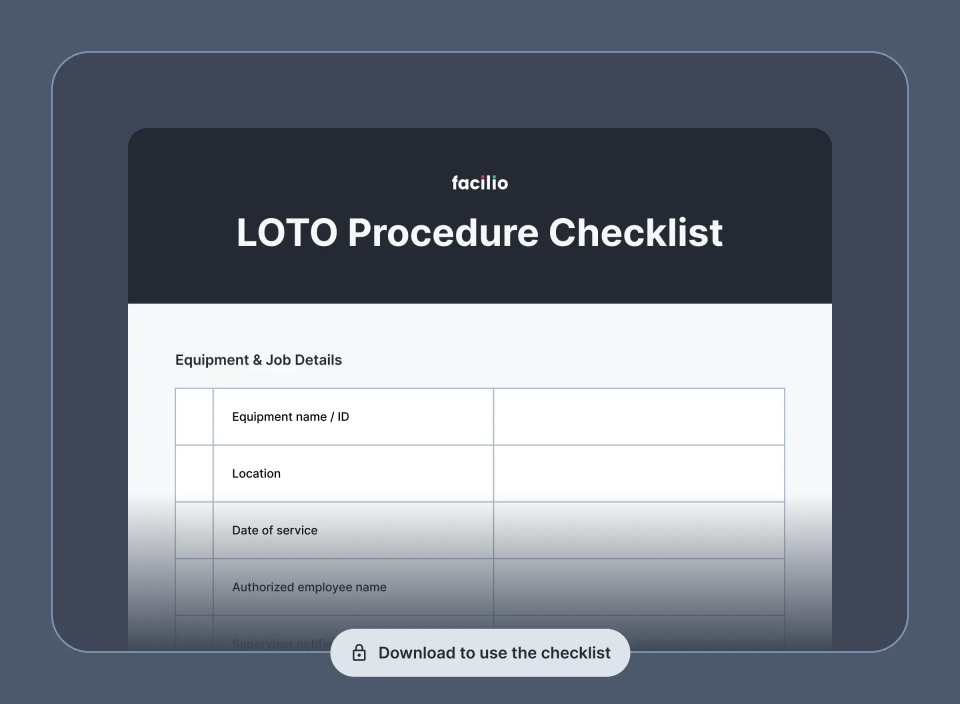
A few notes on using it effectively. Customize it to your specific equipment and energy sources — the template covers the OSHA standard procedure, but every facility has its own variables. Each authorized employee should have their own copy per job, not a shared sheet.
And completed checklists should be retained; if OSHA comes knocking, documentation is your first line of defense.
A checklist doesn't replace training. But it makes sure nothing gets skipped when the pressure is on.
Embed LOTO checklists directly into your maintenance work orders.
See how it works →How does CMMS help manage LOTO procedures at scale?
Paper checklists work for one or two assets. But most facility teams are managing dozens — sometimes hundreds — across multiple sites. At that scale, manual LOTO management becomes a compliance risk.
A CMMS solves this by making LOTO a built-in part of how maintenance work gets done, not a separate process running alongside it.
With a Connected CMMS platform like Facilio, equipment-specific LOTO procedures are embedded directly into work orders. When a technician is assigned to service an asset, the correct checklist surfaces automatically. Completed procedures are logged, timestamped, and tied to the employee — so when OSHA asks for records, you're running a report, not searching through filing cabinets.
For multi-site teams, the standardization benefit is just as important. Every technician follows the same procedure, every time, regardless of location.
And for safety managers, a CMMS provides something paper never could — real-time visibility into which assets are locked out, which procedures are due for their annual review, and where the compliance gaps are.
LOTO compliance doesn't have to be a manual effort. The right CMMS makes it systematic.
Stop managing LOTO on paper. Facilio keeps your procedures standardized, tracked, and audit-ready.
See Facilio's CMMS in action
Frequently asked questions on LOTO
1. What is lockout tagout (LOTO)?
Lockout tagout is a safety procedure that protects workers from hazardous energy during equipment maintenance. It involves isolating all energy sources, applying a physical lock, and attaching a warning tag, so the equipment cannot be started while someone is working on it.
2. What are the 6 steps of LOTO in the correct order?
Per OSHA 29 CFR 1910.147: (1) Prepare for shutdown, (2) Shut down the equipment, (3) Isolate the energy source, (4) Apply lockout/tagout devices, (5) Release or restrain stored energy, (6) Verify isolation.
3. What is the first step in a LOTO procedure?
Preparation. The authorized employee identifies all hazardous energy sources connected to the equipment and notifies all affected employees before work begins.
4. What is the final step of lockout/tagout?
Isolation verification — confirming the equipment is in a complete zero-energy state, typically by attempting a normal startup, before any maintenance work begins.
5. What's the difference between lockout and tagout?
A lockout device physically prevents re-energization. A tagout device warns against it. Lockout is always preferred; tagout alone is only permitted when physical lockout isn't feasible.
6. When is LOTO required by OSHA?
OSHA requires LOTO whenever employees perform servicing or maintenance on equipment where unexpected energization or energy release could cause injury. The standard is 29 CFR 1910.147. Exceptions apply to cord-and-plug equipment where the plug remains under the worker's exclusive control.
7. How often should LOTO procedures be reviewed?
At a minimum, once per year, per OSHA requirements. Reviews must be conducted by an authorized employee other than the one using the procedure. Any equipment changes or incident findings should trigger an immediate update.
8. Can a CMMS help with LOTO compliance?
Yes. A CMMS embeds LOTO checklists directly into work orders, logs completed procedures with timestamps, and gives safety managers visibility across all assets — making compliance systematic rather than manual.
About the Author

More from Facilio