Connected CMMS

 Connected Buildings
 Connected Refrigeration


 Download ebook

 Read case study


 Watch now


 Retail
 Healthcare
 FM Services
 Commercial Portfolios
 Corporate Facilities
 Education
 Data-driven Portfolio Ops
 Facility Management Software
 360° Asset Lifecycle
 Continuous Sustainability

 Blogs
Blogs
 Help docs
 Knowledge Hub
 ROI Calculator
 Ebooks & Guides
 Webinars
 Videos
 Case studies


 About us
 Newsroom
 Careers
 Contact us
 Partners
 Events


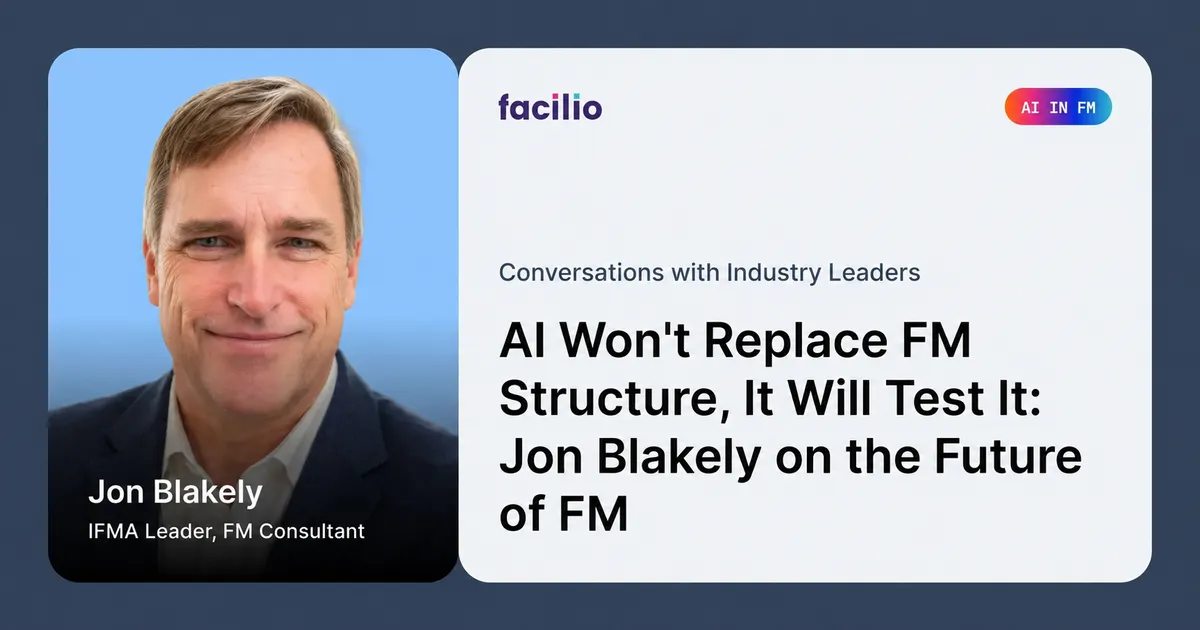

Most facility management teams have plenty of effort behind them and not nearly enough structure, and that gap stays invisible until it turns into an emergency invoice, a blown vendor contract, or a building nobody planned for.
That's the argument running through this conversation, made by someone who has spent his career inside the rooms where FM strategy gets decided.
Jon Blakely is an IFMA leader and a leading executive facility management consultant. He advises organizations on FM maturity, operational structure, and increasingly on where AI does and doesn't fit into the future of the profession. He built his reputation by telling clients what's broken instead of selling them hype, even when that answer is less exciting than a new tool.
We spoke with Jon about FM maturity, reactive maintenance, CMMS data, hidden risk, and where AI stands in the industry right now. No matter which angle we came at it from, the same argument kept surfacing: systems beat ambition, every time.
This is part of Facilio's ongoing conversations with the practitioners who run and advise on facility operations day to day, people who've seen what breaks and why.
Note: Jon's responses have been lightly edited for length and flow.
Diagnosing the Structure Gap
Maturity in FM shows up long before a crisis proves it.
Mature FM shows up in the calendar and the conversations, Jon says. Planned work dominates the schedule, vendors are held to clear standards, and leadership asks "what's coming next?" instead of "what just broke?"
FM systems, not ambition, are the true determinant of organizational success. Ambition without structure creates inconsistency and confusion at every level.
Jon Blakely · IFMA Leader & FM Consultant
Reactive operations, by contrast, live in the inbox and the radio, with priorities shifting by the hour. Nobody can produce a simple, trusted view of risk, backlog, and spend.
"The right systems free leaders to think strategically instead of firefighting constantly; structure is the prerequisite for sustainable performance."
Wanting to be preventive and funding it like a priority are two different things.
Two things keep organizations stuck, according to Jon:
Budget logic gets confused with stewardship. Leaders say they want preventive maintenance, then fund it like a nice-to-have project instead of a non-negotiable risk strategy. Deferred work becomes the default.
No one owns the full lifecycle view. Finance owns the budget while operations owns the pain, and FM ends up negotiating between the two with incomplete data. The organization keeps paying what Jon calls "the emergency tax" instead of building a stable base.
"Reactive maintenance is always more expensive than proactive, in dollars, downtime, and organizational trust. Deferred maintenance is a risk management failure, not a budget strategy."
The Data-to-Decision Gap
Most FM teams sit on mountains of CMMS data that never gets acted on.
Jon argues most CMMS data sits like a warehouse instead of telling a story. Work orders, asset histories, and costs are technically there, but they aren't structured to answer the real questions leadership asks: what's the risk, what's predictable, what's the return. The real gap is translation, not collection — FM teams log tasks while leaders need patterns. Until someone owns turning raw data into a small set of decision-ready insights, the CMMS stays a digital filing cabinet.
Getting a real picture of performance means connecting four things, according to Jon:
Connect those four, and the dashboard becomes useful instead of decorative. Jon warns that green dashboards can mask a mess when too many KPIs dilute accountability. The fix is fewer, sharper metrics — not more of them.
The Risks Nobody Sees Coming
The riskiest problems in FM, according to Jon, rarely announce themselves. They build slowly, compound over time, and stay easy to explain away until they aren't:
Deferred maintenance that quietly becomes capital failure
Vendor underperformance masked by "no news"
Aging buildings entering the decline phase with no lifecycle plan in place
A cultural drift toward "we'll get to it later" as an accepted norm
By the time leadership feels these risks, they've already turned into emergency spend, reputational damage, or a sudden loss of capacity.
Jon frames this almost biologically. Buildings move through growth, maturity, and decline the way people do, and each stage needs different care. Preventive attention at the right lifecycle phase is what extends useful life and protects the organization's money.
AI Is a Multiplier, Not a Fix
Jon doesn't play into the AI-in-FM hype cycle the way plenty of advisors do.
AI adoption sits in what he calls "serious curiosity" right now. Clients bring it up in nearly every strategic conversation, though their posture varies — some actively testing it for work order triage or anomaly detection, others wanting a roadmap before buying anything, and the rest waiting for proof it'll integrate cleanly instead of adding noise. Across all three groups, nobody wants AI for AI's sake. They want fewer surprises and faster, clearer decisions.
When automation comes up, Jon sees people asking for relief in three places first:
Reactive noise: help me find the signal in the flood of work orders and alarms.
Planning and forecasting: help me turn history into a credible budget and capital plan.
Vendor and performance visibility: help me see who's underperforming before it becomes a crisis.
Jon draws a clear line between where AI already delivers and where it's overhyped.
✓ Ready Now
- Pattern recognition across large datasets
- Anomaly detection on comfort, energy, and equipment behavior
- Assisted summarization of complex FM data for executive communication
✗ Overhyped
- Push-button "fully autonomous" buildings
- AI positioned to replace disciplined FM structure rather than amplify it
- Tools promising insight without requiring clean data or governance to back it up
AI is powerful, but it's still a multiplier. If your FM function is a house of straw, AI just helps you see the collapse in higher resolution.
Jon Blakely · IFMA Leader & FM Consultant
That's worth sitting with, because AI doesn't rescue a broken operating model. It shows the cracks in higher resolution, faster.
The Uncomfortable Truth
We asked Jon what a benchmark report would say if it had to tell one uncomfortable truth about FM today. He didn't soften it.
Most organizations are not suffering from a lack of FM effort. They are suffering from a lack of FM structure and alignment, and they are quietly bleeding money because of it.
Jon Blakely · IFMA Leader & FM Consultant
Teams and vendors alike are working hard, but without a clear operating system, aligned expectations, and honest data, organizations normalize the chaos and call it "the nature of facilities."
As Jon puts it, most FM problems start with misalignment rather than equipment failure, and when vendors, teams, expectations, and priorities fall out of sync, costs rise and decisions slow down.
Key Takeaways
Effort was never the problem. Every failure pattern Jon describes — reactive maintenance, unread CMMS data, invisible risk, even AI disappointment — traces back to a lack of structure, not a lack of effort.
Preventive maintenance fails when it's funded like a discretionary project. Treat it as a non-negotiable risk strategy, or deferred work becomes the default.
Someone has to own the full lifecycle view, or no one does. Finance, ops, and FM each hold a piece of the picture, and nobody owns all of it by default.
Four connections make or break your data. Work orders to assets, assets to cost, FM performance to vendor contracts, and FM metrics to business outcomes.
Fewer KPIs, not more. A dashboard full of green can hide a system in decline if the metrics don't match operational reality.
Buildings age like people do. Growth, maturity, and decline each need different care, and the biggest risks are the slow, compounding ones nobody's watching.
AI amplifies whatever you already have. A strong FM foundation gets stronger. A weak one fails faster, and in higher resolution.
Structure is what separates FM teams that scale from teams that survive.
See how Facilio gives your operation the backbone to move from reactive to reliable.
About the Author