Connected CMMS

 Connected Buildings
 Connected Refrigeration


 Download ebook

 Read case study


 Watch now


 Retail
 Healthcare
 FM Services
 Commercial Portfolios
 Corporate Facilities
 Education
 Data-driven Portfolio Ops
 Facility Management Software
 360° Asset Lifecycle
 Continuous Sustainability

 Blogs
Blogs
 Help docs
 Knowledge Hub
 ROI Calculator
 Ebooks & Guides
 Webinars
 Videos
 Case studies


 About us
 Newsroom
 Careers
 Contact us
 Partners
 Events




A Joint Commission surveyor walks onto your floor unannounced and asks for the last test log on your medical gas alarms. The equipment is fine. The generators ran their monthly load test. The isolation rooms hold negative pressure. None of that matters for the next five minutes, because the surveyor does not want to see the equipment. They want to see the record. If it takes your team an hour of digging through spreadsheets and shared drives to find it, you already have a finding.
That gap between "the building works" and "we can prove the building works" is where most hospital facilities teams live. It is also the fastest way to understand what hospital facility management has become in 2026: less about fixing what breaks, more about running a compliant, connected, always-on physical environment where every action is documented and every asset is accounted for.
This is the reality for a discipline that now oversees a market worth about $326 billion in 2024, projected to reach $837 billion by 2034, according to Precedence Research. The stakes rose again this year, and the operating rules changed underneath everyone at once.
What hospital facility management really means (and why it is not commercial property management)
Hospital facility management is the coordinated operation, maintenance, and safety compliance of a hospital's physical environment, from HVAC and medical gas to life-safety systems and clinical spaces, so that patient care runs without interruption. Unlike commercial property management, uptime and air quality here directly protect patient lives.
That single difference reshapes everything. An office tower can lose an air handler for a day and send people home. A hospital cannot. When an operating room loses positive pressure or an airborne infection isolation (AII) room loses negative pressure, procedures stop and infection risk climbs immediately. The federal safety authority OSHA describes hospital facilities management as an interdisciplinary function coordinating space, infrastructure, people, and organization, which is a polite way of saying the facilities team quietly holds the building together underneath the clinical work.
So while the core of facilities management is universal, hospital facility management adds three non-negotiables: 24/7 uptime on critical systems, life-safety and infection-control compliance that carries legal weight, and a documentation trail that has to survive an unannounced audit.
What a hospital facilities team is actually responsible for
The scope is wider than most people outside the department realize. On any given day, a hospital facilities or plant operations team owns:
- Plant operations and utilities: Emergency generators and load testing, medical gas and vacuum systems, boilers, chilled water, and electrical distribution that cannot fail during a procedure.
- HVAC and environmental control: Air changes per hour, temperature and humidity in surgical suites, and the pressure relationships that keep contaminants out of sterile areas.
- Infection control support: Negative-pressure AII rooms, water management to prevent Legionella, and dust and containment barriers during construction, governed by an Infection Control Risk Assessment (ICRA).
- Life safety and fire protection: Sprinkler and alarm inspections, means of egress, and interim life-safety measures when a system is temporarily down.
- Security and access control: Restricting entry to emergency departments, ICUs, pediatric units, pharmacies, and infant-care areas.
- Asset and equipment management: A live register of what you own, how old it is, and when it was last serviced, tied to preventive maintenance schedules.
- Vendor and contractor management: Credentialing outside trades, tracking insurance and licenses, and holding subcontractors to documented standards through vendor management software.
Miss any one of these and the consequence is not a complaint. It is a patient-safety event or a survey citation. That is why the reference point for the whole discipline is the accreditor, and this year the accreditor rewrote the rulebook.
What changes under the Joint Commission 2026 Physical Environment chapter
On June 30, 2025, the Joint Commission announced Accreditation 360, which took effect January 1, 2026, and it directly reshapes how hospital facilities teams are surveyed.
The old Environment of Care (EC) and Life Safety (LS) chapters have been merged into a single Physical Environment (PE) chapter that governs the built environment, utilities, fire and life-safety systems, and medical equipment together. According to ASHE, the consolidation cut the number of standards by roughly 50 percent and reduced elements of performance by about 48 percent for hospitals, aligning the requirements more closely with the Centers for Medicare and Medicaid Services (CMS) Conditions of Participation.
Fewer standards does not mean less scrutiny. It means broader, outcome-based expectations and less room to hide behind a technicality. A leaner rulebook puts more weight on whether you can demonstrate a working program, with current records, across every building you operate. For facilities leaders managing healthcare Joint Commission compliance, the shift makes one capability decisive: the ability to produce complete, current documentation on demand, from any site, without a scramble.
Which system does a hospital actually need: CMMS, CaFM, IWMS, or EAM?
Buyers get lost here, and vendors are happy to keep them lost. The acronyms overlap, but for a hospital the practical question is narrow: what do you need to run maintenance, compliance, and assets across clinical buildings? Here is the honest version.
| System | What it manages | Where it fits in a hospital |
|---|---|---|
| CMMS | Maintenance, work orders, PM schedules, asset service history, compliance records | The operational core for most hospital facilities and plant-operations teams |
| CaFM | Space and facility operations (the term used more in the UK and Commonwealth markets) | Useful when space planning sits alongside maintenance |
| IWMS | The full real-estate and workplace portfolio, including leases and capital projects | Large health systems managing real estate as a portfolio |
| EAM | Full asset lifecycle and reliability, often plant-heavy | Asset-intensive operations focused on lifecycle cost |
For most US hospitals, the operational spine is a CMMS: it runs the work orders, the preventive maintenance, the inspections, and the compliance evidence that a survey demands. The other categories layer on when space, portfolio real estate, or deep reliability engineering become the priority. If you want the full breakdown of each, the linked definitions above go deeper than any hospital guide should.
In-house, outsourced, or software-led: how hospitals run facilities
Every hospital answers one structural question before it buys anything: who actually does the work? There are three models, and most health systems run a blend.
| Operating model | Best fit | The trade-off to weigh |
|---|---|---|
| In-house team | Systems that want direct control, deep institutional knowledge, and clinical trust | You carry hiring, training, and succession, which is hard in a tight labor market |
| Outsourced IFM (for example Crothall, Medxcel, Sodexo, ABM) | Systems that want scale, surge capacity, and a provider's compliance and capital-planning depth | Less direct control and a dependence on the provider's technology and transparency |
| Software-led | Any model, because in-house and outsourced teams both need a system of record | Technology alone does not replace skilled people or a governance program |
The distinction that trips people up is plant operations versus clinical engineering. Plant ops covers HVAC, boilers, electrical, and life safety. Healthcare Technology Management (HTM), or biomed, covers medical devices. They are different teams, often on different systems, which is exactly how records fragment. Whether you insource, outsource, or run integrated facilities management, the connective layer that keeps all of it visible is the same, and it is software.
The problems quietly draining hospital facilities budgets
Ask a hospital facilities director what keeps them up at night and you will hear the same short list, backed by hard numbers.
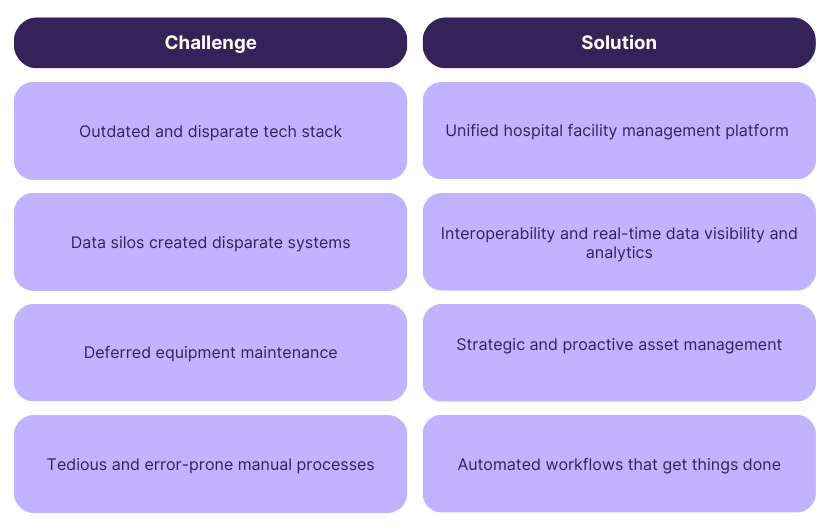
Aging infrastructure that outlived its design life: More than half of US hospital buildings are over 50 years old, and 80 percent of facilities leaders name aging infrastructure their leading concern, per the 2024 Hospital Operations Survey reported by Health Facilities Management. Real-estate advisor JLL frames it bluntly as healthcare's hidden crisis.
A deferred-maintenance backlog that compounds: An ASHE-commissioned analysis found US healthcare facilities have deferred roughly 41 percent of their maintenance, an estimated $243 billion backlog growing $12 to $18 billion a year. Deferral is not saving; it converts a manageable repair into a capital emergency, which is why a disciplined repair or replace decision framework matters.
No reliable data on their own assets: Teams cannot maintain what they cannot see. When the asset register lives in spreadsheets, equipment ages invisibly and PMs slip, which is the root cause behind most survey findings. A live healthcare asset tracking system is the difference between managing assets and guessing at them.
A shrinking, graying workforce: Skilled technicians are retiring faster than they can be replaced, and nearly 80 percent of facilities managers receive less than half of their requested maintenance funding. Fewer people and less budget means the only path forward is doing more with automation.
Siloed systems and paper trails: Facilities, HTM, and compliance often run on separate tools, so the same asset exists in three records and none of them agree. When a surveyor asks for proof, the team spends hours reconciling data it should have had in one place.
What strong hospital facility management delivers
Get these fundamentals right and the return shows up across the whole organization, not just the loading dock.
- Survey readiness on demand: Complete, current documentation means an unannounced survey becomes a report you export, not a fire drill you survive. This is where an audit-ready CMMS earns its keep.
- Uninterrupted patient care: Proactive maintenance on critical systems keeps operating rooms, ICUs, and imaging running, protecting both safety and revenue.
- Lower total repair cost: Catching failures early avoids the four-to-seven-times premium of an emergency fix and slows the deferred-maintenance spiral.
- Higher technician productivity: Mobile work orders, automated scheduling, and routed requests let a smaller team cover more ground without burning out.
- Portfolio-wide visibility: Leaders see performance across every building in one view, which turns healthcare capital planning from guesswork into a data-backed budget request.
- Cleaner clinical relationships: When facilities respond fast and document everything, clinical staff stop working around a broken system and start trusting it, which supports broader quality improvement in healthcare.
Hospital facility management in action: 6 real use cases
The value gets concrete once you see how a connected program handles the scenarios that define a hospital's day.
- Negative-pressure and AII room monitoring: Continuous readings on pressure relationships, with automatic alerts and a logged record every time a room drifts out of range, so infection-control evidence builds itself.
- Medical gas and emergency generator testing: Recurring, code-driven inspections and load tests generate work orders on schedule and store the completed test records against each asset, ready for a surveyor.
- Operating-room readiness and EOC rounds: Digital EOC rounds for healthcare compliance replace paper checklists, capturing findings, photos, and corrective actions in one traceable flow.
- Multi-site rollout across a health system: One standardized program, PM library, and asset hierarchy deployed across dozens of buildings, so every site is run and reported the same way through a modern work order software.
- Survey-documentation automation: Every completed inspection, PM, and repair is time-stamped and linked to its asset, so producing a five-year history is a search, not a scavenger hunt.
- ICRA and contractor compliance during construction: Credentials, insurance, and containment requirements tracked automatically, with non-compliant vendors flagged before they set foot on a clinical floor.
Where hospital facility management is heading in 2026
The direction of travel is clear, and the leaders are already moving.
From reactive to predictive maintenance: IoT sensors and building system integration feed fault detection and diagnostics that surface a failing chiller or air handler before it fails, shifting teams from firefighting to predictive maintenance.
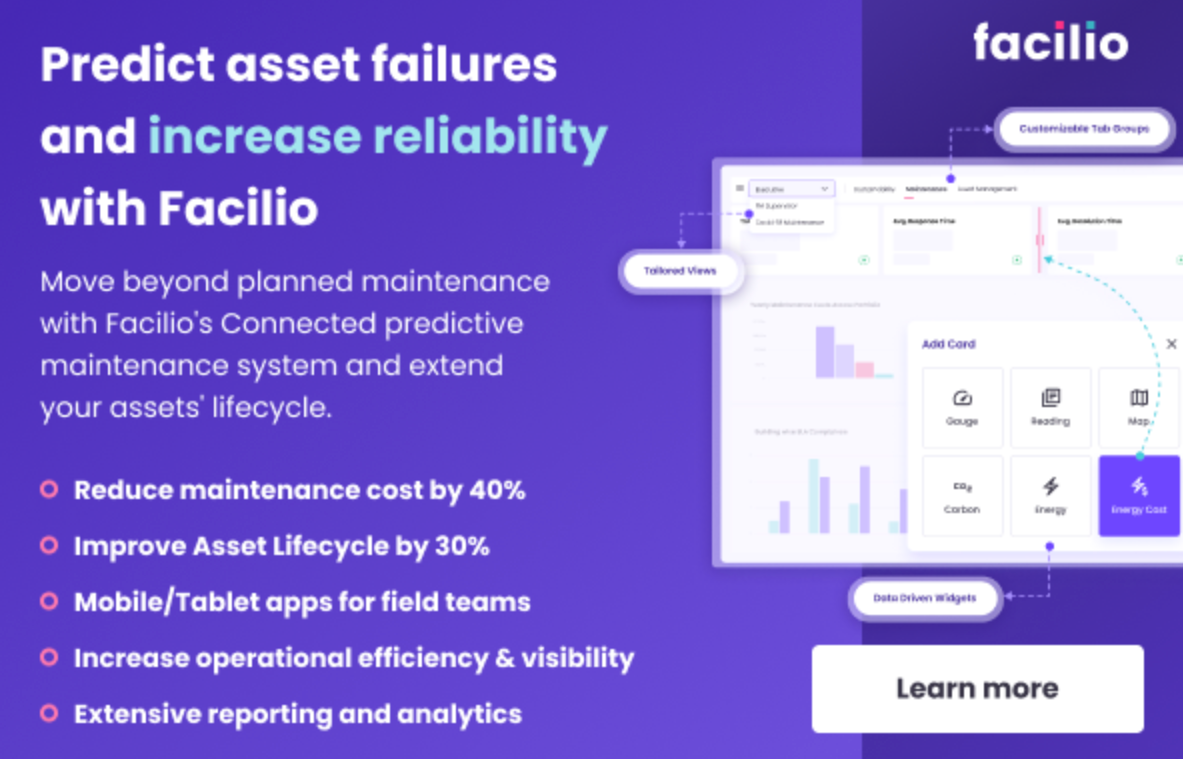
From dashboards to agentic AI: As of early 2026, vendors including Facilio have announced agentic AI suites built to sit on top of existing maintenance and finance systems and take on repetitive intake, triage, and reporting work. It is an emerging capability rather than a finished replacement for skilled staff, and the AI suite is where that shift is taking shape.
From maintenance to decarbonization: All-electric hospitals are moving from concept to reality. UCI Health opened the nation's first all-electric acute care hospital in Irvine, California in December 2025, a 144-bed facility that runs on solar with no natural gas infrastructure, per the American Hospital Association. That shift moves energy from a utility bill into an operational facilities workflow that teams now own.
From single buildings to portfolio operations: Health systems are consolidating dozens of buildings onto one platform to standardize compliance and compare performance across sites, which is the backbone of modern healthcare operational management.
The shift: a Connected CMMS as the connective layer for a health system
Here is the uncomfortable truth about legacy tools. A traditional CMMS was built to log work orders and hold an asset list, and little else. It needs IT support for any integration, its reporting is rigid, and it treats each building as an island. In a health system running critical environments across dozens of sites, that model does not just slow you down, it manufactures the exact documentation gaps a surveyor is trained to find.
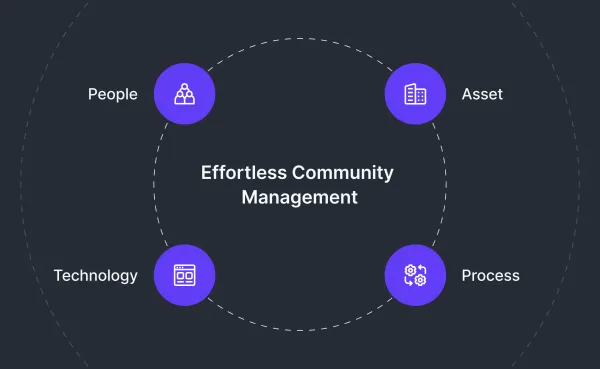
A Connected CMMS is a different category, not a cheaper version of the old one. Instead of a system of record that sits still, it connects three things that a hospital keeps in separate silos:
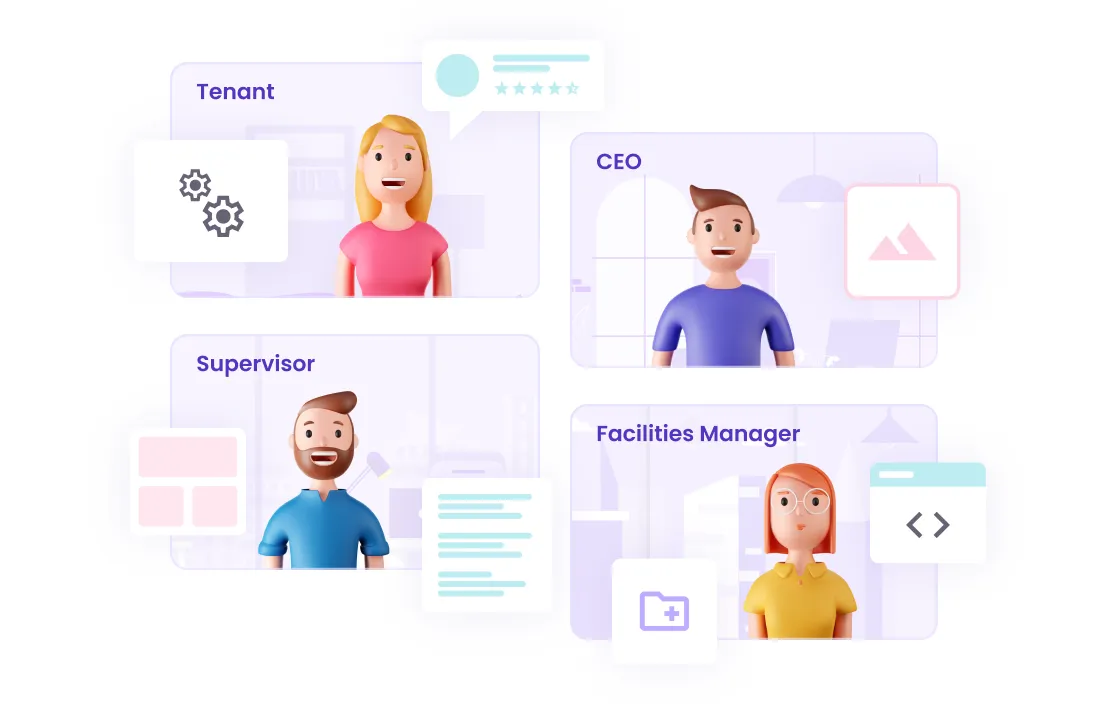
- People: Executives, plant operators, technicians, clinical staff, and outside vendors work from one platform, on web and mobile, with role-based access so the right people see the right data.
- Processes: Compliance rounds, PM schedules, inspections, and approvals run as automated, no-code workflows, so the record is a byproduct of the work rather than a separate chore.
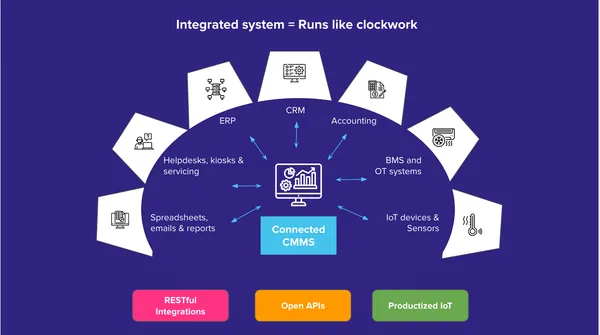
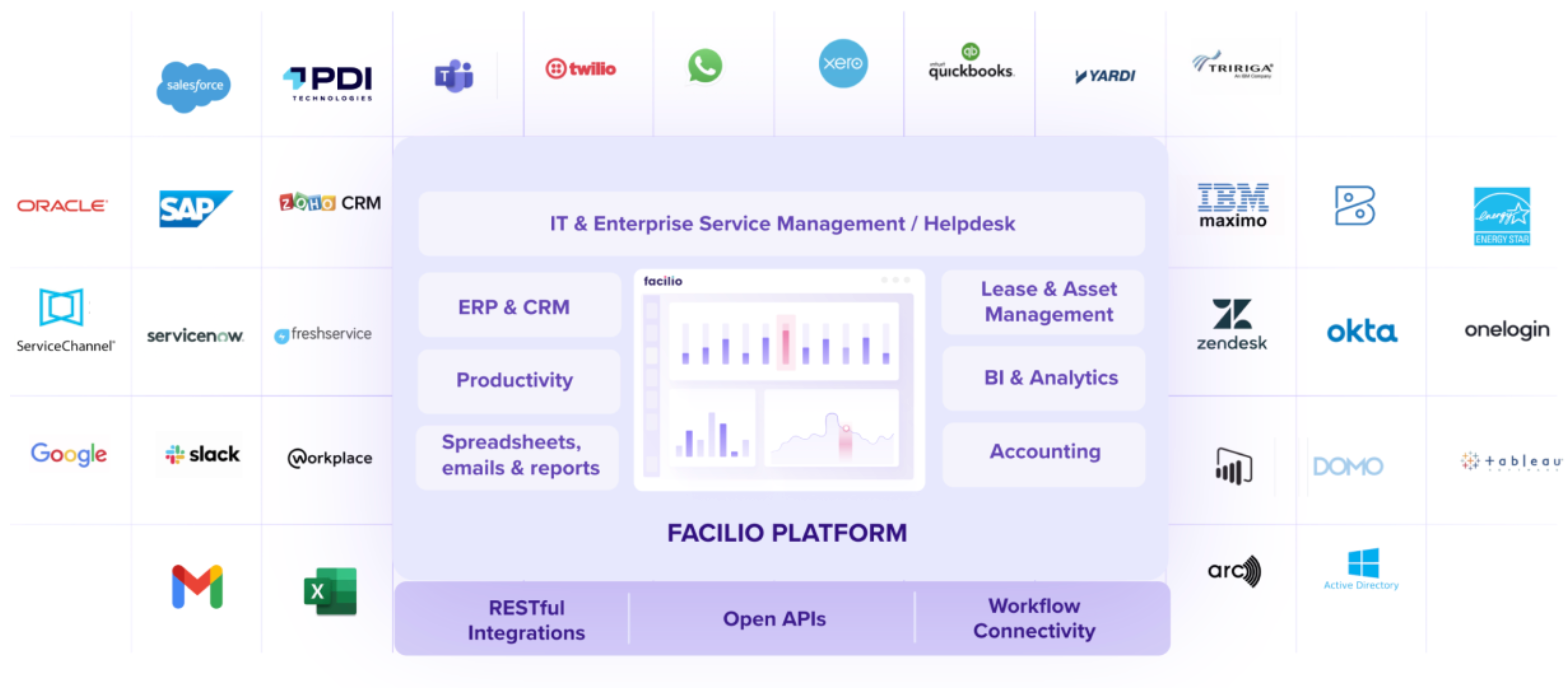
- Systems: Building management systems, HVAC, energy meters, security, and finance connect without ripping anything out, following a connect-and-unify approach rather than rip-and-replace.
That is the move from a passive record to an operating layer that keeps a hospital running. It reframes facilities from a cost center into a source of uptime, compliance, and capital discipline. For teams evaluating platforms, Facilio positions this as facility management software built for exactly this kind of connected, multi-site operation.
How US health systems modernized on a Connected CMMS
This is not theory. Two US healthcare organizations show what the shift looks like at scale.
One of the largest health systems in the United States, running 70 hospital and care sites across multiple states, replaced fragmented legacy asset systems with a single Connected CMMS. The results, documented in the US healthcare leader case study: more than 540,000 medical and facility assets onboarded into one hierarchy, over 100,000 work orders processed, more than 2 million attachments migrated from legacy tools, and Joint Commission audit-readiness built into daily operations across all 70 sites.
A separate US integrated facilities management provider serving mission-critical healthcare environments took a different starting point, moving off spreadsheets entirely. Per the US integrated healthcare FM provider case study: more than 3 million square feet of clinical space digitized, over 200 field professionals working from one platform, and life-safety preventive maintenance automated, all live in 46 days from kickoff.
The common thread is not a feature. It is that both organizations turned scattered, unprovable operations into a single, documented, portfolio-wide system, which is the whole job of hospital facility management in 2026.

Transformation of Healthcare Operations: How Decision-Makers Drive Control and Visibility
Watch VideoHow to choose hospital facility management software
If you are evaluating platforms, weigh them against the criteria that actually decide survey outcomes and daily reliability, not the demo dazzle.
- Compliance evidence built in: Can it generate a complete, dated audit trail per asset and per site without manual assembly?
- Multi-site architecture: Does it manage a standardized program and asset hierarchy across many buildings, with role-based permissions?
- Real integrations: Does it connect to your BMS, HVAC, and finance systems without custom IT projects for every change?
- Offline-capable mobile: Can technicians complete work and capture records in a basement mechanical room with no signal?
- Speed to value: Does it deploy in weeks, not the year-plus that legacy rollouts demand?
- No-code configuration: Can your team change a workflow without waiting on a vendor ticket?
For a wider market view, comparison guides on healthcare maintenance management software, the best CMMS software, and healthcare facility management software options can help you build a shortlist against these criteria.
The bottom line for facilities leaders
Hospital facility management in 2026 is a documentation-and-uptime discipline as much as a maintenance one. The buildings are older, the workforce is thinner, the backlog is larger, and the Joint Commission's new Physical Environment chapter rewards teams that can prove a working program across every site on demand. The organizations pulling ahead are not the ones with the newest boilers. They are the ones who connected their people, processes, and building systems onto one platform, so compliance, uptime, and capital decisions all run from the same source of truth.
If your team is still reconciling spreadsheets before every survey, that is the gap worth closing first. Book a 30-minute demo and see how a Connected CMMS keeps a health system survey-ready across every building: Request a demo.
Frequently asked questions
What is hospital facility management?
Hospital facility management is the operation, maintenance, and safety compliance of a hospital's physical environment, including HVAC, medical gas, life-safety systems, utilities, and clinical spaces, so patient care runs without interruption and the building stays audit-ready.
What does a hospital facility manager do?
A hospital facility manager oversees plant operations, preventive maintenance, life-safety and infection-control compliance, security, asset management, and vendors. The role protects uptime on critical systems and maintains the documentation that accreditation surveys require.
How is hospital facility management different from commercial facility management?
It carries higher stakes. Hospitals need 24/7 uptime on critical systems, strict infection control such as negative-pressure rooms, and legally weighted life-safety compliance, because equipment failures and air-quality lapses put patient lives at direct risk.
What changed with the Joint Commission's 2026 standards?
Effective January 1, 2026, Accreditation 360 merged the Environment of Care and Life Safety chapters into one Physical Environment chapter, cutting standards by about 50 percent and elements of performance by roughly 48 percent for hospitals, with closer alignment to CMS Conditions of Participation.
Does a hospital need a CMMS, CaFM, IWMS, or EAM?
Most US hospitals run a CMMS as the operational core for work orders, preventive maintenance, and compliance records. CaFM, IWMS, and EAM add value when space planning, real-estate portfolios, or deep asset-lifecycle reliability become the priority.
Should hospital facility management be in-house or outsourced?
Both models work, and many health systems blend them. In-house teams offer control and institutional knowledge, while outsourced IFM providers add scale and surge capacity. Either way, a shared software system of record keeps operations visible and compliant.
How does software improve hospital compliance?
It automates inspections, preventive maintenance, and rounds, then time-stamps and links every record to its asset. When a surveyor asks for proof, the team exports a complete, current history instead of reconciling spreadsheets under pressure.
How long does it take to implement hospital facility management software?
Legacy systems can take a year or more, but modern cloud platforms deploy in weeks. One US healthcare FM provider went live across more than 3 million square feet in 46 days, per its published case study.
About the Author

More from Facilio