Connected CMMS

 Connected Buildings
 Connected Refrigeration


 Download ebook

 Read case study


 Watch now


 Retail
 Healthcare
 FM Services
 Commercial Portfolios
 Corporate Facilities
 Education
 Data-driven Portfolio Ops
 Facility Management Software
 360° Asset Lifecycle
 Continuous Sustainability

 Blogs
Blogs
 Help docs
 Knowledge Hub
 ROI Calculator
 Ebooks & Guides
 Webinars
 Videos
 Case studies


 About us
 Newsroom
 Careers
 Contact us
 Partners
 Events


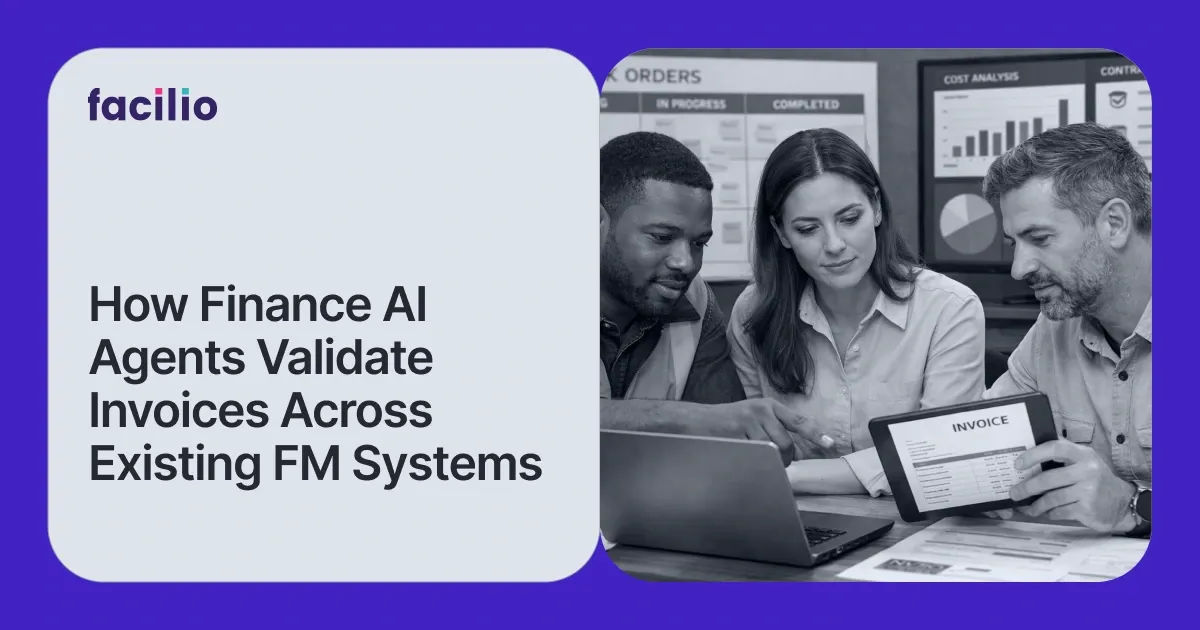

In facilities management, invoice validation is rarely just a finance task. It depends on operational records, contract terms, and vendor documentation that sit across disconnected systems.
This blog explores how a finance AI agent helps connect those records and improve invoice validation in facilities management through a more structured process.
Why FM Finance Is Harder to Control Than It Looks
Facilities management operations run on a continuous flow of work — maintenance jobs, vendor call-outs, inspections, repairs, and service contracts spread across buildings and sites.
Behind every completed job sits a financial trail:
- a quote that was approved
- a work order that was raised
- and eventually an invoice that needs to be paid
On the surface, this seems straightforward. In practice, it rarely is.
The financial data behind a single FM invoice is scattered across multiple systems.
- Work orders are logged in a Computerised Maintenance Management System (CMMS) — the platform used to log, assign, and track maintenance jobs.
- Contract rates and pricing agreements sit in separate documents managed by procurement or commercial teams.
- Vendor invoices arrive in their own formats.
- The payment process runs through the organisation’s Enterprise Resource Planning (ERP) system — the core finance platform used to manage approvals and payments.
These systems rarely connect automatically. As a result, people become the bridge between them:
- finance teams review invoices against contract terms
- operations teams confirm whether the work was completed
- commercial or procurement teams verify whether the charged rates match what was agreed
At portfolio scale — across multiple vendors, buildings, and contracts — this creates a structural gap in financial oversight that grows with the complexity of the operation.
How an AI Layer Connects Invoice Data Across FM Systems
One of the biggest concerns around introducing AI into financial workflows is whether it will disrupt the systems and processes already in place. In facilities management, where finance depends on CMMS data, contract records, and ERP workflows, that concern is understandable. But a finance AI agent designed for invoice validation is not meant to replace these systems. Instead, it works across them — connecting the operational and financial data that already exists in CMMS platforms, contract documents, and ERP systems.
Rather than acting as another standalone application, the AI reads and interprets information flowing through these systems. It can ingest vendor invoices in different formats, access work order data from the CMMS, and reference contract terms or agreed pricing stored elsewhere. By analysing these sources together, it creates a unified view of what should have been charged for a particular job.
This changes how validation happens. Instead of finance teams pulling information from multiple systems to verify an invoice, the AI brings the relevant data together automatically and evaluates it before the invoice moves forward — shifting financial control from reactive to proactive.
Validate invoices across work orders, contracts, and vendor records before they reach finance.
See AI Invoice Validation in ActionThree-Way Matching — How AI Connects Invoices, Contracts, and Work Orders in Facilities Management
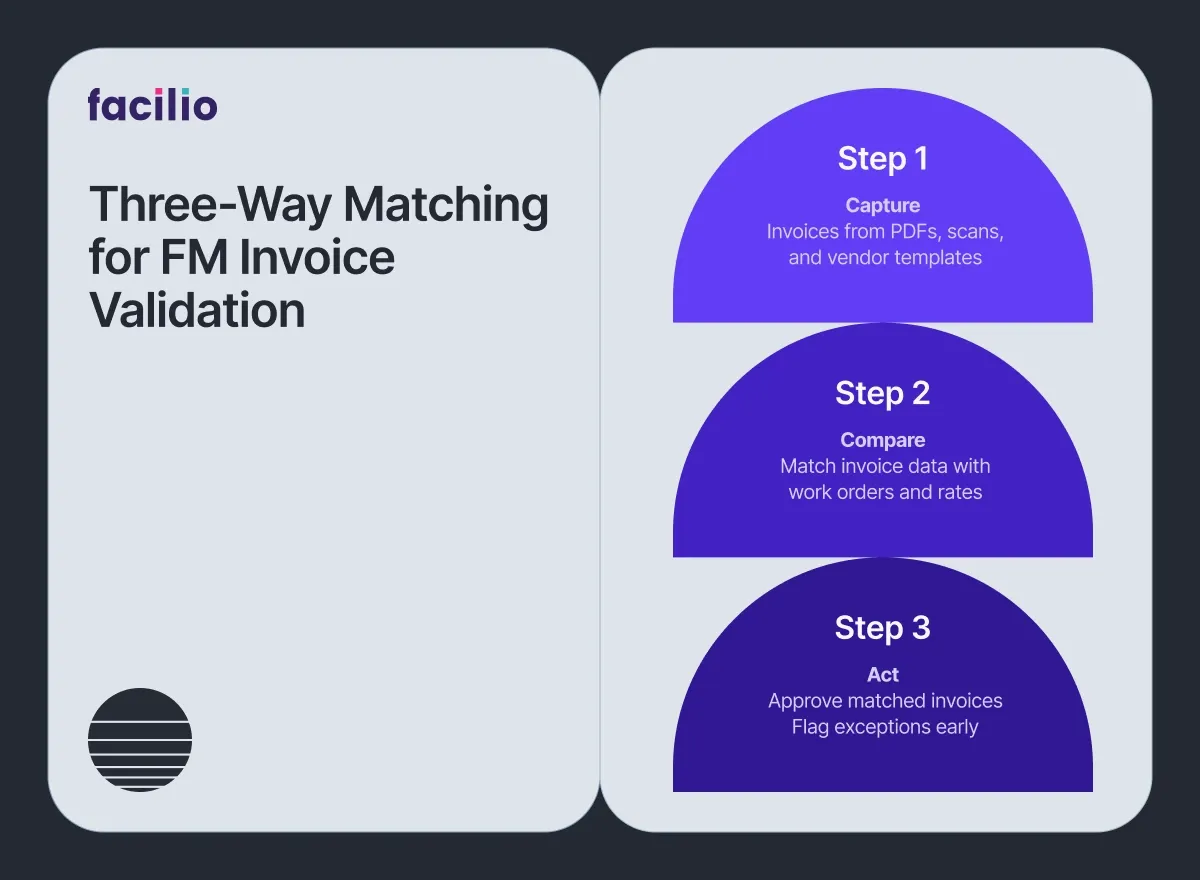
For financial validation to work in facilities management, invoices cannot be reviewed in isolation. They need to be checked against two other sources of truth: the work that was performed and the pricing that was originally agreed. This is where three-way matching becomes essential.
A. What Three-Way Matching Means in Facilities Management
In an FM context, three-way matching is the process of validating a vendor invoice against two related records:
- the work order raised for the job
- the contract or pricing agreement governing how that work should be billed
When these three elements align, the invoice can move forward with confidence. When they do not, it signals that something requires closer review.
B. Why This Comparison Is Difficult in Practice
Traditionally, performing this comparison requires teams to move between multiple systems and documents.
An invoice may arrive as a PDF or image file. The work order sits in the CMMS with details about the service performed and the completion status. Contract rates are often stored separately in procurement documents or commercial agreements.
Because these records exist across different systems, validating invoices often becomes a manual and time-consuming process.
C. How an AI Validation Layer Connects These Records
An AI validation layer brings these pieces together automatically. It extracts line-item information from incoming invoices — reading across formats including scanned documents and PDFs — reads service details from the corresponding work order, and compares the billed rates against the contract terms governing the job.
When all three records align, the invoice can proceed without delay. When they do not, the discrepancy is identified immediately — long before the invoice reaches finance teams for approval.
From Discrepancy Detection to Proactive Financial Control
When invoices are validated against work orders and contract terms before they reach finance teams, the role of financial review begins to change.
Instead of spending time piecing together information from different systems to confirm whether an invoice is correct, finance teams receive invoices that have already been checked against the underlying operational and contractual records.
The validation process shifts from:
- manual verification
- to exception management — reviewing only the invoices where something does not align.
Most FM invoices follow predictable patterns — recurring maintenance services, scheduled inspections, or standard repair tasks governed by established contracts.
When the invoice details match the corresponding work order and agreed rates, there is little need for repeated human validation. The AI recognises these routine cases and allows them to move forward without unnecessary friction.
At the same time, it highlights the exceptions that genuinely require attention — invoices where:
- quantities differ from the work order
- rates deviate from contract terms
- supporting documentation is missing
Over time, the system becomes more effective at recognising these patterns. As it processes more invoices, it learns vendor formats, recurring service structures, and typical pricing variations — allowing it to flag discrepancies with increasing accuracy without requiring manual retraining.
How AI Validation Fits Into the Existing Finance Workflow
The value of an AI validation layer is not just that it identifies discrepancies. It changes where validation happens in the workflow — and how existing finance systems are used.
In many FM environments, invoices move into finance queues, where teams manually compare them against work orders, supporting records, and contract terms before approval. This makes finance the point where mismatches are discovered and resolved — a process that is both time-consuming and late.
With an AI validation layer in place, that sequence changes. Invoices are checked earlier against the relevant operational and contractual records before reaching finance for final approval. Routine invoices move forward with far less friction, while exceptions are flagged for closer review.
This is where Facilio’s AI agent makes a difference — helping validate invoices against work orders and contract terms before they reach finance teams for approval.
For Facilio CMMS customers, deployment is immediate. For teams using third-party CMMS platforms, the AI agent can connect through lightweight APIs or periodic data feeds. Deployment typically takes weeks, not months.
Critically, this does not require replacing the systems already in use. The CMMS remains the source of work order data. Contracts continue to define commercial terms. The ERP — whether that is SAP, Oracle, Microsoft Dynamics, or NetSuite — remains the system of record for approvals and payments. Validated invoice data is pushed directly into these existing finance systems, maintaining the workflows and controls already in place.
For organisations managing large facilities portfolios across multiple vendors and sites, this shift creates a clearer, more controlled path from completed work to financial approval — without disrupting the infrastructure already built around it.
See how Facilio’s Finance AI agent helps validate invoices across your existing FM systems.
See Facilio's AI in Action
Frequently Asked Questions
1. How does an AI agent validate invoices against FM operational records?
The AI compares three records: the invoice, the work order in the CMMS, and the agreed contract rates. It checks quantities, pricing, and service details across them and flags discrepancies before the invoice reaches finance.
2. Will the AI work with our existing CMMS and ERP, or does it replace them?
The AI works across existing systems rather than replacing them. The CMMS remains the source of work order data, the ERP remains the system of record, and the AI performs validation within the current workflow.
3. Can the AI handle invoices in different formats from different FM vendors?
Yes. It can process PDFs, scanned documents, vendor templates, and digital feeds using document ingestion and OCR. Over time, it improves how it recognises recurring vendor formats.
4. How accurate is the AI validation, and can we see how it reached a decision?
Validation accuracy improves as the system processes more invoices and recognises vendor and pricing patterns. Each decision is logged clearly, so finance teams and auditors can see what was checked, matched, or flagged.
About the Author

More from Facilio