Connected CMMS

 Connected Buildings
 Connected Refrigeration


 Download ebook

 Read case study


 Watch now


 Retail
 Healthcare
 FM Services
 Commercial Portfolios
 Corporate Facilities
 Education
 Data-driven Portfolio Ops
 Facility Management Software
 360° Asset Lifecycle
 Continuous Sustainability

 Blogs
Blogs
 Help docs
 Knowledge Hub
 ROI Calculator
 Ebooks & Guides
 Webinars
 Case studies


 About us
 Newsroom
 Careers
 Contact us
 Partners
 Events



What is an OEM? A quick definition
An Original Equipment Manufacturer, or OEM, is the company that designs and produces a piece of equipment. In simple terms, it’s the original maker of the asset, not the reseller and not the service intermediary.
For example, a company that manufactures chillers for commercial buildings is the OEM of that chiller. The same applies to an elevator manufacturer supplying lift systems to a high-rise or a fire system manufacturer producing alarm panels installed across a hospital network.
Now, this is where confusion usually creeps in.
An OEM is not the same as a distributor. The OEM builds the equipment. A distributor or dealer sells or resells it, often handling logistics and commercial transactions.
Likewise, a third-party service provider may maintain the equipment, but they didn’t design or manufacture it.
That distinction may seem small at first. But in facility management, it becomes significant.
Because in real-world operations, an OEM relationship goes far beyond manufacturing.
Why OEM relationships matter in facility operations (and where risks emerge)
In facility operations, an OEM is not just the company that built your equipment. It influences how you maintain assets, who can service them, and how much you spend across their lifecycle.
And as portfolios grow, it also shapes risk exposure.
Here’s how that plays out.
A. Warranty compliance and maintenance control
Most OEM warranties come with strict conditions. Miss a scheduled inspection. Use non-approved spare parts. Delay a required service.
The warranty can become void.
OEMs also define inspection intervals, calibration standards, and servicing requirements. During the warranty phase, flexibility is limited. The manufacturer sets the baseline.
For facility teams, this is not just about uptime. It is about protecting capital investment.
Centralize warranties, SLAs, and service data in one place
Request a walkthroughB. Proprietary parts and authorized servicing
Many OEMs require original components and certified technicians for certain repairs. While this protects performance standards, it narrows vendor choice and can increase service rates.
In large portfolios, this affects response time, cost predictability, and negotiation leverage.
C. Cost structures and contract escalation
OEM maintenance contracts often include:
• Higher annual service fees • Premium spare parts pricing • Escalation clauses in long-term agreements • Limited room for benchmarking
Over time, these conditions influence total operating spend more than most teams initially anticipate.
D. Vendor lock-in and spare parts dependency
Once systems are installed, shifting away from an OEM can be difficult. Warranty clauses, proprietary components, and documentation restrictions create long-term dependency.
If only one source can supply critical parts, pricing power remains with the manufacturer.
E. Data silos and limited portfolio visibility
Many OEMs operate separate service portals or proprietary monitoring platforms. Each system stores maintenance logs and performance data independently.
When managing assets from multiple OEMs, operational information becomes fragmented.
That fragmentation makes it difficult to answer basic portfolio-level questions:
• Which OEM consistently meets response targets? • Which contracts escalate most aggressively? • Where are repeat failures occurring?
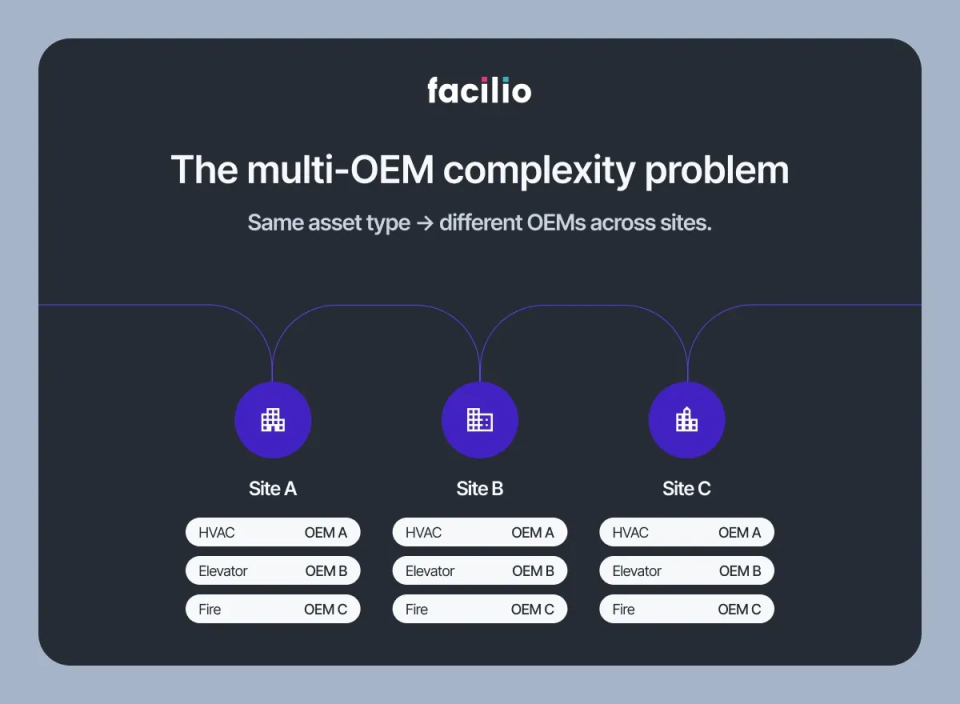
At scale, OEM management stops being a technical decision and becomes a coordination challenge.
Each manufacturer has:
a) Different warranty terms
b) Different maintenance frequencies
c) Different parts requirements
d) Different pricing structures
Maintenance planning quickly becomes more than scheduling work orders. It becomes a financial and compliance exercise. That is why OEM relationships matter far beyond installation day.
Bring all OEM contracts under one unified system
Learn more with a demoOEM vs third-party maintenance – what’s the real difference?
One of the most important decisions in facility operations is whether to rely on the original equipment manufacturer for maintenance or engage an independent service provider.
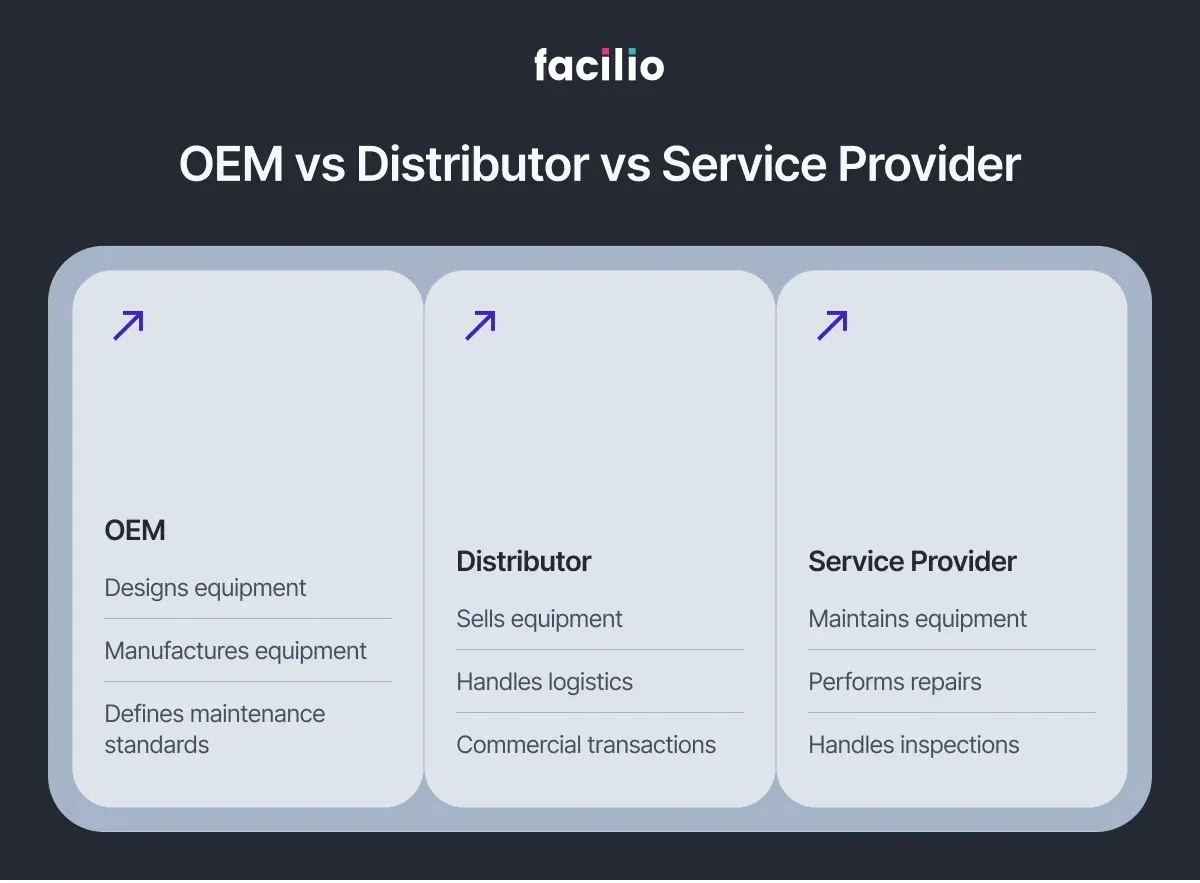
Both models work. But they operate very differently.
Side-by-side comparison
This comparison is simple on paper. In practice, the decision is more strategic.
A. Cost vs Control
OEM maintenance contracts often come at a premium. You are paying for brand-backed service, technical depth, and warranty protection.
Third-party providers may offer more competitive pricing and room for negotiation. Over large portfolios, this can significantly reduce annual maintenance spend.
The trade-off is control. With OEM contracts, processes are standardized. With third parties, you may gain flexibility but assume more oversight responsibility.
B. Risk vs Flexibility
OEM service reduces technical risk, especially during the warranty period. You operate within manufacturer-defined guidelines.
Independent providers offer flexibility. They can tailor service-level agreements, adjust inspection frequency, and sometimes respond faster across mixed-brand environments.
However, improper servicing can create warranty disputes.
C. Compliance vs Optimization
OEM contracts prioritize compliance. You follow the prescribed schedule and documentation process.
Third-party maintenance opens room for optimization. You can benchmark vendors, renegotiate rates, and standardize processes across multiple OEM assets.
For a single building, the difference may feel minor. For a 100-building portfolio with mixed OEM equipment, the impact becomes structural.
The real question is not which model is better. It is the model that aligns with your lifecycle stage, cost strategy, and risk tolerance.
Gain complete visibility across multi-OEM portfolios
See how it worksOEMs and the asset lifecycle – the long-term cost impact
An OEM relationship does not begin and end at installation. It influences cost and performance across the entire asset lifecycle.
To understand its true impact, you have to zoom out.
A. Installation phase
During installation, the OEM sets technical specifications, commissioning standards, and baseline performance parameters.
At this stage, the focus is on capital expenditure. The goal is correct installation and performance validation. OEM involvement here is usually essential and beneficial.
However, early decisions such as bundled service agreements or long-term maintenance commitments can shape costs for years.
B. Warranty phase
During the warranty period, OEM servicing is often mandatory. Maintenance schedules are fixed. Spare parts must be genuine. Documentation must follow manufacturer standards.
This phase prioritizes compliance and asset protection.
Costs may feel predictable, but flexibility is limited.
C. Preventive maintenance cycle
Once assets move beyond warranty, organizations often reassess their maintenance model.
This is where strategic questions arise:
- Should we continue with OEM contracts?
- Can third-party vendors manage this more efficiently?
- Are we paying for technical depth we no longer require?
The preventive maintenance phase is where cost optimization opportunities begin to appear.
D. Mid-life overhaul
As equipment ages, performance declines, and component replacements become more frequent.
OEM dependency during this phase can increase operating costs, especially if proprietary parts dominate repair cycles.
Without benchmarking or vendor comparison, expenses can rise quietly.
E. Replacement planning
Toward the end of the lifecycle, data becomes critical.
- Which OEM systems lasted longer?
- Which required higher maintenance spend?
- Which had repeated breakdowns?
These insights inform future procurement decisions.
Total Cost of Ownership, or TCO, considers not just the purchase price, but all costs incurred over the asset’s life.
a) Higher OEM dependency
b) Proprietary spare parts
c) Mandatory service contracts = Long-term operating cost increase
This does not mean OEM engagement is wrong. It means lifecycle strategy matters.
For facility leaders, the real question is not “Who made the equipment?”
It is “How does this relationship influence cost and performance over 10 to 15 years?”
How digital platforms improve OEM collaboration
As portfolios scale, managing OEM relationships manually becomes inefficient. Separate service portals, spreadsheets, and contract files create fragmented oversight.
Digital platforms help bring structure to that complexity.
A. Centralized warranty tracking
Instead of tracking warranty periods across multiple documents or OEM portals, digital systems consolidate coverage timelines in one place. This reduces the risk of missed compliance requirements and accidental warranty voids.
B. Unified SLA visibility
When working with multiple OEMs, comparing service performance is difficult. Centralized dashboards make it easier to monitor response times, resolution rates, and contract adherence across vendors.
C. Cross-OEM performance benchmarking
Over time, aggregated service data reveals patterns. Which OEM consistently meets targets? Which contracts escalate year over year? Data-driven benchmarking replaces anecdotal decision-making.
D. Consolidated asset history
Maintenance logs, inspection reports, and repair records can be unified into a single asset view. This improves audit readiness, renewal negotiations, and replacement planning.
When OEM management is treated as isolated vendor coordination, complexity compounds. When it is treated as part of a connected asset strategy, organizations gain clarity.
And that is exactly where a connected CMMS fits into OEM strategy.
By centralizing warranty data, service performance, and lifecycle history across manufacturers, it turns fragmented servicing into measurable portfolio governance.
And at scale, that visibility is what separates reactive maintenance from long-term lifecycle control.
See how connected CMMS platforms can simplify multi-OEM management and strengthen long-term asset performance.
Bring every OEM relationship under one connected system
Schedule a Live Demo
Commonly asked questions about OEMs
1. What does OEM stand for?
OEM stands for Original Equipment Manufacturer. It refers to the company that designs and produces the original equipment installed in a product or facility.
2. What is the difference between OEM and ODM?
An OEM manufactures equipment under its own brand and specifications. An ODM designs and manufactures products that other companies rebrand and sell.
3. What is an example of an OEM?
An HVAC manufacturer supplying chillers to a commercial building or an elevator company installing lift systems in a high-rise are examples of OEMs.
4. Is OEM maintenance mandatory during the warranty period?
In most cases, yes. OEM warranties often require prescribed maintenance schedules and approved parts to remain valid.
5. Can third-party servicing void an OEM warranty?
It can, depending on the warranty terms. Some OEMs require authorized technicians during the warranty phase.
6. Are OEM parts better than aftermarket parts?
OEM parts match original specifications and protect warranty coverage. Aftermarket parts may be more cost-effective but must meet performance standards.
7. Is OEM maintenance more expensive than third-party maintenance?
OEM contracts typically cost more due to certified expertise and warranty protection. However, long-term cost depends on asset age and portfolio strategy.
About the Author

More from Facilio