Connected CMMS

 Connected Buildings
 Connected Refrigeration


 Download ebook

 Read case study


 Watch now


 Retail
 Healthcare
 FM Services
 Commercial Portfolios
 Corporate Facilities
 Education
 Data-driven Portfolio Ops
 Facility Management Software
 360° Asset Lifecycle
 Continuous Sustainability

 Blogs
Blogs
 Help docs
 Knowledge Hub
 ROI Calculator
 Ebooks & Guides
 Webinars
 Videos
 Case studies


 About us
 Newsroom
 Careers
 Contact us
 Partners
 Events


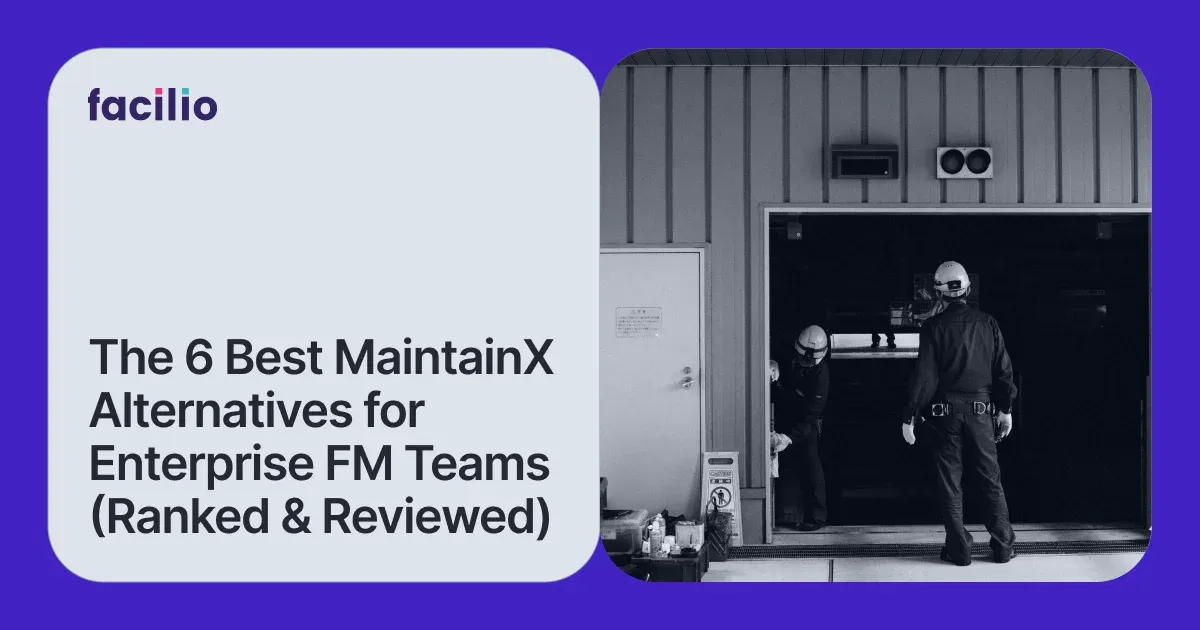

The best MaintainX alternatives in 2026 are 1. Facilio, 2. IBM Maximo, 3. Fiix, 4. Limble, 5. eMaint, 6. UpKeep, and 7. Brightly Asset Essentials.
MaintainX is one of the highest rated CMMS platforms on the market, with a 4.8 on both G2 and Capterra. Teams look for alternatives rarely over quality and usually over scale: once you run a growing portfolio, coordinate vendors, or expect AI to run a workflow rather than draft a message, a work-order-first tool starts to show its ceiling.
This guide ranks seven alternatives for enterprise and multi-site FM, each with a current rating, a real review, and live pricing.
Quick answer: Match them to your buyer. Commercial portfolios weight connected cmms software; asset-intensive plants lean to Maximo, Fiix, and eMaint; small mobile-first crews start with UpKeep or Limble.
What made you start looking past MaintainX?
Select all that apply
How large is your portfolio or organization?
Pick the closest fit
What best describes your industry?
Select all that apply
Your top MaintainX alternative picks
A ranked shortlist with the single job each platform does best, so you can scan the field before the full reviews and the buying guidance further down.
- Facilio: best for connected, AI-driven facilities operations across multi-site commercial portfolios.
- IBM Maximo Application Suite: best for asset-intensive, regulated enterprises with a dedicated IT function.
- Fiix: best for manufacturing and industrial teams that need clean ERP integration.
- Limble CMMS: best for teams that want MaintainX-level usability with more configurability.
- eMaint: best for compliance-heavy and highly configurable plant environments.
- UpKeep: best for mobile-first small to mid-market maintenance teams.
- Brightly Asset Essentials: best for education, government, and facilities portfolios.
Why teams start looking beyond MaintainX
The honest reasons enterprise FM teams outgrow a work-order-first CMMS, so you can check whether your friction is a fixable settings problem or a real ceiling.
MaintainX earned its reputation. The mobile experience is strong, and for a single site the platform does its job well. The conversations change when an operation grows, and the same five pressure points come up again and again:
Asset hierarchies flatten out: buildings, floors, systems, and equipment get hard to model cleanly once a portfolio grows past a handful of sites.
Cross-site reporting turns manual: rolling PM compliance and cost up across locations becomes a spreadsheet exercise rather than something the platform hands you.
Vendor and contract governance needs workarounds: contractor SLAs, quotes, and invoice checks live outside the core work-order flow.
AI assists people, it does not run work: the built-in AI helps an individual work faster, but a human still routes, assigns, and closes every job.
Per-user pricing compounds: the seat-based model that is cheap for a small crew climbs quickly once you roll out across an enterprise.
None of that makes MaintainX a bad product. Our maintainx cmms review covers where it genuinely shines, and our maintainx pricing breakdown shows how the seat model scales. If two or three of those points sound like your week, it is worth seeing what else is out there.
MaintainX alternatives compared at a glance
A side-by-side of all seven platforms on the factors enterprise FM buyers weigh most: best-fit case, multi-site control, autonomous AI, vendor governance, current rating, and pricing model.
| Platform | Best for | Multi-site FM | Autonomous AI | Vendor / contract | Rating (source) | Pricing model |
|---|---|---|---|---|---|---|
| Facilio | Connected multi-site FM | Native, portfolio-wide | Yes, agents run workflows | Native | 4.0 Capterra (25) | Portfolio-based quote |
| IBM Maximo | Enterprise EAM, regulated | Strong | Partial, predictive add-ons | Yes | 4.4 G2 (633) | From about $3,150/mo |
| Fiix | Manufacturing, ERP-heavy | Moderate | Partial, AI scheduling | Limited | 4.5 Software Advice (629) | Free tier; from about $45/user/mo |
| Limble | Configurable mid-market | Moderate | No, AI-assisted | Limited | 4.8 G2 (684) | From about $28/user/mo |
| eMaint | Compliance-heavy plants | Moderate | No | Limited | 4.5 Software Advice (429) | Custom quote |
| UpKeep | Mobile-first SMB to mid | Limited | No | Limited | 4.5 G2 (1,090+) | From about $20/user/mo |
| Brightly | Education, government, FM | Moderate | No | Limited | 4.4 Capterra (284) | Custom quote |
MaintainX assists your team. Facilio's agents run the work.
See it on your portfolio, not a sandbox.
How we evaluate MaintainX alternatives
The criteria behind the ranking, so you can see exactly what each platform was measured against rather than taking the order on trust.
We scored every platform against the requirements that separate a work-order tool from an enterprise FM system, weighted toward what changes outcomes across a portfolio rather than what demos well:
- Work order execution: how fast a technician can raise, prioritize, assign, and close a job from a phone, with SLA timers, status history, and photos on the asset record.
- Preventive and predictive maintenance: whether schedules trigger on calendar dates only, or also on runtime, meter readings, and real condition signals from sensors.
- Multi-site governance: whether the platform runs a portfolio natively, with shared asset types, bulk actions, and cross-site compliance reporting, or simply bolts single sites together.
- Autonomous AI: whether AI assists a person or actually executes a workflow end to end, from intake through assignment to closure and reporting.
- Vendor and contract control: whether contractor SLAs, quotes, and invoice validation sit inside the flow of work or need a separate system.
- Asset lifecycle and inventory depth: whether the tool models deep asset hierarchies and links spare parts to work orders with reorder logic.
- Adoption and total cost: onboarding time, review sentiment on usability, and the full cost of licenses, implementation, and add-ons over a three-year horizon.
Every rating below is a current score as of September 2026, drawn from a different review platform per tool and linked to its source. Where a review base was thin, we described capability rather than inventing a star, and we flag any figure still to be confirmed.
The 7 best MaintainX alternatives, reviewed
Full profiles in ranked order, each with what it is best for, why it lands where it does, a snapshot table, key features, honest strengths and limitations, a real customer review, and sourced pricing.
1. Facilio
Best for: connected, AI-driven facilities operations across multi-site commercial portfolios.
Why it ranks first: it is the only platform here that was built as a connected operations system rather than a CMMS with AI added on, so its agents run entire workflows across a portfolio instead of speeding up steps a person still owns.
| Snapshot | Detail |
|---|---|
| Best for | Multi-site commercial FM |
| Starting price | Portfolio-based quote |
| Key strength | Autonomous AI agents on connected data |
| Rating | 4.0/5 Capterra (25); G2 base thin |
| Free trial | No, guided onboarding and demo |
Facilio is a cloud-native, connected CMMS and facilities operations platform built for organizations that run equipment and services across many buildings rather than one plant floor. Where most computerized maintenance management software is organized around the work order, with a person routing every request, Facilio is organized around removing that person from the tasks where their judgment is not needed.
It centralizes work order management, preventive maintenance, vendor governance, tenant intake, and asset health in one workspace, and a suite of purpose-built AI agents acts on that connected data. That is why it leads a list written for enterprise FM teams, and its limitations are kept honest below so the ranking reads earned.
Key features
- Autonomous helpdesk intake: an AI agent receives a call, WhatsApp message, or email, triages it, creates the work order, assigns the technician, and confirms closure.
- Invoice validation: every contractor invoice is checked against contract terms before it reaches an approver, not after payment.
- Connected asset intelligence: live sync from building systems, meters, and IoT sensors keeps asset health current rather than last-inspected.
- Condition-based preventive maintenance: triggers on time, usage, meter readings, or fault signals, with reusable templates by asset type.
- Vendor and contract governance: contractor check-in, SLAs, quotes, and invoice sync all sit inside the flow of work.
- Multi-channel tenant intake: voice, WhatsApp, and email requests are handled across a portfolio without a coordinator in the middle.
- Asset lifecycle management: deep asset hierarchies and lifecycle tracking hold up across large, multi-site portfolios.
- Reporting that generates itself: management reports, SLA summaries, and anomaly alerts are produced on a schedule, with per-decision audit trails on every AI action.
Strengths
- One connected view spans sites, vendors, and building systems, which removes the reconciliation work that eats FM time.
- The AI agents handle helpdesk intake, invoice validation, and reporting end to end, not as prompts a person still has to action.
- Condition and usage-based automation goes past calendar scheduling, so a fault signal can open and route a job on its own.
- Vendor governance, tenant intake, and compliance sit in the same system as maintenance, so nothing falls between tools.
Limitations
- A single-site shop will find far more platform than it needs.
- It is a newer name than the decades-old incumbents on this list.
- Onboarding is guided and runs a few weeks rather than an instant signup.
- Teams primarily in manufacturing or food production are often better served by a plant-focused tool.
What reviewers say
Facilio holds 4.0 out of 5 on Capterra across 25 reviews, a smaller and enterprise-weighted base than the SMB tools here, and its G2 base is too thin to headline a star. The stronger signal is production proof: Facilio reports its helpdesk agent resolved 80 percent of intake autonomously at Berkeley UAE and that Charter Hall caught 619 invoice errors across 2,117 invoices, and it was named a Verdantix Green Quadrant Leader for commercial CMMS. See the head-to-head in our maintainx vs facilio breakdown, and the agent layer in ai agents for maintainx.
Pricing
portfolio-based on square footage and sites rather than per user, which stays predictable as headcount grows; request a quote on the Facilio pricing page.
80%
Helpdesk requests resolved autonomously by the AI intake agent
FM operations · Berkeley UAE
Berkeley UAE · Read case study →619
Invoice errors caught across 2,117 contractor invoices
Commercial real estate · Charter Hall
Leader
Named a Verdantix Green Quadrant Leader for commercial CMMS
Analyst recognition · 2026
See what autonomous FM operations look like in live production.
Not a sandbox demo, your portfolio and your workflows.
2. IBM Maximo Application Suite
Best for: asset-intensive, regulated enterprises that need deep enterprise asset management and have the IT function to run it.
Why it ranks second: it is the enterprise-grade EAM on this list, with lifecycle depth and compliance rigor no mid-market CMMS matches, which is exactly what large asset-owners need even though it is a heavier tool than MaintainX by a wide margin.
| Snapshot | Detail |
|---|---|
| Best for | Enterprise EAM, regulated industries |
| Starting price | From about $3,150/mo |
| Key strength | Asset lifecycle depth and compliance |
| Rating | 4.4/5 G2 (633) |
| Free trial | No, enterprise sales process |
IBM Maximo is not a MaintainX alternative in the conventional sense. It is a different category of product.
Where MaintainX optimizes for speed and simplicity, Maximo is built for depth and control across power grids, manufacturing lines, hospital equipment, and other critical infrastructure. The suite covers asset management, work orders, inventory, procurement, contracts, and compliance in one place, integrates deeply with SAP and other enterprise systems, and has been the backbone of maintenance operations for utilities and energy companies for decades.
Its AI layer has been expanding into predictive maintenance and anomaly detection.
Key features
- Enterprise asset management: models the full lifecycle, hierarchy, and criticality of high-value assets across the organization.
- Work and inventory management: handles work orders, procurement, and spare-parts control inside one connected suite.
- Compliance and audit trails: captures the documentation and controls that heavily regulated environments have to produce on demand.
- Predictive maintenance: adds condition monitoring and anomaly detection through the Maximo AI layer.
- Deep integrations: connects natively to SAP and other enterprise systems of record.
- Multi-site scale: governs large, geographically spread asset bases from a single platform.
- Configurable workflows: lets teams tailor complex operational processes without leaving the suite.
Strengths
- Asset lifecycle, hierarchy, and criticality modeling reach a depth no mid-market CMMS matches.
- Compliance controls and audit trails are built for the most heavily regulated environments.
- One suite standardizes maintenance, inventory, procurement, and contracts across many facilities.
Limitations
- Implementation is lengthy and expensive, and usually needs specialist help.
- The interface feels dated next to cloud-native tools, especially for field teams.
- Value for money is weakest at mid-market scale, where the cost outruns the need.
- Migrating from MaintainX means a steep jump in complexity and a dedicated IT function.
What reviewers say
Maximo holds 4.4 out of 5 on G2 across 633 reviews. Arkajit D., a chief technology officer at a mid-market firm, wrote in May 2026 that Maximo moved his teams "from a mostly reactive maintenance process to a more proactive approach". If Maximo is on your shortlist, our ibm maximo vs maintainx comparison and our ibm maximo alternative guide cover the trade-off.
Pricing
entry-level SaaS subscriptions start at about $3,150 per month per public listings, with enterprise deployments quoted; those figures exclude implementation, customization, and partner fees, which are often the larger cost.
3. Fiix (by Rockwell Automation)
Best for: manufacturing and industrial teams that need a CMMS to talk cleanly to ERP and production systems.
Why it ranks third: it sits in the sweet spot between MaintainX and Maximo, deeper on analytics and integration than the former without the implementation weight of the latter, which makes it the natural pick for reliability-focused plants.
| Snapshot | Detail |
|---|---|
| Best for | Manufacturing, ERP-heavy environments |
| Starting price | Free tier; from about $45/user/mo |
| Key strength | ERP integration and analytics |
| Rating | 4.5/5 Software Advice (629) |
| Free trial | Yes, plus a free tier |
Fiix occupies an interesting middle ground. Acquired by Rockwell Automation in 2021, it has leaned into industrial use cases, particularly for teams that need maintenance to sync with SAP, Oracle, or other enterprise systems without a lengthy integration project.
It covers work orders, preventive maintenance, asset management, inventory, and reporting, and its analytics layer is more developed than what MaintainX offers at comparable tiers. The free tier makes it easy to evaluate before committing.
Key features
- ERP integration: syncs with SAP and Oracle so maintenance data flows into production and financial systems without a long integration project.
- AI maintenance scheduling: uses Fiix Foresight to flag likely failures and plan work around runtime and condition data.
- Work order management: runs the full lifecycle from request to closure with complete asset history attached.
- Preventive maintenance: schedules tasks on time or usage and links the parts each job needs.
- Analytics and reporting: builds dashboards for downtime, cost, and reliability KPIs at a depth checklist tools lack.
- Inventory control: tracks spare parts against work orders and financial records.
- Free tier: gives small teams a no-cost plan to trial core CMMS features before buying.
Strengths
- ERP integration with systems like SAP and Oracle is cleaner than most CMMS tools manage out of the box.
- The analytics layer runs deeper than a checklist-first tool, which suits reliability programs.
- A genuine free tier lets a team prove the platform before committing budget.
- AI-assisted scheduling helps reliability teams plan around runtime and condition data.
Limitations
- The interface is more complex than MaintainX, so frontline adoption takes longer.
- Lower tiers feel limited, and extra user licenses get expensive as a team grows.
- Tenant workflows and portfolio governance sit outside its maintenance-and-reliability focus.
What reviewers say
Fiix scores 4.5 out of 5 on Software Advice across 629 reviews. Lillian G., a reviewer in hospital and health care, wrote in November 2023 that the platform "significantly improved our maintenance efficiency and reduced equipment downtime". Our maintainx vs fiix comparison covers where each one wins.
Pricing
a free tier is available, with the Basic plan from about $45 per user per month, Professional from about $75 per user per month, and Enterprise quoted; annual billing includes one free month on the paid tiers.
4. Limble CMMS
Best for: teams that want MaintainX-level ease of use with more configurability and stronger reporting.
Why it ranks fourth: it is the most natural step up for a team whose main frustration with MaintainX is customization, and it carries one of the strongest review profiles on this list across multiple platforms.
| Snapshot | Detail |
|---|---|
| Best for | Configurable mid-market maintenance |
| Starting price | From about $28/user/mo |
| Key strength | Usability plus configurability |
| Rating | 4.8/5 G2 (684) |
| Free trial | Yes (verify current terms) |
If your primary frustration with MaintainX is that you want more control over dashboards, workflows, and how data is structured, Limble is the most natural move. It ranks alongside MaintainX for ease of use, but reviewers give it higher marks for flexibility.
The work order system is genuinely strong, you can edit work orders after closure, which MaintainX does not allow, and bulk asset import with automatic hierarchy building is a real time-saver for teams migrating off a legacy system.
Key features
- Configurable dashboards and workflows: let you shape how data is structured and displayed rather than accept a fixed layout.
- Work order management: supports edit-after-closure and drag-and-drop scheduling that technicians actually use.
- Bulk asset import: loads large asset bases and builds their hierarchy automatically on import.
- Preventive maintenance: triggers time and usage-based schedules from reusable templates by asset type.
- Parts and inventory: monitors stock levels and reorders automatically before a repair stalls.
- Custom reporting: turns downtime, cost, and compliance data into KPI dashboards you define.
- Work request portal: lets no-seat requesters submit and track issues without a paid license.
- AI-assisted features: layer suggestions and summaries on top of the core CMMS.
Strengths
- Configurable dashboards and workflows give more control over structure than MaintainX allows.
- Work orders can be edited after closure, and drag-and-drop scheduling is practical rather than cosmetic.
- Bulk asset import builds hierarchies automatically, which speeds a migration off legacy tools.
- Adoption stays fast even as configurability deepens, a balance few tools strike.
Limitations
- Vendor management and contract governance for complex FM operations are not there.
- The mobile interface lags the desktop experience, a real gap for technician-heavy teams.
- Its AI assists rather than executes, so it will not run a workflow on its own.
- Some capability teams later need sits in a higher tier than expected.
What reviewers say
Limble holds 4.8 out of 5 on G2 across 684 reviews. Ellen G., a manufacturing engineering technician, wrote in January 2026 that Limble "removes a lot of the human error that typically comes with manual tracking". See our maintainx vs limble comparison and our limble cmms alternatives guide for the wider field.
Pricing
quoted through Limble's calculator rather than a fixed public rate, with third-party listings commonly citing a Standard tier from about $28 per user per month, which is worth confirming with the vendor.
5. eMaint CMMS (by Fluke)
Best for: compliance-heavy, highly configurable plant environments where auditability is non-negotiable.
Why it ranks fifth: it is the specialist for regulated, asset-intensive operations that need deep audit trails and Fluke sensor integration, a narrower fit than the tools above but the right one when compliance is the whole point.
| Snapshot | Detail |
|---|---|
| Best for | Compliance and regulated plants |
| Starting price | Custom quote |
| Key strength | Configurability and compliance depth |
| Rating | 4.5/5 Software Advice (429) |
| Free trial | Demo; annual billing, 3-user minimum |
eMaint sits in a different category from the mid-market tools here. A Fluke company, itself part of Fortive, it is chosen by teams for whom compliance and auditability come first, with a track record across manufacturing, chemicals, energy, and regulated industries.
The platform is highly configurable, you can build custom workflows, model detailed asset hierarchies, and generate compliance reports that satisfy regulatory requirements, and it connects to Fluke test equipment for condition data.
Key features
- High configurability: builds custom workflows, fields, and forms to fit complex operational requirements.
- Compliance reporting: produces audit trails and documentation that satisfy regulators, including 21 CFR Part 11 support.
- Asset hierarchies: models detailed asset structures across multiple stockrooms and sites.
- Fluke sensor integration: pulls condition data straight from Fluke test equipment into the CMMS.
- Preventive maintenance: sets custom triggers and reliability-centered schedules for critical assets.
- Inventory management: controls multi-stockroom parts and ties consumption to each work order.
Strengths
- Deep configurability lets teams build custom workflows, fields, and forms for complex requirements.
- Compliance reporting and audit trails are built to satisfy regulators in life sciences, energy, and food.
- Native integration with Fluke test equipment brings condition data straight into the CMMS.
Limitations
- It is not built for speed, and non-technical users face a learning curve.
- Pricing steps up quickly, with annual billing and a three-user minimum.
- Tenant intake and portfolio-level visibility for commercial real estate sit outside its lane.
What reviewers say
eMaint holds 4.5 out of 5 on Software Advice across 429 reviews. Joel N., a reviewer in oil and energy, wrote in September 2026 that "every integration / workflow we want is possible with emaint".
Pricing
eMaint now quotes all tiers, billed annually with a three-user minimum; third-party references have historically cited a Team tier from about $69 per user per month and an Enterprise tier near $120 per user per month, both worth confirming with the vendor [verify].
6. UpKeep
Best for: mobile-first small to mid-market maintenance teams that want to be running on a phone within a day.
Why it ranks sixth: it competes for the same buyer as MaintainX and matches it on mobile-first simplicity with a broader integration ecosystem, so it is a lateral move for many teams rather than a clear step up in ceiling.
| Snapshot | Detail |
|---|---|
| Best for | Mobile-first SMB to mid-market |
| Starting price | From about $20/user/mo |
| Key strength | Mobile adoption and free requesters |
| Rating | 4.5/5 G2 (1,090+) |
| Free trial | Yes; free requester accounts |
UpKeep and MaintainX occupy the same market segment and compete for the same buyer, so if you are evaluating one you are almost certainly looking at the other. UpKeep has a longer track record and a broader ecosystem, with more integrations and more historical data from a larger user base.
The mobile experience is excellent, onboarding is fast, and unlimited free requester accounts make a wide rollout cheap. For small to mid-market teams going from paper to digital, the two are genuinely close.
Key features
- Mobile work orders: let technicians create, assign, and close jobs from the field with photos attached.
- Free requester accounts: give unlimited view-and-submit users access at no per-seat cost.
- Preventive maintenance: runs automated time-based schedules and reminders so routine work is not missed.
- Inventory with barcode scanning: tracks parts against assets using barcode scans on a phone.
- In-app messaging: keeps the conversation for each job attached to its work order.
- Meter readings: capture usage data to drive meter-based maintenance tasks.
- Reporting dashboards: surface downtime, cost, and compliance views at the higher tiers.
- Broad integrations: connect to a wider third-party ecosystem than MaintainX offers.
Strengths
- The mobile app is genuinely fast to adopt for technicians and requesters alike.
- Unlimited free requester accounts make a facility-wide rollout cheap.
- A broad integration ecosystem outreaches MaintainX at comparable tiers.
- Onboarding is quick, which suits a team digitizing maintenance for the first time.
Limitations
- Preventive logic is time-based, without native condition triggers.
- Portfolio-wide visibility is partial rather than native, so multi-site teams outgrow it.
- Analytics depth and custom dashboards sit behind the higher tiers.
- Per-user pricing climbs at scale, and the ceiling resembles MaintainX.
What reviewers say
UpKeep holds 4.5 out of 5 on G2 across more than 1,090 reviews. Marek K., a documentation specialist, wrote in September 2026 that "moving off paper to digital records has made a huge difference". Our maintainx vs upkeep comparison and our best upkeep alternatives guide cover the wider field.
Pricing
the Lite plan starts at about $20 per user per month, Starter at about $45, and Premium at about $55, with Professional and Enterprise quoted, per UpKeep.
7. Brightly Asset Essentials
Best for: education, government, and facilities portfolios that want a proven CMMS with sector-specific depth.
Why it ranks seventh: it is the closest facilities and public-sector peer on this list, well suited to schools, campuses, and government estates, though its custom-only pricing and lighter AI keep it below the leaders for broader enterprise FM.
| Snapshot | Detail |
|---|---|
| Best for | Education, government, facilities |
| Starting price | Custom quote |
| Key strength | Sector-specific FM depth |
| Rating | 4.4/5 Capterra (284) |
| Free trial | No, quote-based |
Brightly Asset Essentials, now part of Siemens, is a facilities-oriented CMMS with deep roots in education, government, and membership organizations. It covers work order management, preventive maintenance, and asset tracking, and it structures its offering around industry-specific tiers rather than a one-size plan, which is why sector fit is its defining strength.
For a school district or a government estate, it speaks the right language out of the box.
Key features
- Work order management: requests, assigns, and tracks jobs with full asset history in one place.
- Preventive maintenance: schedules recurring tasks tied to specific assets and locations.
- Asset tracking: keeps condition and lifecycle records across every facility.
- Capital planning: forecasts facilities and infrastructure spend for teams working to public budgets.
- Sector-specific configurations: ship tailored setups for education, government, and manufacturing out of the box.
- Reporting: provides compliance and operational dashboards built for facilities teams.
- Mobile access: lets field staff create and update work orders from a phone.
Strengths
- Sector-specific configurations fit education, government, and membership organizations out of the box.
- Capital-planning tools suit teams managing long-lived infrastructure on public budgets.
- Work order, preventive maintenance, and asset tracking depth cover core facilities needs.
Limitations
- Pricing is custom only, with no free trial and no published rate.
- The AI layer is lighter than the leaders on this list.
- Vendor and contract governance is limited, and depth suits estates more than complex CRE portfolios.
What reviewers say
Brightly Asset Essentials holds 4.4 out of 5 on Capterra across 284 reviews, with steady scores on Gartner Peer Insights and TrustRadius. Jay D., a special projects foreman and CMMS administrator in primary and secondary education, wrote in February 2026 that with the system "we live and die by it".
Pricing
custom only, structured across industry-specific tiers for education, government, manufacturing, and membership organization.
Key features that actually matter when you choose a MaintainX alternative
The capabilities that separate a work-order tool from an enterprise FM system, so you weigh what changes your operation rather than what fills a feature grid.
Every platform here manages work orders well, so that is table stakes, not a differentiator. When you are replacing MaintainX at scale, weigh the capabilities where these tools actually diverge:
- Autonomous versus assistive AI: decide whether you want AI that suggests, like most tools here, or AI that executes a workflow end to end. It is the single biggest architectural split on this list.
- Multi-site governance: look for native portfolio control, shared asset types, bulk actions, and cross-site compliance reporting, not single sites bolted together.
- Vendor and contract control: if contractors do your work, invoice validation and SLA enforcement inside the work-order flow save more time than any dashboard.
- Preventive and predictive depth: confirm whether schedules can trigger on condition and meter data, not just the calendar, and whether sensor data flows in without middleware.
- Asset hierarchy and inventory: model buildings, systems, and equipment cleanly, and link spare parts to work orders with reorder logic.
- Pricing model at your headcount: per-user pricing that is cheap for a small crew can dominate the bill at enterprise scale, so compare on total cost, not the entry rate.
- Adoption on mobile: the best tool is the one technicians actually open, so weight field usability heavily.
Our guide to the best cmms software goes wider on the category if you are still framing requirements.
How to choose the right MaintainX alternative for your team
A short decision framework that maps team size, industry, and capability needs to the right shortlist, so you can narrow seven options to two or three.
Start with the problem you are actually trying to solve, then match it to the field:
- You run a small, mobile-first crew on one or two sites: UpKeep and Limble fit before an enterprise platform does. Both are fast to roll out and priced for smaller teams.
- You are cost-sensitive or want to trial free: Fiix has a free tier and UpKeep offers free requester accounts, though watch how per-user pricing climbs as you add technicians.
- You maintain asset-intensive plants with reliability and compliance needs: weigh Fiix, eMaint, and IBM Maximo, in ascending order of depth and implementation weight.
- You are in education, government, or public facilities: Brightly Asset Essentials speaks your sector out of the box.
- You run commercial facilities across many sites and want AI to run work, not just assist: Facilio is built for that case, with autonomous agents, vendor governance, and tenant intake on connected data.
If budget is the deciding factor, price each option at your real headcount rather than the entry rate, and set your MaintainX baseline before you compare.
How to switch from MaintainX without downtime
A practical migration path, because the fear of a messy cutover keeps more teams on the wrong tool than any missing feature does.
Moving off MaintainX is lower risk than most teams expect if you sequence it:
- Export your data first: pull work orders, asset records, PM schedules, and parts data out of MaintainX before you commit, and confirm your shortlisted tool supports bulk asset import. Limble and several others build hierarchies automatically on import.
- Run a single-site pilot: stand up one location on the new platform, validate work order flow and PM triggers, and keep MaintainX live in parallel until the pilot proves out.
- Rebuild PM schedules deliberately: treat migration as a chance to clean up duplicate or stale schedules rather than copying them across wholesale.
- Phase the rollout: move sites in waves, train technicians on mobile first since that is where adoption is won, and keep requesters submitting through a familiar channel.
- Cut over once compliance reporting matches: only retire MaintainX when the new platform reproduces the reports and audit trails you rely on.
Ask each vendor directly about migration support and typical timelines. A guided onboarding, which Facilio and the enterprise tools include, is worth more than a discount if it protects uptime during the switch.
Common mistakes to avoid when choosing a MaintainX alternative
The traps that lead teams to buy the wrong tool, so you can sidestep the expensive ones before you sign.
- Buying on the entry price: the per-user rate that looks cheap in a demo can dominate the bill once you roll out across an enterprise. Model total cost at your real headcount.
- Treating all AI as equal: most tools mean suggestions and dashboards when they say AI. Confirm whether it executes a workflow or just informs one.
- Solving a scale problem with a lateral move: switching MaintainX for another work-order-first CMMS with the same ceiling fixes the brand, not the constraint.
- Underweighting mobile: a platform your technicians will not open is a failed rollout, no matter how strong the back office feels.
- Ignoring vendor and contract needs: if contractors do your work, a tool without invoice validation and SLA control quietly pushes that cost back onto your team.
- Skipping the pilot: committing across every site before validating one is the fastest way to a painful cutover.
The bottom line
Every platform on this list is a capable CMMS, and the right one depends on which problem you are solving.
If it is mobile adoption and fast onboarding for a lean team, UpKeep and Limble are hard to beat. If it is reliability and compliance in an asset-intensive plant, Fiix, eMaint, and IBM Maximo earn their depth. If it is education or government facilities, Brightly fits the sector.
But if your operation is heading somewhere a work-order-first CMMS was not built to go, across multiple sites, with vendor governance, tenant workflows, and the expectation that AI should run work rather than assist it, that is the case Facilio was built to serve. It is the difference between software that makes each step faster and software that removes the step. If that is the direction you are heading, it is worth a conversation.
Your next step
Ready to see what autonomous FM
operations look like in practice?
Most MaintainX replacements are really a step up in scale. Facilio removes the step instead of just speeding it up, with AI agents, vendor governance, and tenant intake on connected data.
Frequently asked questions
Short, direct answers to the questions FM and maintenance buyers ask most when they compare MaintainX alternatives.
What is the best MaintainX alternative for enterprise FM teams?
For enterprise FM and multi-site portfolios, Facilio is the strongest option, since it is the only platform here whose AI agents run full operational workflows on connected data rather than assisting a person step by step. For asset-intensive regulated industries, IBM Maximo is the traditional enterprise choice.
Is MaintainX good for large enterprises?
MaintainX is a highly rated CMMS, with 4.8 ratings on G2 and Capterra, and it works well for large organizations with simple, site-specific maintenance. Reviewers consistently flag limits in asset hierarchy depth, cross-site reporting, and vendor management once portfolio complexity or autonomous AI is on the requirements list.
What is the cheapest or free MaintainX alternative?
Fiix offers a free tier, and UpKeep provides unlimited free requester accounts with paid plans from about $20 per user per month. Limble starts near $28 per user per month. Watch how per-user pricing compounds as you add technicians, since the cheapest entry rate is rarely the cheapest at scale.
Which MaintainX alternative is best for a small team?
For a small, mobile-first team, UpKeep and Limble are the easiest to roll out and the friendliest on price. Both get technicians productive within a day, which matters more for a lean crew than enterprise depth they will not use.
How does Facilio differ from other MaintainX alternatives?
Every other platform here is primarily a CMMS that manages work orders, assets, and schedules. Facilio is a connected operations platform where AI agents handle entire workflows autonomously, from helpdesk intake through invoice validation to reporting, which matters when your bottleneck is operational overhead at scale rather than work order creation.
Which MaintainX alternative has the best AI?
Facilio's AI operates at a different level from the AI features in MaintainX, Limble, UpKeep, or Fiix. Those platforms offer AI-assisted suggestions and predictive insights, while Facilio's agents execute workflows end to end. Confirm any vendor's AI claims against a live demo, since assistive and autonomous AI are very different in practice.
How much do MaintainX alternatives cost?
Most use per-user, per-month pricing: UpKeep from about $20, Limble from about $28, Fiix from about $45. eMaint and Brightly quote custom, and IBM Maximo starts near $3,150 per month and typically runs much higher with implementation. Facilio prices on a portfolio basis rather than per user, which stays more predictable as headcount grows. Re-verify every figure with the vendor before purchasing.
About the Author

More from Facilio