Connected CMMS

 Connected Buildings
 Connected Refrigeration


 Download ebook

 Read case study


 Watch now


 Retail
 Healthcare
 FM Services
 Commercial Portfolios
 Corporate Facilities
 Education
 Data-driven Portfolio Ops
 Facility Management Software
 360° Asset Lifecycle
 Continuous Sustainability

 Blogs
Blogs
 Help docs
 Knowledge Hub
 ROI Calculator
 Ebooks & Guides
 Webinars
 Videos
 Case studies


 About us
 Newsroom
 Careers
 Contact us
 Partners
 Events



You met every SLA. Response times stayed within target. Tickets were closed on schedule. The dashboards were green.
Yet when the contract came up for renewal, the client chose another provider.
If you’ve been in FM long enough, you’ve probably seen this happen. Contracts rarely fall apart because of one big failure. More often, they slip slowly. Reactive work starts creeping up. The same assets keep showing up in tickets. Closure notes become thinner. Nothing looks alarming in isolation.
But over time, the client starts to feel the difference.
What makes this frustrating is that the signals are already there. Work orders, SLA timestamps, technician notes, backlog trends — your systems are recording the story every day.
The problem isn’t that the data is missing.
It’s that no one is really reading it as a pattern.
This is where AI starts to matter.
In this article, we have tried to explain how AI reads your operational record and surfaces contract risk early enough to act before it reaches escalation or renewal.
How contracts start drifting long before anyone notices
Most FM contract churn does not start with a dramatic failure. It builds gradually through small operational signals that rarely show up in performance reports.
By the time leadership notices a problem, the client relationship may already be under strain.
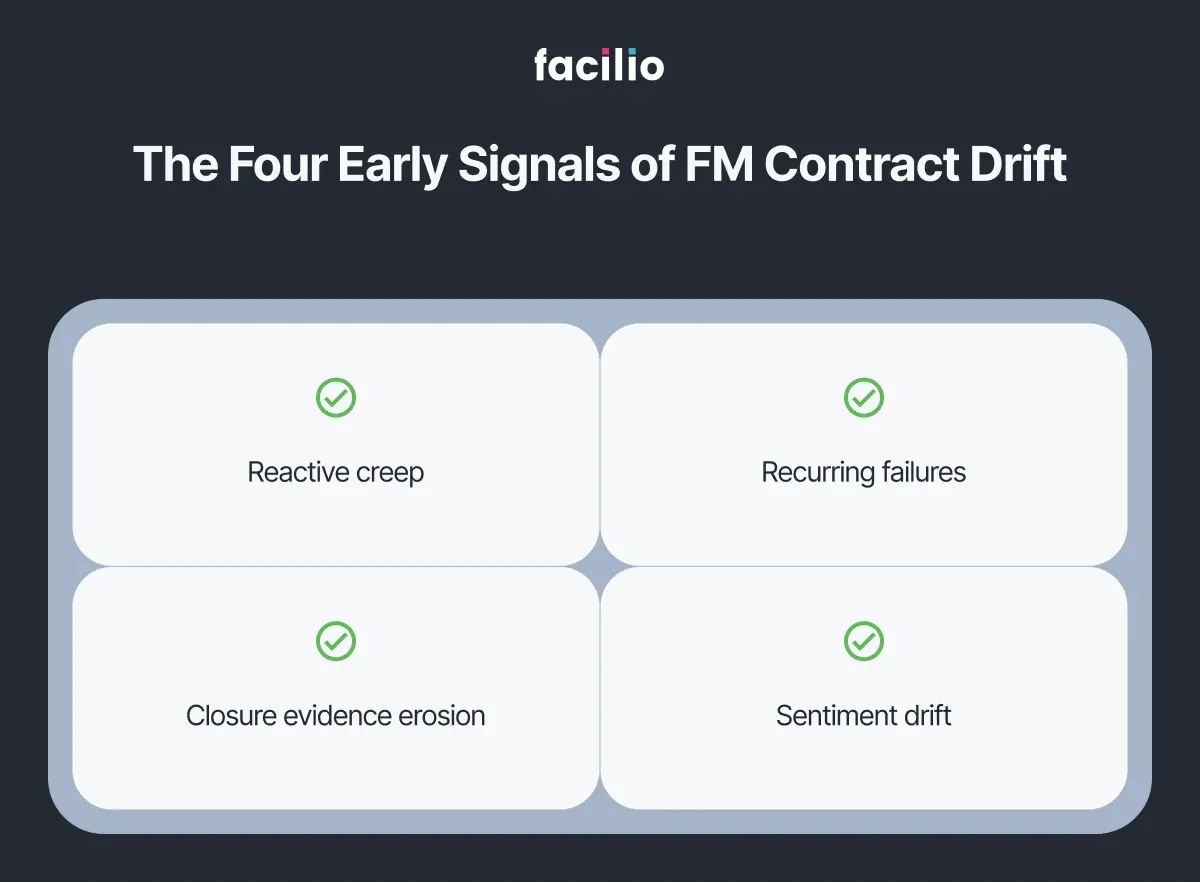
In practice, four patterns tend to drive this drift.
A. Reactive creep: Planned maintenance slowly gives way to reactive work. Preventive tasks get postponed to deal with urgent issues, and the reactive vs planned ratio begins to shift. It rarely happens overnight. Month by month, the operation becomes more firefighting than proactive maintenance.
B. Recurring failure loops: The same asset, location, or system keeps generating work orders across weeks or months. Each ticket may close within SLA, so nothing looks alarming on the dashboard. But the root issue remains unresolved. Clients often notice this repetition long before the provider connects the pattern.
C. Closure evidence erosion: Tickets get marked complete without photos, checklists, or proper sign-off. On paper the job is closed, but there is little proof of what was actually done. When disputes or audits arise, the operational record becomes difficult to defend.
D. Sentiment drift: Frustration begins appearing in tenant portal comments, helpdesk follow-ups, or escalation emails. These signals rarely show up in operational dashboards, but they quietly shape how the client experiences the service.
Together, these patterns create what many FM leaders recognize as an SLA compliance gap. Reports may still show green, while the client’s day-to-day experience of the service is steadily declining.
That gap is where most FM contracts are lost.
Why the real problem isn’t missing data, but how it’s interpreted
Work orders, SLA timestamps, backlog aging, technician notes, closure evidence — it's all being generated, every day, across every account.
But it's being queried backwards: "what happened last month?" rather than read forwards: "what is about to happen next week?"
That gap between what the data knows and what leadership knows is where contract risk lives.
Three signal types sit inside this operational record, largely unread:
a) Backlog run-rate: The velocity at which open tickets are aging against SLA targets, a leading indicator of breach risk before it materialises.
b) Repeat ticket clusters: The same asset, location, or failure type appearing across multiple work orders, a pattern that points to unresolved root causes no single ticket view reveals.
c) Closure evidence rate: The percentage of closed work orders with complete proof — photos, checklists, sign-off. A declining rate is one of the earliest and most reliable signals of contract trust erosion.
The operational record already contains the intelligence FM leaders need. What's been missing is an always-on layer that reads it continuously and surfaces risk before it reaches a client.
See how Facilio's OpsVision reads operational data to surface early contract risk signals.
Explore OpsVision NowWhat changes when AI starts reading the operational record
Knowing that contract risk exists is only useful if you know where to look and what to do.
The following six outputs turn the operational record into a continuous governance layer, giving FM leadership the clarity to act before clients escalate.
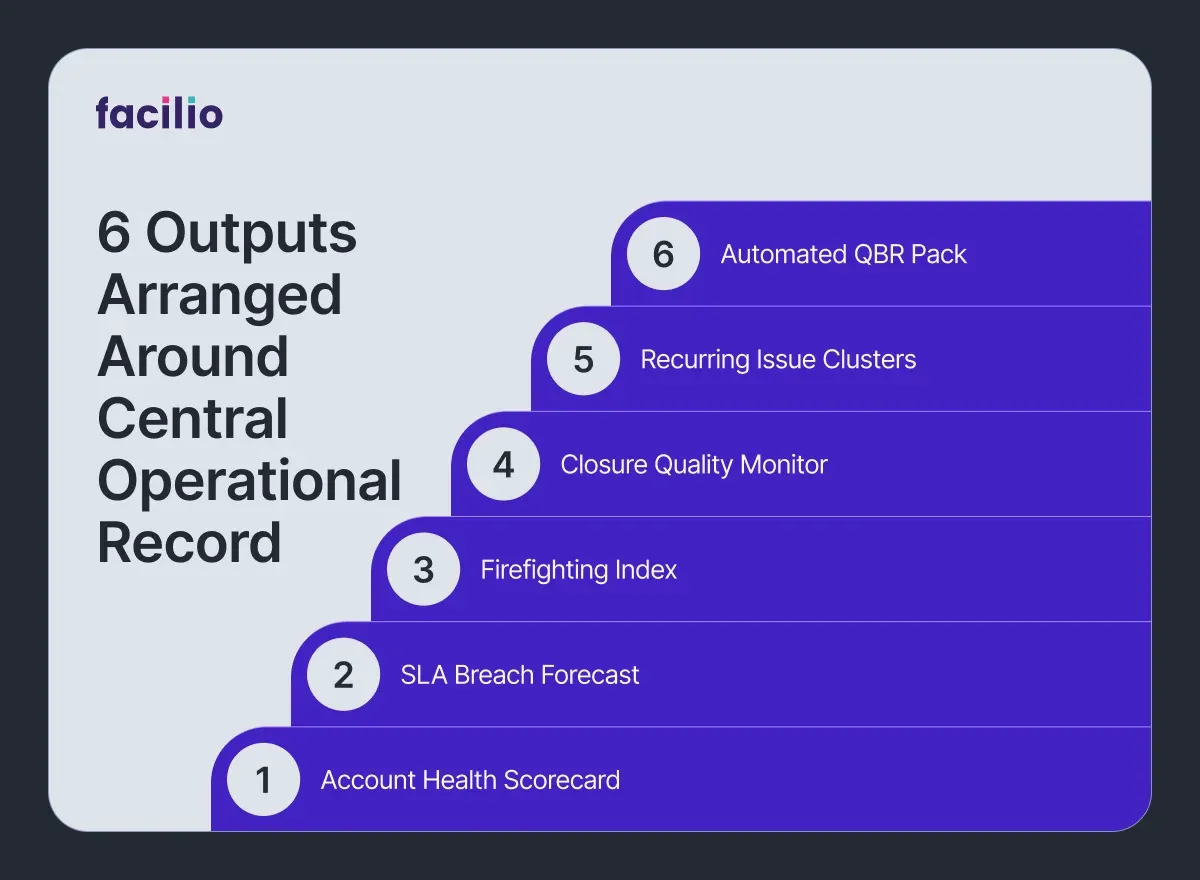
a) Account health scorecard: A weekly Green/Amber/Red status per client account, with the top three risk drivers surfaced automatically. Not a report to be built — a signal to be acted on. Leadership sees which accounts need attention this week, not which ones failed last quarter.
b) SLA breach forecast: Rather than reporting what breached last week, this output flags what is likely to breach next week — based on backlog aging, ticket run-rate, and unresolved high-priority clusters. Early warning, not post-mortem.
c) Firefighting index: A continuous view of the reactive-to-planned ratio by account and site. When this ratio shifts, it tells leadership something important: the team is no longer running the building — the building is running the team.
d) Closure quality monitor: Tracks evidence completeness rate, reopen rate, and systemic gaps by vendor or site. Beyond confirming that tickets were closed — it confirms they were resolved, with proof. The difference matters in every dispute and every audit.
e) Recurring issue clusters: AI groups tickets by pattern across descriptions, locations, and asset types — surfacing repeat failures that no individual ticket view would reveal. Each cluster comes with a hypothesised root cause and a recommended intervention.
f) Auto-generated QBR pack: What currently takes account teams one to three days to assemble — performance summary, risk flags, recurring issues, evidence, forward actions — generated automatically from the operational record in minutes. The account manager reviews and presents. They no longer build from scratch.
Taken together, these six outputs shift the conversation from reporting on the past to governing the present and give FM leaders the visibility to protect renewals, margins, and client relationships proactively.
Turn work orders, SLA trends, and technician notes into continuous contract health insights.
View Contract Health in ActionWhat this means for contract renewal and margins?
The operational intelligence described above translates into three measurable outcomes for FM providers.
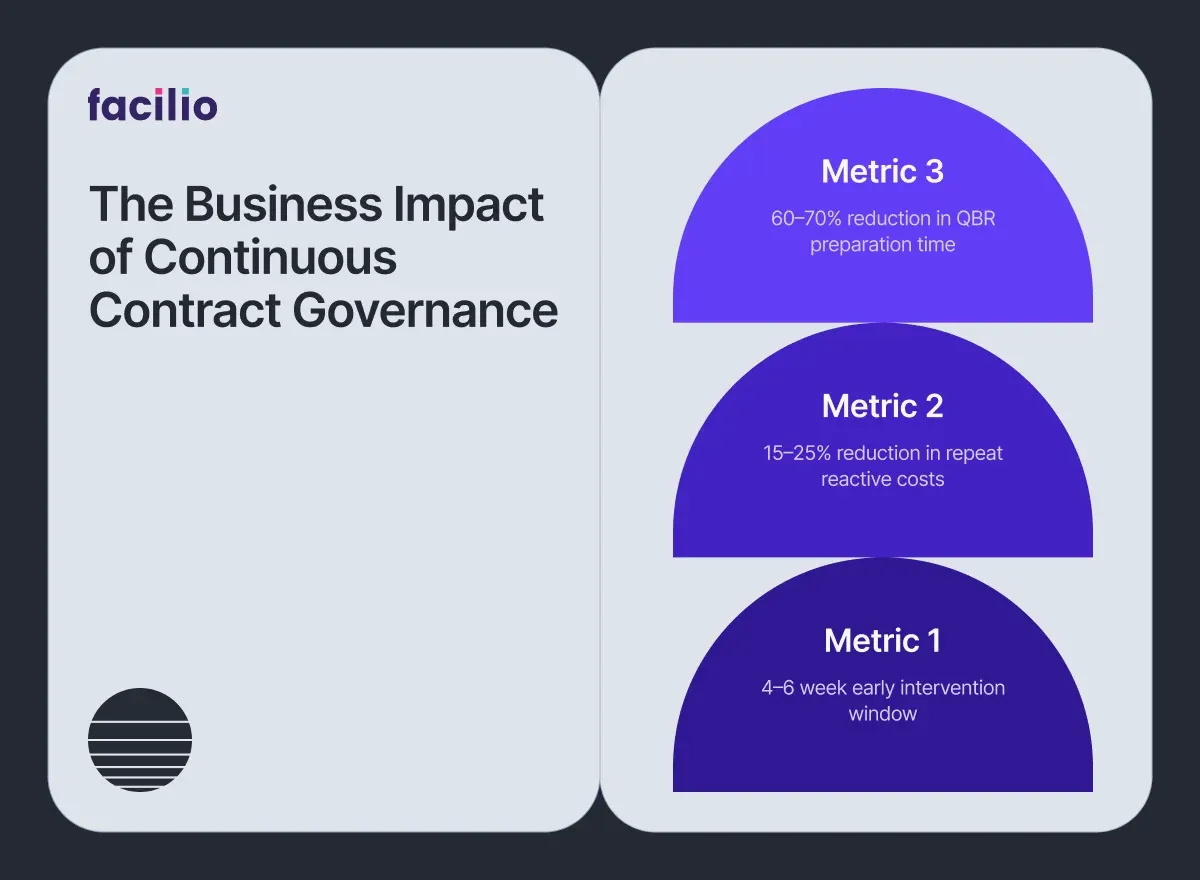
a) Renewal protection: Continuous contract monitoring creates a 4–6 week intervention window that simply doesn't exist today. Accounts that would have been lost at rebid become recoverable, because the drift is visible early enough to act on.
b) Margin protection: Recurring issue detection and closure quality monitoring directly reduce the cost of rework, revisits, and dispute overhead. For most FM providers, this translates to an indicative 15–25% reduction in repeat-reactive costs, one of the largest hidden margin drains in long-term contracts.
c) Leadership time: Auto-generated QBR packs and weekly account scorecards eliminate the manual analysis work that currently consumes senior time. Indicative reduction in QBR preparation time: 60–70%.
Proactive contract governance isn't a reporting upgrade, it's a commercial advantage.
That advantage, however, depends on having the right intelligence layer in place.
How Facilio's OpsVision turns operational data into contract intelligence
OpsVision is Facilio's AI operational intelligence layer, built specifically to read the data FM providers already generate and convert it into the six outputs described above.
It works as an overlay on top of existing systems. There is no rip-and-replace, no platform migration, and no disruption to current workflows.
For Facilio CMMS customers, deployment is immediate — work orders, SLAs, and maintenance history are already inside the platform.
For teams running third-party CMMS, OpsVision connects via lightweight API or periodic data feed.
Deployment typically takes weeks, not months.
What it produces on an ongoing basis: weekly account health scorecards, continuous SLA breach forecasts, recurring issue clusters with recommended interventions, and auto-generated QBR packs — all derived from the operational record your team is already creating.
No new data collection. No new processes. Just the intelligence that was always there, finally being read.
See how OpsVision reads your operational record to detect contract drift early.
See Opsvision in action.
Frequently asked questions
1. What is contract drift in facilities management?
Contract drift is the gradual erosion of service delivery quality — rising reactive loads, recurring unresolved issues, weakening closure evidence, and declining client trust — that accumulates before it becomes visible in escalations or renewals. It is the most common hidden cause of FM contract churn, and the hardest to detect without continuous operational monitoring.
2. Can a provider be SLA-compliant and still lose a contract?
Yes. SLAs measure response times and ticket closure counts — not client experience. A provider can meet every SLA target while the client experiences repeated failures, inconsistent service quality, and deteriorating trust. Contract health requires operational intelligence that goes beyond SLA metrics.
3. How does AI detect FM contract risk early?
AI reads operational data continuously — work orders, SLA run-rates, backlog aging, technician notes — and surfaces patterns that signal risk: rising reactive ratios, repeat issue clusters, declining closure evidence rates. This creates a 4–6 week intervention window that manual reporting and periodic reviews cannot provide.
4. Does continuous contract governance require replacing our existing CMMS?
No. OpsVision works as an AI overlay on top of existing CMMS platforms — including third-party systems via lightweight API or data feed integration. There is no migration, no disruption to existing workflows, and no rip-and-replace. Deployment typically takes weeks.
About the Author

More from Facilio