Connected CMMS

 Connected Buildings
 Connected Refrigeration


 Download ebook

 Read case study


 Watch now


 Retail
 Healthcare
 FM Services
 Commercial Portfolios
 Corporate Facilities
 Education
 Data-driven Portfolio Ops
 Facility Management Software
 360° Asset Lifecycle
 Continuous Sustainability

 Blogs
Blogs
 Help docs
 Knowledge Hub
 ROI Calculator
 Ebooks & Guides
 Webinars
 Case studies


 About us
 Newsroom
 Careers
 Contact us
 Partners
 Events




Facilities management portfolios process invoices at scale. Dozens of vendors. Hundreds of contracts. Thousands of invoices across sites, service categories, and billing cycles.
At that scale, the assumption is simple — if each invoice looks correct, finances must be under control.
That is where margin leakage quietly begins.
Margin leakage is often confused with revenue leakage — but they are different problems. Revenue leakage is income that was never collected. Margin leakage is profit that was lost despite payment being made — through overbilling, contract deviations, and invoice errors that passed approval undetected.
The errors that drain FM margins rarely look significant in isolation. A charge slightly above the contracted rate. The same job billed twice across two sites. A pricing escalation clause that was never applied. Individually, each passes review. Across a portfolio, they compound.
Most FM finance teams do not identify these patterns during routine invoice review. They surface in audits — after payment is made, and after margin is already lost.
The problem is not diligence. It is visibility.
Why FM Invoice Errors Stay Invisible Across Vendors and Sites
Invoice review in facilities management is almost always transactional. An invoice arrives, a team member checks it against the relevant work order or contract, and it either moves forward or gets queried.
That process works reasonably well for a single invoice. It breaks down at portfolio scale.
The problem is structural, not operational. When invoices are reviewed individually, there is no mechanism to detect patterns that only become visible across the full vendor base — a vendor consistently billing slightly above contracted rates, a duplicate charge appearing across two sites three months apart, or a pricing escalation that was missed not once but across every applicable contract.
Even where three-way matchingis already in place it confirms whether a single invoice is correct. It does not surface whether the same error is repeating across dozens of invoices over time.
These are not errors that stand out in isolation. They are patterns that only reveal themselves when every invoice is compared across vendors, sites, contracts, and billing history together.
Manual review cannot do that. Not because finance teams lack capability, but because the volume makes it structurally impossible.
Where FM Margins Leak: Invoice Patterns Teams Don't See
In facilities management portfolios, margin leakage rarely appears as a single large error. It accumulates through patterns — billing inconsistencies that repeat across vendors, contracts, and sites over months without ever triggering a flag in routine review.
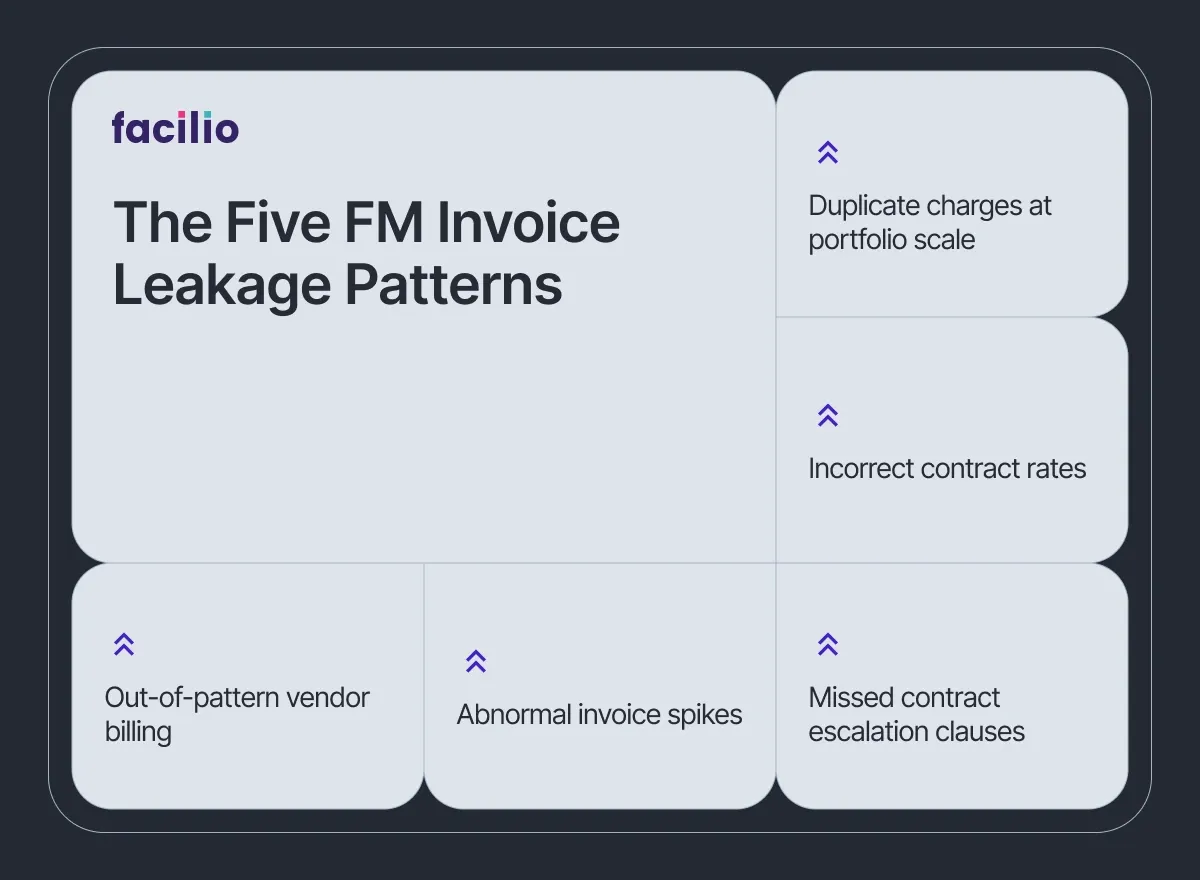
These are the most common patterns that compound across FM portfolios:
Duplicate charges at portfolio scale
The same job billed twice across two different sites, or the same invoice submitted in consecutive billing cycles. Individual site reviews rarely catch these because each invoice appears legitimate in isolation.
Incorrect contract rates
A vendor billing at a rate that has drifted from the agreed contract price — by a small margin, consistently, across multiple service categories. Small percentage deviations across high invoice volumes create significant cost exposure.
Missed contract escalation clauses
Pricing escalations agreed in contracts that were never applied — or incorrectly applied — leading to consistent under- or overcharging across invoices.
Abnormal invoice spikes
A sudden cost increase for a recurring service with no corresponding change in work order scope. Without portfolio-level benchmarking, spikes like these pass through approval without scrutiny.
Out-of-pattern vendor billing
A vendor whose invoices deviate from their own historical billing behaviour — different line item structures, unusual charge categories, or timing that does not align with service delivery patterns.
See how Facilio’s AI detects invoice anomalies across your portfolio.
Schedule a DemoHow AI Detects Invoice Anomalies Across FM Portfolios
The reason invoice patterns stay invisible in manual review is the same reason AI is effective at surfacing them — scale.
Where a finance team reviews invoices sequentially, AI monitors invoices across vendors, sites, and contracts simultaneously. It does not sample. It does not prioritise by invoice size. It evaluates the full portfolio continuously.
What looks like noise in a single invoice becomes a pattern when seen across hundreds — and that is where AI changes the equation.
Instead of reviewing invoices in isolation, AI places each invoice in context:
- Contract expectations for that service
- Historical billing behaviour of the vendor
- Patterns across similar invoices in the portfolio
This is what makes pattern detection possible at scale.
A vendor billing 3% above contracted rates on a single invoice looks like a rounding issue. The same vendor doing it consistently across 40 invoices over six months looks like systematic overbilling — and that distinction is surfaced automatically.
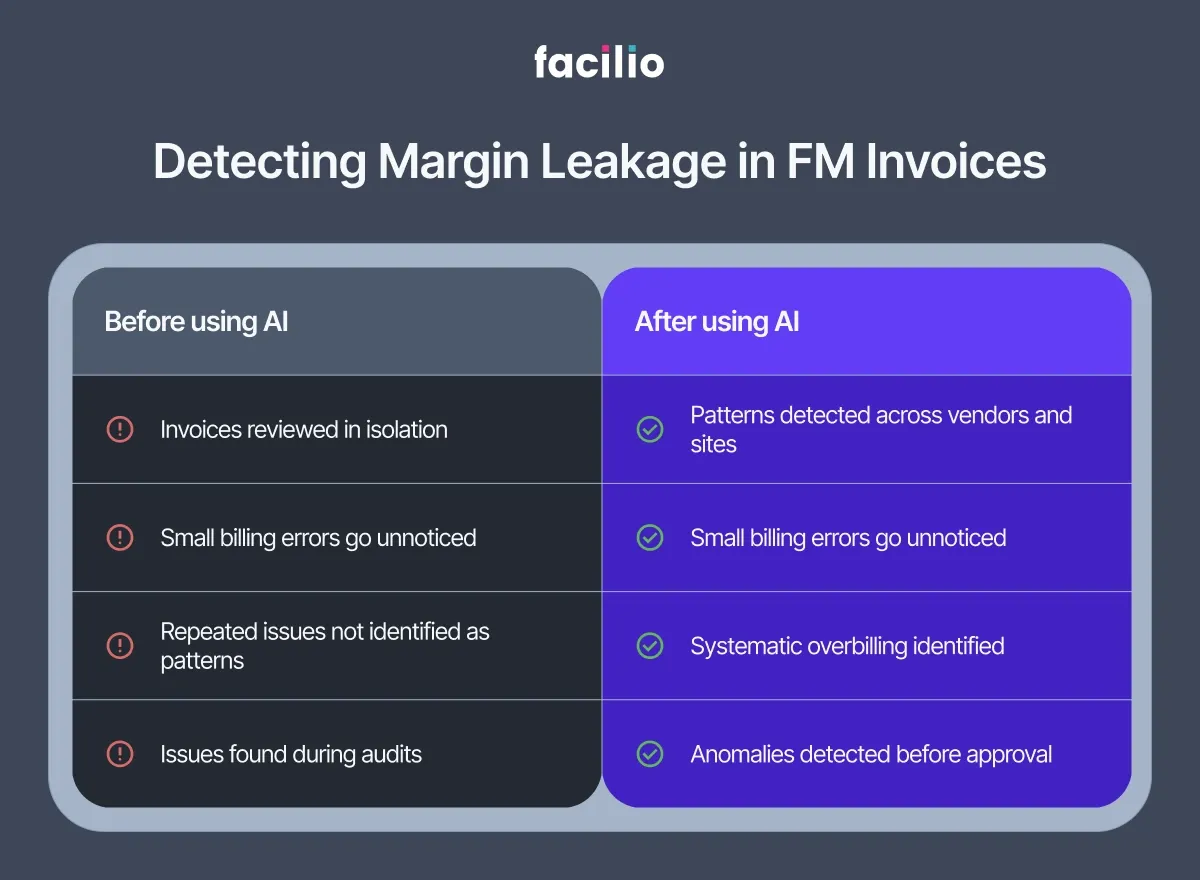
Beyond rate checks, AI benchmarks each invoice against historical patterns for comparable work. If a charge is materially higher than what the same vendor billed for similar jobs in the past, it is flagged — not because a rule was triggered, but because the pattern is anomalous.
According to McKinsey, one organisation deployed AI agents to enforce invoice-to-contract compliance and cut value leakage by 4% of total spend.
While this example comes from a procurement-heavy industry, the underlying problem is structurally identical in FM — invoice volumes are too large for manual pattern recognition, across vendor bases too complex for periodic review.
How AI Turns Invoice Detection into Continuous Margin Control
Detecting an anomaly is only half the equation. What happens next determines whether detection translates into actual margin protection.
When AI identifies an issue, it does not simply raise an alert and wait. It structures the exception and routes it with full context already attached:
- What was flagged and why
- How the charge compares to expected rates
- Historical billing patterns for that vendor
- Context from similar invoices across the portfolio
This means the finance team receives a pre-built case, not a raw query. Review becomes a decision, not an investigation.
For invoices that show no anomalies — the majority in most FM portfolios — AI enables straight-through processing. Clean invoices move forward without manual intervention, allowing finance teams to focus on exceptions that require judgment.
The outcome is not just faster processing. It is a shift in how financial control operates across the portfolio — from reactive checks that catch problems after payment, to continuous monitoring that prevents them before approval.
How FM Teams Can Operationalise Continuous Invoice Control Across Portfolios
For FM portfolios still relying on periodic audits, continuous AI monitoring changes where control happens — from after payment to before approval.
AI-driven invoice monitoring works best when it strengthens financial control without disrupting the systems teams already rely on. There is no need to replace existing infrastructure: the CMMS continues to hold work order data, contracts define commercial terms, and the ERP remains the system of record for approvals and payments.
Facilio's AI agent, Luca, operates as a layer across these systems — whether within the Facilio CMMS or alongside third-party platforms — without requiring changes to existing systems or workflows.
The outcome is a more structured, scalable approach to invoice approval — one that helps teams catch issues earlier while preserving the controls already in place.
See how Facilio’s Finance AI agent surfaces hidden billing errors across vendors and sites.
See Facilio's AI in Action
Frequently Asked Questions
1. What causes margin leakage in facilities management invoices?
Margin leakage in FM comes from billing inconsistencies that repeat across vendors, contracts, and sites without being detected. Incorrect rates, duplicate charges, missed escalations, and abnormal spikes may seem minor individually, but they compound into significant erosion at portfolio scale.
2.Why are invoice errors hard to detect across large FM portfolios?
Manual review checks invoices one at a time against a single work order or contract. It cannot detect patterns that only become visible across vendors, sites, and billing history together. At portfolio scale, that becomes structurally difficult without automation.
3. What types of invoice patterns typically go unnoticed in FM?
Common examples include duplicate charges across sites, rate deviations from contracted pricing, missed escalation clauses, abnormal cost spikes on recurring services, and vendors billing outside their normal historical patterns. Each can look legitimate in isolation.
4. How can invoice anomalies be detected across vendors and sites?
AI monitors invoices across the full portfolio simultaneously, looking for unusual billing patterns across vendors, contracts, sites, and historical trends. This makes it possible to surface anomalies before they become approved costs.
5. How can FM teams move from reactive audits to continuous financial control?
By shifting from post-payment review to continuous pre-approval monitoring. AI continuously evaluates invoices across the portfolio, allowing clean invoices to move forward while flagged exceptions are surfaced early with the context finance teams need.
About the Author

More from Facilio