Connected CMMS

 Connected Buildings
 Connected Refrigeration


 Download ebook

 Read case study


 Watch now


 Retail
 Healthcare
 FM Services
 Commercial Portfolios
 Corporate Facilities
 Education
 Data-driven Portfolio Ops
 Facility Management Software
 360° Asset Lifecycle
 Continuous Sustainability

 Blogs
Blogs
 Help docs
 Knowledge Hub
 ROI Calculator
 Ebooks & Guides
 Webinars
 Case studies


 About us
 Newsroom
 Careers
 Contact us
 Partners
 Events


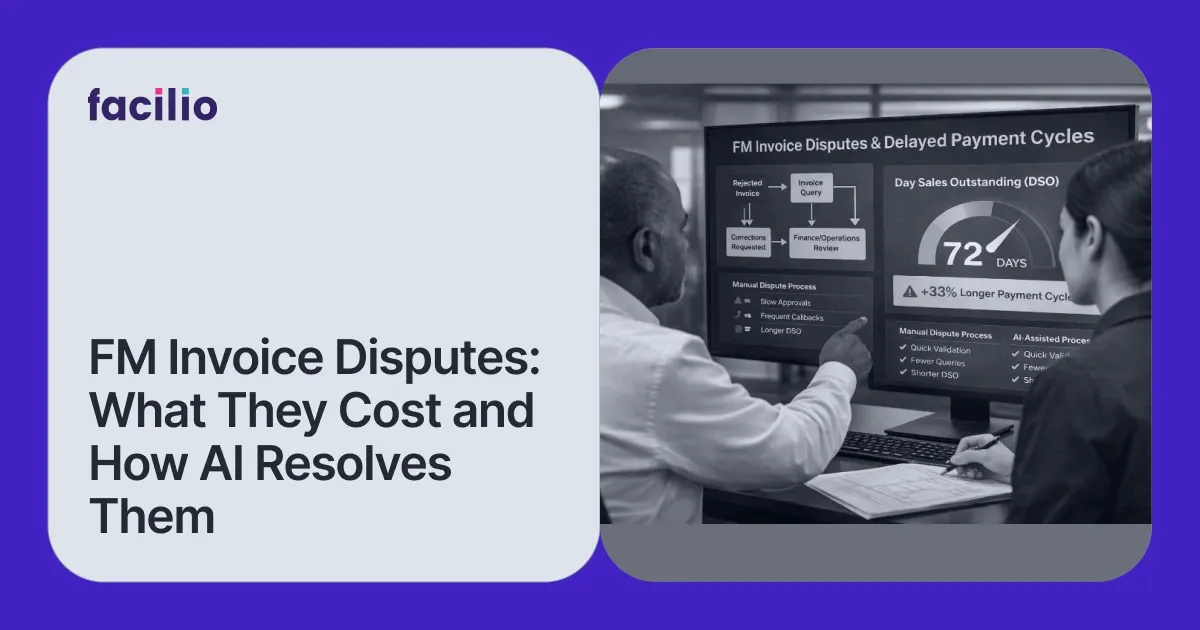

In facilities management, revenue leakage often builds quietly. It takes shape through invoices that are rejected, queried, resubmitted, and delayed until payment cycles stretch well beyond what contracts intended.
Revenue leakage in FM refers to income tied to completed work that is delayed or never fully collected because disputes, rework cycles, and approval bottlenecks slow invoices down across vendors and sites.
It is different from margin leakage, which refers to profit lost through billing inconsistencies at portfolio scale. Both affect financial performance. Both often remain invisible until they begin to show up in reports.
But where margin leakage is a portfolio pattern, revenue leakage is an operational one. It starts the moment an invoice is disputed.
The question for FM finance teams is not whether disputes are happening. It is how much they are costing — and how much of that cost could be avoided.
Why FM Invoices Break Down Before Approval
A facilities management invoice is rarely simple. A single invoice can include labor hours across multiple technicians, materials and parts, subcontractor charges, call-out fees, and service rates governed by contract terms that were negotiated months or years earlier.
That complexity creates natural points of misalignment — between what was agreed in the contract, what was recorded in the work order, and what the vendor has billed.
When these records do not align, invoices do not move forward. They get queried, held, or sent back — triggering a cycle of back-and-forth between finance, operations, and the vendor before payment can proceed.
The challenge is not usually intent. It is the number of variables involved in proving that the invoice accurately reflects the work completed and the terms agreed.
This is where AI can reduce dispute risk early — by identifying inconsistencies before they turn into approval delays, rework, and payment friction.
What Happens When an Invoice Gets Rejected in FM Workflows
When an FM invoice is rejected, the expectation is that it can be quickly corrected. In practice, it rarely is.
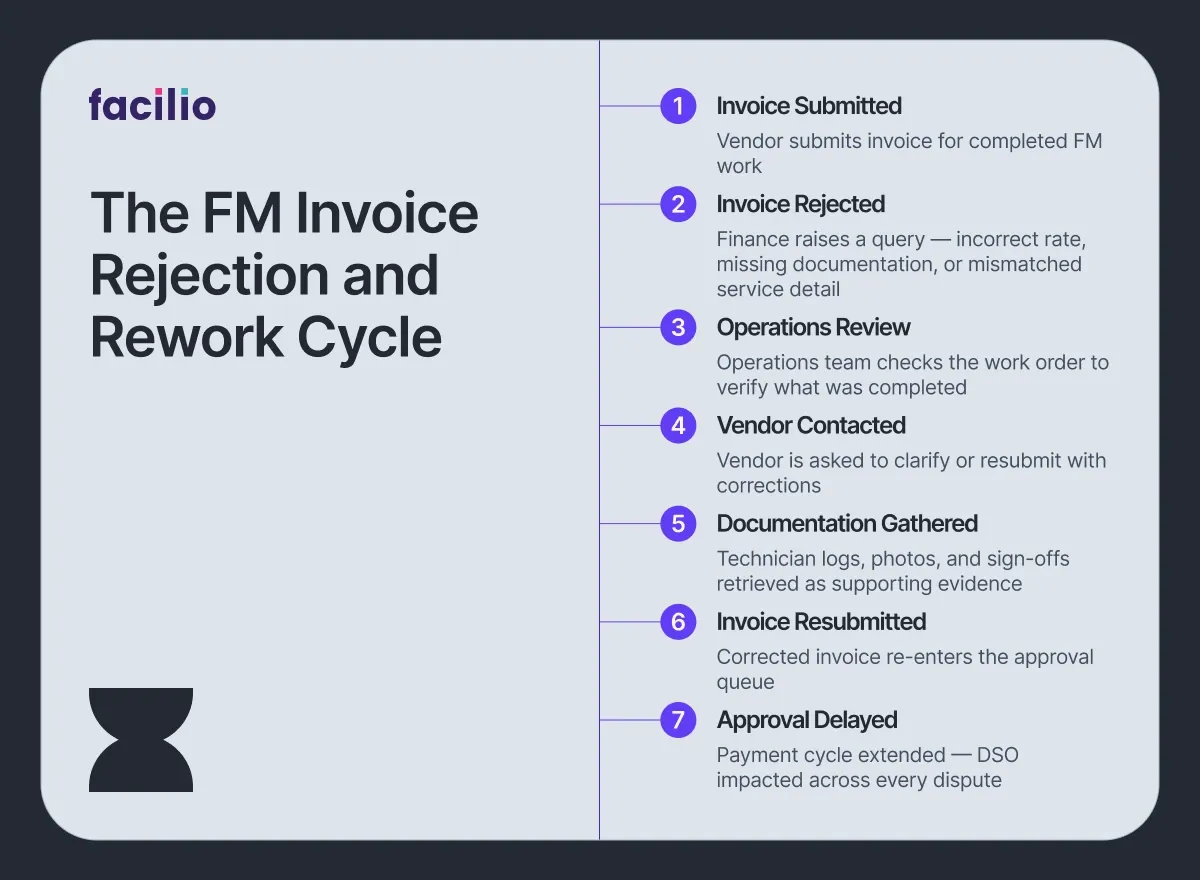
A typical rejection triggers a sequence that involves multiple teams and systems:
- Finance raises a query — incorrect rate, missing documentation, or mismatched service detail
- Operations reviews the work order to verify what was completed
- The vendor is contacted to clarify or resubmit with corrections
- Supporting documentation is gathered — technician logs, photos, sign-offs
- The revised invoice re-enters the approval queue
Each step takes time, and every handoff adds delay. In FM portfolios managing dozens of vendors across multiple sites, this cycle is not an exception — it is part of the day-to-day invoicing process.
The operational cost is real. Finance teams spend time on queries instead of approvals. Operations teams are pulled away from service delivery to validate past work. Vendors wait longer for payment while the cycle runs its course.
What makes this particularly costly is that most of the information needed to resolve the dispute was already available before the invoice was submitted — it simply was not checked.
Want to know how Facilio's Finance AI agent reduces invoice disputes and improves payment cycles?
Talk to our teamHow Invoice Disputes Quietly Extend Payment Cycles in FM
Every rejected invoice adds time to the payment cycle. A dispute that takes two weeks to resolve is added to DSO — the metric that measures how long it takes to collect payment after work is completed.
In isolation, that delay seems manageable. Across a portfolio with multiple vendors, recurring disputes, and staggered billing cycles, the cumulative effect on cash flow is significant.
For FM service providers, the consequences are direct. Working capital gets tied up in disputed receivables. Cash that should be available to fund operations, pay subcontractors, and service new contracts sits in unresolved invoice queues instead.
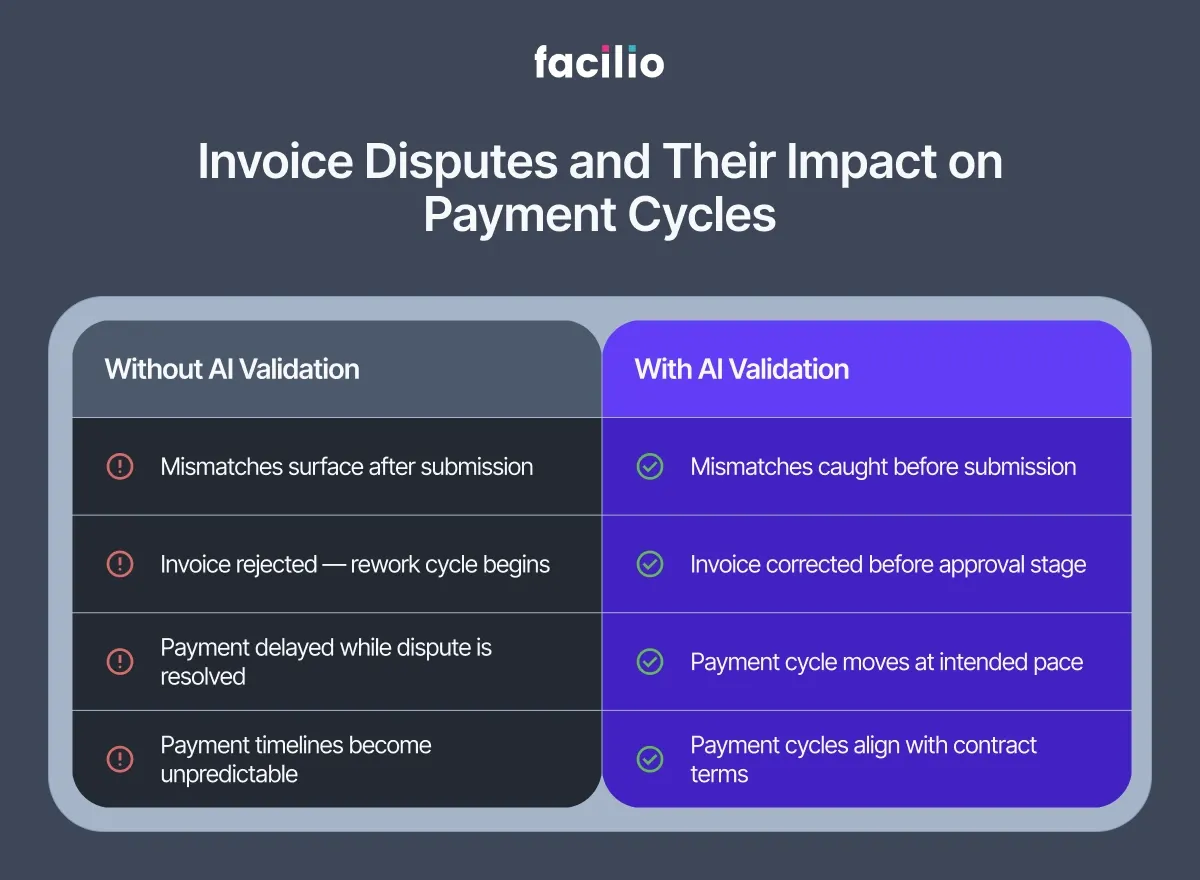
For building owners and operators, disputes create a different but equally real problem. Finance teams absorb the coordination overhead. Approval cycles slow down. Vendor relationships come under pressure when payment timelines become unpredictable.
When disputes compound on top of already extended payment cycles, the gap between work completed and cash received grows wider with every billing cycle.
How AI Prevents Invoice Disputes Before They Happen
Most FM invoice disputes are not inevitable. They are the result of mismatches that could have been identified before the invoice was submitted — if the right checks had been in place.
This is where AI changes the dynamic. Instead of waiting for a client to reject an invoice and trigger the rework cycle, AI identifies common dispute triggers before the invoice reaches the approval stage.
These checks focus on the issues most likely to cause rejection:
- Rates that do not match contracted pricing
- Line items that do not correspond to completed work
- Missing or incomplete supporting documentation
- Charges that deviate from the vendor’s usual billing patterns
When an issue is identified, it is flagged before submission — giving the FM team or vendor the opportunity to correct it before it becomes a rejection.
For invoices that clear these checks, the path to approval becomes more predictable. Clean invoices move forward without manual intervention, reducing the volume of queries finance teams need to manage.
This is different from the broader problem of margin leakage across a portfolio, where repeated billing patterns erode profitability over time.
The outcome here is narrower but equally important — fewer rejections, shorter approval cycles, and a more predictable path from completed work to collected payment.
How AI Reduces Rework and Improves Payment Cycles in FM
Preventing disputes before submission changes more than just the rejection rate. It changes how finance teams operate, how vendors experience the payment process, and how predictably completed work translates into payment.
Preventing disputes before submission changes more than just the rejection rate. It changes how finance teams operate, how vendors experience the payment process, and how predictably completed work translates into payment.
The operational changes are immediate:
- Fewer invoices are rejected and returned for correction
- Finance teams spend less time on queries and more time on approvals
- Operations teams are not pulled into validation cycles for past work
- Vendors receive clearer feedback earlier, reducing resubmission delays
The financial impact follows directly. When disputes decrease, payment cycles shorten. When payment cycles shorten, DSO improves. And when DSO improves, cash that was previously tied up in disputed receivables becomes available sooner.
For FM service providers, this means working capital is freed up faster — reducing reliance on external financing to bridge the gap between work completed and payment received.
For building owners and operators, it means approval workflows move at a pace that reflects actual service delivery — not the friction of repeated invoice corrections.
This shift does not require replacing existing systems or workflows. It requires identifying and resolving issues at the right point — before the invoice is submitted, not after it is rejected.
How Facilio Helps FM Teams Reduce Disputes Before Approval
Invoice disputes in FM are rarely just billing problems. They create rework across finance, operations, and vendor teams — slowing approvals, stretching payment cycles, and delaying cash that should already have been collected.
Most FM teams are not missing invoice data. They are missing the layer that checks it early enough to prevent disputes before they trigger rejection, resubmission, and payment delay.
Already on Facilio?
The finance AI agent works on top of your existing CMMS platform records and workflows. No new infrastructure. Faster deployment.
For teams using third-party CMMS platforms, it means the same dispute-reduction logic can still be applied through a connected intelligence layer — without replacing the systems already used to manage work orders, contracts, and approvals.
The outcome in both cases is the same: fewer invoice disputes, faster approvals, and a more predictable path from service delivery to payment.
See how Facilio's Finance AI agent reduces invoice disputes and improves payment cycles in FM
See Facilio's AI in Action
Frequently Asked Questions
1. Why do invoice disputes happen so frequently in facilities management?
FM invoices are structurally complex — a single invoice can include labor, materials, subcontractor charges, and contract-specific rates across multiple service categories. That complexity creates natural points of misalignment between what was agreed, what was completed, and what was billed. Without early checks, these mismatches often surface only after the invoice has been submitted.
2. What typically causes an FM invoice to be rejected?
The most common causes are rate discrepancies, missing or incomplete supporting documentation, line items that do not correspond to completed work orders, and charges that were not pre-approved. Each of these can be identified before submission, but they are rarely caught consistently through manual review alone.
3. How do invoice disputes impact payment cycles and DSO?
Every dispute adds time to the payment cycle. Finance queries operations, operations checks the work order, the vendor resubmits, and the revised invoice re-enters the approval queue. Across a portfolio with recurring disputes, the cumulative effect extends DSO significantly and keeps cash tied up in unresolved receivables.
4. What happens operationally when an invoice gets disputed?
A disputed invoice triggers a rework cycle involving multiple teams — finance, operations, and the vendor. Documentation needs to be retrieved, work records verified, and corrections made before the invoice can be resubmitted. In FM portfolios managing dozens of vendors across multiple sites, this cycle consumes significant time and effort across all three parties.
5. How can FM teams reduce invoice disputes before submission?
By identifying and correcting common mismatches before invoices reach the approval stage. AI can flag issues such as rate discrepancies, missing documentation, and incomplete line items early — allowing teams to resolve them before they trigger rejection. This reduces rework, shortens approval cycles, and improves payment predictability.
About the Author

More from Facilio