Connected CMMS

 Connected Buildings
 Connected Refrigeration


 Download ebook

 Read case study


 Watch now


 Retail
 Healthcare
 FM Services
 Commercial Portfolios
 Corporate Facilities
 Education
 Data-driven Portfolio Ops
 Facility Management Software
 360° Asset Lifecycle
 Continuous Sustainability

 Blogs
Blogs
 Help docs
 Knowledge Hub
 ROI Calculator
 Ebooks & Guides
 Webinars
 Case studies


 About us
 Newsroom
 Careers
 Contact us
 Partners
 Events


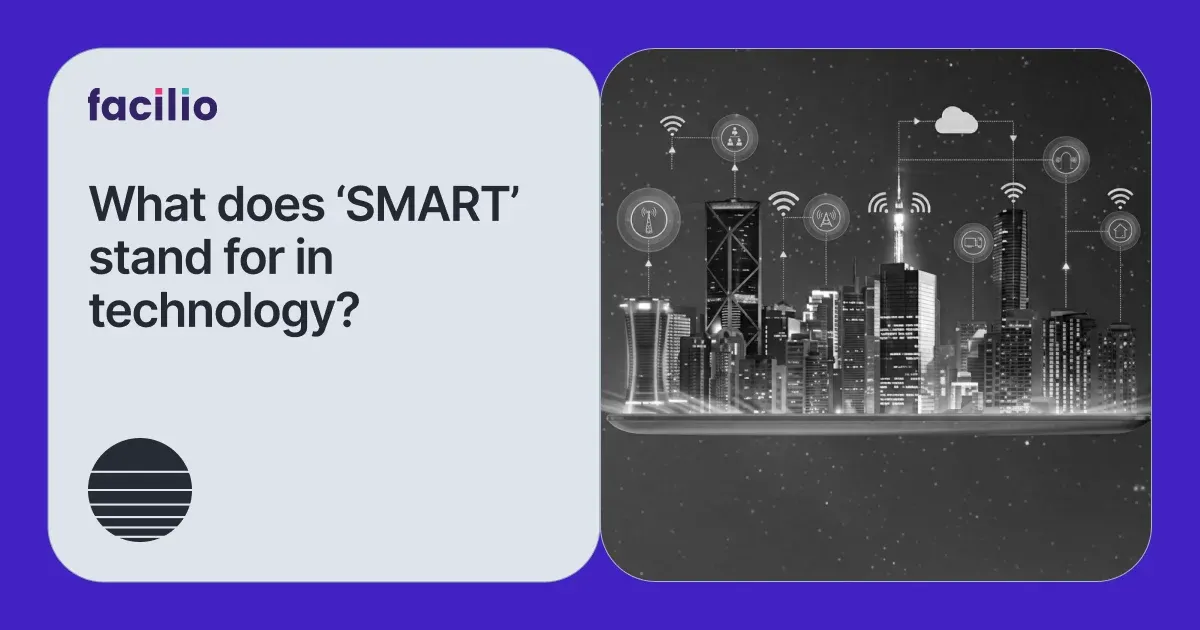

Smart technology refers to interconnected, network-enabled devices that use sensors, artificial intelligence (AI), and data analytics to operate autonomously or remotely. These systems—spanning smart homes, wearables, and industrial tools—improve efficiency, convenience, and security by learning user behavior and adapting to environmental conditions.
Today, smart technology applies across domains including smart homes, smart cities, and smart health. Thermostats optimize energy at home. Sensors improve traffic flow in cities. Wearables monitor personal health in real time.
Definition of Smart Technology
Smart technology describes devices and systems designed to operate in a more intelligent, efficient, and interconnected manner. These technologies incorporate AI, IoT, automation, data analytics, machine learning, and network connectivity to understand and respond to user behavior or environmental conditions.mrisoftware+1
The term "SMART" originally derived from "Self-Monitoring, Analysis, and Reporting Technology"—but has since evolved to encompass broader intelligence and advanced functionality across industries.
Key characteristics include:
- Connectivity & IoT: Devices like smart speakers, fridges, and lighting connect via Wi-Fi or networks to exchange data.
- Automation: Systems perform tasks without manual input—smart locks secure doors, lighting adjusts automatically.
- Artificial Intelligence: Devices adapt to preferences and conditions, learning habits over time.
- Remote Management: Control from anywhere using smartphones or voice commands.
- Data-Driven Operations: Sensors and analytics optimize in real time, like energy management or safety monitoring.facilio+1
Smart Technology Defined: Interconnected systems using sensors, AI, IoT, and data analytics for intelligent, adaptive, autonomous operation.
IoT sensors in facility systems exemplify this in commercial buildings, enabling predictive, data-driven responses.
What Does SMART Stand For in Technology?
The SMART acronym stands for Self-Monitoring, Analysis, and Reporting Technology—coined in the 1990s for hard drives capable of detecting their own faults and predicting failures. It captures the core of what smart technology means: systems that independently track status, process data, and communicate insights without human intervention.ambientproptech+1
Letter by letter:
- Self-Monitoring: Continuously tracks internal conditions like temperature, wear, or battery.
- Monitoring: Gathers environmental data via embedded sensors.
- Analysis: Uses algorithms to detect patterns and anomalies.
- Reporting: Delivers alerts and actionable insights to users.
- Technology: The hardware-software backbone enabling it all.facilio+1
While the original SMART acronym focused on storage, modern usage extends to all adaptive devices—from wearables to building management systems optimizing commercial real estate.
How Smart Technology Works
Smart technology operates through a continuous cycle of sensing, transmitting, analyzing, and acting—turning raw environmental inputs into intelligent outputs in real time.
- Sensors Gather Data: Detectors capture motion, temperature, energy usage, or occupancy.
- Connectivity Transmits: Data flows via Wi-Fi, Bluetooth, or 5G to cloud platforms.
- AI/ML Analyzes: Algorithms identify patterns, predict failures, and optimize performance.
- Systems Act: Automation executes—HVAC adjusts, alerts fire, lights dim.
- Feedback Loops Learn: Each cycle refines future decisions.facilio+1
See How Facilio's AI Turns Building Data Into Smarter Facility Decisions.
Get a demoSmart Technology Examples
Smart technology demonstrates its versatility across everyday and enterprise settings. Examples evolve from simple connected devices to advanced AI-powered robots handling complex home tasks.
Consumer & Home Automation
Thermostats (Nest) self-regulate climate for energy wins. Philips Hue lighting responds to voice or presence. Security cameras and smart locks deliver live remote monitoring. Robotic vacuums and inventory-aware fridges handle chores independently. Smart doorbells add entry alerts. Voice speakers tie everything together.
Wearables & Personal Health
Smartwatches, fitness trackers, and smart glasses log heart rate, steps, sleep, and vitals continuously. Health monitors support chronic condition management with live feeds. Patient monitoring systems allow distant oversight, significantly reducing hospital visits.
Urban & Smart City Infrastructure
Traffic management networks use sensors for smoother commutes and reduced congestion. Adaptive street lighting saves power through ambient detection. Smart waste bins signal when full, streamlining collection routes. Smart grids dynamically balance energy loads across cities.
Enterprise & Industrial Applications
Building management systems (BMS) orchestrate HVAC, lighting, and security in one platform. Smart lifts optimize passenger flow and cut wait times. Industrial IoT platforms connect machinery for ongoing oversight. Collaborative robots (cobots) partner with workers for safer, faster output. Smart sensors deliver live production data for precision manufacturing.facilio+1
Smart buildings increasingly rely on IoT for energy management to maintain efficiency at portfolio scale.
Workplace & Government
Interactive displays foster collaboration and security in offices and government settings. Evolving AI robots take on complex and repetitive home tasks.
Benefits of Smart Technology
Smart technology provides facility managers and property owners with measurable gains across connectivity, data processing, machine learning, automation, user experience, security, and efficiency.
Connectivity Benefits
Devices integrate smoothly across networks.
Wi-Fi, Bluetooth, and 5G enable real-time data exchange. Control systems remotely from smartphones or computers. This delivers flexibility and oversight without physical presence—adjusting building temps or monitoring assets from anywhere.
Data Processing Benefits
Raw sensor data becomes actionable intelligence.
Systems process large volumes instantly for swift decisions. Predictive analytics forecasts equipment issues ahead of time—reducing maintenance costs by 25-30% compared to reactive approaches.
Machine Learning and AI Benefits
Algorithms study usage patterns to uncover trends.
This powers automation like occupancy-based lighting and HVAC pre-scheduling. Downtime decreases 35-45% through timely, data-driven interventions.
Automation and Control Benefits
Sensors trigger actions without manual input.
HVAC ramps before meetings. Lights fade after hours. Labor requirements drop, errors minimize, and energy efficiency improves by 15-20%.
User Interface Benefits
Dashboards and voice commands simplify control.
Personalization tailors views to roles—maintenance teams see alerts, facility managers see ROI. Engagement increases with intuitive, accessible interfaces.
Security Benefits
Continuous monitoring detects anomalies instantly.
Integrated compliance tools meet regulatory standards. AI-driven safeguards save an average of $1.9M per avoided breach.
Efficiency Benefits
Algorithms allocate resources precisely where needed.
Peak demand smooths out automatically. OEE climbs 35-50% as assets run at optimal performance. Systems scale seamlessly with portfolio growth.oxmaint+1
Challenges of Smart Technology
Smart technology demands careful planning to counter real limitations.
Upfront costs for hardware, integration, and training mount quickly. Internet lapses halt operations entirely. Data collection raises privacy concerns across users and organizations. Security gaps can expose systems to sophisticated threats.
Cybercrime costs are projected to reach $10.5T annually by 2025. The average US data breach costs $10.22M. Surveys show 57% of users worry about data misuse and 46% cite hacking as a primary concern. Early detection systems average 1 false positive per month.
Addressing these proactively—through robust platforms with built-in safeguards—is essential for sustainable adoption.
Facility management software builds compliance and security in from day one, reducing exposure across portfolios.[facilio]
Future of Smart Technology
Facility executives planning ahead know smart technology is set for significant advancement. By 2030, AI-driven ecosystems will dominate, with edge computing reducing latency and enabling self-healing systems.mrisoftware+1
Key shifts ahead:
- AI Agents: Autonomous operations managers handling HVAC faults before they escalate—downtime reductions exceeding 50%.
- 6G Networks: Instant data sync across portfolios for real-time decisions at scale.
- Net-Zero Integration: Smart grids and sensors driving sustainability compliance, essential for ESG reporting.
- Hyper-Personalization: Adaptive systems that configure themselves based on individual and organizational behavior.
Forward-thinking teams use facility management software to consolidate IoT data into actionable dashboards that scale with growth. The future favors unified platforms.
Discover How Facilio Turns Smart Technology Into Real Building Performance.
Book a demo
Frequently Asked Questions (FAQ)
What is smart technology?
Smart technology refers to network-enabled devices using AI, IoT, and sensors to operate autonomously and adapt to user behavior—improving efficiency, security, and convenience across homes, buildings, and cities.
What does the SMART acronym stand for?
SMART stands for Self-Monitoring, Analysis, and Reporting Technology—devices that track their own health and surface insights automatically.
What are examples of smart technology?
Home: Nest thermostats, Philips Hue lights, smart locks, cameras, speakers. Wearables: Smartwatches, fitness trackers. Commercial: BMS, IoT sensors, cobots. Cities: Traffic systems, smart grids, waste management.
What are the benefits of smart technology?
Energy savings of 15-20%, maintenance cost cuts of 25-30%, reduced downtime, remote control, real-time security alerts, and scalability for growing portfolios.
What are the main challenges of smart technology?
High upfront costs, internet dependency, privacy risks (57% concerned), and cyber threats reaching $10.5T globally by 2025.deepstrike+1
About the Author

More from Facilio