Connected CMMS

 Connected Buildings
 Connected Refrigeration


 Download ebook

 Read case study


 Watch now


 Retail
 Healthcare
 FM Services
 Commercial Portfolios
 Corporate Facilities
 Education
 Data-driven Portfolio Ops
 Facility Management Software
 360° Asset Lifecycle
 Continuous Sustainability

 Blogs
Blogs
 Help docs
 Knowledge Hub
 ROI Calculator
 Ebooks & Guides
 Webinars
 Case studies


 About us
 Newsroom
 Careers
 Contact us
 Partners
 Events



Facility operations used to depend on proximity.
If something went wrong with an HVAC system, a refrigeration unit, or a building alarm, someone had to be physically present to notice it. Control rooms were local. Monitoring happened site by site. Response times depended on who was available nearby.
That model no longer works.
Today’s portfolios span cities, countries, and continents. Retail chains operate hundreds of outlets. Healthcare networks manage distributed campuses. Commercial real estate portfolios include dozens of buildings with thousands of assets.
Yet the expectation is simple: everything must work—everywhere, all the time.
That’s why remote monitoring has become one of the most critical capabilities in modern facilities management.
Why the traditional monitoring model is breaking down
As facility portfolios expand, operational complexity grows exponentially.
A single site may generate thousands of telemetry signals—from HVAC controllers, refrigeration monitoring systems, lighting infrastructure, power meters, and environmental sensors.
Multiply that across hundreds of locations, and operations teams face a constant stream of alerts, alarms, and performance data.
Without a centralized monitoring framework, teams struggle with:
- Limited visibility across distributed sites
- Slow response to equipment failures
- Overwhelming volumes of raw alarms
- Difficulty prioritizing critical operational issues
In many organizations, alarms still arrive through fragmented systems. Some are routed through BMS dashboards, others through emails, and some through vendor-specific portals.
The result is operational blind spots.
And blind spots create risk.
The operational cost of fragmented visibility
When facilities teams cannot monitor assets remotely and continuously, problems escalate faster than they should.
1) Critical issues surface too late
A refrigeration failure in a retail store. A temperature spike in a data room. A pump malfunction in a water system.
Without real-time monitoring, teams often discover issues only after service disruptions occur.
Alarms exist to provide early warnings. They notify teams when thresholds are breached or anomalies appear, enabling proactive responses before problems worsen.
But when alerts are scattered across systems, their value diminishes.
2) Alarm overload creates operational noise
Modern buildings generate massive numbers of alerts.
Most of them are routine. Some are duplicates. Only a few require immediate intervention.
Without intelligent prioritization, teams are forced to sift through endless streams of raw alarms.
That slows down response times and drains operational focus.
In industries like retail or multi-site operations, filtering and prioritizing alerts becomes essential to ensure teams address only the most critical issues.
3) Portfolio-level insights become impossible
Facility leaders responsible for large portfolios often lack a unified operational view.
Instead of seeing performance across all sites, they rely on fragmented reports and manual updates.
But modern facility operations require more than site-level awareness. Leaders need a real-time view across every asset and building in their portfolio.
Remote monitoring changes that.
The shift toward portfolio-wide operational visibility
Remote monitoring introduces a new model for managing facilities: centralized operational awareness.
Instead of monitoring assets locally, organizations can oversee infrastructure across their entire portfolio through a unified system.
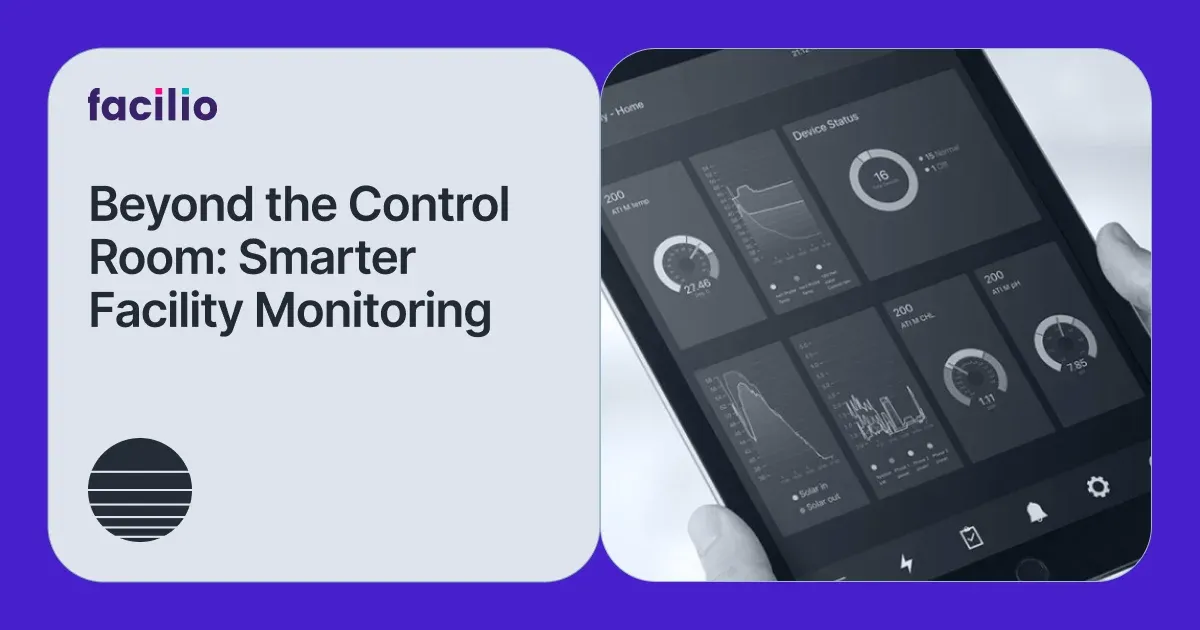
This approach provides facility managers with a bird’s-eye view of sites, buildings, assets, and operational events across geographically distributed properties.
The result is a fundamental shift in how operations teams work.
Problems no longer hide inside individual buildings. They surface immediately at the portfolio level.
Turning raw alarms into actionable intelligence
One of the biggest challenges in remote operations is separating signal from noise.
A single site can generate hundreds of alerts daily. Across a portfolio, that number can climb into the thousands.
If every alarm receives equal attention, response teams quickly become overwhelmed.
This is why modern monitoring systems prioritize alarms based on predefined conditions.
Filtering mechanisms categorize incoming alerts and identify which ones truly require action, ensuring that only relevant alarms reach facility teams.
This approach transforms monitoring from reactive alert chasing into structured operational intelligence.
Gain Real-Time Visibility Across Every Site and System Respond Faster. Operate Smarter.
Talk to ExpertsPrioritizing the issues that truly matter
Even after filtering, some alarms require more attention than others.
A temperature fluctuation may be informational. A refrigeration failure could threaten inventory. A power imbalance might risk system stability.
In remote monitoring environments, critical alarms are flagged so that teams can focus on the most severe issues first.
Flagged alarms highlight problems with the greatest operational impact and ensure that response teams address them immediately.
This prioritization helps organizations move from reactive maintenance to proactive operations.
Monitoring assets without being on-site
At its core, remote monitoring enables facilities teams to supervise equipment and infrastructure regardless of physical location.
Assets, controllers, and sensors continuously report performance data. Operations teams can view their status, detect anomalies, and respond to alerts in real time.
Instead of dispatching technicians blindly, teams can:
- Identify the exact system experiencing issues
- Understand the operational context
- Prioritize response based on severity
This level of insight allows organizations to maintain operational continuity across distributed environments.
How remote monitoring benefits different facility leaders
The value of remote monitoring varies depending on who relies on it.
For portfolio managers: Unified operational oversight
Portfolio managers oversee dozens—or hundreds—of sites.
Without centralized visibility, understanding portfolio performance becomes difficult.
Remote monitoring enables leaders to track operational conditions, alarms, and asset performance across all facilities from a single operational layer.
This allows them to identify recurring issues, compare site performance, and prioritize operational improvements with confidence.
For operations leaders: Faster response to critical events
Operations heads are responsible for maintaining system reliability across multiple facilities.
With real-time monitoring and structured alarm prioritization, they can:
- Detect operational disruptions earlier
- Allocate resources efficiently
- Prevent minor issues from escalating into major failures
Instead of reacting to problems after service disruptions occur, teams respond proactively.
For facility managers: Clearer insight into asset health
At the site level, facility managers benefit from greater clarity around how assets are performing.
When alarms and alerts are contextualized and prioritized, teams spend less time chasing noise and more time addressing real operational risks.
This improves both productivity and asset reliability.
Building a smarter operational command center
As facility portfolios continue to expand, remote monitoring is becoming the backbone of operational control.
The traditional model—site-level monitoring with manual oversight—is being replaced by centralized digital command centers that supervise assets, alarms, and systems across entire portfolios.
This shift is enabling organizations to:
- Respond faster to operational disruptions
- Improve asset reliability
- Optimize maintenance workflows
- Strengthen operational visibility across distributed facilities
And as buildings become increasingly connected, the importance of remote monitoring will only grow.
The bottom line
Facilities operations are no longer confined to individual buildings.
Modern portfolios demand continuous oversight across hundreds of assets and multiple locations. Without remote monitoring, teams are forced to react to problems after they occur.
With the right monitoring framework in place, organizations gain real-time visibility into their entire operational ecosystem—detecting issues earlier, prioritizing critical alarms, and responding faster across sites.
That’s exactly where Facilio comes in. By centralizing remote monitoring across your portfolio, Facilio helps operations teams move from reactive firefighting to proactive control.

Bring Portfolio-Wide Visibility and Control to Your Facility Operations with Facilio’s Remote Monitoring Platform.
Schedule a Live DemoAbout the Author

More from Facilio