Connected CMMS

 Connected Buildings
 Connected Refrigeration


 Download ebook

 Read case study


 Watch now


 Retail
 Healthcare
 FM Services
 Commercial Portfolios
 Corporate Facilities
 Education
 Data-driven Portfolio Ops
 Facility Management Software
 360° Asset Lifecycle
 Continuous Sustainability

 Blogs
Blogs
 Help docs
 Knowledge Hub
 ROI Calculator
 Ebooks & Guides
 Webinars
 Case studies


 About us
 Newsroom
 Careers
 Contact us
 Partners
 Events



A tenant reports a broken air handling unit by phone on Monday morning. Nobody picks up, so they send a WhatsApp message an hour later. By Tuesday they have emailed the property management inbox. Three contacts. Three channels. Three separate queues that no one has connected.
The fault still has not become a work order.
This is not an exceptional failure. It is the standard outcome of running a manual helpdesk across multiple communication channels. The tenant is not the problem. The channels are not the problem. The problem is that each channel arrives independently, with no shared memory, and no single intake layer reading all of them.
Key Takeaways
- 56% of customers say they have to repeat themselves when switching between support channels. In FM, that repetition delays work order creation and erodes occupant trust. (SQM Group)
- Most FM helpdesks run four active channels — phone, WhatsApp, email, and web chat — as separate queues with no unified intake layer.
- When channels are disconnected, the same fault generates duplicate requests, missed follow-ups, and work orders that arrive incomplete or not at all.
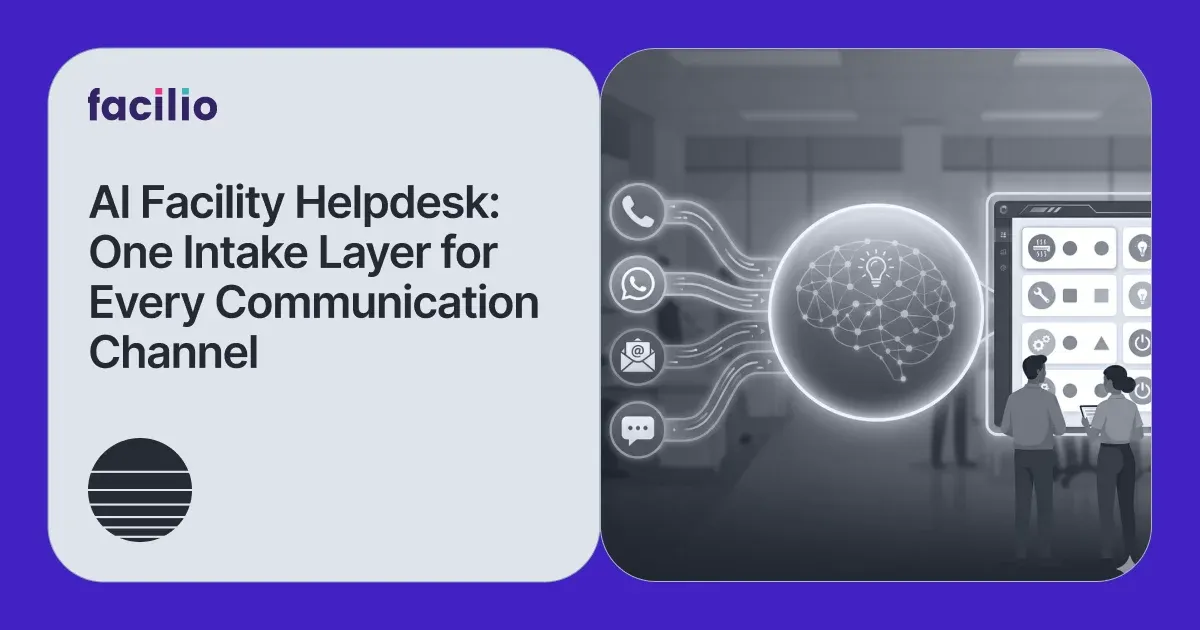
- Facilio's AI helpdesk agent, Mira, receives and processes requests across all four channels through a single intake layer — creating one structured work order regardless of which channel the tenant used.
- Deployment works on top of any existing CMMS. No infrastructure replacement, no hard cutover.
Why Tenants Report the Same Issue Three Times Before Anyone Fixes It
Tenants do not choose a communication channel strategically. They use whichever one is fastest at the moment the problem occurs. A burst pipe at 11pm is a phone call. A follow-up on an unresolved fault at 9am is a WhatsApp. A formal complaint about a delayed repair is an email.
None of these contacts are unreasonable. The problem is what happens to them on the helpdesk side.
Each channel lands in a different inbox, read by different people at different times. The operator who answers the phone call has no visibility of the WhatsApp that came in two hours earlier about the same fault. The email, which arrives in a shared inbox checked every hour, does not reference either of the previous contacts because the tenant has no way of knowing they were not received.
The result: three intake records for one fault. Possibly three work orders. Possibly none, if the operator assumed someone else had already acted.
56% of customers report having to repeat themselves when they switch between support channels. In a facility service context, every repetition is a delayed work order — and a delayed work order is a narrowing SLA window. (SQM Group)
How Channel Fragmentation Turns a Simple Request into a Multi-Day Coordination Problem
Each channel arrives as a separate queue — with no shared memory
Phone calls require someone to be available to answer, log the call, and create a record. WhatsApp messages sit in a shared or personal inbox until an operator opens it. Email queues are processed in batches. Web portal submissions are logged in a separate system from the call log.
None of these queues communicate with each other by default. When a tenant contacts the helpdesk across two channels, those contacts exist as separate events with no link between them. The operator handling the WhatsApp has no way of knowing a call came in an hour earlier — unless they happen to check both logs.
The tenant becomes the system of record, re-explaining context on every contact
Without shared memory across channels, the tenant carries all the context. Every new contact requires them to re-explain the fault, re-confirm their location, re-state the urgency. This is not a minor inconvenience — it is a sign that the service operation has no institutional memory of the request.
For tenants in commercial portfolios, this experience reads as disorganisation. In residential or mixed-use assets, it reads as indifference. Either way, it damages the perception of the service before any technician has moved.
Follow-ups and status requests consume the same intake capacity as new faults
Every 'just checking on the status of my request' call is a new intake event for a manual helpdesk. The operator must locate the original request, check its status, and relay the answer — consuming the same time as handling a new fault report. As portfolio size grows, the proportion of intake capacity consumed by follow-ups, duplicate requests, and clarification calls increases proportionally.
This is the hidden cost of channel fragmentation: not just the missed requests, but the operational overhead of managing the confusion they create.
The Four Channels Facility Teams Are Managing — and What Falls Through Each One
Phone calls: answered inconsistently, logged manually, context lost after the call ends
Phone remains the primary channel for urgent and after-hours faults. When it is answered, the quality of the record depends entirely on the operator — their familiarity with the building, the clarity of the caller, and how much time they take to log before the next call arrives.
When it is not answered, the fault record starts at zero. No log, no work order, no acknowledgement. The tenant calls back, or they do not.
WhatsApp: sits in a shared inbox until someone acts on it
WhatsApp has become a dominant intake channel across commercial, residential, and mixed-use portfolios, particularly in the Middle East, South Asia, and Australia-Pacific regions. It is faster and more convenient for tenants than a phone call.
For helpdesk teams, it introduces a structural problem. WhatsApp conversations exist on a device or in a shared account — separate from the CMMS, separate from the call log, with no automatic escalation if a message sits unanswered. A message sent at 10pm on a Friday may not reach a work order until Monday morning.
Email: checked in batches, response time determined by who is on shift
Email captures more detail than a phone call, but it processes slowly. Shared helpdesk inboxes are checked periodically, not continuously. An email reporting a fault at 2pm may not become a work order until 3:30pm — not because the team is inattentive, but because batch processing is how email queues are managed.
The additional problem with email is that it rarely contains the structured data a work order requires. The tenant describes what they see, not the asset ID, the system category, or the urgency classification the CMMS needs. A human must interpret and translate before a work order can be created.
Web chat and portal: submitted and forgotten — no acknowledgement until a human reads it
Tenant portals and web chat widgets are positioned as low-friction intake options. In practice, they function as asynchronous queues with the same manual processing bottleneck as email. The tenant submits a request and receives an automated confirmation email. What happens next depends on how quickly the queue is checked.
Without proactive status updates, the tenant has no visibility between submission and resolution. If the request is lost or misclassified, they do not know until they follow up — starting the contact cycle again.
How Facilio's AI Helpdesk Agent Handles Requests Across Every Channel in a Single Intake Layer
The fix is not a better-trained team or a more disciplined approach to checking each inbox. It is removing the channel boundary from the intake process entirely.
Mira — Facilio's AI helpdesk agent — receives requests across voice, WhatsApp, email, and web chat simultaneously. Every inbound contact, regardless of channel, is processed through the same intake logic before any human is involved.
Step 1: Mira receives and acknowledges requests instantly across every channel, at any hour
The moment a request arrives — a phone call at 11pm, a WhatsApp message at 7am, an email submitted over lunch — Mira acknowledges it on the channel used. The tenant knows their contact has been received. First contact acknowledgement is no longer a function of who is at the desk.
This single step eliminates the most visible symptom of channel fragmentation: the unanswered contact that produces a follow-up, which produces another, which produces a complaint.
Step 2: Mira retrieves existing service records before creating new ones — no duplicate work orders
When a tenant contacts the helpdesk, Mira checks for an existing open service request linked to that tenant and location before creating a new record. A WhatsApp follow-up on a phone-reported fault surfaces the original SR, confirms the current status, and updates the tenant — without creating a second work order for the same fault.
This is where the distinction between multichannel and unified intake becomes operationally significant. Multichannel means multiple queues exist. Unified intake means one service record exists, accessible from any channel.
Step 3: Mira extracts all required fields and creates a complete, structured work order regardless of channel
Whether the request arrives as a spoken sentence, a WhatsApp voice note, a three-line email, or a portal submission, Mira extracts the same set of required fields before the work order is created: tenant identity, building and floor, fault type and asset reference, urgency classification, and dispatch instruction.
Where context is missing — no asset reference, unclear location — Mira asks a clarifying question on the same channel before proceeding. The work order is not created until every required field is captured. Incomplete records that require technician callbacks are eliminated at the intake stage.
Step 4: Mira dispatches to the correct team and confirms assignment back to the tenant on the same channel they used
Once the work order is complete, Mira routes it to the responsible team based on fault type, asset, and urgency. The tenant receives a confirmation on the channel they used — phone, WhatsApp, email, or portal — with the technician assigned and the expected response window.
No manual dispatcher decides who handles it. No operator calls the tenant back to confirm. The assignment and the communication happen in the same step.
Step 5: Mira monitors open requests and sends proactive status updates without the tenant needing to follow up
After dispatch, Mira tracks the open service request and sends updates at defined points in the workflow: technician assigned, technician en route, work completed. The tenant does not need to call to find out what is happening.
The follow-up call — which consumes intake capacity, creates duplicate logs, and signals to the tenant that nothing is happening — is replaced by a proactive update the tenant receives before they think to ask.
What Multi-Channel AI Intake Looks Like Across a Live Portfolio
Consider a 12-building commercial portfolio with tenants reporting faults across all four channels. On a typical weekday, the helpdesk receives a mix of phone calls, WhatsApp messages, portal submissions, and emails — with after-hours contacts primarily via WhatsApp and phone.
Under manual handling, each of these channels is a separate queue. The morning team arrives to a WhatsApp inbox, an email queue, and a portal submission list, none of which are connected. Contacts that arrived overnight require reconstruction: which ones are duplicates, which ones are follow-ups on existing faults, which ones are new requests that need work orders created from scratch.
With Mira, every contact overnight has been processed. Acknowledgements have been sent. Existing SRs have been updated where the contact was a follow-up. New work orders have been created where the contact was a new fault. The morning team inherits a structured, complete intake record — not a queue of unprocessed contacts.
What Changes for Facility Teams When Every Channel Feeds the Same Intake Layer
How Facilio's Helpdesk AI Connects to Your Existing Channels and CMMS
Works across the channels tenants already use — no new apps or numbers required
Mira connects to existing phone lines via SIP trunking, WhatsApp Business via Meta Business Manager credentials, support email inboxes via standard forwarding configuration, and web portals via a JavaScript snippet embedded in the existing tenant interface. Tenants continue using the channels they already use. No new infrastructure is introduced.
Connects to any CMMS via Facilio's Connections and Relay layer
Work orders created by Mira are pushed to the team's existing CMMS in real time. For teams running Facilio's Connected CMMS, integration is native. For teams running IBM Maximo, Archibus, Yardi, Oracle, SAP, or other platforms, integration is handled via Facilio's Connections and Relay architecture — a lightweight, outbound-only agent that bridges systems without opening firewall ports or requiring data migration.
No migration. No parallel system. No disruption to existing workflows.
Configured per site and per client before go-live
Before deployment, Mira's intake logic is calibrated against the portfolio's building data, asset register, and CMMS field mapping. For FM service providers managing multiple client accounts, each client's urgency thresholds, routing logic, and SLA parameters are configured independently. Mira applies the correct configuration to every request for every client, automatically.
Stop Managing Requests Channel by Channel
The channel problem in FM is not going to resolve itself. Tenants are not going to converge on a single communication method. WhatsApp adoption is growing in commercial and residential portfolios across the Middle East, India, and ANZ. Email remains the channel of record for corporate tenants. Phone is irreplaceable for urgent and after-hours faults.
The question is not which channel to prioritise. It is whether the intake layer behind all of them can handle the volume without fragmenting. Manual helpdesks have a structural ceiling on that capacity — and every additional channel added to the portfolio brings that ceiling closer.
A unified AI intake layer does not remove channels. It removes the friction that makes managing multiple channels unsustainable at scale.
See how Facilio's helpdesk AI unifies every inbound channel into a single, structured intake layer across your entire portfolio.
See Facilio's AI in Action
FAQs
Can Facilio's helpdesk AI handle requests from WhatsApp and email alongside phone calls?
Yes. Mira processes requests across voice, WhatsApp, email, and web chat through a single intake layer. Every request, regardless of channel, goes through the same structured process: acknowledgement, data extraction, urgency classification, work order creation, and dispatch. The channel used by the tenant does not determine the quality or speed of intake.
How does the AI know a WhatsApp follow-up is about the same issue as an earlier phone call?
Mira identifies existing open service requests linked to the tenant and location before creating a new record. When a follow-up arrives, Mira surfaces the original SR, confirms the current status, and updates the tenant — without creating a duplicate work order. This cross-channel linking is applied automatically, without operator involvement.
Does the AI handle requests differently depending on which channel they come from?
No. Mira applies the same intake process to every request regardless of channel. Urgency classification, asset identification, work order structure, and routing logic are consistent across voice, WhatsApp, email, and web chat. The channel used does not affect how the request is classified or how quickly it becomes a work order.
What happens to requests that arrive outside business hours on non-voice channels?
Mira operates 24/7 across all channels. A WhatsApp message sent at 2am is processed on receipt — acknowledged, classified, and routed to the appropriate queue or dispatched directly if the urgency classification requires it. No request waits until the next business day to become a work order.
Does multi-channel AI require replacing our existing helpdesk software?
No. Mira integrates with any CMMS or helpdesk platform. Work orders are pushed into the existing system in real time via Facilio's Connections and Relay layer. The intake layer changes; the systems your team already uses do not. Deployment typically takes weeks, not months.
About the Author

More from Facilio