Connected CMMS

 Connected Buildings
 Connected Refrigeration


 Download ebook

 Read case study


 Watch now


 Retail
 Healthcare
 FM Services
 Commercial Portfolios
 Corporate Facilities
 Education
 Data-driven Portfolio Ops
 Facility Management Software
 360° Asset Lifecycle
 Continuous Sustainability

 Blogs
Blogs
 Help docs
 Knowledge Hub
 ROI Calculator
 Ebooks & Guides
 Webinars
 Case studies


 About us
 Newsroom
 Careers
 Contact us
 Partners
 Events


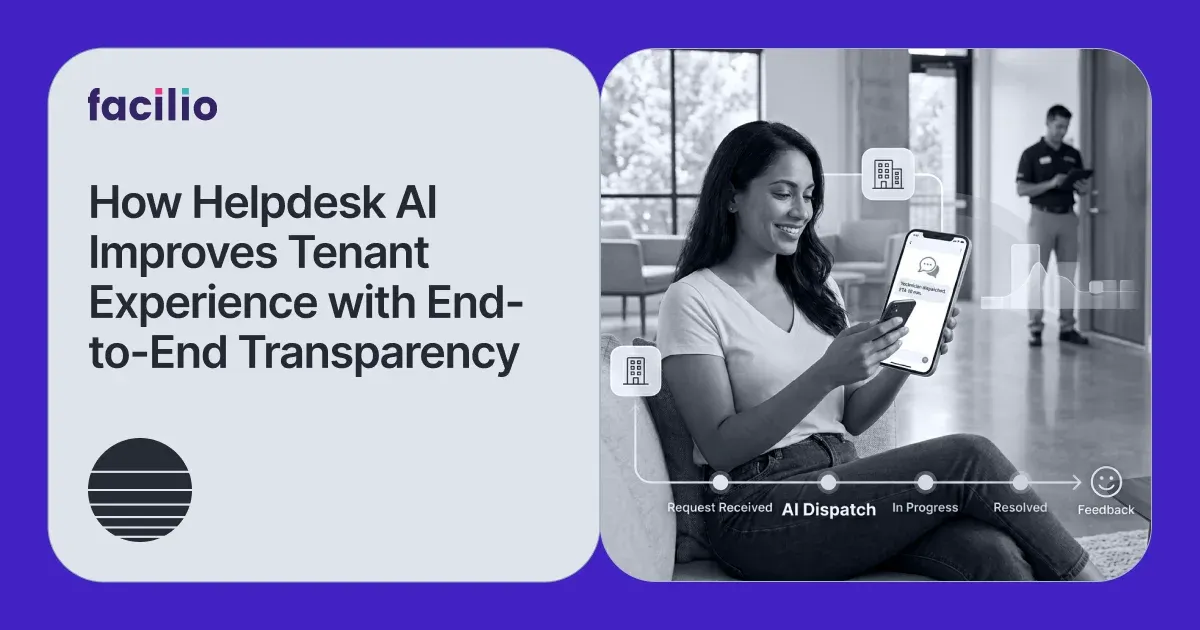

When a facility service request is submitted, most of the work that determines whether a tenant feels well-served happens after intake, not during it.
Acknowledgement, updates, troubleshooting, and confirmation of completion: these steps are rarely automated, consistent, or tracked.
This blog covers what breaks down across each stage, and how AI handles the full loop from first contact to resolution.
Key Takeaways
- Most tenant complaints about FM service are about communication gaps.
- Manual helpdesks mostly treat every contact as a new event. Context rarely carries across channels or shifts.
- AI closes the full loop: acknowledgement, cross-channel context, pre-dispatch troubleshooting, proactive updates, and completion confirmation, without operator involvement.
- Consistent AI intake produces structured data that surfaces recurring asset failures, vendor delays, and staffing gaps before they compound.
- AI agents work on top of any existing CMMS. No migration required.
Why Fast Response Times Do Not Prevent Tenant Complaints
Most FM operations track time to acknowledge, time to dispatch, and time to close. These metrics measure discrete moments, not what the tenant experiences between them.
Fast response and clear communication are two different problems. A technician can arrive within the SLA window while the tenant still has no idea anyone is coming, because nobody told them.
52% of customers describe most service interactions as fragmented, meaning they had to follow up, re-explain, or chase confirmation that something was actually done. Resolving faster does not fix any of that.
When a tenant calls to follow up on an email they sent, the operator handling the call has no visibility of it unless they search manually. Under volume or across shift changes, that search often does not happen, and tenants end up explaining the fault again.
33% of customers are most frustrated by having to repeat themselves across contacts.
None of these experiences results from slow fieldwork. They result from a service loop with gaps: points where communication should happen but does not.
5 Gaps in Every Service Request That Leave Tenants Frustrated
Closing the service loop requires action at five specific points.
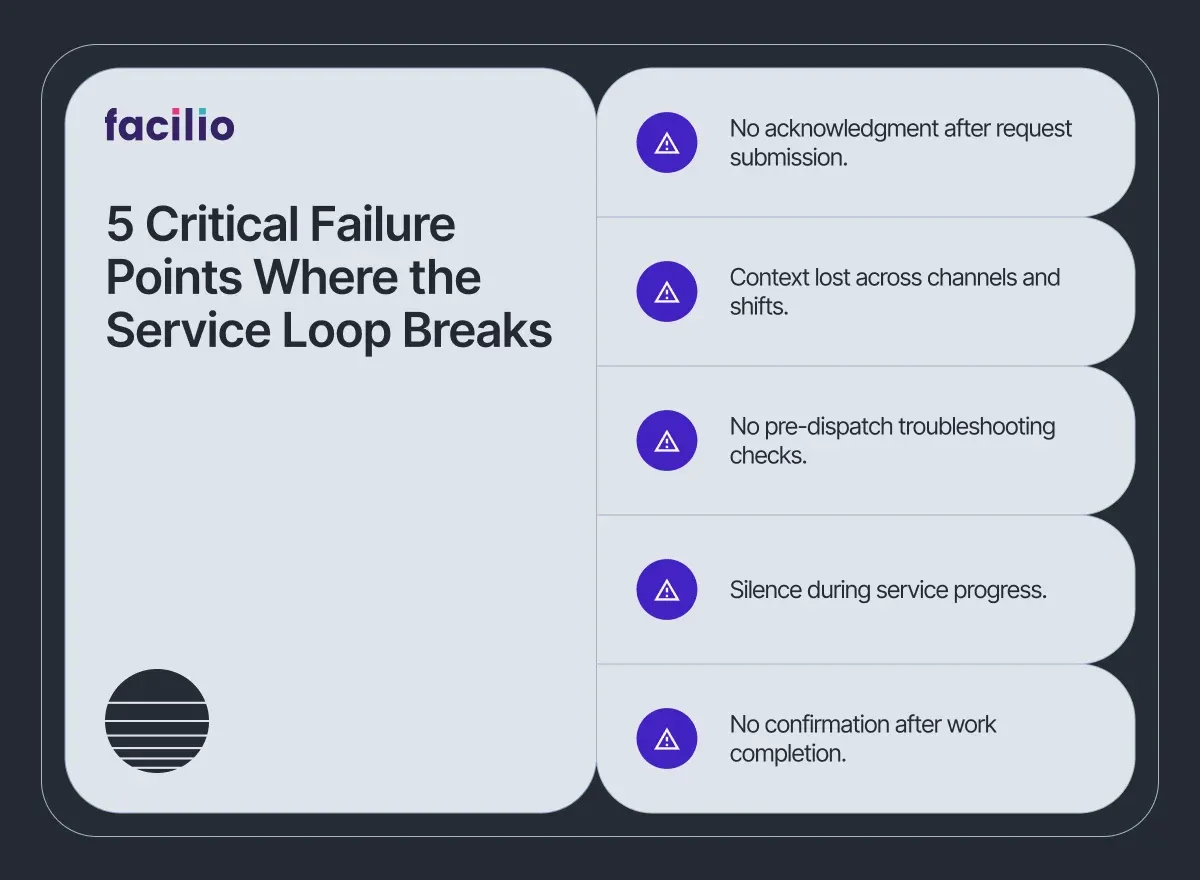
Each one currently depends on a human being available, attentive, and consistent — which is why the loop breaks under volume, across shifts, and across channels.
1. No acknowledgement after the request is submitted
When a request is sent through WhatsApp at 9 PM or raised via the portal during a busy period, it usually just sits in the queue.
Whether it gets acknowledged depends on when someone notices it, so tenants have no confirmation that it was received.
2. Context lost when the tenant contacts a different channel
73% of customers expect to move between channels without repeating themselves. Only 13% of businesses currently deliver this. A phone follow-up on an email-reported fault starts from scratch — different operator, no shared record, same explanation required again.
3. No troubleshooting before dispatch, leading to avoidable visits
When intake does not capture enough detail, dispatch happens by default. Technicians arrive without the right context, or for faults that a pre-check could have resolved without a visit.
4. Silence between intake and resolution, leaving tenants in the dark
Once a request is logged, tenants expect to hear what is happening. When status updates are not built into the workflow, tenants call in for reassurance, which creates a second handling event for the same request and makes the process feel slower than it is.
5. No completion confirmation, the tenant follows up the next day
When work is completed, the tenant should be told clearly and promptly, but that step is not always systematic.
Without a formal closeout message or confirmation, tenants may only learn the issue is resolved by checking back themselves, which can create unnecessary follow-ups and reduce confidence in the service process.
Eliminate communication gaps with an end-to-end AI helpdesk automation.
Explore Helpdesk AIHow Helpdesk AI Closes Each Gap in the Tenant Service Loop
Facilio's helpdesk AI handles the full service loop autonomously, from the moment a request arrives to the moment the work is confirmed complete.
Each of the gaps has a direct fix. Here is what the helpdesk AI does at each point.
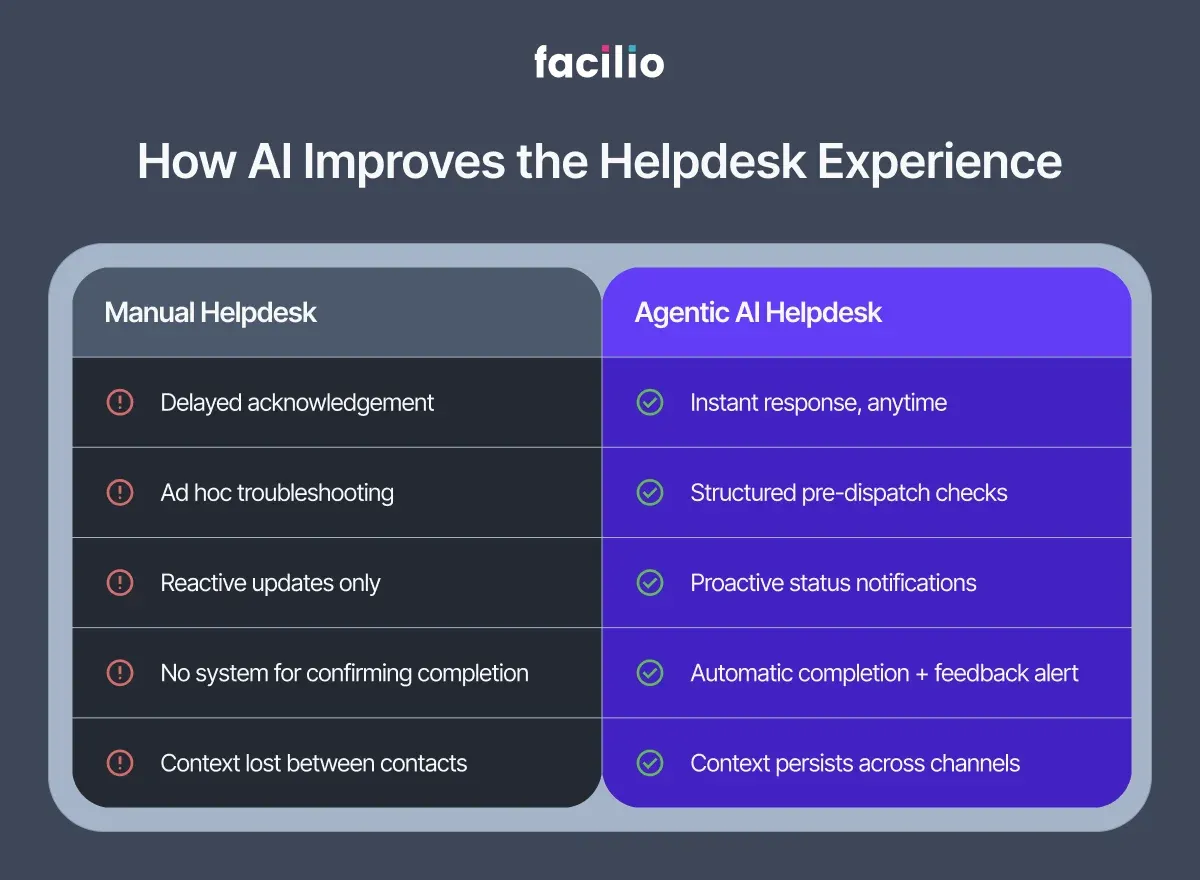
A. Instant Acknowledgement, Urgency Classification, And Context Carryover
- Every request that arrives on any channel is acknowledged instantly on the same channel, at any hour.
- Urgency is classified using defined logic, not operator familiarity or caller tone.
- If this is a follow-up, the existing service record is retrieved automatically and no duplicate work order is created.
B. Automated Work Order Creation With Pre-Dispatch Triage
Before any technician is dispatched, the helpdesk AI runs a guided pre-check with the tenant. Faults that can be resolved remotely are closed on the spot.
Example: Thermostat settings, configuration, power issues: resolved on the spot where possible
If dispatch is needed, the technician arrives knowing what has already been checked
- Pre-check results, asset reference, location, urgency tier, and responsible team are logged automatically into the work order.
- The technician is assigned and notified automatically.
- The tenant receives the technician name and ETA on the channel they used.
C. Proactive Status Updates Throughout Service Request Lifecycle
Updates go out automatically at each stage without operator triggers:
D. Formal closeout with feedback capture
Upon work order closure, tenants receive completion confirmation via their original channel, and feedback is captured for the specific request, asset, and technician.
The entire interaction is logged and linked to the work order for audit and pattern analysis.
Custom language and tone configuration:
Facilio's helpdesk AI operates across English and Arabic with regional accents and tone configurable per site.
Every building gets the language and register its tenants expect, without affecting intake consistency or data quality across the portfolio.
Facilio's helpdesk AI operates across English and Arabic with regional accents and tone configurable per site.
Every building gets the language and register its tenants expect, without affecting intake consistency or data quality across the portfolio.
What Improves for Tenants with an AI Agent at your Helpdesk
AI service intake turns frustration into reliable experiences. The numbers show real results from closing those gaps.
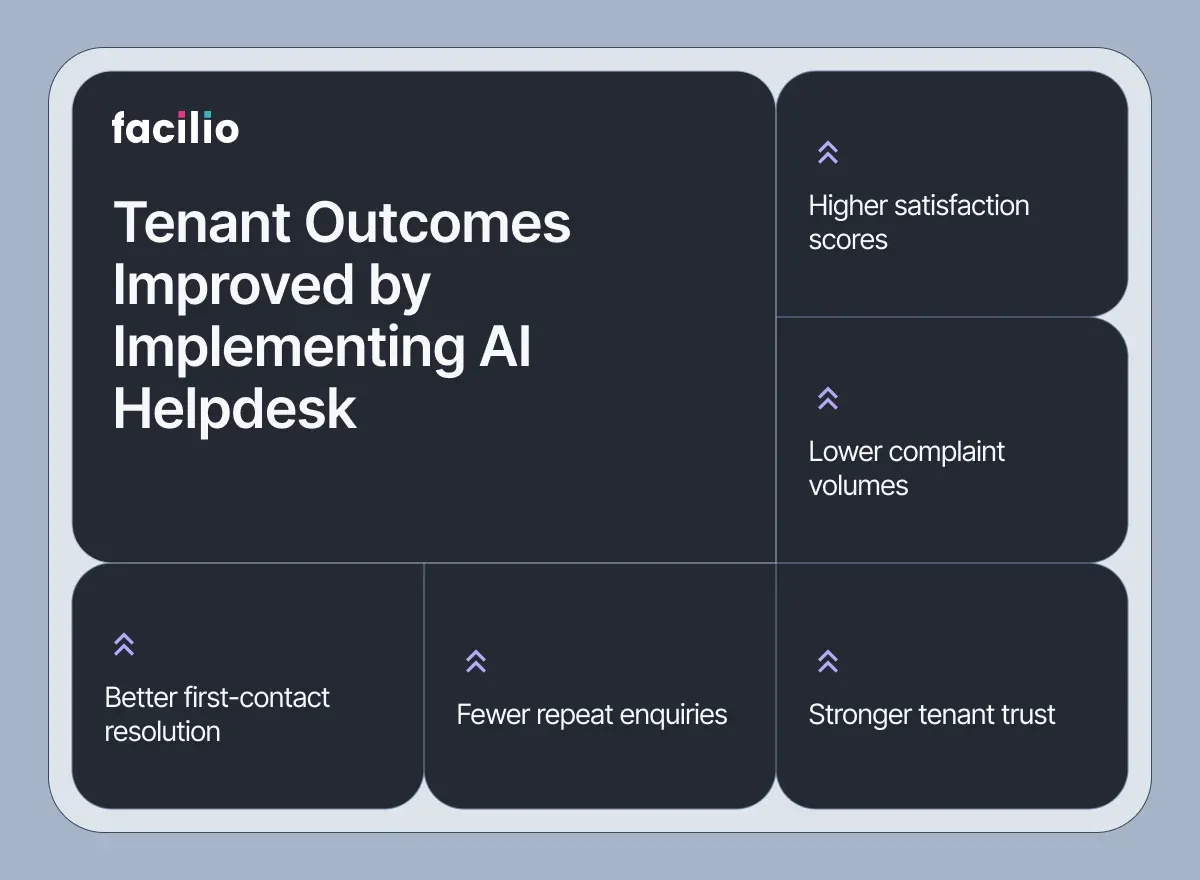
Satisfaction scores improve because tenants are kept informed at every stage, not left guessing between contacts. AI service implementations report a 15% improvement in customer satisfaction scores within the first year.
Complaint volumes drop because tenants stop calling back to check since status updates happen automatically. AI reduces customer churn by 10–15% over 18 months by eliminating the friction that quietly drives disengagement.
First-contact resolution rates rise because pre-dispatch troubleshooting resolves a proportion of requests before a technician is sent. AI delivers a 30% improvement in first-contact resolution rates by handling triage and pre-checks before escalation.
Repeat contacts for the same issue fall because context carries across channels and the service record is never lost between shifts. AI led to a 25% drop in repeat enquiries in one of the largest documented AI service deployments.
Trust in the service operation builds over time because every request, regardless of channel, time, or building, is handled to the same standard. 83% of customers say they are more loyal to organisations that provide consistency across every interaction.
These outcomes compound. Consistent tenant experiences drive retention while operational signals surface from structured data.
Ensure 100% service consistency across every building and shift with AI helpdesk agents.
Explore AI AgentsHow Agentic AI Intake Turns Service Requests into Operational Intelligence
Every service request contains operational signals, but most systems treat this data as isolated tickets.
The same HVAC complaint logged multiple times goes unnoticed. AI agents changes this by consistently categorizing requests (fault types, urgency, asset references), allowing patterns to emerge.
Three types of signals that become visible when intake is structured:
- Recurring complaints at the same asset: When the same fault appears at the same asset across multiple requests, consistent categorisation makes that pattern visible. The team can act before the fourth reactive call, not after.
- Vendor performance gaps: Repeated delays from the same vendor show up in accumulated timestamps. With variable manual logs, that comparison is unreliable. With structured intake, it is automatic.
- Emerging operational risk before escalation: Structured intake data reveals request volume spikes around assets or locations early. Teams can investigate using AI root cause analysis before backlogs or SLA breaches..
This is the direct output of consistent, structured intake where every service event is captured in a form that an AI intelligence layer can use.
How Facilio's Helpdesk AI Connects to Your Existing Channels and CMMS
Facilio's Helpdesk AI pushes work orders directly into the team's existing CMMS in real time.
For teams on Facilio’s Connected CMMS, integration is native.
Facilio’s CMMS software was built as a system of action, not just record-keeping, which means work orders, SLA timers, asset records, and escalation workflows are already structured to receive and act on what the helpdesk AI produces.
For teams on IBM Maximo, Archibus, Yardi, Oracle, SAP, or other platforms, integration runs through Facilio's Connections and Relay architecture, an outbound-only agent that requires no firewall changes or data migration.
Works with the channels/systems already in use
The helpdesk AI connects to existing phone lines via SIP trunking, WhatsApp Business via standard Meta credentials, support email via forwarding configuration, and web portals via a JavaScript snippet.
Configured for every building and every client before go-live
Urgency thresholds, routing logic, SLA parameters, and escalation rules are configured for each building or client account before deployment.
For FM service providers managing multiple accounts, each client's parameters are set independently. The helpdesk AI applies the correct configuration to every request automatically.
Runs in parallel with your current process, no hard cutover
AI implementation in facility management most often stalls at integration, not at the AI itself. Facilio's deployment happens alongside existing processes, typically within weeks of initial setup.
Facility Helpdesk Has Changed. Run It End to End Now with AI Agents.
Facility teams that consistently deliver good tenant experience are not necessarily faster than their peers.
They are more consistent: every request acknowledged, every update sent, every loop closed. That consistency is what AI makes possible at scale, across every channel, every building, every shift.
Facilio's helpdesk AI runs that loop, from first contact to confirmed close, without replacing your existing systems or your team.
See how Facilio's Helpdesk AI closes the full service loop across every building, every channel, every tenant.
See Facilio's AI in Action
FAQs
Do I need to replace my current facility management system to use helpdesk AI?
No, helpdesk AI agents integrate with your existing CMMS or property management software via API. Facilio's helpdesk AI works as an added layer for intake and communication, letting you keep your current systems and channels.
How does AI carry context when a tenant switches communication channels mid-request?
The helpdesk AI identifies open service requests linked to the tenant and location before creating a new record. A follow-up via a different channel retrieves the existing SR and updates the tenant. Context is held at the service record level, not the channel level.
Does AI work for portfolios where tenants speak different languages?
Yes. The helpdesk AI supports English and Arabic, with regional accents and voice tones configurable per site. Language and tone settings are applied per building before go-live. Intake quality and data structure remain consistent across all sites regardless of language.
Can helpdesk AI send automatic updates to tenants without manual input?
Yes, the Helpdesk AI sends updates at key workflow points automatically. Tenants get notifications for acknowledgement, technician assignment, and completion. No operator action is needed.
Can helpdesk AI handle maintenance issues without a technician?
The helpdesk AI can guide tenants through basic troubleshooting steps like resetting breakers or checking appliance error codes. If the issue isn’t resolved, the AI will automatically escalate and assign a technician. This reduces unnecessary site visits and speeds up resolution.
About the Author

More from Facilio