Connected CMMS

 Connected Buildings
 Connected Refrigeration


 Download ebook

 Read case study


 Watch now


 Retail
 Healthcare
 FM Services
 Commercial Portfolios
 Corporate Facilities
 Education
 Data-driven Portfolio Ops
 Facility Management Software
 360° Asset Lifecycle
 Continuous Sustainability

 Blogs
Blogs
 Help docs
 Knowledge Hub
 ROI Calculator
 Ebooks & Guides
 Webinars
 Case studies


 About us
 Newsroom
 Careers
 Contact us
 Partners
 Events


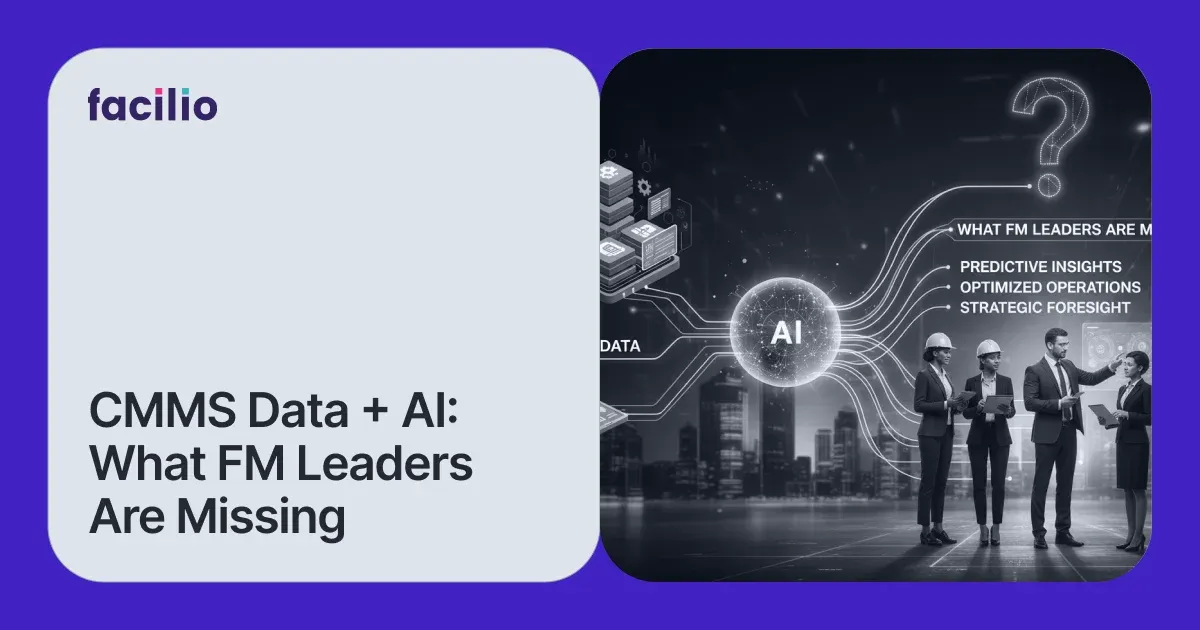

How confident are you, right now, that you know where your portfolio is underperforming?
Most FM leaders will pause at that question. Not because the data doesn't exist — it does, in volume. Work orders, SLA records, asset maintenance logs, vendor response histories. Your CMMS holds months, sometimes years, of operational signal.
The problem isn't data, but how you interpret the data.
That signal sits inside operational systems, unread at the portfolio level, until something forces a review — a budget query, a board question, an SLA dispute that's already escalated.
At that point, a team pulls reports manually, reconciles figures from multiple sources, and assembles a picture that reflects where things stood two or three weeks ago. Decisions get made on that picture. Budgets get set. Vendor contracts get renewed.
And the risks that were already visible in the operational data — the SLA drift, the recurring asset failures, the maintenance backlog building quietly across three sites — stay invisible a little longer.
The question isn't whether your CMMS platform contains the answer. It almost certainly does.
The question is whether anyone is reading it.
What Is Your CMMS Actually Recording Every Single Day?
The common assumption is that FM organisations lack data. The reality is almost always the opposite.
Your CMMS generates a structured operational record every day across six distinct data categories:
- Work order history — what broke, when, and how often
- PPM completion — planned vs. actual, by site and asset
- Asset lifecycle records — fault history, service intervals
- Vendor performance — SLA adherence, response times
- Inspection outcomes — defects, remediation, compliance status
- SLA compliance rates — by site, contractor, and service type
In a ten-building portfolio, this amounts to thousands of monthly data points. They contain:
- Maintenance cost variance — visible in reactive spend trends before budget reviews flag it
- Asset failure probability — readable from fault code repetition and service cycle gaps
- Vendor reliability trajectory — trackable from SLA adherence patterns across rolling periods
So clearly, the gap isn't data. The gap is that no one at portfolio level is reading it continuously and by the time someone does, the window to act has usually closed.
 Abirami N
Why Does FM Reporting Break Down Across Multi-Site Portfolios?
The reporting process that works at two sites stops working at ten. Not because the process is wrong, but because it was never designed for this volume.
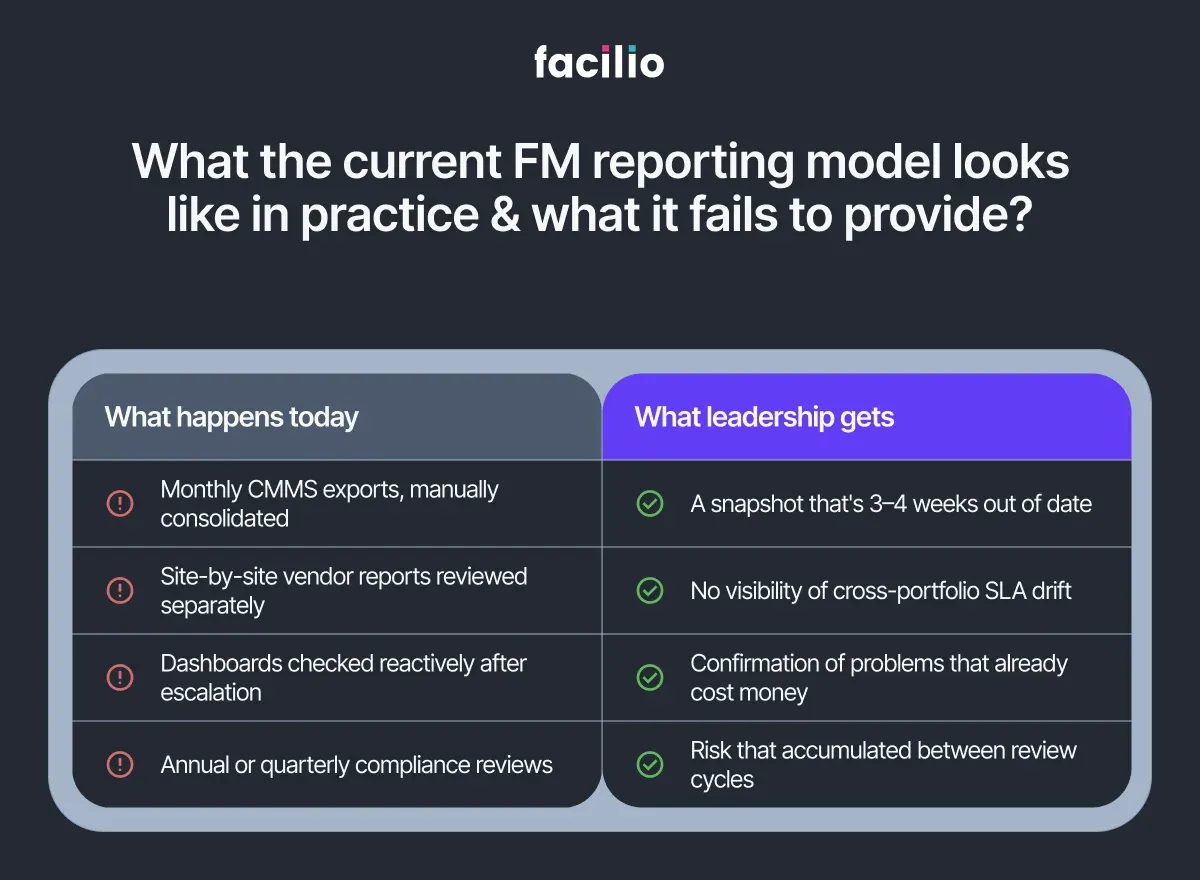
Most FM reporting today follows the same sequence: data exported from the CMMS, consolidated in spreadsheets, reviewed in periodic meetings, surfaced to leadership in a slide deck or summary report. At each step, time passes and detail is lost.
Three ways scale breaks the model:
- Analyst capacity doesn't grow with the portfolio — the same team is processing more data, more slowly, with more room for error
- Site-level reporting hides cross-portfolio patterns — a vendor underperforming across four buildings looks fine in any individual site report
- Monthly cycles create a structural lag — leadership is always making decisions on last month's picture, not this week's operational reality
The result is a reporting model that produces confidence in a picture that's already out of date and leaves the real performance signals sitting unread in the CMMS.
That's the problem the next generation of FM intelligence is built to solve.
See how OpsVision reads your operational record in real time.
Explore OpsVision NowHow Does AI Turn Raw CMMS Data Into Portfolio Intelligence?
The answer to the FM data gap isn't a new system. It's a layer that continuously reads the system you already have.
That's the premise behind AI portfolio intelligence for facilities management and specifically behind OpsVision, Facilio's operational analytics layer.
Rather than replacing your CMMS or requiring an ERP migration, it sits on top of the operational data already being generated and does what no analyst team has the capacity to do: read it continuously, across every site, every week.
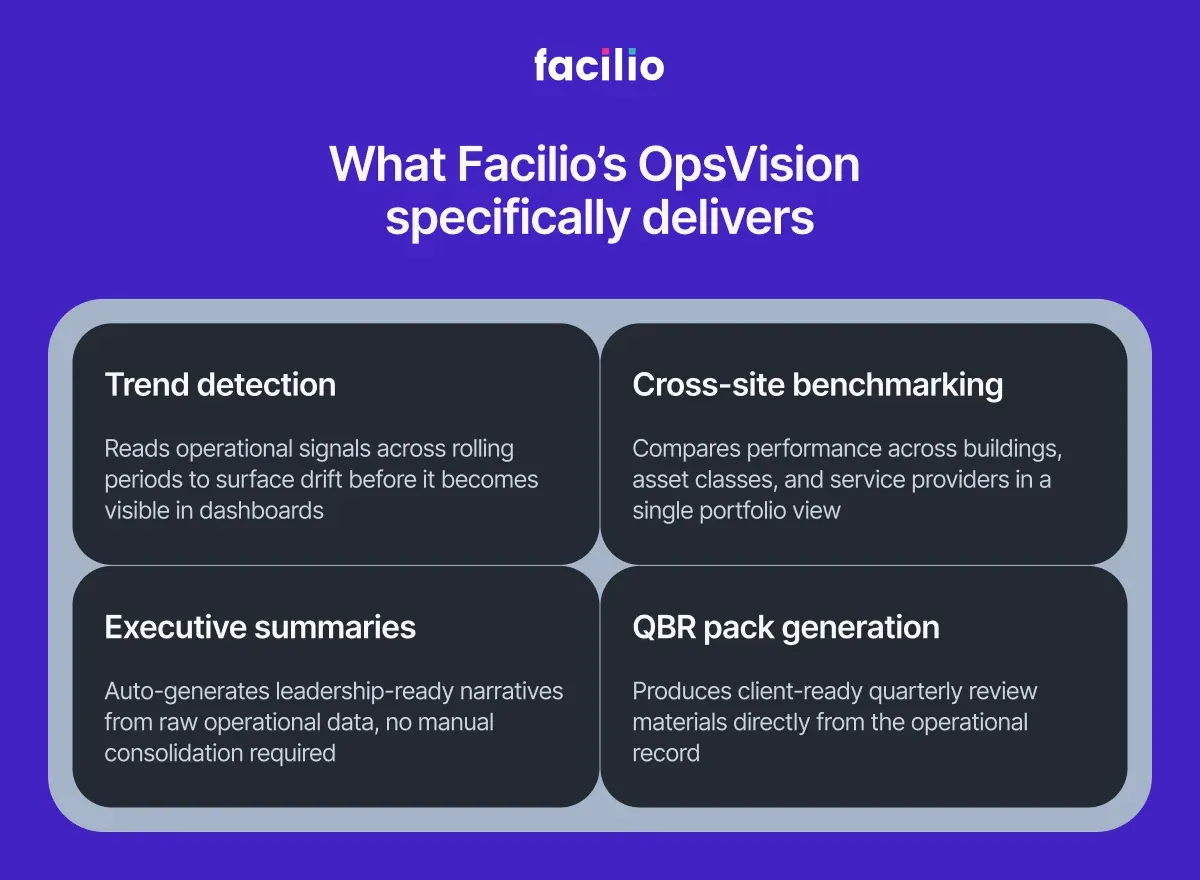
What changes when AI reads the operational record
- Anomalies surface automatically — a maintenance backlog building on a specific asset class flags before it becomes a reactive spend spike
- Recurring issues get identified before escalation — repeated fault codes across sites are clustered and surfaced as a pattern, not buried in individual work orders
- SLA risk becomes visible weeks in advance — not after a breach has already occurred and triggered a penalty conversation
- Cross-site performance is benchmarked continuously — leadership sees which buildings are drifting and which vendors are underdelivering, in the same view
The operational data is already there. OpsVision is the layer that finally reads it.
What Can FM Leaders Actually Do With Continuous AI Intelligence?
When the operational record is being read continuously, the nature of FM leadership decisions changes. Not incrementally, but structurally.
Leadership is no longer investigating what went wrong. It's acting on what is about to go wrong — weeks before it becomes a cost, a penalty, or a board conversation.
What executives can do with continuous portfolio intelligence
- Forecast maintenance budget variance — reactive spend trends and PPM completion rates give finance teams early warning of budget pressure before the quarter closes
- Identify underperforming assets before capex decisions — fault frequency and service cycle data reveal which assets are approaching end-of-life, informing capital allocation rather than reacting to failure
- Benchmark vendor performance across the portfolio — SLA adherence, response times, and repeat callout rates are visible across all contractors simultaneously, not one contract review at a time
- Detect compliance risk before audit cycles — inspection outcomes and remediation status are tracked continuously, so gaps don't accumulate between review periods
This is what the shift from reactive to proactive FM leadership looks like in practice; this is not a technology project, but a change in what leadership knows, and when.
The data your CMMS generates every day already contains the answer to most portfolio risk questions. The gap has never been collection — it's been interpretation, at scale, continuously.
AI closes that gap without replacing a single system your operations team relies on.
Find out what your portfolio data has been trying to tell you.
Talk to usIs Your CMMS Already Sitting on the Answer And No One Is Reading It?
Static reports. Delayed decisions. SLA risk that was visible in the data weeks before it became a penalty. These aren't inevitable features of FM at scale — they're symptoms of an intelligence gap that AI closes without replacing a single system your team relies on.
Already on Facilio? OpsVision and our AI copilot for facilities management activate directly within your existing platform. activates directly within your existing platform. Your operational data is already there. Portfolio intelligence is the next layer, not a new project.
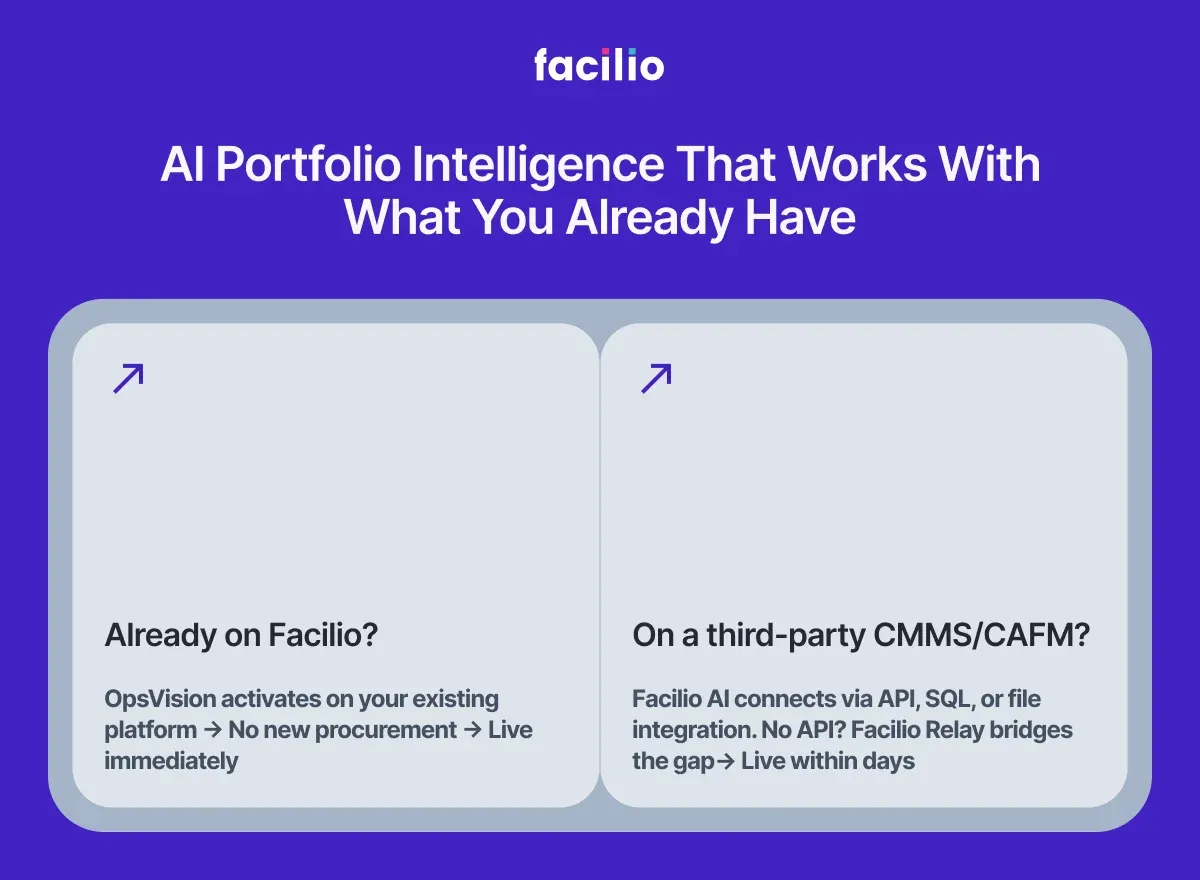
Running Maximo, Archibus, FSI, MRI, or another CMMS?
Facilio's AI agents connect on top as a standalone layer — via API connectors, SQL integrations, or file-based pipelines. And for on-premise systems with no API, Facilio Relay bridges the gap without exposing your infrastructure. Most organisations go live within days.
Either way: cross-site benchmarking, SLA drift detection, and auto-generated executive summaries — all reading the data your CMMS is already generating.
Your data is ready. Is your organisation?
Deploy OpsVision on Your CMMS.
Frequently asked questions
1. Does AI for FM analytics require replacing our existing CMMS?
No. AI portfolio intelligence layers on top of your existing CMMS, CAFM, or legacy FM platform. It reads the operational data already being generated — work orders, SLA records, asset history — without requiring system migration, ERP integration, or any changes to your current workflows. Most deployments are live within days.
2. What operational data does AI actually need to generate executive insight?
The data your CMMS already contains: work order history, PPM completion rates, SLA compliance records, asset fault codes, vendor response times, and inspection outcomes. No new data collection is required. AI reads what facilities operations generate as a matter of course and interprets it at a portfolio level that manual reporting cannot match.
3. How long does it take to see portfolio-level intelligence after deployment?
Most organisations see initial portfolio-level outputs within days of connecting the AI layer to their operational data source. Anomaly flags, SLA risk signals, and executive summaries are immediate. Trend detection and cross-site benchmarking sharpen over rolling periods as pattern recognition builds across a longer operational history.
4. Can AI detect SLA risk before a breach occurs?
Yes. By reading SLA compliance trends continuously, AI identifies deteriorating performance patterns weeks before they result in a breach. Leadership sees the specific sites, asset classes, and vendors driving the risk, while there is still time to intervene.
About the Author

More from Facilio