Connected CMMS

 Connected Buildings
 Connected Refrigeration


 Download ebook

 Read case study


 Watch now


 Retail
 Healthcare
 FM Services
 Commercial Portfolios
 Corporate Facilities
 Education
 Data-driven Portfolio Ops
 Facility Management Software
 360° Asset Lifecycle
 Continuous Sustainability

 Blogs
Blogs
 Help docs
 Knowledge Hub
 ROI Calculator
 Ebooks & Guides
 Webinars
 Case studies


 About us
 Newsroom
 Careers
 Contact us
 Partners
 Events



Recurring breakdowns are not bad luck. They are a pattern and the evidence has been sitting in your work order data all along.
Every reactive callout generates data.
A work order is raised. A fault is described. A vendor is assigned. Parts are ordered. A closure note is added — sometimes detailed, sometimes three words.
Across a 20-building portfolio, this happens hundreds of times a month. And almost none of it is ever read together.
The maintenance history for a single asset typically lives across multiple places:
- PPM logs from a vendor you replaced two years ago
- Reactive ticket history in your current CMMS
- Parts replacement records in a spreadsheet someone updates quarterly
- Closure notes written by three different technicians who never compared findings
The root cause of a recurring failure is almost always visible in that data. The problem is that no team has the bandwidth to read it all at once — across every asset, every building, every week.
That's the gap. Not missing data. But, missing analysis.
And that's exactly the gap AI is built to close.
Why recurring failures are a data problem, not a maintenance problem
Every reactive callout generates data. But here's the problem — it never lands in one place.
Maintenance records sit in your CMMS. Vendor notes live in emails and PDFs. Work order closure notes are half-complete. The service history for a single asset is split across multiple technicians and contractors who never compared findings.
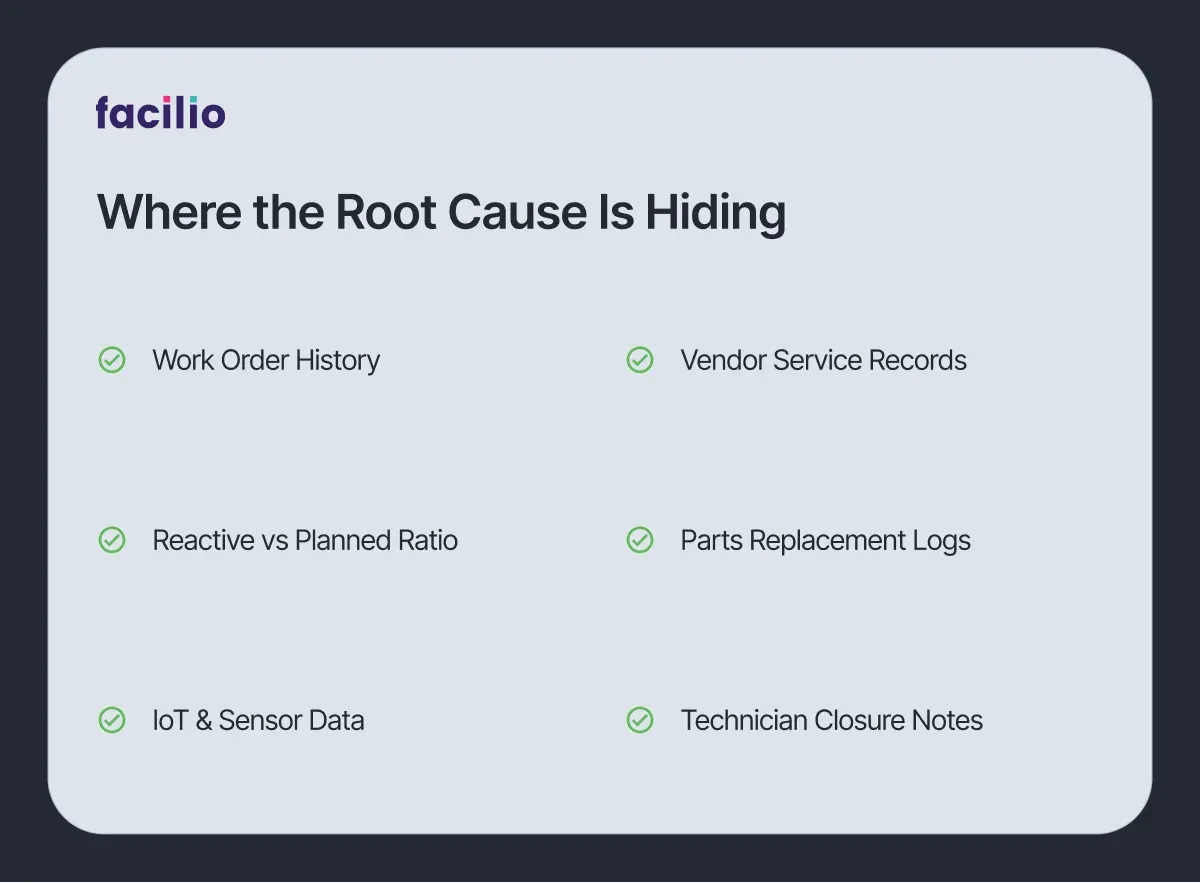
The root cause evidence is almost always present across these six sources:
- Work order history going back 12 to 24 months
- Vendor service records and closure notes
- Reactive vs planned maintenance ratio trends
- Parts replacement history and lead times
- Environmental and IoT sensor logs
- Technician notes and escalation records
Most FM teams capture all of this. Almost none analyze it together. And that gap — between data captured and data understood — is exactly where recurring failures live.
That's the problem AI is built to solve.
What can AI see in your CMMS data that your team can't?
Artificial intelligence does not need to read every record manually. It does something more valuable: it reads all of them simultaneously, identifies statistically significant patterns, and surfaces the most likely driver of a problem — before the next failure occurs.
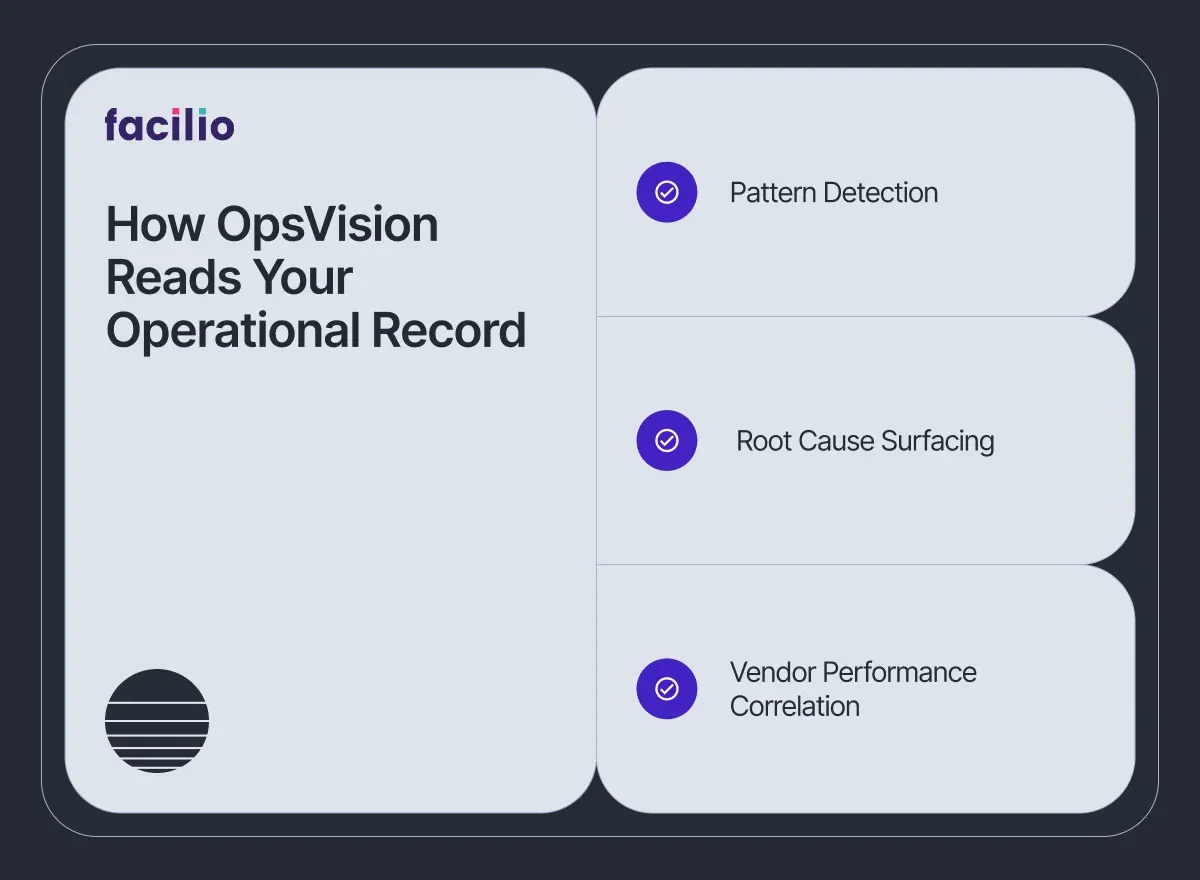
Applied to facilities maintenance data, AI operates across three distinct analytical layers:
1. Pattern detection across fragmented records
AI reads work order history across months and multiple vendors, identifying clusters of related failures even when technicians recorded them with different descriptions or fault codes.
A chiller that generated six reactive tickets described as 'compressor fault,' 'cooling performance issue,' 'temperature deviation,' 'refrigerant low,' 'fan motor warning,' and 'system reset' is not six different problems. It is one recurring failure with six different labels. AI groups them.
2. Root cause surfacing before the next failure
By analyzing the sequence of events before each failure — prior repairs, vendor assigned, parts used, time elapsed since last planned maintenance — AI identifies the most likely systemic driver. It might be a persistent refrigerant leak that successive vendors patched rather than resolved. It might be a PPM interval that is too long for the actual duty cycle of the asset.
It might be a parts supplier delivering components that fail prematurely. AI does not guess: it calculates which explanation best fits all available evidence.
3. Vendor performance correlation at scale
AI cross-references asset failure patterns with the contractors who last serviced them.
Across a large portfolio, patterns emerge that no individual manager would catch: one vendor whose repairs on HVAC units have a 30-day failure recurrence rate three times higher than other contractors; one building where reactive tickets spike consistently in the six weeks following a specific vendor's quarterly visit. These are governance signals, and they are invisible without AI.
See how OpsVision reads your maintenance data and gives back real-time insights.
Explore OpsVision NowSee how Mira standardises service intake across every client, channel, and shift.
Explore Mira NowWhat does AI-powered root cause analysis actually look like in FM operations?
Consider a facilities team managing 15 commercial buildings across two cities. Reactive work orders for HVAC equipment in three specific buildings are running at twice the portfolio average. Nobody knows why.
Before AI: One engineer spends two days pulling work order history, cross-referencing invoices, calling technicians.
The conclusion: the units are old.
Recommendation: raise a capex request.
After OpsVision: The same data is analyzed in minutes. All three buildings share the same HVAC sub-contractor. The reactive spike began six months ago — shortly after that contractor changed their service team.
The same pattern, at lower intensity, is already visible in two additional buildings.
This isn't an asset age problem. It's a vendor quality problem.
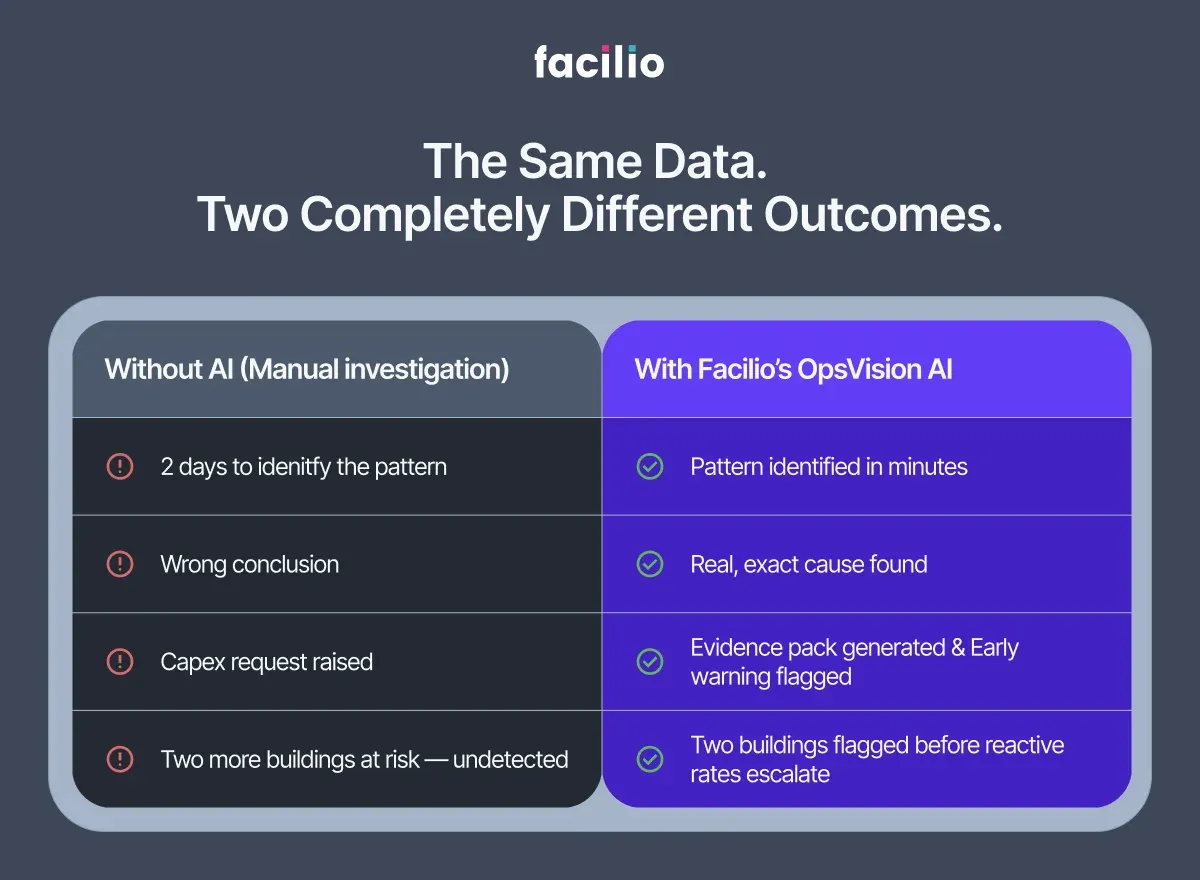
The output is specific and actionable:
- An account health score for that vendor, showing performance drift across the portfolio
- A comparison of reactive rates before and after the team change
- A structured evidence pack for the performance conversation with the contractor
- An early warning flag for the two buildings before their rates escalate
The operations director doesn't need to investigate. They need to act — and OpsVision has made the right action obvious.
That shift — from chasing the problem to addressing its root cause — is where the real operational and financial impact starts to show.
Your next recurring failure is already in your data.
Let OpsVision find itHow much does recurring failure cost and what happens when AI stops it?
Addressing root causes rather than symptoms has a compounding effect on FM operations. The reactive queue shrinks. Vendor conversations shift from defensive to evidence-based. And leadership stops hearing about the same asset in every weekly meeting.
Facilio customers applying AI-powered operational intelligence to asset performance data have reported:
- Up to 40% reduction in unplanned downtime when systemic failure patterns are identified and addressed at the root cause
- 30 to 40% reduction in reactive work order volume as pattern-based maintenance replaces reactive dispatch cycles
- Near-zero missed SLA incidents when AI monitors asset risk signals continuously rather than relying on manual reporting
There's a governance dimension too. When insurers or auditors ask why the same asset failed repeatedly, an AI-generated evidence trail answers the question clearly — before it becomes a liability.
OpsVision layers onto any existing CMMS or CaFM. No system replacement, no migration. Most deployments go live within days of connection — with meaningful asset patterns surfacing in the first week.
How do Facilio's AI agents take you from failure pattern to resolved?
Most tools stop at the insight. Facilio's AI agents take it further and they work whether you're already on Facilio or running a third-party CMMS.
OpsVision continuously reads your operational data to surface recurring failure patterns, vendor performance drift, and asset risk signals — before they escalate.
FM Copilot puts that intelligence to work at the point of action — giving technicians instant access to asset history, repair context, and SOPs without switching systems.
And when leadership needs answers, OpsVision's board reporting delivers executive-ready summaries automatically — no manual consolidation, no day spent building slides.
Already on Facilio? These agents are built directly into your existing platform — no additional setup, no new systems to learn.
On Maximo, Archibus, Planon, or another CMMS? Facilio's AI agents connect via secure API and act as an intelligence layer on top of your existing stack. No rip and replace. No migration. Just the analytical capability your current system doesn't have.
Recurring failures aren't inevitable.
But with Facilio's OpsVision AI, they become the exception — detected early, resolved at the root cause, and reported with confidence.
Your maintenance data already holds the answer. OpsVision finds it.
See Opsvision in action.
What Do FM Teams Ask Before Deploying an AI Agent?
1. Can AI identify recurring equipment failures without replacing my existing CMMS?
Yes. AI tools like OpsVision connect to existing CMMS platforms via secure API and analyze the data your team already generates — work orders, service logs, vendor records, asset histories — without requiring system replacement or data migration. This is an overlay, not a replacement.
2. What data does AI need to trace maintenance history effectively?
Work order history, vendor service records, reactive versus planned maintenance ratios, parts replacement logs, and technician closure notes. Most FM teams already capture all of this data. The challenge is not capturing it — it is analyzing it together across time, assets, and vendors. AI does that analysis continuously.
3. How long before AI surfaces meaningful patterns from existing maintenance data?
Typically within days of initial data connection. Patterns in recurring failures are often visible almost immediately once historical work order data is ingested and cross-referenced. Unlike traditional BI tools that require manual query configuration, OpsVision surfaces patterns automatically without requiring the team to know what to look for.
4. Is AI root cause analysis different from predictive maintenance?
Yes, though the two are related. Predictive maintenance forecasts future failures based on current condition signals — sensor data, vibration readings, runtime hours. Root cause analysis using maintenance history explains why past failures repeated — a distinct and often more actionable starting point, particularly for assets where IoT sensor data is limited or unavailable.
5. Can this work across multiple buildings and multiple vendors simultaneously?
Yes. Portfolio-scale pattern detection is one of AI's strongest applications in facilities management. OpsVision analyzes asset performance, vendor behavior, and failure patterns across an entire portfolio simultaneously — identifying which buildings, assets, or contractors generate disproportionate reactive workload, regardless of how many sites, vendors, or CMMS systems are involved.
About the Author

More from Facilio