 Connected CMMS

 Connected Buildings
 Connected Refrigeration


 Download ebook

 Read case study


 Watch now


 Retail
 Healthcare
 FM Services
 Commercial Portfolios
 Corporate Facilities
 Education
 Data-driven Portfolio Ops
 Facility Management Software
 360° Asset Lifecycle
 Continuous Sustainability

 Blogs
Blogs
 Help docs
 Knowledge Hub
 ROI Calculator
 Ebooks & Guides
 Webinars
 Videos
 Case studies


 About us
 Newsroom
 Careers
 Contact us
 Partners
 Events



The air handling unit on Level 4 failed on a Tuesday morning. Tenants called within the hour. Emergency contractor rates. Two days of disruption. A building manager buried in complaints.
What nobody saw until afterward, three reactive tickets on that same unit over the previous six weeks. A pattern sitting inside the CMMS, unread.
The team wasn't negligent. They were busy. Pattern recognition across hundreds of assets and thousands of work orders isn't something any FM team can do manually, not at scale, not consistently.
This is the default state of most FM operations. Reactive by design, data-rich by accident, one step behind the next failure.
The signals were there. They just weren't being read and that gap has a measurable cost.
Why Is Reactive FM Quietly Draining Your FM Budget?
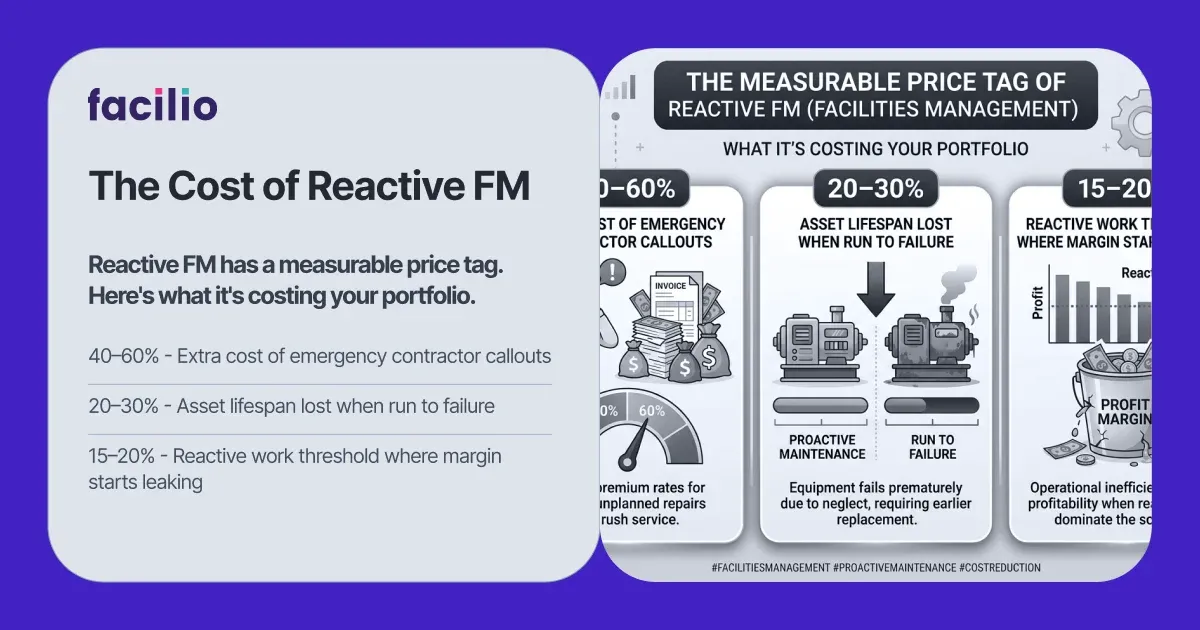
Emergency contractor callouts typically run 40–60% above standard rates. A single unplanned HVAC failure in a commercial building can cost $3,000–$8,000 in reactive repair, lost productivity, and tenant management time — before any SLA penalty is calculated.
And penalties do get calculated. Most FM contracts carry SLA clauses that trigger financial deductions for response or resolution breaches. A portfolio running 15–20% reactive work above its planned baseline isn't just operationally stretched — it's quietly leaking margin on every overrun.
The hidden costs stack up across four areas:
- Emergency response overhead — reactive callouts cost 40–60% more than planned interventions, every time
- SLA penalties — response and resolution breaches trigger financial deductions that compound across a large portfolio
- Accelerated asset replacement — equipment run to failure loses an estimated 20–30% of serviceable lifespan, moving capital replacement conversations years forward
- Leadership time — a single major tenant escalation or compliance breach can consume a full day of a building manager's week; across a multi-site portfolio, this becomes a structural drag on senior capacity
None of this is unusual. It's the normal operating condition of FM teams that are staffed to respond, not to anticipate.
The underlying problem isn't effort or intent. It's information — specifically, the inability to read what work order data is already signalling before the failure, the penalty, or the call.
That data exists. Here's what it actually contains.
Why Are FM Teams Data-Rich But Insight-Poor?
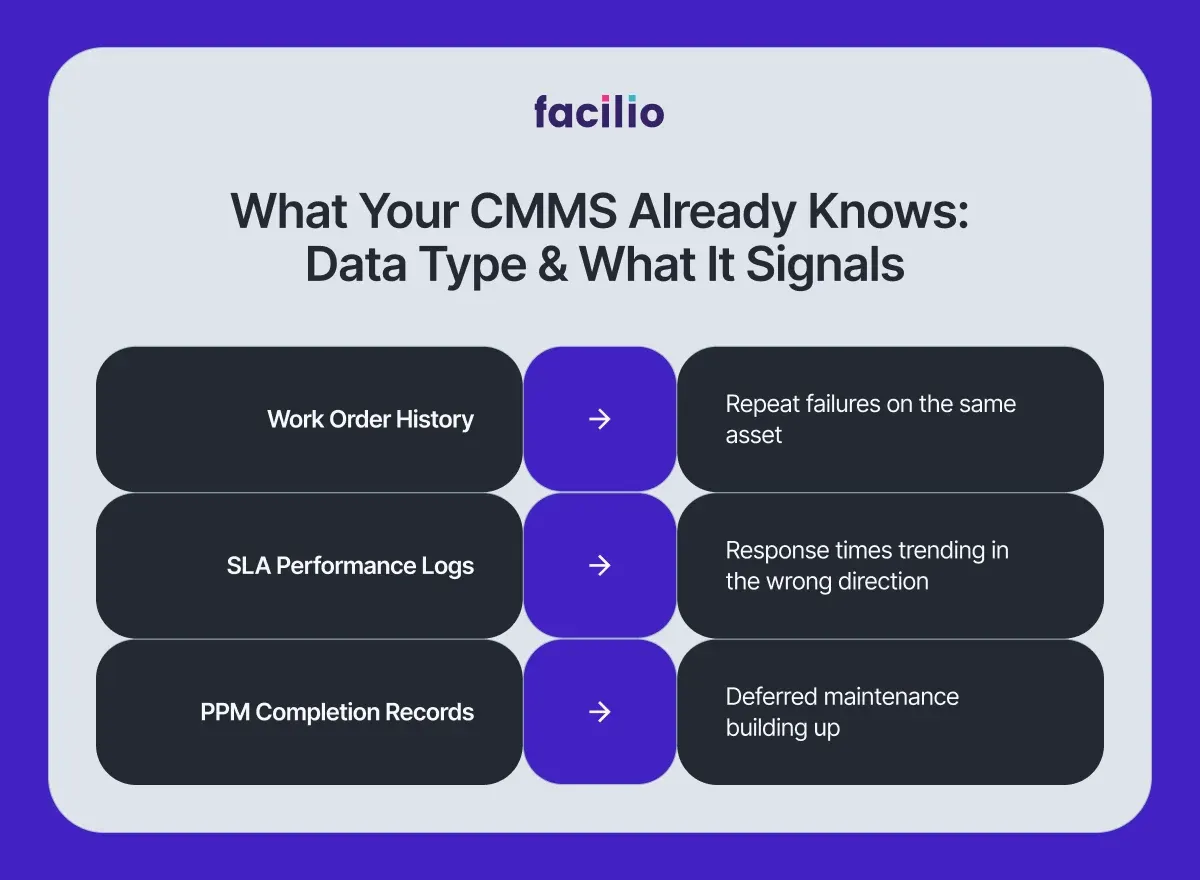
Most FM teams aren't short on data. A mid-sized commercial portfolio running 10–15 buildings generates thousands of work orders a year. Every reactive ticket, every planned maintenance cycle, every SLA record and technician note is logged, timestamped, and sitting in the CMMS.
The data problem in FM isn't scarcity. It's volume and fragmentation.
Consider what a typical building operation produces across a 90-day window:
- Work order history — reactive and planned, with timestamps, asset tags, and closure notes
- SLA performance records — response times, resolution times, breach flags, and exception logs
- Maintenance cycle data — PPM completions, deferrals, skip patterns, and inspection outcomes
- Technician notes — unstructured but often containing the earliest human signal that something is wrong
Each of these data streams holds patterns. An asset that's been reactively attended three times in eight weeks. An SLA response time that's been creeping upward, site by site, over a quarter. A maintenance cycle that's been deferred twice running on the same piece of critical plant.
Individually, these look like routine operational activity. Together, they form a risk signal, but only if someone is reading across all of them simultaneously, continuously, and at scale.
That's where the gap is. Not in the data. In the capacity to find patterns within it before those patterns become failures.
That's precisely what AI was built to do and what the next generation of FM operations is already putting to work.
Find out what your CMMS data is already signalling.
Talk to UsHow Does AI Turn CMMS Patterns Into Operational Risk Signals?
Knowing that patterns exist inside your operational data is one thing. Reading them continuously, across every asset and every site, without adding headcount — that's a different capability entirely.
This is what operational intelligence means in practice. Not a dashboard showing last month's performance. Not a weekly report surfacing exceptions after the fact. A continuous layer that reads your CMMS data in the background and flags risk while there's still time to act.
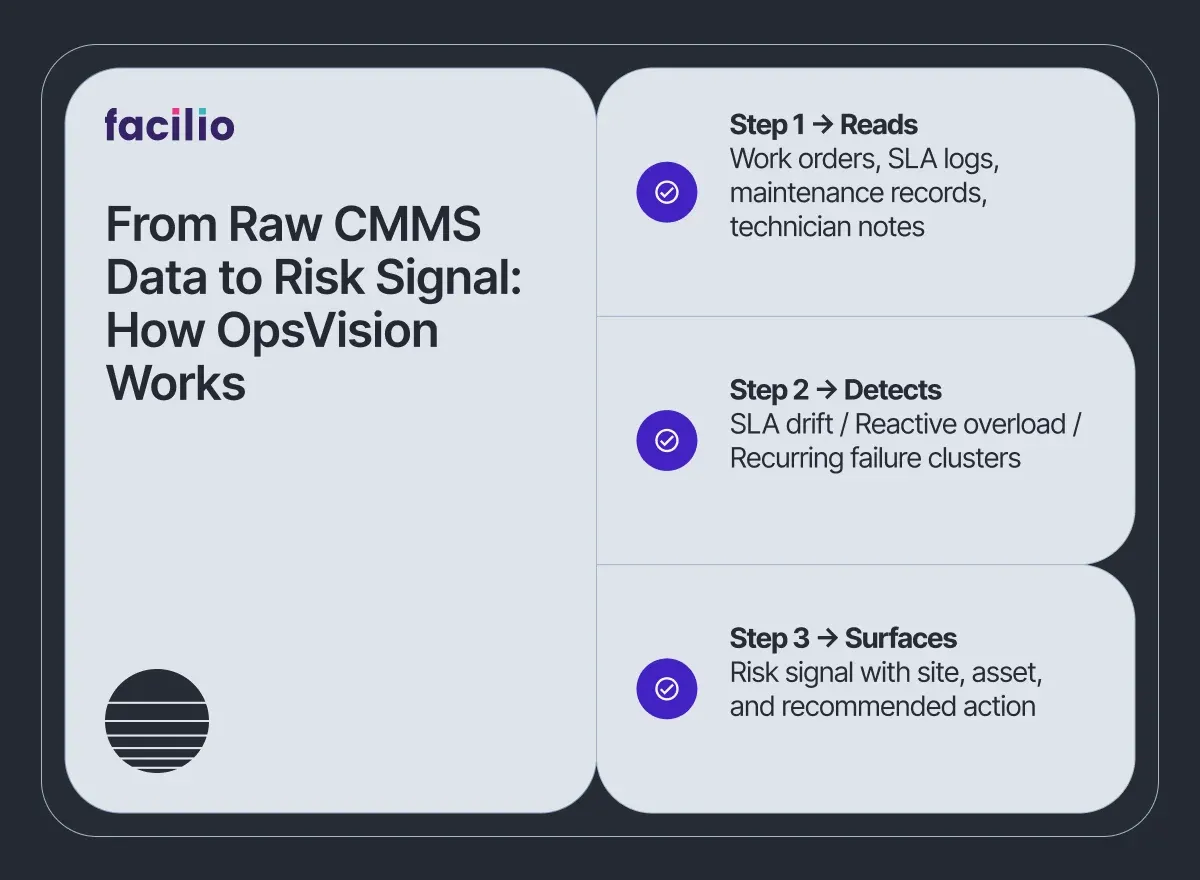
Facilio's OpsVision does this across three dimensions that matter most to FM operations:
- SLA drift detection — tracks the directional movement of response and resolution times, identifying sites where SLA compliance is deteriorating before a formal breach is recorded
- Reactive-to-planned ratio tracking — monitors the shift from planned to reactive work continuously, surfacing the imbalance before it overwhelms the maintenance schedule
- Recurring failure clustering — groups repeat asset failures and fault patterns across sites automatically, turning unconnected tickets into structured risk signals
The difference between this and manual reporting isn't just speed. It's consistency. Reporting cycles run monthly. OpsVision runs continuously and it doesn't miss a pattern because the team had a busy week.
See how OpsVision detects SLA drift before it becomes a breach.
Explore OpsVision NowWhat Can FM Leaders See Earlier and What Changes When They Do?
For FM leaders, the value of operational intelligence isn't technical. It's the ability to walk into a leadership meeting with a clear picture of where the portfolio stands, not where it stood four weeks ago.
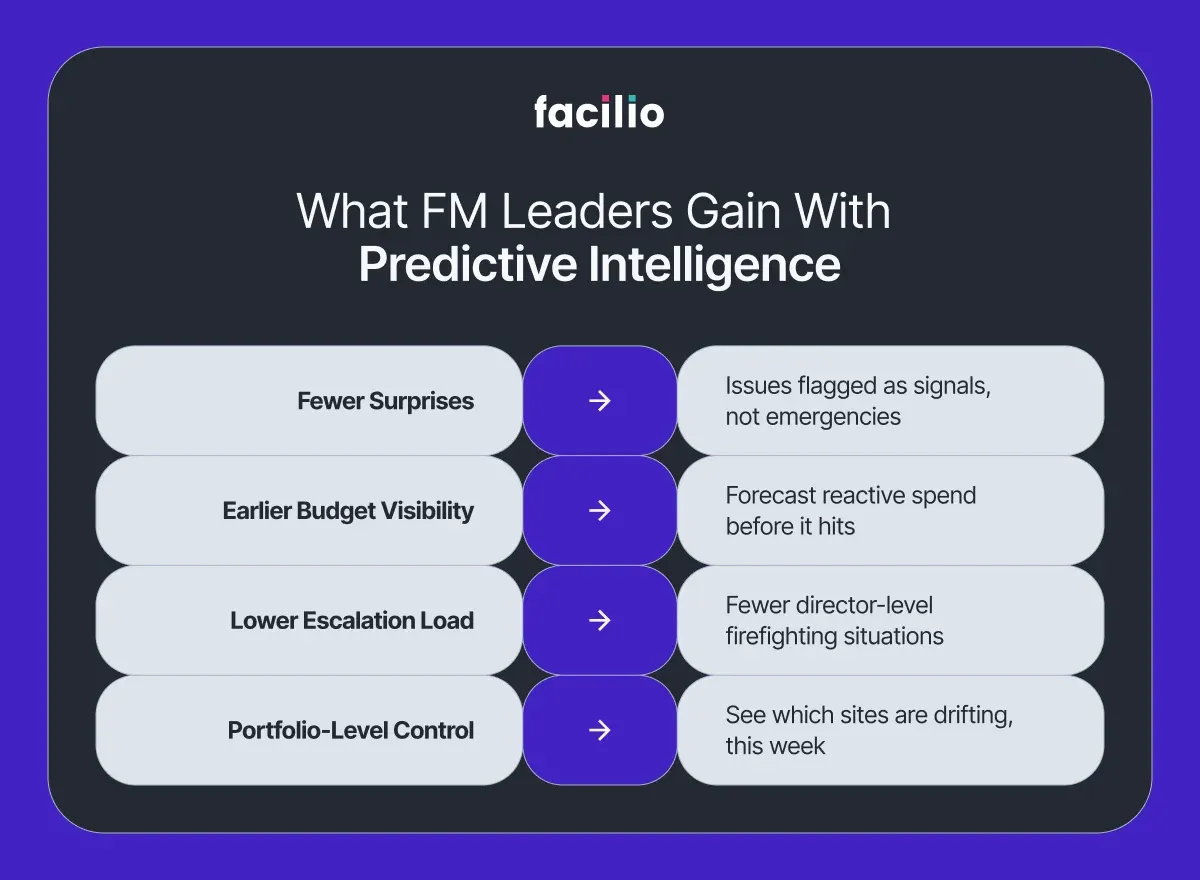
Here's what that looks like in practice across a multi-site operation:
- Fewer operational surprises — asset failures, SLA breaches, and contractor performance issues surface as early signals rather than emergency escalations; leadership stops being the last to know
- Earlier budget visibility — reactive maintenance spend is one of the hardest costs to forecast; when OpsVision identifies assets trending toward failure, capital and maintenance budgets can be adjusted before the cost hits
- Reduced escalation load — a significant portion of senior FM time is consumed by issues that were predictable in hindsight; earlier signal means fewer tenant complaints, fewer contractor disputes, and fewer situations that require director-level intervention
- Portfolio-level control — rather than managing site by site, leadership gains a consolidated view of where risk is building across the entire portfolio, which sites are drifting, and where attention needs to go this week rather than next month
The shift isn't from reactive to perfect. It's from reactive to informed. FM leaders who have this visibility make better resourcing decisions, have more defensible conversations with boards and investors, and spend less time managing consequences.
The question is whether the systems already in place can deliver it, without replacing what's working.
Do You Need to Replace Your CMMS to Get Predictive FM Insights?
Facilio’s OpsVision doesn't require a platform replacement.
If you're already running Facilio's Connected CMMS, OpsVision is built directly on top of your existing platform. Your work order history, SLA records, PPM data, and asset logs are already structured and accessible. There's no integration project, no data migration, and no additional setup overhead. The intelligence layer activates on the operational record you've already built.
If you're running a third-party CMMS — Maximo, Archibus, FSI, MRI, Planon, or a legacy system — Facilio's AI agents work as a standalone intelligence layer on top of your existing infrastructure. Through Facilio Relay, a lightweight on-premise bridge, OpsVision connects to your current platform without requiring an API or a system replacement. It reads what's already there and surfaces the risk signals your current reporting cycle is missing.
In both cases, most deployments are live within 3–7 days.
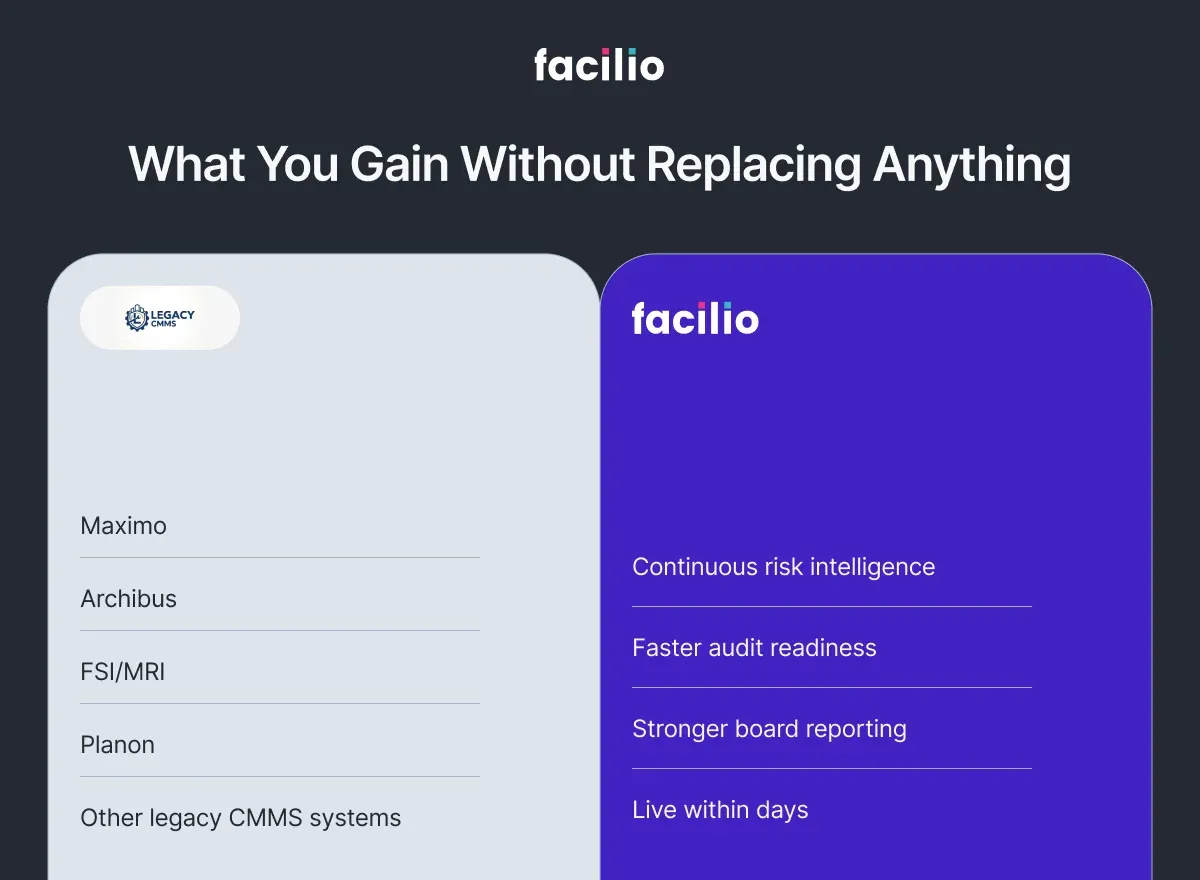
For FM leaders, this matters beyond technical reassurance. The organisations moving from reactive to predictive operations now aren't waiting for the perfect system or the next budget cycle. They're using what they already have, more intelligently.
The operational data that predicts your next SLA breach, asset failure, or reactive overload is already sitting in your system. The patterns are there. They just need to be read differently.
Your CMMS is already generating the signals. Is your team reading them?
Deploy OpsVision on Your CMMS.
Frequently Asked Questions
1. Does predictive FM require replacing existing software?
No. OpsVision layers onto your existing CMMS — Maximo, Archibus, FSI, MRI, or legacy systems — without disruption. There is no rip-and-replace requirement. It reads the operational data your current platform is already generating and surfaces it as structured risk intelligence.
2. What FM data does the AI actually use?
OpsVision works across the core operational record most CMMS platforms already hold — work order history, SLA performance logs, planned maintenance schedules, reactive ticket patterns, asset tags, and closure notes. No new data collection is required. The intelligence comes from reading existing data more continuously and at greater scale than any manual process can.
3. How long before OpsVision surfaces useful patterns?
Most deployments surface meaningful patterns within the first few weeks. The more historical data available in the CMMS, the faster recurring failure clusters and SLA drift signals become visible. Teams with 12+ months of work order history typically see actionable intelligence within days of going live.
4. Can this work across a multi-site portfolio?
Yes and multi-site operations are where the value compounds most. OpsVision benchmarks performance across sites simultaneously, identifying which buildings are drifting, which assets are trending toward failure, and where reactive workload is rising relative to planned maintenance. Portfolio-level visibility is built into the product, not an add-on.
About the Author

More from Facilio
